·       Website

o   Email alexeitaylor@gmail.com with any website issues

o   Blog Posts

§  Use Chicago Style in Post

§  Upcoming blog post: Be sure to include an inline citation and image

§  Instructions:

·       Function: to understand the readings

·       Discuss all the assigned authors and their basic arguments

·       Be honest if you had trouble with something in the writing

·       Don’t use the posts to talk about something else

o   Talk about the readings

o   The essay in October is for expressing critical capacity in writing

·       If there is room, talk about how it is relevant to final project

·       Read Kristen’s post for Week 1 as a good example:

o   Honest, takes pieces from everything but around one topic, sees a way forward in the subject

·       Balibar

o   Not really promoting the views he speaks of, he is mapping out major ways political conversations have taken place. All of them have these strategies around them, and can fall prey to their own convictions.

§  Talks about what they can do and where they fall short

o   The naming of the concepts he gives are “fungible”

§  We can find our own names for these concepts, and use this to compare systems that others propose

o   Model 1: Emancipation

§  Aligned with liberty, equality, struggle

§  Universality is the core

§  These different aspirations are unconditional

·       Everyone has rights in this model

§  “Demos” : body of citizens, with rights, constitutes itself by the rights

·       Emancipation becomes a goal and aspiration, but the precondition is that we are all equal

o   Begs the question of how we define “equal” and who actually (realistically) given those rights.

§  Problems with this model:

·       In order to have politics, there needs to be an “us and them”

·       The power of the “Us” is predicated on the exclusion of the “them”

·       Thus, the paradox is that this is a condition for the creation of this system but also impossible to create a truly equal emancipation system

o   This contestation of the exclusivity of the “haves” that creates the reality of the “have-nots” struggle creates politics

o   Who can confer and create rights continues to be a point of contemporary debate.

·       Not about claiming rights we don’t have, but in this paradigm you claim rights you should have but but have to struggle to maintain.

o   Model 2: Transformation

§  Politics of Conditions

·       No history except in determinate conditions (what citizens need)

§  Reference to Foucault:

·       Foucault explicates structures, but power is running through our bodies all the time

·       Can’t isolate into blocks, it is fluid and manifests through many actions and realities

§  Marx’s Theorems

·       Determinate practice is crucial.

·       Social relations are economic relations.

·       Conditions or relations have histories.

§  Politics as change within change:

·       Always changing but within history.

§  Political subject is always in process of struggle

·       Never ending, just evolves into new forms of struggle

§  Society is a complex of actions that transform each other

·       Always in the vocabulary of change and adaption.

§  Political Action is always plural, there is an anticipation for control of adversity

§  Problems with this Model:

·       Limits

o   Uncertainty of where limits lie, so people are policing themselves and each other on limits.

o   If these limits are uncertain, items become “contingent”.

§  AKA: opportunistic ideals, pushing at the edges shows the cracks to keep it going, constantly polarizing itself

o   Everytime we hit the limit, especially looking at violence, then we go past that

o   Civility

§  We are forcing past the the self/other is now gone, we need to completely erase the other from the human

·       This is the “idealism of hatred” and the seeds of fascism

§  Viciousness of the contemporary that we haven’t seen: there is a need not only to control the other, but to reappropriate the self

·       Take everything from you until you are less than nothing

·       Politics that takes the violence of identities

§  Throw away people of society

·       People who are worth absolutely nothing

§  Everyone having a right to political action is laughable

§  So, we should treat each other with civility, as a solution.

·       Creates a place for politics

·       Adversaries, not enemies

§  Problems with this Model:

·       Civility from above: distrustful of populations and affects

o   Seen as threatening

o   When you have the behave yourself all the time, what is being threatened? If anything will be threatening, then you police yourself and put yourself at risk.

o   Thus, the State can’t be the agent otherwise they become fascist

§  3 Theses of Identity

·       Trans individual: not purely individual or purely communal

·       Looks mostly at identifications, because identity is fluid

o   Everyone has multiple identities at different points in life

o   One use of fascist ideology is to FIX identity and destroy their complex identities to a single one

§  To become Anti-fascist, we (men) must become-minoritarian.

·       Not becoming minorities, but must become minoritarian

·       But what does that mean? What does it look like?

o   But how do you learn from the becoming and act from this place?

·       Still tied to Identification/Disidentification model

o   State can’t give civility, and if it comes from below, then it becomes impossible since you start the becoming-fascists of the group

o   Can disidentification, as opposed to identification, allow us to not identify with the seductive elements of fascism?

·       Mouffe:

o   Conditional and Unconditional -Similar to Balibar

o   Class Discussion:

§  Art as a mode of connection

·       Art mobilizes communities for social justice

§  Art Space built by Alfredo Jaar

·       Asked the community to build a space out of paper when they didn’t have one, and then he burned it down

·       He did it because it wasn’t his place to impose the space on the people but they should build their own

·       Similar to Mouffe’s conception of frontier

§  Alfredo Jaar

·       Makes visible parts of community that you may not be able to see, acts of transformation

§  Contingency as a mode

·       Ability to highlight new articulations

§  Moves past de-identification

§  Transformation of the political as a mode of producing new possibilities

§  The political is a field of antagonism, adversaries

·       Either it can become murderous and terrible (Like Balibar says)

·       Or, we have a notion of civility to moderate

§  Respect, civility, democracy are assumed to be common ground that all understand

·       What are the limits of this civility?

·       Ranciere:

o   Distribution of the Sensible:

§  Distinguishes something that is shared and is exclusive, the visibility of how items and powers are distributed in the world

§  Creates the common and the exclusion

o   Diana’s Opinion: we are overworking people so that they are unable to participate in the political

§  Not exclusive to the artisan, as Plato talks of, it is the way society uses and consumes our time

·       How do people resolve this? TV, social media, etc.

·       AKA: how do they participate in the political if they are being barred from the stereotypical “political”

o   Why are some of the presidents people who have been trained on television?

§  They are trained to consume all their time and space of the sensible.

o   Plato:

§  Role of the Artist in Soceity he prescribed as putting forward the aims of the state

·       Fascinated with the Stage, because it is ambivalent

o   It is a place of illusion and fantasy, but also

§  3 Forms of sensible

·       Fiction, fantasy in public space

·       Mute signs, paintings

·       Bodily movement, choreographic

§  For Ranciere, these forms define involvement in politics

·       Making visible is necessarily in these facets as well

o   Aristotle and the Form of Mimesis

§  He thinks of Mimesis by definition representational

§  Thinking representational politics in contrast with participatory politics

·       Think of Mexico, they claim participatory politics

·       Depends how you participate and what it means

·       Representational politics require less work on citizen behalf

§  Realizes as Mimesis and representation (later in the book) as something to get away with

o   We’re not looking for art to do something that it doesn’t already do

§  Think of the aestheticization of Nazism: the marching of similar bodies

·       But in a protest it does this to good ends for visibility

·       Art is ALREADY doing these things

·       Ghosting through the readings:

o   Less of a direct conversation of affect

o   Important to look at passion, feeling, unruly, irrational, etc.

·       Final Project – What is important to take away from this week?

·       Key Concept Tracking

o   Passion (Affect) Function in Politics and Art : Activating people, moving people,

o   Us/Them creating:

§  Drama with antagonism between actors and spectators

§  Politics in creation of structures

o   Art, Activism, and Resistance

§  Cluster, maybe this belongs with Spectator conceptions?

o   Civility

§  Relating to respect and assumed spaces of knowledges

§  Making possible for a political discussion

§  Perhaps tie this to political correctness?

o   Fictions and Lies

§  Fictions we tell, and lies that we tell

Espectáculo y espacio-tiempo cibernético

El espectáculo es una ficción, también lo es el espectáculo político, por eso la repetición de gestos, los tonos de voz, el cuidadoso lenguaje corporal.  Los protagonistas del espectáculo son personajes cuyas características son exaltadas de acuerdo con el objetivo perseguido. En los tiempos del espectáculo, del liderazgo individual,  del carisma y la identificación aspiracional, encontrar formas distintas y comunitarias de hacer política parece un camino destinado al fracaso. A esto se enfrentaron los zapatistas en 1994, a esto sumado al ya conocido y vivido racismo e invisibilidad de la realidad de los pueblos indígenas, pero su estrategia consistió en usar el hambre de espectáculo a su favor, así nació el personaje, el subcomandante marcos, el mestizo encapuchado. Él se convirtió en el eje distractor sembrado por los zapatistas mientras adelantaban sus procesos políticos  bajo formas  de relacionamiento igualitario, horizontal y comunitario, esta estrategia fue develada por el propio  subcomandante Marcos frente a un grupo de periodistas independientes en un evento en el que el mismo desaparecería para dar lugar al subcomandante Galeano, mediante un acto reivindicativo de la lucha zapatista como una muerte para la vida, que operó también como despedida de la lucha armada y el reconocimiento del carácter civil imperante en el movimiento para ese momento, Diana Taylor lo explica de esta manera “In short, the heroic figure of a mestizo man in military attire had begun to undercut the ethos of a broad, collective, life-affirming movement that was far more powerful and impressive than any one leader”. La muerte de Marcos, puede ser leída, como propone Taylor, como un proceso de desidentificación y en este sentido la atención es dirigida a una realidad menos espectacular pero más real: la cohesión del movimiento zapatista, su ideal comunitario. 

El movimiento zapatista no solo ha sabido poner las lógicas del espectáculo a su servicio, sino también las tecnologías de la comunicación, mediante las cuales ha creado una audiencia que traspasa las fronteras mexicanas. Un ejemplo de esto es el caso analizado por Lane, al referirse al uso de las tecnologías en las protesta y actuaciones políticas que tiene lugar en el ciberespacio, en el que, de manera simbólica, la simulación sugirió un conflicto entre posible iguales y en el plano real evidenció la desmesurada fuerza de las políticas del gobierno, en particular su accionar militar.  Resulta interesante este concepto de espacio tiempo cibernético y su articulación a procesos recientes de descontento social, como los estudiados Butler en  Notes Toward a Performative Theory of Assembly , pero también movimientos como el #metoo #NiUnaMenos o las protestas sociales que actualmente tienen lugar en diferentes países de América Latina.

Zapatistas Wanted Dead Or Alive: a manifesto of radical women of color

“‘Marcos’ final speech is a puzzle: ‘he who has never lived does not die’ undoes ‘he who does not exist and never existed.’ Dead, not dead, not not dead. But how, he asks, ‘do you kill what was never alive?’ How, in other words, can you kill the Marcos meme? You can’t” (Taylor). In THE DEATH OF A POLITICAL “I:” THE SUBCOMANDANTE IS DEAD, LONG LIVE THE SUBCOMANDANTE!, there is a conversation of reincarnation of figures and what people/bodies can see but furthermore represent, especially in regards to zapatisma.

The quote above is similar to Dolores “Lolita” Lebrón manifesto. “Yo no vine a matar. Yo vine a morir.” Her autonomy exists in her ability to claim death, to exist through the lens of death, because she is not in control of liveness, hers and definitely not others. The colonized female embracing death as a practice of agency is radical, but also all that is left for her to claim. The life of the body is given to the colonizer, but death is given to the colonized. This is similar to the final speech of Marco. One is immortal because life is never granted to those who are seen “dead” by a society, those who are in control of their own death but not their own existence/life.

This quote from Our Word is Our Weapon stood out to me in regards to what being a woman and being a zapatista is. “She. Has no military rank, no uniform, no weapon. Only she knows she is a Zapatista. Much like the Zapatistas, she has no face or name. She struggles for democracy, liberty, and justice, just like the Zapatistas…she is a part of the amorphous yet solid part of society that says, day after day, ‘Enough is enough!'”(De Leon 38). A woman of color is a metaphysical dilemma that is fighting between life and death, existence and visibility, agency and identity. The Zapatista is no longer a name carried by man, but an ideology that has been long before carried by women of color.

Toward other worlds

This week’s readings dialogue around Zapatismo and its rejection of the “cult of the individual” (“Between Light and Shadow”) for collective resistance before the annihilating violences that structure our world today. Importantly, the Zapatista movement’s tactics and strategies offer us apertures through which we can consider the making of alternative worlds. In “Between Light and Shadow,” Subcomandante Marcos declares that, recognizing that “our dilemma was not between negotiating and fighting, but between dying and living,” the movement made a choice for more life: rather than adopting the logics of war, the Zapatistas built infrastructure around education and health, improving living conditions and creating autonomy: “Instead of fighting for a place in the Parthenon of individualized deaths of those from below, we chose to construct life.” Judith Butler has argued that precarity reveals “social [bonds] that [have] been cut or destroyed in a way that seeks to deny a shared precariousness” (“Precarity Talk” 169), that is, the disappearance of the welfare state and its replacement by the State that perceives certain populations as disposable, for example. Faced with the annihilating force of neoliberalism and targeted violence, the Zapatistas’ choice has, within it, a movement away from the individual in order to do the work that actively considers the “conditions of life that variably sustain life, and those conditions [as] pervasively social, establishing…the interdependency of persons” (Butler, Frames of War 19) (although this action is not exclusive to the choice, but inherent in their world-view).

It is our conviction and our practice that in order to rebel and to struggle, neither leaders nor bosses nor messiahs nor saviors are necessary. To struggle, one only needs a sense of shame, a bit of dignity, and a lot of organization. As for the rest, it either serves the collective or it doesn’t.

-Subcomandante Marcos

This communitarian world is one possibility of alternative world-making that the Zapatistas offer us. It is interrelated with the possibilities that Taylor’s text on the “Death of a Political ‘I’” brings, both through the performance of Marcos as multiple identities, “a colorful ruse,” a “hologram,” and his “death” (in quotations because as Taylor aptly observes, “narrative…outlives its author”), which performed the shift to a “new phase of struggle” in which leader figures were no longer necessary: “that’s why they told me that when I was reborn, it would be as a collective” (“Between Light and Shadow”). Perhaps motivated by Jill Lane’s text, I am interested in the holographic nature of the figure of Marcos and how it manifests itself materially. Taylor highlights its “potential of indeterminacy…always a collective—never a singular ‘I’.” One the one hand, considering its status as between light and shadow, the hologram here is material and opaque—I wonder how this distraction and its lack of transparency, a “marvelous magic trick” (“Between Light and Shadow”) operates within the concept of “indigenous technology” proposed in this week’s readings. On the other hand, the diffusiveness of Marcos brings to mind another reading of Lane’s proposal of simulation and embodiment as spatial practice (131).

Another possibility emerges in Lane’s piece and Taylor’s interview with Ricardo Dominguez: the use of digital technology, cyberspace in particular, to find “different [lines] of flight” (Lane 129). In the Dominguez interview, he recounts how digital Zapatismo was able to take up the tactic of “electronic disturbance,” using hacking and other interventions to enact “electronic civil disobedience.” In this way, the Zapatistas were revolutionary in being able to intervene digitally while operating outside of its infrastructure (Dominguez), “ripping in” in succession towards the formation of communities –networks– that could work together to reconfigure systems of power; “In the same way they ripped into [it], I was ripping into the space they had created. That aura was that somehow there could be a possibility of interconnecting real bodies embedded outside of the grid as a direct manifestation of the ethics and aesthetics of how networks and tactical media should really respond” (Dominguez)– is this not a manifestation of how Lane argues that cyberspace can be understood as “a form of spatiality produced by material practices…and at the same time, produced by the social relations” (131)?. Dominguez’s discussion of “electronic disturbance theater” as an aesthetic process is also significant in its reading of the word “technology” apart from progressive notions of futurism; Dominguez’s interpretation of digital Zapatismo as “not bound to technology, not bound to a specific sort of instantiation, but to a poetics” is illuminating in not only showing how this electronic disobedience dislocated the definitions of cyberwar, cyberterrorism, and cybercrime (Dominguez), but also, in the case of the poetic gestures and interventions, how the aim of the acts were to “shift the conditions of technology away from technology” using the poetic voice. That is to say, there was a movement away from a concept of network power as being bound to technology (although, as Lane argues, EDT protests also staked important claims around the public nature of cyberspace), and towards the usage of poetics to create different narratives that before seemed impossible in the face of savage neoliberalism (Dominguez).

Electronic Civil Disobedience

This week’s readings offer critical views on the developments of digital protests in the last twenty years pertaining the Zapatista movement.

Lane’s analysis breaks down how the Zapatistas started the first postmodern revolution by juxtaposing the performativity of war as a Zapatista method towards entering the public arena, with their sophisticated Internet presence from the start—despite the lacking infrastructure in Chiapas itself. Lane contends that cyberspace affords populations new ways of protesting, and the ways in which Zapatistas mobilize dissidence through websites reveals the ways in which cyberspacetime is viewed and utilized more as a comercial and private space, rather than a public one. Cyberspace, then, is not an isolated virtuality, a world of images according to Plato: it produces a new spatiality, is produced by material conditions and social relations that in turn are affected by cyperspace, creating an open loop, a dialectic, which makes possible a porous space of appearance with real repercussions in each.

In a similar vein, Ricardo Domínguez, a founding member of Critical Arts Ensemble and Electronic Disturbance Theater, relates how the emergence of the Zapatistas in the early 90s modified and amplified his early notions of electronic civil disturbance. With the advent of web browsers and accessible html in the dawn of the new century, Domínguez centers on how the Zapatistas were spurring northeastern communities in the US to utilize emergent tactical media as a way of compounding their grassroots community organizing in Chiapas. Therefore, what the Zapatistas were accomplishing through their dialectic between the real and the virtual involved uniting solidary communities on and off the grid, those with infrastructure and power and those without, from NYC to Chiapas, and displacing these very structures of power through unprecedented cyber activism. Domínguez also brings to the conversation the idea of uniting an ethics to an æsthetics, and how these new tactical media experiments respond to a poetics as well as a call for change: electronic disturbance could be done directly from the margin to the very center, and it could be done æsthetically, informed by Mayan indigeneity.

Subcomandante Marcos’s speech on 25 May 2014, “Entre la luz y la sombra”, also illustrates the changing tendencies in the Zapatista movement and the need for new blood to take over in his absence, then declared. He reiterates that the Zapatista movement has chosen the path of life, has chosen to offer their constituents and the inhabitants of Chiapas a better quality of life, liberated and autonomous from the neoliberal policies that aim to bleed the continent dry. In twenty years, the movement has shifted its aims towards bettering indigenous communities directly, and el Sub now recognizes that his persona has been a mirage, una botarga, that the movement has transcended the need of a single caudillo at the lead, that now communities should be able to organize for themselves and have a collective voice away from the traditional models of Left organization in Latin America.

What this week’s readings have me pondering now are the myriad of ways in which communities have historically used the Internet for grassroots organization despite the consumerist frame in which the Internet was created and continues to operate. With new legislation aimed at limiting freedoms in Internet use, how can the Internet truly be democratic? How is the Left, as much as the Right, utilizing electronic civil disobedience as a means for defeating and erasing their enemies, and how is all this hubbub continually shifting the ground for politics to take hold?

#TodossomosDylan

La figura del líder ha sido un tema que ha rondado nuestras discusiones y lo que significa esta figura en el mundo del espectáculo político. Esta vez, pensando en la figura del Subcomandante Marcos y mientras leía su último acto, pensaba mucho en la resonancia que tienen su palabras para una América Latina convulsionada de la actualidad. Su lucha es una lucha que hoy aún existe en Chile, Colombia, etc.: “La guerra de arriba, con la muerte y la destrucción, el despojo y la humillación, la explotación y el silencio impuestos al vencido (…) “Era y es la nuestra, como la de muchos y muchas de abajo, una guerra por la humanidad y contra el neoliberalismo..”. Algo muy similar es lo que señala Diana Taylor hacia el final de su artículo, pensando en el eco que tiene la figura de Marcos en las protestas en las calles del pueblo, que hoy son tan relevantes: “Much like Che, he may come to epitomize the idea of the heroic figure of anti-imperialist armed struggle from the periphery of the mountains and the jungles that has now given way to collective protest on the streets of major cities around the world”.

Pero así como lo menciona él, no se trata de pensar el movimiento zapatista desde una figura individual en particular, sino en un nosotros, en el que todos somos Marcos (o no). Siguiendo con el artículo de Taylor: “Marcos” was always collective—never a singular “I.”. Lo que Marcos representa no es la encarnación de un héroe a quien adorar, es un proyecto entero, “Marcos” as a meme has the force of an idea—resistance, rebellion, trans-boundaries (…) He was able to personify the thoughts and priorities of a movement far older and greater than he was.”, remarca Taylor.

Para conectar lo anterior con la entrevista a Ricardo Domínguez, en sus palabras se puede dar un ejemplo de cómo la repercusión de este movimiento se concreta en la realidad y se reproduce así mismo como un movimiento colectivo demandando justicia, resistiendo: “we have this network that happened within a few days. The New York Committee for Democracy in Mexico started doing encampments in front of the Mexican consulate”, primero así en la calle, pero que también le permitió a Domínguez (casi como un visionario) la resistencia desde el espacio digital: “And I did a piece on electronic civil disobedience and intergalacticos, and I was able to take them to our thing.net office to show them the beginning prototype of electronic [disturbance theater].”

Lo anterior, nos lleva finalmente al trabajo de Jill Lane, en el que la autora reconoce los alcances que puede llegar a tener una protesta digital: “Because a cyber-protest usually involves thousands-even hundreds of thousands-of participants, the system will begin to repeat and re- write the poem at incredible speed, composing and recomposing the fragmented world of the Zapatistas in its very own system”. Este alcance, el ‘engagement’ del que habla Lane, es hoy aún más fuerte y efectivo con la aparición de ‘Social Media’. Volviendo a la América Latina convulsionada, y particularmente me refiero a la situación reciente de Colombia, si no fuera por la reproducción de videos de miles de participantes, protestando y resistiendo, jamás podríamos tener acceso a un acercamiento real al abuso por parte de la policía y el Estado. Y si todos somos Marcos, ahora el HT que es tendencia en Colombia es #TodosSomosDylan, un estudiante al que las fuerzas represoras del Estado Colombiano le disparó mientras protestaba pacíficamente este fin de semana.

Transforming the Zapatista


The mountain told us to take up arms so we could have a voice.
It told us to cover our faces so we would have a face.
It told us to forget our names so we can be named.
It told us to protect our past we could have a future. 

Marco, p. 102

This week’s readings focus on the Zapatista social movements and leaders. Beginning with Our Word is Our Weapon, the work engages us in a compilation of conference speeches, military communiqués, and open letters spliced with poems, short stories, and allegories to provide a human face to what many would consider an evolving “postmodern” movement. Setting a foundation for the grass-roots elements of the revolutionary Zapatista movement, the collection of writings communicates a participatory, arguably non-hierarchical style of politics. Given that there is a constant “we” in the social, Subcomandante Marcos aims to highlight the political space as an ongoing struggle for life outside of death. As such, the Zapatista movement must extend beyond one person. Recognizing this, Taylor (2014) marks the moment when Subcomandante Marcos declares the death of his political persona. While the Subcomandante’s individual inventiveness fulfills a symbolic function, his (re)construction of Subcomandante Insurgente Galeano takes a communal narrative. The reinvented activist explains, the Zapatista movement must always focus on the people, as such his rebirth must be as a collective (Taylor, par. 10). 

As the Zapatista movement continues to develop, the dark ski mask that covers the activists face has transformed into the veil of the internet. Lane (2003) highlights one specific instance where the unorthodox methods of the Zapatista Electronic Disturbance Theatre created an “air force” of paper planes to cross digital “barbed wire” in an effort to distribute a poem discussing the struggle for peace in Chiapas, Mexico (p. 130). In an interview with Taylor, Ricardo Dominguez explains digital Zapatismo can be considered postmodern “because they had somehow accomplished, by ripping into the electronic fabric, this possibility of expanding a network and manifesting a network without having access to a network (par. 7). Like Sup. Marcos had previously done, digital Zapatistas reinvent themselves online to embody an appropriate response to injustices and to further expand grass roots globally.

it’s like a poem

In Entre La Luz y la Sombra unx camarada from the EZLN claims: Su mirada se había detenido en el único mestizo que vieron con pasamontañas, es decir que no miraron. Growing in the south of Mexico City, the window I had into the Zapatista thought, labor, and aesthetics was the Facultad de Filosofía y Letras at UNAM. As the daughter of two Pumas, I spent many days walking the triangle between la Facultad de Economía, la Facultad de Derecho, la Facultad de Filosofía y Letras and most importantly, Las Islas. As a young girl I would stop to listen young universitarios talk about Marcos, or adopt Zapatista communal practices of resistance within the university. The figure of the indigenous Zapatista woman was, and will always be, the most important symbol of resistance in Mexico. However, I quickly noticed that even in its purposeful and tactical ambiguity, the figure of El Subcomandante, would often cloud the essence of la lucha. Visually, the image most often circulated of the Zapatista movement is the one of this mestizo man, front and center. Which is why, in spite of the ways the Zapatistas used and co-opted their own narratives in the media, I personally appreciated the performative gesture Prof. Taylor mentions in this weeks text in which el Subcomandante performs the death of el Subcomandante Marcos and the birth of Subcomandante Galeano. This metamorphosis invites us to ask what Chris Hedges wonders via Taylors text: What do the Zapatistas need us to be? 

As Ricardo Dominguez highlights the aesthetic avant- garde practices of the Zapatista movement, I wonder if we can position the guerilla practice of naming, and renaming as a fundamental performative tool which not only functions as an act of remembrance, or rather a re-living of a fallen comrade, but also as an aesthetic manifestation of reinvention which fights against the narrative which always positions indigeneous communities as windows into our origins, and our past, rather than as a contemporary and futuristic form of existence with endless potential of revolution, reinvention, and rebirth. Thus, I turn to Jill Lane’s and Ricardo Dominguez’ re-telling of the “discursive missile” from Zapatista Air Force to describe the Zapatistas body: (it is) a difficult thing to stop and arrest, it’s like a poem.

A life through death

This week’s readings create their own self-fulfilling world, or at least the efforts and possibility of such creation within Zapatistas. It is about a fight for human right pursued by indigenous people, and also led (at least ideally) by them. Marcos, as the subcomandante of the revolution, had become the most iconic figure in the fight through time. However, this is not a traditional story about the becoming of a legendary political leader and the “glorious fruit” he and his followers bring about. It is a narrative of the making and disappearance of a single leader, as he  ultimately dissolves into people.

In Marcos’ book, it is obvious that he pours his efforts into the pursuit for human rights in a  rather universal context, starting from Mexico but trying to out to all population living under the same precarity as the consequences of neoliberalism, of which he regards as the forth World War. It seems that a unity of people without oppressing hierarchy is the destination of the campaign, therefore the unique organization of Zapatistas is of great significance. By stating that “it is our conviction and our practice that in order to rebel and to struggle, neither leaders nor bosses nor messiahs nor saviors are necessary. To struggle, one only needs a sense of shame, a bit of dignity, and a lot of organization” (Marcos, Between Light and Shadow), Marcos unfolds a blue print where the majority of people would not be sacrificed to suffice what the power and mighty minority demand. The only way to truly accomplish this goal and secure its sustainability would be “death” of a leader, who might one day become a dominant ruler is not carefully watched. Marcos constantly attempts to remind people of such a destination by calling out to them “in the name of the children, elders, men and women, all of them indigenous”, emphasizing that “we”  “want you to know we recognize your greatness as indigenous peoples and human beings, and we want you to receive this salute sent, through my hands, from all the indigenous rebels of the Zapatista National Liberation Army.s” (Marcos, 224). In these persuasive writings, Marcos is a  hologram with a leader’s persona, a figure constructed only to be destroyed one day, ideally a media from people, through people to people, and for people.

In the Death of a Political ‘I’, Taylor traces the reasons behind the political performance of Marcos’ farewell to the audience, in comparison with some other political figures. Through years of struggle, Marcos has already become a cultural phenomenon, known as meme. It appears to be a mortal person, whereas in fact its spirit is imprinted in a zeitgeist, tied to modernity, human rights and community, therefore “the man who was Marcos may die, but “Marcos” will live as long as he fulfills a symbolic function (Taylor). The liveness of “Marcos” is replicated, distributed and reside in all people that hold the same belief, it has no irreplaceable flesh, and thus it can be evergreen and immortal.

they danced a long time, but they didn’t care because at that time, time didn’t exist

His final words (“Between Light and Shadow”) Subcomandante Insurgente Marcos begins with: “Good evening, afternoon, or morning, whichever it may be in your geography, time, and way of being. Good very early morning.” I see this approach to time and space as crucial for the digital Zapatista. In their article “Digital Zapatistas” Jill Lane and Ricardo Dominguez ask:“Can a collective social body materialize – make itself felt, register its effects – in electronic space? ” (p.131) I would like to add the component of time to this question. Through the constant repetition of utterances such as “once there was a time when time wasn’t measured” and “at that time, time didn’t exist” in “Our Word Is Our Weapon” by Subcomandante Insurgente Marcos, I am again reminded of the hegemony of constructed (metric) time. “(…) constituting presence in digital space that is both collective and politicized (…)” and out of time; timeless.  “You can kill individuals, Marcos recognizes in his final speech, but you can’t kill an idea.” The embodied idea can float in cyberspace and cybertime, landscapes without beginning or end, background or foreground. Since there is no pulse or meter you can dance to the silence inside you, like the gods, and therefore listen and dance through the others; through the we. (Our word is our weapon)

I dance we.
We dance we.

The zapatista presence

The readings for this week center the Zapatista movement in México as a postmodern revolution that used different spaces as the cyberspace as a way to expand their presence descentering it from a single figure and leader, reproduce their ideas and to make it more accessible while reimagining the idea of presence.

Taylor, explains the complicated performance and important gesture of the “death” of Subcomandante Marcos. She explains the idea that, in spite of the attention that the movement caused, the government  still “couldn’t see us” (the indigenous people) while they got a lot of attention from the media. This is very telling of the mechanisms of media that might highlight rebellions and their mestizo leaders, but still invisibilize indigenous people. Yet, the figure of comandante Marcos as a “drag-king” (Paul Preciado) that utilizes the mask to “transform the body of the multitude into the collective agent of revolution” is highlighted as a death that did not kill the ideas of the movement.  As his figure disappeared, the movement became more centered in collective struggle, rather than in the image of just one leader. Yet, Taylor also looks at the important aspect of the circulation of the image of Marcos, as “his performance was that he was able to personify the thoughts and priorities of a movement far older and greater than he was.” In the interview to Domínguez they present us the idea of using the media as a space for bridging the most marginal with the spaces and systems of new forms of power.

Lane and Domínguez analyzes the use of digital media as a space for public protest that was also a form to “register a huge, collective, politicized presence in digital space.” (130) Through the analysis of the Electronic Disturbance Theater the authors explain the relation between performance and embodiment in the cyberspace as the Digital Zapatismo used “disturbance spaces” resignifying what we have been discussed as the space of appearance.

Amorphous yet solid

“She. Has no military rank, no uniform, no weapon. Only she knows she is a Zapatista. Much like the Zapatistas, she has no face or name. She struggles for democracy, liberty, and justice, just like the Zapatistas. She is part of what the EZLN calls “civil society”—a people without a political party, who do not belong to “political society,” made up of leaders of political parties. Rather, she is a part of that amorphous yet solid part of society that says, day after day, “Enough is enough!”

Subcomandante Marcos
Twelve Women in the Twelfth Year
The Moment of War
MARCH 11, 1996

In this passage, dead, not dead, not not dead Subcomandante lays out the aesthetics of a Zapatista woman. Much like the Zapatistas, she is amorphous since he “takes away” all her physical attributes like uniform, weapon, face or name, yet solid as she knows who she is. In fact, only she knows who she is and her knowledge of herself comes from comparison with the Zapatistas like the knowledge of the Zapatistas comes from her understanding of herself. I think this paragraph illustrates the way the Zapatistas get built and aware of themselves and evolve through the members. So, as Subcomandante said he no longer exists when he is not necessary to those who constitute the Zapatistas.   

I guess the ability to change a form and a medium is what makes the Zapatistas special and “durational” as Domínguez described them. Taylor said that the decision to “kill” the hologram of “the recognizable leader” in favor of the collective was made within “the undergoing change” in the style of political performance.” But what makes the Zapatistas so sensitive to those changes?

 I find the answer in the perception of the Zapatistas time. Subcomandante wrote that when they had “erupted and interrupted in 1994 with blood and fire, it was not the beginning of war for [them] as Zapatistas”: “We had been enduring for centuries.” So there is no starting or ending point: even dead Subcomandante is reborn as a collective. The political spectacle for the group does not follow the linearity of the past, present or future since the concept of time is erased under oppression when they were not present in time. The transition to the cyberspace was easy and natural for the Zapatistas in comparison to inflexible political parties because they didn’t have a presence in the physical space that they could lose. Lane wrote that “for EDT, as for the Zapatistas, cyberspace can be practiced as a new public sphere, a runway for the staging of more productive “lines of fight” for those struggling for social change.” But the communal efficiency of the work done by the Zapatistas cannot be explained only through common struggle. I’m in favor of what Domínguez called “that aura” “that somehow there could be a possibility of interconnecting real bodies embedded outside of the grid as a direct manifestation of the ethics and aesthetics of how networks and tactical media should really respond.” No matter whether we call it hope, aura or belief, it is what outlives sub/comandantes and their memes, creating new forms of collectivity. 

Never Lived Nor Die

As the leader of an indigenous guerrilla group Zapatistas, Marcos changed the politics of Mexico as a grass-roots rebellion. Later he became a symbol of international democracy movements. “Marcos” becomes more than one person. As the words in the Between Light and Shadow: “ The construction of Character Marcos –’So then, as I mentioned, the work of constructing this character began. One day Marcos’ eyes were blue, another day they were green, or brown, or hazel, or black – all depending on who did the interview and took the picture. He was the back-up player of professional soccer teams, an employee in department stores, a chauffeur, philosopher, filmmaker, and the etcéteras that can be found in the paid media of those calendars and in various geographies. There was a Marcos for every occasion.” Marcos is an embodiment of an “Non-free media”. The movement becomes more decentralized and establishes a new wave: “Marcos, the character, was no longer necessary. The new phase of the Zapatista struggle was ready…My name is Galeano…Anyone else here named Galeano? [the crowd cries, “We are all Galeano!”] Ah, that’s why they told me that when I was reborn, it would be as a collective. And so it should be”.
The characteristic of Marcos is that he is masked. As a military force in military and public opinion, he destroys the individual of his own, and no one recognizes him. That is to say, everyone can be him, and he is likely to change. The leader of an idol has become less important. The people who are truly autonomous do not need idols, do not need leaders, only need friends, neighbors and a system that allows small communities and individuals to coexist with the collective.


Different people have different Marcos. In this sense, “Marcos” is no longer a person’s name, but a symbol of struggle and creation; the battle strategy that Marcos adopted is irrelevant. Even he thinks, not light, just flashing / not a path, just a footprint / not a guide, just one of the paths to tomorrow. This is what we are trying to explore is the reason for the rise of the Zapata movement and its significance to us.
As Taylor points out, after Marcos publicly absented himself, the figure of Marcos is no longer important: “Why was “Marcos” no longer necessary? The man formerly known as Marcos gave a few indications. Various shifts had tilted the center of the movement in a different direction. …The younger generation, born into Zapatismo, was taking the lead. Moreover, the movement was re-indigenizing itself—shifting decision making to its indigenous leaders and developing other, more horizontal, leadership strategies (“rule by obeying”)”. Marcos can be seen as a universal impulse in the different groups all over the world: “Marcos” reactivated the trickster’s potential of enormous trans-possibility: trans-race, trans-gender, trans-personal, trans-national, trans-historical”. Marcos could never be killed anymore: he never lived nor died.


Dominguez suggests the Zapatista is a postmodern revolution because “ they had somehow accomplished, by ripping into the electronic fabric, this possibility of expanding a network and manifesting a network without having access to a network”. The Zapatistas challenged Dominguez’s definition of electronic civil disobedience: “But there was this other aura that I felt that the Zapatistas, whether by purpose, by intent, or by accident, were calling for the strengthening of what I would call electronic disturbance, electronic civil disobedience. They seemed, in their network intergalactico, to be creating a platform that I had not imagined. In the same way they ripped into it, I was ripping into the space they had created. That aura was that somehow there could be a possibility of interconnecting real bodies embedded outside of the grid as a direct manifestation of the ethics and aesthetics of how networks and tactical media should really respond: not as anonymous, techno-driven cells who took on the power of whatever the issues were, but really a bridging between those who are most marginal outside the system and those systems that seemed to be the site of new power. And that they could really reconfigure it at a distance what was important about that element: we could dislocate it and reconfigure it”. Internet makes people easy to assess the cyberspace. The contestation movement redefined the possibility of electronic disturbance. Launching information war weapons is a postmodern revolution of aesthetics and electronic civil disobedience. It is poetic and it has already surpassed the definition of cyberwar, cyberterrorism, cybercrime. As Dominguez said “So I think that digital Zapatismo allowed a conversation to manifest itself around what these gestures were. And also what emerged at the end of 98 was that digital Zapatismo was then able to try to translate through its practices of electronic disturbance theater into the growth of hacktivism”.

The story of Marcos is still continuing. In Our Word is Our Weapon, the indigenous groups struggling and eager to liberation, will be forever memorized, and influence more and more international decentralized movements towards social justice: “. . . in which Marcos, in an attempt to raise awareness of what is truly at stake in Chiapas and in Mexico, points to the institutionalized corruption of values that encourages the incursion of globalization into their nation and betrays all Mexicans. . . . in which the indigenous voice of resistance and dignity speaks through Marcos, and Marcos speaks of the indigenous life and spiritual values that sit at the heart of their communities and at the heart of Mexico. . . . in which war is declared against oblivion and prejudice”.

Política del holograma (o un fantasma recorre la montaña chiapaneca, el fantasma de zapatismo)

Como afirma Diana Taylor “Indigenous peoples remained invisible to their oppressors, who saw only the mestizo in the ski mask”. Si durante 500 años los derechos de  las comunidades indígenas fueron invisibilizados (por los conquistadores españoles, por las narrativas de los estados modernos latinoamericanos, por el imperialismo y por el extractivismo de la grandes corporaciones) el nacimiento de Marcos como tecnología performática indígena opera, por un lado, a través de la figura retórica llamada lítote, es decir, negando lo contrario de lo que se quiere afirmar, la invisibilización, mediante el ocultamiento en un holograma (“it was only on donning a mask that they entered public visibility”, afirma Jill Lane). El holograma, por otro lado, al ser nadie, es al mismo tiempo  una agencia de multitud. Y por su naturaleza incorpórea, está hecho de la misma materia de la que se hace lo espectacular, lo mediático, lo que se televiza, comparte, twitea y viraliza. Por eso, como afirma Marcos en su último discurso, el holograma permitió a la comunidad zapatista acceder a un reino del que estaba omitida por completo y disputar políticamente en ese mismo campo sus sentidos: el de los medios de comunicación (“la sabiduría indígena desafiaba a la modernidad en uno de sus bastiones”). Sin embargo, en su última acción performática, Marcos dice que ” SupMarcos pasó de ser un vocero a ser un distractor”, cuyos efectos mediáticos fueron suspendidos, y debido a esa razón había que matarlo. 

¿Pero se puede matar un holograma? 

La acción performática de destruir el holograma en una última puesta en escena (al mismo tiempo que una estrategia para reingresar en los medios de comunicación para denunciar el asesinato de Galeano y otros militantes zapatistas) es a la vez la desafiante demostración de que no se puede matar lo que nunca tuvo un cuerpo, porque tiene muchos. La política del holograma, entonces, como afirma Diana Taylor, es mostrar que las ideas no se matan, porque son colectivas y porque recorren como  un fantasma, como el fantasma del zapatismo, la montaña chiapaneca. “The Subcomandante Marcos is dead! Long live the Subcomandante!”, concluye Taylor.

The Zapatistas movement

The Zapatistas movement is a very strong display of mobilization and creating spaces for marginalized groups in a society and creating effective change on a governmental level. This is a movement that played a huge part in expanding indigenous rights and their recognition in the Mexican society. Though the discrimination and violation of human’s rights for the indigenous population in Chiapas still remain, the movement has made some gateway for the population. The figure if subcamandante Marcos is represents a form of political resistance that transcended different time and spaces. Thus, “Juxtaposed with the descriptions of an oppressive structure of class, values, and of the political machinery that holds it all in place, Marcos offers a window into the indigenous world that sits at the bottom of the heap, and at the heart of the nation. Using simple, direct, parabolic language that alludes to Mayan deities and the Popol Vuh, Marcos insists that political issues are human rights issues, while creating a consciousness of indigenous Mexico and a place for it in the political and social parlance of present-day Mexico” (p. 25). This movement and his figure are a political performance that keeps the ideas in place to continue a revolution, while creating a new outlook of what is currently transpiring in these areas. The testimonials and building the movement has transcended into modern movements, both with physical manifestations and the digital. Creating a counter response to political protests is a historical change that will further the movement and never losing sight of the task at hand. Therefore, “And I think the Zapatistas were at the lead of really thinking the poetics of real bodies and electronic bodies in contestation, in invention, and walking towards a utopia that we can’t really define, but perhaps we’ll know it when we get there so anti-anti-utopian in a certain sense” (Dominguez). The influence will always be there, and the perspective may change and create new ways to invoke change.  

The digital

In their article “Recombinant Theatre and Digital Resistance”, the Critical Art Ensemble argue for an expanded consideration of digitality, beyond its associations with the fields of information and communication technology. The piece presents a broad range of examples that show the ways in which the digital (as opposed to the analogue) manifests as an ideological formation in post-Enlightenment society. It describes the changes in the industrial revolution, the increasing alienation of people from their labor, as an example of digital formations. The scientific development of DNA as a way of understanding biology is also used as an example of a shift towards digital thinking, towards thinking in terms of discrete units as opposed to continuous beings.

This discussion of the discrete units that make up the digital paradigm is expanded by the concept of networks, the new structured relationships between these units. Both Edwards and Poster discuss the implications of these global networks to our understanding of sovereignty. In his chapter titled “Citizens, Digital Media and Globalization”, Mark Poster develops the concept of the “netizen” as a new category for advocating rights in an era of digital communication. Along similar lines, Brian Edwards discusses the “selfie-determination of nations” to consider the blurred national boundaries in the circulation of content online. I was particularly struck by the discussion, in both of these texts, of the implications of a media sphere that combines entertainment and politics, developing similar registers for their consumption. The overlapping functions of these media might help us think through the ways political spectacles mimic other kinds of spectacles and produce similar kinds of spectatorship practices.  

Selfie-Determination

Brian Edward’s “Trump from Reality TV to Twitter, or the Selfie-Determination of Nations” argues, “we are witnessing a shift in a sustaining if fraught relationship between culture and politics, between what has been called soft power and hard power” (28). Edwards points out that “the history of technology and society itself has long been central to politics” (idem), from the Industrial Revolution to the popularization of the printed press. For the author, digital technologies relationship to new social forms is directly implicated to both the rise of global populisms and what he calls “the selfie-determination of nations”.

            The selfie-determination of nations refers to “a digitally mediated, imagined community in which individual citizens, bots, and trolls exist side by side. [And] It is at times difficult to know who is real and who is a digital creation (39). Although a bit simplistic, Edward’s argument is a pungent one. The author recognizes the impact of globalized economies in the way we communicate but it fails to extend his analysis outside US-politics. The rise of global populism is rendered as an American “cultural export”, without any thought given on how American neoliberalism is slowly turning into a neofascist wave around the globe, a transformation led by economic insecurity and cultural scapegoating.

            Following Edward’s “exportation” argument, Jair Bolsonaro, “the trump of the tropics” as he has been called by US-media, is certainly following Donald Trump’s media strategy, with a more explicitly fascist approach. Like Trump, he uses twitter to communicate with his followers, where he is always in control of the narrative. Manipulation by bots and trolls organized action is becoming ever more common, actually interfering on how people perceive politics, and posing a dangerous threat to democracies all around.

New ways of mobilizing bodies

In Diana Taylor’s article titled “The Politics of Passion”, she states that, “by politics of passion, then, I refer to the mobilization of affect for political ends on collective, structural, and trans-ideological levels that skirt the traditional organization of political parties and practices (such as lobbying and voting)”. This highlights the current political situation in the States and in other countries, where there is an establishment of “passion politics” which aim to de-politized political movements and create a space where these movements thrive on emotions. People gathering together to protest a common goal has been a form of bringing change to a political and moral change, however currently there are many representations of gathering bodies to present an ideological change, that may not be the norm that gathering bodies reflected in the past. In this technological age, different movements are spread widely on the internet, which creates a different space for this kind of mobilization. Thus, “while flesh bodies expand into their electronic and digital bodies, the balance between online and off does not always work in the same way”. Many of these online movements do not function in the same ways as the mobilization of bodies in a public space, it also is a form a spreading information quickly, where the traditional media outlets exclude from their platforms. In Benjamin Arditi’s article, he addresses the way in which insurgents have bridged the gap between the traditional media and the use of technology in their political movement. They provide a passionate movement that reminiscent of this sense of hope and bringing something new, there is something that is coming and will be present soon. Therefore, “tactics and practices devised by activists become part of a collective political know-how, a political jurisprudence of sorts that functions as a toolbox available for anyone else to use”. This furthers the movements of these groups because there is an archive left for many with the same ideological background can use to continue the movement and keep mobilizing bodies in the technological space. On the hand, Trumps presidency is marked by online performative politics, where twitter is now his place for putting out his ideas and catering to his base. This strategy is very effective for him and it blurs the line between him as a president and his accessibility to the public in various forms. Thus, “Trump occupies what Donald Pease has called a “short circuit” in a network within which the potential for liberation and domination cross” (p. 40 Brian T. Edwards).  

The use of digital media for Cortinas de humo

The readings for this week analyze how the use of digital media has become a tool of action for politicians and different groups, as well as a way to rethink the idea of citizenship. Edwards (2018) states that the rise in the use of technology and media have not also been a means for open expression, but they have also contributed to the raise of nationalism as new forms of identification developed with different technologies. An example of this is in Trump’s interventions and appearances as a resemblance of American reality shows; “The global circulation of Donald Trump’s rhetoric and persona beginning with the 2015 campaign ruptured a crucial divide between popular culture and political discourse and under Trump US political system itself has become a form of global entertainment.” (27) The author calls “the selfie determination of nations” where real people, bots and trolls coexist, while performance on Twitter creates an fake intimacy. In Trump’s case the use of Twitter played an important role in his political spectacle. Here, the manipulation of the victims, for example, is a way to reproduce spectacle or “the political theater” (36).

For Poster (2006), this rise of digital media complicates our notion of citizenship. For the author, citizen and natural rights are constructed from a West perspective where “Human rights and citizenship are tied together, but in here we can ask, based on what ideas of humanity are those rights constructed? Here, Poster introduces the idea of the “netizen” for the political subject constituted in the internet (78) that has become a new cultural practice of resignification while also enhancing existing political formations. In here, the net is also used for political figures to take advantage but the net also contains its own forms of hierarchy and control; “many forms of political presence characteristic of the nation-state are reproduced.” (83).

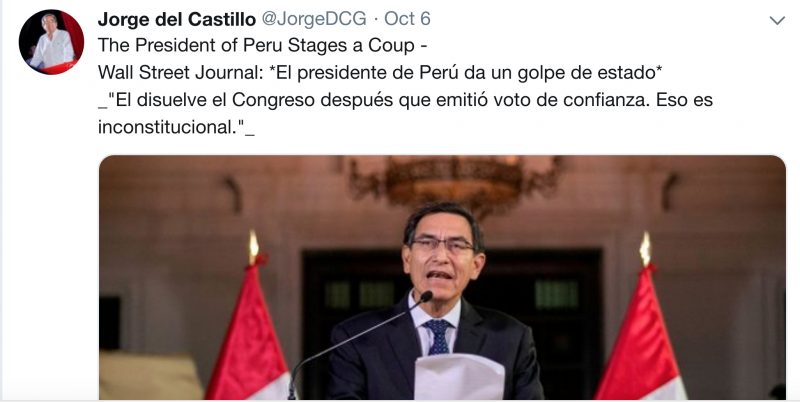
An example of these ideas are seen in what in Peru is called “Cortina de humo” and that started during Fujimori’s dictatorship where media characters like Laura Bozo were utilized to distract audiences and contribute with the spectacularization of the country, while real human rights crimes were been committed. These mechanisms last until today where Twitter is used by fujimoristas to create and spread fake news and terror. This was lately observed with the idea of the “golpe de estado”. Fortunately, there is a section of groups that resist these mechanisms using the same tools.

The new central figure of Argentine right wing politics: the troll

The readings of this week analyze the shift of political culture, identities and practices with the rise of digital technology. In “Trump from Reality TV to Twitter, or the Selfie-Determination of Nations”, Brian T. Edwards underlines how Trump adopted reality television and Twitter formats to create the appearance that he addresses his base directly, with a performance rhetorically and aesthetically far more appealing to contemporary audience/population that the one utilized by traditional politics. In that sense, Mark Poster coins the term “netizen” to think a new kind of political identity that shares allegiance to the nation with allegiance to the net as identical political and social practices. On the other hand, Paul Starr summarizes the concept “surveillance capitalism” as a technique implemented by governments and corporations to harvest personal data in digital media in order to produce behavioral modification.

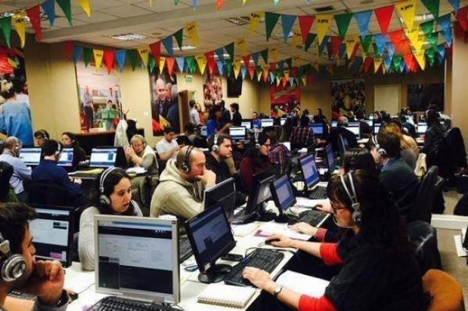
These ideas can shed light to a way of influence public opinion that became the principal strategy of right wing governments in Argentina, namely, the use of  microtargeting, trolls and viralization of fake news to impact voting behavior. In the case of Macri in Argentina, this technique consisted in the secret hiring of Cambridge Analytica to microtarget fake news to voters, and then to massively viralize hashtags about this fake news with trolls.

In the photo we can see the Trolls Center of the Pro government, whose existence started to be suspected when thousands of tweets of users with names uncommon in Argentina and with a “google translate” writing style shared the hashtags that supported Mauricio Macri.


Although after the voting it was revealed that most of the news that this trolls shared were fake, the immediate effect that they had was decisive to decide the presidential result. In that way, the troll became the most prominent figure in Argentine politics during the last years, shifting the traditional importance of social movements, as the impact of digital media and the incalculable effects of viralization far way exceeded the possible impact of popular corporeal manifestations.

Decentralization

From reality TV to social media, the boundary between entertainment and news become more and more blur and almost collapse. Edwards thinks, to understand the phenomenon, we need to investigate the role of media played for Trump—”What complicates the distinction between reality TV and Twitter is that some of the same audience carries over from one to the other. The massive presence of bots in the audience of Twitter is new, and the means of engagement with the president’s utterances are quite different for users of the social network than for consumers of television broadcasts…But to get to Twitter, or rather to arrive at the place where his use of Twitter would be so effective, Trump had to play part in a transformation of television itself”. (Edwards, P32) Additionally, Edwards states the relationship between culture and politics shifts into a soft power formation. In the age of Trump, American popular culture altered the politics in America: “The transformation was not produced only by Trump himself, although he has had an outsized role in altering the manner by which US culture circulates globally. Nevertheless, the effects on politics (both domestic and international) are more important than the causes. The global circulation of Donald Trump’s rhetoric and persona beginning with the 2015 campaign ruptured a crucial divide between popular culture and political discourse, and under Trump, the US political system itself has become a form of global entertainment”. (Edwards, P 27)

In the new relationship between digital media and society, technology itself becomes the centre of politics in some way. The example of Trump`s tweet illustrates how his performance style solidifies his audience by direct contacting and thus challenged the traditional mainstream media. Edwards says: “The decade since then has generated social formations that intersect and interact with digital technology so closely that it is often difficult to name where one begins and the other ends. Of course, historical perspectives on a moment while it is still taking place are both difficult and urgent. It is not incidental that we have seen the expression of revolutionary impulses around the world, which, whether they have been successful or not, are in some way built on people finding a voice that they did not have before, and now think they have”. (Edwards, P29)

Similarly, Poster brings up the idea that how digital media technology contributes to the social reality construction—He questioned in the information era, Western political ideology such as the liberal and humanist are seriously questioned. The subject of citizenship and previous social relations are overturned by the new technology. –” The architecture of the internet, by contrast, is that of a decentralized web. Any point may establish exchanges with any other point or points, a configuration that makes it very difficult if not impossible to control by the nation-state. ..In all of these ways, the internet contains the potential of new practices. The process of realizing this potential is, it must be emphasized, a political one”.

Poster discuss the new relationship between people and society by the redefining the notion of human and citizen in the information era. By drawing the postmodern theory, Poster argues that new media may contribute to decentralization, brings interaction to people, and may not leads to new imperialisms. Poster was critiquing Hardt and Negri`s theory: “The internet holds the prospect of serving to introduce post-national political forms because of its internal architecture, its new register of time and space, its new relation of human to machine, of body to mind, its new imaginary, and its new articulation of culture and reality. Despite what may appear in the media of newsprint and television as a celebration of the internet’s harmony with the institutions of the nation-state and the globalizing economy, new media offer possibilities for the construction of planetary political subjects, netizens who will be multiple, dispersed and virtual, nodes of a network of collective intelligence. (Poster, P84)

 The national identity has been challenged by globalization. Poster says: “In the present context, one must tread lightly and carefully in any critique of the limitations of these bulwarks of human freedom. Yet circumstances today present an extraordinary case of transcultural and transnational mixing.” Also, Poster brings up the notion of netizen to demonstrate how identity crosses the countries: “In contrast to the citizen of the nation, the name often given to the political subject constituted in cyberspace is “netizen.” …Yet the netizen might be the formative figure in a new kind of political relation, one that shares allegiance to the nation with allegiance to the net and to the planetary political spaces it inaugurates. Certain structural features of the internet encourage, promote or at least allow exchanges across national borders”.

While Poster discusses about how digital performed in the politics, Critical Art Ensemble (CAE) analyse the new paradigm of digitality by investigating culture vectors, such as digital economy, digital arts, information theatre—”the formation of digital theatre (in the broadest sense of this term) is a struggle over the micro-sociology of the performative matrix of everyday life” . (CAE, P151) “Over the past century, a long-standing tradition of digital cultural resistance has emerged that has used recombinant methods in the various forms of combines, sampling, pangender performance, bricolage, detournement, readymades, appropriation, plagiarism, theatre of everyday life, constellations, and so on”. (CAE, P151)—CAE talked about how digital resistance challenged tradition social specialization division and art form, to lead a call for interdisciplinary collaboration. 

Digitality creates hybrid analogic forms of aesthetics: “however, in the aesthetic realm of the commodity, the appearance of difference is more desirable. Today auto manufacturers offer a digital infrastructure with an analogic superstructure…To this day, digital aesthetics is still on the economic margins. While it is dominant in appearance in the form of the mass media-now literally the domain of the digital-the high end of value is still found in the analogic “ (CAE, P154) The notion of Plagiarism seems become a form of cultural production. When aiming to the expectation of sameness, counterfeit is no longer simply counterfeit. One good example of digital arts may be Duchamp: “With his readymade series, Duchamp struck a mighty blow against the value system of the analogic. Duchamp took manufactured objects, signed and dated them, and placed them in a high culture context. Duchamp’s argument was that any given object has no essential value and that the semiotic network in which an object is placed defines its meaning, and hence, its value.’ (CAE, P155)

Also, by mentioning recombinant theatre and information theatre, CAE argues the authority can be distributed through bodies and reshaping the subjectivity: “Gilles Deleuze and Felix Guattari have persuasively argued in A Thousand Plateaus that the matrix of authority is centered on the body…In other words, those involved in the virtual theatre are nothing more than neutralized subjects incapable of disrupting the matrix of authority and thus establishing an autonomous subjectivity”. (CAE, P162)

Reference:

Brian T. Edwards, “Trump from Reality TV to Twitter, or the Selfie-Determination of Nations”

Mark Poster, “Citizens, Digital Media, and Globalization”

Critical Art Ensemble, “Recombinant Theatre and Digital Resistance”

Trumping reality

To Machiavelli, the state is an amoral entity, a force without no inherent purpose, and whose direction is always imposed by the ruler. Different from Aristotle, whose beliefs led him to think about the education of the citizens as a means to maintain the spirit of the polity, Machiavelli regarded the citizens as inert beings, completely divorcing the politics of the State from the ethics of the people. If the State is no longer an instrument for achieving the good life, then what is the State for? Even though Machiavelli had the Monarchy in mind when he wrote The Prince, the question that arises after reading his book is possible the same question that has being raised by several anti-government movements today, in our democratic world.

The bitter conclusion that the state, the nation-state as well as any other, is not an inherently beneficent entity, but a dynamic, expansive and aggressive force with no ethical principle, also calls into question the belief of the state as the guardian of the sovereign rights of its people. Nowhere in The prince is there any limitations placed upon the power of the state, no regard for human rights or equity. The core of the state, according to Machiavelli, is power. However, persuasion is much needed for a ruler, and Machiavelli attributes this not to learned or earned authority, but to the appearance of strength, rendering power visible to the subjects. The appearance of strength should not only be the main concern for the prince, as it also should be his political strategy. Appearance, Machiavelli suggests, trumps reality.

As Machiavelli explains “love is helped by a chain of obligation which, men being selfish, is broken whenever it serves their purpose; but fear is maintained by a dread of punishment which never fails” (69). The proposition that the power of the prince is maximized through fear rather than love highlights the importance of affection in the political process, since fear, for Machiavelli, can be generated, as opposed to love which is guarded by Machiavelli as an internal feeling. According to the author, fear ultimately results in more control, maximizing the power of the prince. No wonder why his work was so important to fascists rulers around the world, from Stalin to Mussolini…

The Political Spectacle of Corporeal Violence

This week’s readings shed new light on the deeply political role of spectators in the face of the political spectacles of corporeal violence, namely persecution, torture/execution, and disappearances.

In The Scapegoat, Girard defines the practice of scapegoating as both transcultural and transhistorical, mapping the ways in which cultural, religious, and physical stereotypes whip up public mentality into violent mobs, and how certain bodies are inscribed as the source of the plague which must be expiated from the centripetal corpus of society. For the analysis of political spectacles, this provides a framework for identifying how political actors commodify the spectacle of persecution into the theatrics of politics by igniting mob mentalities and discordant affective inclinations towards minorized polulations. The spectators, then, mobilized through prosecution, become persecutors; we cannot forget that these mobs, invariably, thirst for the spectacle of corporeal violence—lynching, guillotines, stoning, etc.

In Discipline and Punish, Foucault traces the development of the modern European penal system and, in judicial practices, the foregoing of the torture of the body in favor of the reformation of the soul. Foucault identifies the body as the locus of political subjectivation, where the authority of the sovereign is (re)inscribed through judicial torture and gruesome public executions. Spectators were meant to cower and acquiesce to the spectacle of violence, in the face of tortured bodies reaching their final scaffold; by shifting towards a shadowing of torture and execution, now the invisible investigations and uses of torture and execution offer the spectators, the public, the guarantee of punishment for their criminal activity. In this shift from the hypervisibility of corporeal violence to its invisilibization, from public torture of the body to private interventions on the soul (through psychiatry, medicine, criminology, etc.), a more efficient form of population control is achieved.

In “Percepticide”, Taylor analyzes a similar shift in the gaze of the spectator. In the public’s reaction to state violence during Argentina’s Dirty War, the overwhelming omnipresence of repression and disappearance, spectators were taken aback, aghast, “silent, deaf, and blind” (123). This self-blinding in the face of extreme state violence, defined as percepticide, turned populations silent, ever-wary, of unexpected attacks, and made witnesses turn a blind eye in the hopes of not being involved or swept up in the waves of violence. Percepticide is useful in the analysis of political spectacles by foregrounding how the state, in moments of crisis, manipulates bodies into being complicit through the spectacle of in/visible corporeal violence, and by reminding us that terror, therefore, is in principle artificial (in the sense that it is theatrics, artifice), reminding us, therefore, that we need only fear fear itself and what it can do to populations: to mob it out, or to look the other way.

Normalization and the visible manifestations of power

Michel Foucault’s “Discipline and Punishment” traces a “genealogy of the present scientifico-legal complex from which the power to punish derives its bases” (23) “against the background of a history of bodies” (25). According to the author, the function of the penal system is to maintain social order and to reinforce “sovereign power”, by preserving the pre-existing power structure. More importantly, as Foucault notes, in the penal and juridical system, “the body is invested with relations of power and domination” and inserted in a system of subjection, where “the body becomes a useful force only if it is both a productive body and a subjected body” (26). That is why “the sentence that condemned or acquits is not simply a judgment of guilt, a legal decision that lays down punishment; it bears within it an assessment of normality and a technical prescription for a possible normalization.” As René Girad also notes, the “difference that exists outside the system is terrifying because it reveals the truth of the system, its relativity, its fragility, and its mortality” (Girad 21).

If “torture is a technique” (Foucault 33), its objective is to exert the “sovereign power” by means of revealing the “truth” (Foucault 44) of the crime and the criminal – the abnormality of it -, as well as “the operation of power” (Foucault 55) that established this dissymmetry of forces and its mechanisms – “its visible manifestations” (Foucault 57).

As a “political ritual”, the public execution sought to “recharge” (Foucault 57) the “sovereign power”. The spectacle surrounding it had the effect of educating the people on the consequences of disturbing the social order and defying the “sovereign power”; that is the consequence of acting abnormally. This was possible because the people were to “take part in it” (Foucault 58) both as spectators and witnesses of this power, dismantling any possible trace of solidarity with those who had been condemned, for “[I]t is not enough for the social bond to be loosened; it must be totally destroyed” (Girard 15).

The political problem posed by solidarity was that it led to the intervention of the people in the spectacle of the executions, questioning the “right to punish” attributed to the “sovereign power”: If the execution “spectacle” was poorly performed, it carried with it the danger of turning into a “carnival” (Foucault 61), where roles were flipped, and so was power – authorities were mocked while criminals were transformed into heroes.

The threat posed by “solidarity” is then neutralized in the modern penal system, where visibility turns into secrecy. Diana Taylor addresses this operation of power in her analyze of Griselda Gambaro’s play Information for Foreigners, where the theatrical representation of Argentina’s violent politics is made visible. By staging this visibility in a “theatre” setting, Gambaro’s confronts the spectator’s position as a passive bystander, also calling into question the lack of solidarity in the face of political repression. Gambaro not only de-normalizes the spectator passivity but by “showing” what was intended to be “invisible” to the public, she also exposes the “percepticide” (Taylor 123) that prevents kinship to take form as a political affect.

The Body’s Position in Power

The force of a political entity has often been divided into two main categories: soft power and hard power, each with their own relationship to the body. Hard power is brutal force, what the Taylor reading talks about as torture or what Foucault speaks about when he refers to the public execution. Soft power is along the lines of persuation and ideology, and is the careful crafting of the subject as a particular actor by the particular forces. Each reading focuses on the intersections and complications between these two types of power. Taylor discusses both the violence inflicted as well as the willing “percepticide” of the general populous in response. Harkening back to Arendt’s ethics of visibility, the populous upon seeing that one of their own has been maimed can simply go on as if they haven’t seen or experienced this, so their happens to be a failed uptake (to use Austin’s term) of the act in the mind of the viewer. “Perhaps the fact that we know what is going on and yet cannot see it makes the entire process more frightening, riveting, and resistant to eradication” (Taylor 132). The result of this failed uptake, the inability for the sight to cause change, is part of a larger fallacy that “the public, local as well as international, can miraculously avert violence by watching it” (134). The hard power of violence then shifts to the soft power of persuation, but always backed by the potentiality for escalation. This is emphasized in Foucault as he outlines in his history of the prison. Opting to go away from the spectacle of the public execution, Western societies move toward a prison system that gets not only at the body but at the soul- pathologizing and moralizing the inner part of a person’s being. By transcending the body itself, but always with the shadow of violence lurking behind, one is able to start corrective force instead of punitive force. The body, to Foucault, holds a kind of knowledge, what he calls the ‘political technology of body.’ These actions of the body, part of a larger scheme of normative rules, constitute ourselves and thus are able to be more effective at subduing the population. Then, the power is spread out among all of us and not centralized in an easily toppled governmental hierarchy. We are all the wardens policing each other based on norms, alluding to Girad’s conception of persecution as a uniquely social crisis where the general population are all “potential persecutors, for they dream of purging the community of the impure elements that corrupt it, the traitors who undermine it” (16). The body then is a vehicle for politics in a particular way. Subject-hood becomes constituted by systems but also a sight of resistance and a moment to create new systems, as within Girad’s and Foucault’s theories is the assumption that there is power within the individual. I am particularly interested in the ways that we can harness that power to create new political realities. 

Note on persecution

How persecution and violence came into being in human society, how does it work against human bodies, and what are the possibilities of resistance, consist of the main themes of this week’s reading. Foucault’s Discipline and Punish provides a historical, thorough analysis of how bodies became the target, the object, of painful torment, as well as how such torment became the apparatus of executing power, whether it is the  sovereignty power of making die and letting live, or the biopower of making live and letting die. Making flesh suffer–especially in a way that is of humiliation and alienation–against its initial willing, shows absolute domination over “others”. Therefore there is not only the visible method of persecution, which is violence, but also a hidden logic of racialization–the creating of “us” against “them”.

Girard pointed out this dangerous yet constant phenomenon, or even the need of division within human society as the root of stereotypes of persecution. According to Girard, there are always the same key elements that motivate persecution. First is the eclipse of culture that causes social crisis, which makes people “blame either society as a whole… or other people who seem particularly harmful for easily identifiable reasons” (Girard, 14). It is almost alarming to realize such vicious instinct of looking for scapegoat to take the blame, ruling out the “abnormal”, in order to somehow ease the pain of life, or simply the feeling of being disconcerted. Then there comes an absurd move towards scientific reasons, such as poisoning, creating a myth that overlooks the personal insignificance and believes in the great danger small group can pose to a vast society.

The “us and them” discussion continues in Percepticide while Taylor focuses on the what it means of seeing and being seen. The strong temptation people feel to see is due to the voyeuristic pleasure, which is largely a sexual desire in its own form, and can be manipulated by either letting see or leaving an absence in theatre, with a precondition of distancing. However, once such scopic pleasure is smushed, as in Gambaro’s work, seeing gains an enormous power and it transmits within the crowd, bouncing back and force, connecting everyone as a whole so there is no escape for only one side. Victims are seen closely but can also “returns our look” (Taylor, 135). This duality of mutual visibility reminds me of the very classical scene in Wes Anderson’s The Grand Budapest Hotel (2014), where the M. Gustave, Zero and the Boy with apple in the picture all stares at each other, while at the same time drawing the audience in despite the existence of a screen. It in a way represents the complex relationship between persecuted Jews, the silenced people of kinship (maybe as potential allies of persecutors) , mirroring the tragedy of history as a warning of today, of what tragedy might happen when people turn away from the fact and refuse to see.

The Grand Budapest Hotel 2014

Foucault, Michel. Discipline and Punish: The Birth of the Prison. Second. New York: Random House.Inc, 1995.

Taylor, Diana. “Percepticide.” In Disappearing Acts: Spectacles of Gender and Nationalism in Argentina’s “Dirty War,” 119–281. Durham: Duke University Press, 1997.

Girard, René. “Stereotypes of Persecution.” In The Scapegoat, 12–23. Baltimore, Maryland: The John Hopkins University Press, 1986.

The Body as Political Technology

The disappearance of torture as a public spectacle, Foucault claims that punishments that touched the body were no longer in practice but, punishment was now aimed at the soul. For example, the trials and sentences that are supposed to improve humans. Foucault goes into adding how penalty targeted the soul, judgments targeted the motives of humans, and offenses were targeting scientific knowledge. “The body now serves as an instrument or intermediary: If one intervenes upon it to imprison it, or to make it work, it is in order to deprive the individual of a liberty that is regarded both as a right and as a property.” The body is now out of the question to punish, Foucault explains that in order to reach something other than the physical body, it would be through imprisonment, confinement, deportation, and prohibition from entering in certain areas (pedophiles?) but, the body will be affected by punishment because, according to Foucault, we cannot escape a corporal punishment. To further his argument, he elaborates on how the body is used as a political technology and the body as an object to be used for others, he believes that there is a connection between the sound and punishments due to the fact that the soul can allow for new possibilities. The soul acting as a prison itself because is now in control of the sciences, specially in medicine (perhaps doctors, psychiatric, me medical field?). In the spectacle of the scaffold, Foucault mentions that an audience must exist in order for a an execution to appear, it establishes order, he sees them as economies of power. Torture and executions are a communal system with a truth-power relation through the body of the condemned as punishment mechanism. Girard on The Scapegoat, is offering a way of listing the stereotypes of persecution, for example, distinctions are necessary to maintain social order; the victim; as well as accusations made against victims and those existing outside the system. The signs of the victims, and the systems complex differences (foreigners) may become objects of persecution, for example, the attack on the Jews in the Black Death as he mentions in the book. 

Taylor affirms in her book that much of the history of Argentina became a product of nation-ness and gender. Authoritarianism, audiences, and state terrorism and the practices against “the other” along with performance, are necessary in the oppression of women. A connection exists between gender and nation, that is, they become a product of performance “doing one nation-ness/gender correctly promises privilege and a sense of belonging, yet involves coercive mechanisms of identification” Taylor says on pg 92. This public spectacle is part of a performance style in constructing national identity, political actors persuade their audiences through seduction, leader use this power dynamics as Taylor calls it, the patriarchal view. I find that it was masculinity to the main performer throughout the history of Argentina with the feminicides, something that is prevalent in Mexico, too. 

A push back

Foucault’s painting of the modern legal system can be seen in the police murders of unarmed black people. As we see videos of black men being harassed and killed by law enforcement we begin to normalize the spectacle of black death. A new study finds killings are now the leading cause of death for young men, particularly, young black men (Edwards et al., 2019). Though Foucault argued “punishment, then will become the most hidden part of the penal process” (p.9) I would push back and point to these very public (thanks to social media) spectacles of discipline and punishment. We have become the spectators to legal death (or execution) as we see black bodies parish at the hands of police in the name of justice or perhaps the protection of others. Judgement and examination is then had on a very public and legal level. We see police officers and black bodies become adjudicated as we all become spectators to the violence and trials online and in our city streets. Even more, we begin to see how judicial power and punishment affects the officer, the condemned, and the viewing public.  

As Taylor notes, “in order to be empowered by seeing, to be able to look back at the monstrous gargoyles without turning into lifeless stones, we must see beyond the theatrical frame and decode the fictions about violence, about torturers, about ourselves as audience” (p.137). To reject the role of the passive spectator, we must look beyond any manipulations of the realities in front of us. The thing about the Black Lives Matter movements and those alike is that they typically bring the police officer under persecution. It makes us (re)consider our relationship to justice and it’s affiliated systems. Instead of bringing the black body to question, the mob turns to look at the enforcer (the police officer) as the cause for violence and injustice. In this case, crowd mobilizes against the toxic officer and against the penal process to fulfill “the dream of purging the community of the impure elements that corrupt it” (Girard, p. 16, 1986). 

Edwards, F., Hedwig, L., Esposito, M. (2019). Risk of being killed by police use of force in the United States by age, race–ethnicity, and sex. Proceedings of the National Academy of Sciences of the United States, 116(34). doi: 10.1073/pnas.1821204116 


Industria cultural, perfomance y disidencias sexuales y de género.

La naturalización de comportamientos sociales que perpetúan las desigualdades basadas en las diferencias sexuales y de género, impregna todos los escenarios de la vida pública y privada estableciendo regulaciones difícilmente visibles y cuestionables. Las desigualdades se traducen en relaciones de poder que se reproducen no sólo en el escenario político por excelencia sino en los campos artísticos, culturales, sociales, familiares, desde dónde a su vez se perpetúan narrativas unidireccionales que dan por inamovibles los roles que ocupamos en la sociedad y, por tanto, mantienen el poder político, cultural, social en unos sujetos específicos (generalmente hombres cis, heterosexuales, blancos o blanco-mestizos y pertenecientes a las élites económicas y culturales).  En este contexto, me interesa aproximarme a manifestaciones artístico/políticas que irrumpen o intervienen eventos promovidos desde la industria cultural, en los que se evidencian y promueven estas relaciones desiguales de poder basadas en las diferencias sexuales y de género, promoviendo cambios culturales que se manifiesten en decisiones de la industria cultural y la adopción de políticas públicas encaminadas a transformar las relaciones de poder en el sector cultural, esto es, al final, en maneras de erosionar la incuestionabilidad del poder masculino.

El performance, en tanto es práctica, corporalidad, hacer creativo, forma de transmitir memoria e identidad, así como de entender el mundo (Taylor, 39), ha sido utilizado como herramienta para hacer evidentes las desigualdades de sexo y género, y para deslegitimar en el campo cultural el poder masculino como validador de las expresiones artísticas que surgen desde las disidencias sexuales y de género. A la vez, pensar el performance como un encuadre nos permite aproximarnos a los acontecimientos, particularmente en este caso, a los realizados en el marco de la industria cultural, como puestas en escena en las que cada cual desde identidades – ya sean asignadas socialmente o adoptadas- actúa roles específicos.  Un ejemplo del tipo de performance e intervenciones que me interesa analizar es el siguiente https://www.youtube.com/watch?v=U-IrWZeAHO0

Fecha: 19 de septiembre de 2019

Lugar: Feria del libro de Barranquilla, Colombia.

Situación: En un evento anunciado con el nombre “Marvel Moreno, un legado”, dos hombres cómodamente instalados en un escenario conversan.  El hombre de la izquierda es escritor y periodista, el de la derecha es escritor y además es el exesposo de Marvel Moreno. La conversación, de acuerdo con los videos que pueden verse en internet transcurre de la siguiente manera:

– (…) tuve ocasión de conversar con ella, no puedo decir que conocí a Marvel, pero todas las personas que la conocieron sostienen que tenía muy claro lo que quería hacer y que cuando tomaba una decisión no la detenía absolutamente nadie- dice Mauricio Vargas.

-Exactamente, exactamente. Y a los cinco meses, no, menos, nos casamos- Responde Plinio Apuleyo Mendoza

La conversación continúa entre anécdotas sobre amigos escritores mientras doce mujeres en silencio caminan y forman una fila entre los dos hombres y el público, se paran de frente a este, se toman de las manos, se sueltan, se abren las chaquetas para dejar a la vista sus camisetas estampadas con la palabra “ES”. Para este punto con un cambio elocuente en la entonación y el ritmo del discurso Apuleyo Mendoza dice

-Ahora hablemos de su obra, en qué sentido. Realmente yo pensaba en ese momento que el afán de escribir era simplemente contar un poco de su vida, su experiencia personal, esas cuestiones…

Las mujeres se han quitado sus chaquetas, han dado media vueltas y en sus espaldas se lee “El tiempo de las amazonas”, referencia directa a la novela que Marvel Moreno escribió antes de morir y que permanece inédita.

–Leí unos textos muy interesantes en un libro que publicaron en Toulouse sobre ella- dice Apuleyo Mendoza

Las mujeres caminan y nuevamente queda el espacio vacío entre los dos hombres y el público. Se escuchan urras y aplausos. Pasan de mano en mano copias con el primer capítulo de El tiempo de las amazonas y un manifiesto que complementa el sentido de la intervención.

Nos podemos aproximar a esta situación desde aquello que nos permite ver, experimentar, teorizar y desde su compleja relación con el sistema de poder (Taylor, 6).  Podemos, por ejemplo, pensar en la intervención del colectivo El tiempo de las mariposas como la creación de un tercer espacio o la emergencia de un espacio liminal. Uno de las ideas que discutimos en clase se relacionaba con la instalación de un “nosotros” que implica necesariamente un “ellos”; lo vimos en Balibar como uno de los problemas del modelo emancipatorio (7) y lo vimos en Mouffe quien al comprender toda identidad como relacional, concluía la existencia de la diferencia: el otro y su exterior constitutivo. (24). Esta ubicación en el espacio de lo público que podría entenderse en términos generales como una confrontación, es desarticulada en el performance que traigo como ejemplo, en la medida en que desarticula la distribución espacial y los roles inherentes esa distribución. Las mujeres se sitúan en un espacio liminal entre el público y el escenario. Es decir, se niegan a ser público pasivo en la medida en que entienden el rol de espectadoras, en este contexto, como una aceptación de la autoridad masculina que no consideran legítima.

“La acción conjunta puede ser una forma de poner en cuestión a través del cuerpo aspectos imperfectos y poderosos de la política actual. (17). “Cuando los cuerpos se congregan en la calle, en una plaza o en otros espacios públicos (virtuales incluidos) están ejercitando un derecho plural y performativo a la aparición, un derecho que afirma e instala el cuerpo en medio del campo político, y que, amparándose en su función expresiva y significante, reclaman para el cuerpo condiciones económicas, sociales y políticas que hagan la vida más digna… (18). Pienso en estas dos citas de Butler en relación con la ubicación de las mujeres del colectivo El tiempo de las amazonas en este espacio liminal entre el público y el escenario. Al no irrumpir en el escenario, deciden no “tomarse el espacio del otro”, optan por evidenciar –con la disposición de sus cuerpos y el texto de sus camisetas–, como en ese escenario está operando un reparto histórico de roles que debe ser puesto en duda, transformado.  Este acto es más potente en tanto, no es en el escenario (en el que se conversa de anécdotas, como se dijo) sino en sus camisetas, en donde aparece la referencia a la obra de la escritora Marvel Moreno.

Es esta capacidad de evidenciar las desigualdades basadas en el sexo y el género, mediante, en palabras de Butler, el ejercicio del derecho de aparición, y sus efectos en la industria cultural y las políticas públicas culturales uno de los temas en los que me interesaría profundizar en el proyecto final.

Keywords: Identidad; disidencias sexuales y de género; políticas públicas; aparición

Video para la clase (4:23 – 6:20)  https://www.msnbc.com/rachel-maddow/watch/worlds-collide–poetry-at-a-trump-rally-565905475573

“A gente combinamos de não morrer”

In the performance entitled after the homonymous work of Brazilian fiction writer Conceição Evaristo (in: Olhos D’água, 2014) and intentionally misspelled as “A gente combinamos de não morrer” (“We agreed not to die”), transgender Brazilian artist Jota Mombaça (Monstra Errática) carefully manufactures handmade knives with precarious materials such as branches, shards of glass and red string. With the performance’s title, also inscribed on the artist’s forearm, Mombaça proposes a form of “pact of surviving”, articulating through afro-diasporic lenses issues of violence and resilience among non-normative and non-white bodies. The performance ends with the artist surrounded by a variety of newly crafted objects that resemble, at the same time, both weapons and tools (see Fig. 1). Mombaça wields each one of them and points to the spectators, staring firmly and forward, ready for the attack to come, but also, and strategically, in position to counter-attack (see Fig. 2). Vulnerability here becomes a twofold position: a set of knowledge gained through shared experiences and a form of power that guides a practice of survival.

Figure 1: Branches, shards of glass and red string give shape to a precarious form of weapon-tool. Jota Mombaça (Monstra Errática). “A gente combinamos de não morrer”. Performed at Goethe Institute in Salvador, Bahia, 2018. Source: Taylla de Paula.
Figure 2: Jota Mombaça (Monstra Errática). “A gente combinamos de não morrer”. Performed at Goethe Institute in Salvador, Bahia, 2018. Source: Taylla de Paula

“A gente combinamos de não morrer” intersects matters of race and sexuality in a combined manner in order to create a network (“A gente” / “us”) brought together by the precariousness of life and the possible responses it may invoke in the context of political cultures in post-colonial worlds; where norms, social and political organizations have developed in contexts of power that maximize precariousness for some and minimize it for others. In the post-colonial world, the one that Mombaça claims not to exist[i], “death has become the most profitable business in existence”[ii], and “life” can only be ethically articulated in the plural tense. Through an alliance, Mombaça’s pact of survival establishes a nonidentitarian and transnational lineage, where the historic memory of the minoritarian becomings surfaces as strategies of resistance and social transformation in the context of a “death-world”[iii].

Similarly, the political practices that take shape inside contemporary feminist movements in Latin America, such as the “Ni una menos” and “Vivas Nos Queremos” movements, confront the necropolitics that systematically murders trans and cis women, and that excludes them from the opportunities of life. These movements mobilize alliances through the performative exercise of rights, demanding “the right to have rights”[iv], to follow Hanna Arendt’s axiom. And even though there performativity surfaces in a linguistic manner – “Ni una menos”, “Vivas Nos Queremos” –, it gains visibility, hence political intelligibility, through corporal movements, acts of resistance and the creation of improvised and ephemeral assemblies.

I’m especially interested in how these feminist alliances are taking shape within the expansion of what Sayak Valencia calls the “necro-liberalism”, in a moment when far-right politicians are surging to power around Latin America based on platforms of ethno-economic nationalism, Christianity, and patriarchal family values. More specifically, in the case of Brazil, this call for alliance takes place in face of the recent elect government of Jair Bolsonaro. Bolsonaro’s rhetoric is not strange to what Valencia identifies as the “hetero-necro-patriarchy”[v] and its reliance on the neocolonial governance, “where death is a kind of civilizing technology that persists until today and connects the current context with colonial intermittency”[vi]. Through the suppression of certain people produced as disposable or unwanted, the neocolonial governance also radically denies their “right to appear” (Butler 2015). Violence and death become common elements, where necropolitics create the state of emergency in which trans women, cisgender women, and other minoritarian becomings have to survive.

In order to counterpose the neocolonial governance of contemporary far-right governments, Valencia proses the incorporation of transgender discourse into feminism as an epistemological tool, generating strategies of common resistance between cis and trans women that refuse altogether the biological model of womanhood, while also potentially creating bridges in communities highly exposed to social and state necropolitics, “in spaces where vulnerability and damage to the bodies of women and nonbinary people and injustice are the norm”[vii].

This perspective calls into question the idea of demanding rights as separate and exclusive claims to separate identitarian groups, divorced from the violent web of relationships that concede or cease these rights in the first place. As Butler explains: “Even as located beings, we are always elsewhere, constituted in a sociality that exceeds us. This establishes our exposure and our precarity, the ways in which we depend on political and social institutions to persist”[viii]. However, transfeminist alliances like the one proposed by Mombaça’s performance are not necessarily directed towards “political and social institutions” represented by the power of the State. Rather, it’s a gesture that, from the start, recognizes the State apparatus’s participation in the differential allocation of vulnerability, and therefore, it is not an ally.  The objective of Mombaça’s pact is first and foremost to enhance the potentiality of survival for those who are considered unintelligible[ix], for those whose vulnerabilities are maximized by the action or absence of the State. Ultimately, it is a critical form of alliance, one that proposes a participatory and interchangeable practice of resistance in the present and not the claim of a right.

Keywords for the final project: Alliance; Transfeminism; Space of Appearance; Resistance


Political Spectacle: In 2019, traditional samba school Mangueira won the Rio Sambadrome competition parade with a show that paid tribute to Rio councilwoman Marielle Franco, who was assassinated the year before. The lyrics talked about the unsung Brazilian heroes, many of them indigenous, black or females, such as Franco. The parade’s last image is of a Brazilian flag in the samba school’s official colors (green and pink). Instead of the traditional national motto “Ordem e Progresso” (“Order and Progress”) , the flag had a curved band inscribed with the phrase “Indians, blacks, and poors” —> https://youtu.be/scKZBmi3-F0?t=3071

[i] In another performance entitled “The Colonial Wound Still Hurts” (Venice, 2015), Mombaça writes on top of a map with the artist’s own blood: “The colonial wound still hurts. The post-colonial world doesn’t exist”. Not only the phrase is inscribed with the red liquid, but also the national borders of territories such as the US, Europe, Russia, Israel, Brazil, India, China and South Africa are highlighted with blood. As it asserts itself as a bodily fluid with the potentiality for tainting everything it touches as it spreads around the geographically constructed body of the world, blurring and redefining its borders, Mombaça’s bloody inscription emphasizes the correlations between territorial conquest and violation (both corporal and geographically), challenging the euro-centered cartographic representation of the world through its modes of visibility. Mombaça’s intervention operates in order to redefine this visibility, for there can be no postcolonial world while the colonial bodies still bleed.

[ii] Valencia 2019: 16.

[iii] Mbembe 2003: 40.

[iv] Arendt, Hannah. “O declínio do Estado – Nação e o fim dos direitos do homem”. In: O sistema totalitário. Lisboa: Dom Quixote, 1978.  p. 347-374.

[v] Valencia 2019: 183.

[vi] Idem.

[vii] Valencia 2019: 186.

[viii] Butler 2015: 97.

[ix] See Butler, Judith. “Política de gênero e direito de aparecer”. In: Corpos em aliança e a política das ruas: notas para uma teoria performativa de Assembleia. Translated by Fernanda Siqueira Miguens. Rio de Janeiro: Civilização Brasileira, 2018, p. 57.


Performing Queer Memory Beyond National Trauma

The construction of queer memory and identity in Peru goes in hand with the claim of neglected rights; “…if one is to claim that sexuality as a right over and against a set of laws or codes that consider it criminal or dishonorable, then the claim itself is performative. This is one way of naming that exercise of the right precisely when there is no local law to protect that exercise.” (Butler, 57) With these words Butler explains how one has the right to occupy a space and reclaim the right to exercise one’s sexuality, even if this one is codified as non-normative and as a consequence punished. In this way, the right is then prior to our forms of relating and being intimate with one another; gender and sexuality here are not the only performative instances –as Butler explained in previous works- but also the right to claim the freedom to engage in the sexualities we prefer that becomes then political.

An important aspect of my research and interest in the final project is linked to the ideas we have reviewed during class, specifically thinking about the possibilities to collect queer memory and to reclaim one’s rights through performance and theater. As part of my personal history and different levels of my identity as a queer Peruvian, I am specifically interested in the recovery of unofficial queer memory of the times of political violence in Peru (1980-2001). One question posted by Butler relates to what I seek to untangle; in a nation that does not consider one as a citizen because of their sexuality and/or ethnicity; “what does it mean to lay claim rights when one has none?” (57) Moreover, how can a dead body speak and reclaim its rights? An approach to these questions is related to Taylor’s idea of the possibilities to leave a trace with the body, both as presence and non-presence and creating an affect that is about “past, present and future” (Taylor, 10). In performing queer memory, the body multiplies and becomes the performers and spectators’ bodies, as they perform a different way of knowing; performance here is “a practice and an epistemology, a creative doing, a methodological lens, a way of transmitting memory and identity, and a way of understanding the world.” (39) The performing body then acts as a way to make visible what is invisible to the institutional and normative national memory, using the poetic language of the performance that implies that the regular normative use of language is not enough, or as Boal would put it; where the “Oppressed are let to have their own languages, symbols, time” (Boal, 155)

As Peruvian national memory leaves aside non-normaive bodies, it seems urgent to construct a counter-history that comes from a personal perspective, to speak about memories and voices that were/are left outside of the narratives of what constitutes a national history of trauma. Peru is a country that struggles with “forgetting its past and repeating it” and where the institutional forces keep working on disrupting, institutionalizing and invading versions of the past that serve to the continuity of the conservative wing –fujimorismo- and that neglect the rights of oppressed populations as sexual dissidents. For this reason, numerous activists, artists and sexual dissidents are working to create collective memory while reclaiming their rights to exist. Groups like Trenzar, No Tengo Miedo, and Transhistorias, among others, are working to create interventions inside and outside theaters to use testimony as a way to collect contemporary queer memory, but also to link the current situation of LGBTIQ people to a history of state violence that spans through the years of political violence. These interventions then act as both rehistorization of the violent effects and memory process of queer bodies, and as an epistemology that seeks to educate the population on queer identities. Here, “Performances operate as vital acts of transfer, transmitting social knowledge, memory and a sense of identity through reiterated actions.” (Taylor, 25) These interventions not only summon bodies to be visible, but also they become a way to reclaim political power or as Butler explains; “Contestations are enacted by assemblies, strikes, vigils, and the occupation of public spaces; on the other hand, those bodies are the object of many of the demonstrations that take precarity as their galvanizing condition.” (9) These interventions then open the idea of the creation of a queer future that “includes the possibility of change, critique, and creativity within frameworks of repetition.” (Taylor, 15) These interventions also imply and create a sense of belonging as they make visible identities that have been erased by state forces. As Taylor explains then, the performance becomes an enactment of memory, a collective testimonial that makes visible the scars left in the social body” (22).

The performances of queer activists become a queer gesture; one that documents the emotional and that reviews the past and makes us think about the possibility of a future. These interventions not only make evident the regulatory charater of sexualities and the trauma caused to non-hegemonic identities as part of the system that constitutes the nation, but also subvert the power by enunciating themselves from the space of the abject body to reclaim freedom and sexual agency. This is why the gathering, and appearance in public space becomes an important tool to recover the agency of minoritatian populations. As Butler explains, “they are exercising a plural and performative right to appear, one that asserts and instated the body in the midst of the political field, and which, in its expressive and signifying function, delivers a bodily demand for a more livable set of economic, social and political conditions no longer inflicted by induced forms of precarity” (11) The performance, the ritual and the assembly of bodies here becomes a way to belong, to occupy a space that invisibilizes the non- normative body and to activate memory.  Through performance also the lost bodies that suffered violence haunt us, and these haunting is produced by the performer’s body that reclaims their rights to exist as well as to produces a way of a symbolic reparation.

Keywords: queer memory, identity, affect.

Political spectacle video: https://www.youtube.com/watch?v=4yS9dcsTzV4

Perpetuating Colonial Epistemology

Perpetuating Colonial Epistemology

Walter Mignolo wrote that, “imagery of the modern/colonial world system located the production of knowledge in Europe”, signaling the monopolizing tendencies of a colonial power during and after the colonization of a specific space. Many former colonial lands suffer from colonial traumas, from a tangible and intangible standpoint. Thus, there are many physical representations of these scars in the places that were colonized while the less obvious scars are narrated through a hegemonic lens. These disenfranchised lands constantly place the power of their progression through the perspective of their colonizer, thus giving them the superiority that they established as the oppressor. The issue that lies in many former colonies does not have to with its progress, but the perpetuation of colonial power structures, that were set in place to create a separation between the subjects that formed part of that given society. The aftermath of the colonial domination presented knowledge production as something that could only be help by the superior, a European subject. By this notion, the colonized subjects will not be able to obtain this form of knowledge, since they are kept outside of this epistemological circle. Therefore, the former colonized societies have transformed into a state of colonized knowledge, that unconsciously reiterates colonial power structures through an institutionalized realm.

In class we have looked many political theories that address the performative factors of a political spectacle. Political figures and government representatives often portray a version of things that carries out their narrative. The political spectacle in a former colony such a Jamaica, carries out the task through the reiteration of the colonial mentality, which created political structures that is based on inferiority and superiority. Therefore, linking this colonization of knowledge in Jamaica to Judith Butlers, Notes Towards a Performative Theory of Assembly, gives a more obvious view of the physical aspects of this political spectacle and the underlying unconscious perpetuations of these colonial societal hierarchies. For Butler, the body is a physical perspective of the act of a political stance. However, if the body is not conscious of its role in continuing a discriminatory form of thinking, then it further complicates a change in mentality on a national level. Thus, there is a creation of dominance over the ethic, social, and ecology of political spectacles and the politics of performativity. The isolated induvial from the assembly is representative of the continuous colonial power, and the force that they carry is the act of propagating this epistemological force that looks to a hegemonic ideology of knowledge. According to Butler, “we miss something of the point of these public demonstrations if we fail to see that the very public character of the space is being disputed, and even fought over, when these crowds gather” (p. 71). Therefore, many bodies in the same demonstration are not fully aware of their roll in this reencounter with the new temporal space, that is disputing the ancient regimens.

 In Jamaica, the political scene is dominated by corruption and continuing the colonial political regimen that existed for centuries. Even though the country was emancipated in the early 60s, it is as if the nothing has shifted to represent the country for what is isolated from a mother country. It is with this backwards mentality that the colonization of knowledge is able to dominate the society. Looking from a racial perspective, the Jamaican society still subscribe to the idea of a color spectrum. Hence, promoting the racial division that existed during the years of colonization on the island. There is a societal understanding that the lighter you are the more intelligent and well-spoken you are. The darker skinned members of the population, which is the majority, occupy the last position of the hierarchy in the Jamaican population. This system dates back to the one created with the governance of the colony. Though, many subjects in Jamaica are conscious of this centralized discrimination, the society does not react in a way to eradicate this mentality and create a philological base that reflects the diversity of the society. Consequently, the society has retaliated against this racial issue by ironically turning to bleaching. Bleaching is the act of lightening one’s skin using different creams made with various chemicals that will make the skin lighter. This epidemic in the Jamaican society is a now a cultural movement, and a way of style. This is a direct link to the colonial mentality that was established in the island, that lead to an epistemological dominance that made the population of European descendants and racial mixed families superior to the African descendant population. As result, this has now become the new face of the colonial mentality that is present in the Jamaican society, and one that continues to perpetuate a system that produced and created a new culture that is then placed outside of the hegemonic European epistemology.

This structure of racial hierarchy is not only upheld in the society but also in the political spectacle of the country. By the same token, the members of parliament that are the face of the society are that of European descent. They are elected because they are seen as the people who hold the superior knowledge in Jamaica, therefore they can represent the country on an international level. Comparatively, Butler states that, “we see some ways bodies in their plurality lay claim to the public, find and produce the public through seizing and reconfiguring the matter of material environments; at the same time, those material environments are part of the action, and they themselves act when they become the support for action” (p. 71). In this political climate based on colonial undertones, the bodies that are participating in the political spectacle are aware of the hierarchical system, however they are helping to uphold it, while placing themselves outside of the assembly. On one side, there are subjects acknowledging the political problems in the society but there is not a united front, since the popular mentality is the colonial mentality. The same bodies that are affected by the problem are the same bodies that refuses to work together to solve the problem. Again, sustaining the political structure that actively exclude them from the political representation. Likewise, in Notes Toward a Performative Theory of Assembly, the author states, “this time of the interval is one in which assembled bodies articulate a new time and space for the popular will, not a single identical will, not a unitary will, but one that is characterized as alliance of distinct and adjacent bodies whose action and whose inaction demand a different future” (p. 75). This in turn is a portrayal of performative power, that goes beyond the natural law of things, since it is not yet forged into that system. Therefore, there is a demand for action using the body as its main focus and creating this performativity. In the case of the Jamaican society, even if the bodies come together and congregate, there is a rift between the understanding of the political and societal problem linked to its colonial history since the majority of the population believes that that system is the correct formation for a society and its inhabitants.

In conclusion, due to the strong colonial past of Jamaica the societal understanding of the world is defined through a hegemonic lens that was created by the colonial powers, Europe. Though the subjects in the Jamaican society represent a new form of culture and understanding of their world, they unconsciously and consciously perpetuate the epistemology of the former colonial bodies. Not just on an epistemological standpoint but from a political perspective. Judith Butler suggests that gathering bodies can bring about political change, where demands are made to create a change that is needed. But what happens when these bodies gather but are no insisting upon a change but rather sustaining the problem that needs to be changed? This is the case in my home country, the mentality of the society is so deep-rooted in colonial principles that is merely impossible to congregate and bring change towards a dominating epistemological presence that is the coloniality of knowledge.           

Key words:

Reiterated Power, conferring of rights in politics, and Identification


Final Project: acción y resistencia

Tres conceptos claves: Resistencia, Comunidad y Migración

Para nuestro proyecto final me interesa poder explorar la relación que tienen estos tres conceptos, la cual también ha funcionado para mí como hilo conductor de las lecturas que nos han acompañado en lo que llevamos del semestre. Incluyo la palabra Migración porque es central en mi investigación, pues trabajo alrededor de la reflexión de los migrantes como sujetos políticos capaces de transformar y resistir en tiempos en donde las instituciones les dan la espalda una y otra vez, y son ellos como sujetos emancipados, quienes juntos, son capaces de decir: aquí estamos, aquí seguimos avanzando, nosotros existimos, estamos organizados y queremos una nueva vida.

Esta idea de un ‘nosotros’ ha sido también central en las lecturas y ha funcionado como eje para pensar en la creación de una comunidad, la cual comparte identidades, objetivos comunes, pues como decía Mouffe: “we can understand why Politics, which always deals with collective identities, is about the constitution of a ‘we’ which requires as its very condition of possibility the demarcation of a ‘they’” (5). Por eso, lejos de ver al migrante como un sujeto pasivo, es importante posicionarlo como sujeto organizado, que se moviliza acompañado y que a través de distintas instancias comunitarias es capaz de resistir y de avanzar. Por eso considero que sería muy útil reflexionar sobre lo que significan las caravanas migrantes como performance político, entendidas como acción y resistencia.

Cuando hablamos de la categoría de ‘ciudadano’ para pensar al migrante, vemos cómo es un concepto que en muchos de los gobiernos contemporáneos es una categoría brutalmente desterrada. En el ideal político que mencionaba Balibar: “To be a citizen, it is sufficient simply to be a human being (4)”, el migrante, completamente deshumanizado, pone en quiebre los principios de base en los que en teoría se sostienen las sociedades modernas. Esto también es posible relacionarlo con la idea de ‘poblaciones descartables’ que planteaba Butler en su texto. Me resulta muy útil conectar estas ideas con el trabajo de Didi-Huberman, pues el autor señala que cuando se habla de ‘crisis de refugiados’ o ‘crisis de migrantes’, en realidad, de lo que debería hablarse es de una crisis de las instituciones incapaces de proveer las condiciones mínimas de apoyo, ayuda, solidaridad y reconocimiento para quienes necesitan abandonar sus lugares de origen y empezar una nueva vida en otro territorio, aquí la cita exacta de Didi-Huberman: “«La “crise des refugiés” dont on parle tant aujourd’hui pourrait être considéré, plus encore, comme une crise politique des institutions juridiques de l’hospitalité occidentale » (Passer Quoi Qu’il En Coute, 2017:78).

¿Qué hace entonces el migrante ante esta negativa explícita?, ¿qué hacen los migrantes quienes saben que son vistos como amenaza a la seguridad de los territorios nacionales? Se organizan, resisten y avanzan. Por eso, las caravanas migrantes como performance político son un excelente ejemplo para ver a una comunidad unida, resistiendo juntos y generando una visibilidad que de manera individual jamás se habría alcanzado. Así también lo plantea Butler: “I want to suggest only that when bodies assemble on the street, in the square, or in other forms of public space, they are exercising a plural and performative right to appear, one that asserts and instates the body in the midst of the political field, and which, in its expressive and signifying function, delivers a bodily demand for a more livable set of economic, social, and political conditions no longer afflicted by induced forms of precarity” (11). Este ‘derecho de aparecer’ en plural es el que dio una enorme visibilidad a uno de los problemas contemporáneos más áridos y que necesita seguir generando mayor visibilidad, mayor empatía y mayor solidaridad por múltiples espectadores localizados en diferentes posiciones/lugares.

Dado que la crisis migratoria contemporánea ha supuesto un limbo para definir a los cuerpos que durante un tránsito físico quedan despojados de identidad jurídica, ciudadanía y persona, es importante analizar y reflexionar sobre lo que ha significado para el mundo y para los propios migrantes la posibilidad de moverse con otro, en compañía, en comunidad, en unidad, como un ‘nosotros’. En Reunión (2017), el escritor argentino Dani Zelko reúne una colección de historias que se contaron oralmente y son convertidas en poemas. Se trata de trayectorias de migrantes y gira en torno a una vida articulada a ese viaje, ese viaje de expulsión y refugio al mismo tiempo. En el libro se pueden leer los testimonios de múltiples voces de diferente procedencia con puntos en común alrededor de la supervivencia, me interesa destacar un fragmento del relato de Maritza, una mujer Trans de Guatemala que subraya lo significativo que fue viajar en comunidad, resistir en compañía: “Fue cuando estuve en Tapachula que me enteré de la caravana y me encontré con mis amigas y el viaje cambió por completo. Ahora somos un grupo de treinta y cinco chicas trans, nos hacemos compañía las unas a las otras, en el tren nos ayudamos muchoy créeme que viajar en tren es menos que una estrella, hambre, sed, agresiones, violaciones, el viaje en tren sí que es peligroso de veras (…) te piden cien dólares por persona solo para pasar y si no les pagas te violan y te matan y a veces si les pagas también (…) Por suerte nosotras éramos parte de la caravana, éramos mil quinientas personas subiendo, hace tiempo que no pasaba así y gracias a que fuimos un grupo grande llegamos a Tijuana, no fue fácil pero llegamos.”

Como el caso de Maritza, existen miles de voces de otros migrantes que reconocen lo vital que es resistir en comunidad y la importancia de la caravana migrante como manifestación política de acción y resistencia, en definitiva: como performance político. Estas ideas alrededor de la migración también me conectaron sin duda con una de las piezas que reúne Taylor en su libro Performance, de la página 69, en donde su autor, Ricardo Domínguez, diseña el ‘Transborder Immigrant Tool (TBT): “a cell pone designed to help those crossing the desert of the US-Mexico border region on foot find water and call for help if they needed it. Although the TBT had not been developed and was never put in use, the symbolic and political efficacy of the unrealized act was so strong that Dominguez was demonized by right-wing politicians and the press and threatened with losing his tenured position at the University of California” (68). Lo destaco, porque me conecta con otras formas de seguir visibilizando, de crear empatía y de seguir repensando los tres conceptos planteados en esta propuesta: resistencia, comunidad y migración.

Video (Click para ventana externa en Vimeo):

Caravana Migrante from AMBULANTE on Vimeo.

10 Points

Below find 10 points that I found noteworthy that have been developed throughout our readings thus far:

  1. Power Relations
    1. Foucault calls a society that does not have power relations merely an abstraction. This obscuring of relationships between a dominant ideological force and its subjects is present in performative acts. 
    2. Performance functions “within systems of subjugating power in which body is just another product” (Taylor 96), using the body as an interruption to the status quo. This highlights Balibar’s point in calling speech a power relation. 
  2. Transformation
    1. Performance is a means to transmit knowledge  by means of the body, thus constructing an epistemology that does not rely on writing, but still operates as a vital act of transfer; transmitting social knowledge, memory, and a sense of identity (Taylor 25, 37).
    2. If politics signals a change within change, than performance is innately political (Balibar 12).
    3. Witnesses serve as a catalyst to this kind of political transformation. Theatre encourages feelings to develop within witnesses in order to transform the field itself (Brecht 190). 
    4. In light of this, theatre is here to present “a vision of the world in transformation and therefore is inevitably political insofar as it shows the means of carrying out that transformation or delaying it” (Boal). 
  3. Identifications
    1. Brecht did not want an audience to necessarily identify with his characters, for they were merely representations. This correlates with Balibar’s hope for performances to speak to identifications rather than identities (27).
    2. Balibar also claims every identity to be ambiguous, thus open to leagues of different interpretations. Because performance can be in this way world-making, merely seeing or witnessing can be a form of knowing or digesting information or potentialities in the ephemeral.
  4. Mimesis
    1. Taylor argues that performance is about the past, present, and future (10). It approaches historical context as experimentation; it is a fragmented testing ground for what was, what is, and what can be. 
    2. Boal contends that art is a copy of created things, thus an imitation of nature.
  5. Real vs Unreal
    1. Mimises opens up the question of the importance  of make believe vs make belief
    2. Theatre is classically a place to theorize, or to interpret one’s surroundings in order to draw conclusions. Here, the reenacted can become “real”. However, Taylor contends that performance does not suggest actions are “real,”  instead it gives a voice to what is nameless or invisible by design, further blurring the lines between the real and the unreal (24).
    3. That  being said, Brecht further argues that theatre must be geared into the reality if it wants to effectively represent the reality it seeks to critique. 
  6. Spect-actors
    1. There are many types of voyeurism in the process of performance, but what has been discussed throughout our readings is the relationship between action and spectator (or, spect-actors). Performance challenges the limits of artists and viewers, and in this way is social and relational (Taylor  73). 
    2. Doing nothing (as a spectator is noted to do when in an audience) is a form of doing something. Thus, we can never break outside of theatre as spectacle. The goal is to answer “what am I responsible for?” within this scenario.
    3. In light of this, Brecht defines the one important point for spectators is “that they should be able to swap a contradictory world for a consistent one.”
  7. Anti-Normative
    1. “Breaking norms is the norm of performance” (Taylor)
    2. Performance is unstable and irrational
    3. There is something potent in a definition that requires the breaking of rules and preconceived notions. I feel like this implies a notion of perpetual unrest, aggravating temporality, and encouraging critical thought.
  8. Affectation 
    1. Usually the affective is labelled as adversarial because it does not necessarily operate in the realm of rationality, which is championed within society. However, performance is not judged on rationality’s terms; the affective  is the effective (Taylor 92). 
    2. This speaks to the alienation effect mentioned by Brecht. By alienating the familiar, the public is in turned amazed, or enlivened, stirred by complexities regardless of their truth.
  9. Passion into Pleasure
    1. Brecht asks us to treat theatre as a form of entertainment and we should attempt to discover when it is relevant to our emotions (180).
    2. Brecht also calls pleasure the most noble function for theatre; “nothing needs less justification than pleasure”.
    3. Theatre then strives to show us the feelings that are possible within the realm of humanity (Brecht 198).
    4. Boal calls Happiness the supreme good of man. Thus, one’s desire to be happy, to be entertained, to find pleasure, cannot be undervalued in performance.
    5. Faculties given to us by nature, once enacted, become passions, which are more likely than not reiterated to become  habitual.
    6. “Pleasure comes from solving the challenges of our times”
  10.  Empathy
    1. Brecht names empathy as a method of observation
    2. Because theatres were once observed as places of healing, this innately empathetic quality is fueled not by identification, but by emotional engagement.
    3. Empathy is to understand what is happening with another creature. It is used to survive. 
    4. Catharsis as a means to correct and purify what nature has given us and what we may have manipulated (Boal). 

A few thoughts on performance and politics

Reflecting on the readings from the past two weeks, a couple of connections are beginning to emerge which can be related to the concept of political spectacle. I’m including and discussing five potential points for further discussion here:

1. Visibility and Public Space

“The distribution of the sensible reveals who can have a share in what is common to the community based on what they do and on the time and space in which this activity is performed. Having a particular ‘occupation’ thereby determines the ability or inability to take charge of what is common to the community; it defines what is visible or not in a common space, endowed with a common language, etc.” (12)

In Politics of Aesthetics, Rancière discusses the distribution of the sensible through the metaphor (or perhaps the literal state) of visibility. The visible then refers to those activities which can intervene politically in virtue of participating or being enacted in a common or public space. Through his account of the aesthetic regime of art, he situates a particular kind of artistic intervention that can transcend the barriers of an occupations (it’s possible restriction of access to the common space) and act politically. This seems to resonate with many elements of performance and theatre which are highlighted in the readings of the second week. For Boal and especially for Brecht, theatre should work to intervene in the particular distributions of the sensible that can prevent many from acting in public space. The concepts of visibility, public space and occupations can then be important ones to consider moving forward in our collective project.

2. Affect

Much of our discussion last week centered on the potential as well as the limitations of empathy as articulated by Boal, Brecht and Taylor. The question of empathy opens up the affective dimension implied in the experience of spectatorship as well as the experience of political action.

Catharsis serves an important role in Aristotelian theatre as a form of purification. Despite Boal’s critique of Aristotelian theater, the critique is based on the form’s effectiveness in producing emotional responses not its failure. For Balibar, hatred is a significant element for fascist identification and for the process of exclusion. For each of these thinkers, the affective is indeed effective (though perhaps negatively so). The question is, then, how can affect be mobilized or reimagined within a framework of resistance such that it produces a material or structural defiance to systems of power.

3. Identification

Balibar’s account of a politics of civility has been helpful in allowing me to think through a differentiation between empathy and identification. For him, “identity is the product of an invariably uneven, unfinished process, of hazardous constructions requiring greater or lesser symbolic guarantees. Identification is received from others and continues to always depend on them” (28). Although identity can be perceived to be something personal or internal, Balibar points us to its inherently social and (hence?) political nature. The movement between identification and disidentification becomes central to his conceptualization of civility. He emphasizes the violence implied in this process, calling it a “disincorporation” or a “dismemberment” (32). The constant potential for change in this processes of disidentification-identification are reminiscent of Butler’s account of performativity (as presented in Diana Taylor’s book) – which emphasizes the recurrent enactment of particular normative behaviours as the basis for gender difference. How can these two texts help us think about the rhythms of identification and the external sources which influence them? How does political spectacle intervene in this process?

4. Agency and Spectatorship

“Performance asks the spectator to do something, even if that something is doing nothing.” (Taylor, 86)

The passivity of spectators in traditional theatre (the adherence to particular conventions implied) and Boal’s theorization of the “spect-actor” point us towards different kinds of spectatorship, which differently theorize the agency of spectators in interpreting and intervening on a particular action. What are the dynamics of majority/minority implied in spectatorship and how do those construct power (as well as affect)?

5. Potential

If performance need not be true or false, real or pretend, how do we contend with it within the contemporary “distribution of the sensible”? How is “potential” a political force? How can it enact resistance?

10 concepts

  1. Whether is be the influence of the performer or the revolutionary action of the spectator authors expand on viewership as functioning under systems and relations of power
  2. Artistic practices have the ability to bring to view unjust political ideologies. Through Taylor’s analysis of various performances we can see how performance functions as a call to attention for the spectator and the politics being critiqued.
  3. Pleasure is the passport. Though many audiences see live performance as a form of entertainment, pleasure often acts as the entry point for critical discourse.
  4. Performance is neither true or false, it is either effective or ineffective. Does the performance make you feel? Does it bring the spectator to act? 
  5. Art acts as a representation (i.e. the platonic model). There is the idea of the table; the material, the table itself; the interpretation/representation, the painting of the table. 
  6. Theatre does not want distance. It wants to create a actor-spectator relationship. Boal highlights the viewer is capable of responding and interrupting what is on stage. Though Brecht and Boal both agree that “western theatre” requires passivity from the audience.
    1. The requirement of passivity spotlights how theatre can act as colonization.  
  7. The body is acts as a site of transfer for knowledge. It is a creative doing which illuminates that which was not seen before. 
    1. Boal highlights through his exercises that to control one’s body is to make is capable of being more expressive.
  8. Political art is a confrontation to the hegemonic practices that rule societies. 
  9. Struggle often activates performance. Be it through the tension that exists between the proletariat and the bourgeois (or from the spectator and the actor) this struggle pushes individuals to react to what is happening
  10. Art is dangerous. It’s emotional engagement with the spectator can be coercive insofar as it encourages the spectator to take revolutionary action.  

Ten bullet points

1. Make believe and make belief. “make believe” is pretending the unreal to be real consciously and it happens so often in performance, especially in theatre that we tend to forget its existence. But isn’t that how “make belief” happens? When things start to feel spontaneous and then snick into our subconsciousness. It is a level higher above and much more powerful, touching upon people’s passion and irrationality.

2. The making of they and us. By which I mean spectator-ship and retro spectator-ship, particularly in the contemporary theatre and other performance fields.

3. Identification. This is something implied by Brecht when he talks about the roles actors should play in theatre. I also want to expand its context to find out how we identify with one another and how we revel against others. In other words, how is ally and enemy formed with intention.

4. Truth and representation (and fiction). It is of common knowledge that theatre is not a copy of reality. Aristotle states that it should be the recreation of the creative principles in nature and help nature to right its wrongs. Therefore, it should contribute to something true although itself is fictional. I wonder does truth matter or even matter as the core value in performance? If so, then how far can representation go without running into distortion?

5. Entertainment and Education. I do agree that theatre should be joyful, it should reach out with emotion and speak to the souls, make them akin. However, it then inevitably becomes educational. And that is exactly what Brecht did with his own theatre work. Theatre is used to achieve sublimation, to inspire greater admiration or awe and to make a difference, which I find fascinating and hope to explore more. Also, which is the true core and which is the tool, or candy coat? That is also something worths thinking.

6. Empathy. It is called the dangerous thing by Boal, as it’s manipulative, encouraging people to give up part of their emotion to another being and enable that person to lead or even act on behalf of themselves. He cast it away because of its potential power, very much likely as what Plato did with art. I have always understood empathy as one of the greatest gift in human, and I wonder if it is a merit of humanity, or a instinct all mammals have (According to Taylor). Moreover, is empathy only about emotion and sensory feelings, or it’s bonded with the most instinctive and trust worthy judgement that involves ration, which happens so fast that we barely realize.

7. Emancipation, freedom and equality. The question of nature right versus legal right still haunts me from the first day. Emancipation refers to some people being deprived of their natural right (freedom and equality) and become the object to be freed, which infer to different class structures. Schiller even states that art should be used to educate and make people more qualified to their right of freedom. However, as nature right, it should not be earned but given by birth, and having to earn it already indicate an established solid structure of politics that is somehow paradoxical and against its original motto.

8. Alienation. Something seems a method in theatre but a core reflecting the social and political construction in fact.

9. Civility. A complicated concept, especially when associated with political correctness. It helps build a bridge for all political discussions, but also create complexity through regulations, sometimes even covers up the most pressing issues.

10. Activism. It concerns “doing” in transformation on a large scale and requires the cluster to turn passion into strategy, which then ideally involves ration.

List of words, concepts or ideas

This is the list of words and phrases that I chose, I tried to put together concepts from the readings on political theory and those more related to art and the place of artists in society, trying to propose opposing words and concepts that show the crossroads between politics and performance.

Representation vs Participation
Political moment
Space and time
Estrangement or distancing efffect / identification
No spectators and Ideal spectators
Spectacularization of politics
Acts of transformation / Transformation of Reality
Breaking norms is the norm of performance
Resistance
Art / Activism / Artivism  

Mouffe and the Monterrey Colombias: Artivism and Social Cultural Practices

In Agonistics Chantal Mouffe claims “If artistic practices can play a decisive role in the construction of new forms of subjectivity, it is because in using resources which induce emotional responses, they are able to reach human beings at the affective level. This is where art’s great power lies–in its capacity to make us see things in a different way, to make us perceive new possibilities (97).” This statement is made after a thorough analysis of Alfredo Jaar’s work, which incites conscious transformation by intelligently affecting people’s sensations and emotions. Mouffe, Bailbar, Taylor, Boal, and Brecht all appeal to political and artistic platforms that activate the subject. The following words keep coming to mind: action, activation, activism. Positioning these authors together is a reminder that political performance, or political art forms, are necessary to highlight our obligations as citizens: as critical, active, political subjects. In insisting upon the role of the “spect-actor”, Boal and Brecht break theatrical and performative power structures located within the forms of the theatre and the rehearsal in a way that functions as a metonym for a larger social system. This action echoes Mouffe: “Envisaged as counter-hegemonic interventions, critical artistic practices can contribute to the creation of a multiplicity of sites where the dominant hegemony can be questioned.” I’d like to interpret those sites as slumbering bodies of subject-citizens and think of the creation of those sites more as an activation, an invitation, an awakening. Furthermore, I’d like to think through these ideas while centering not only artivism or artistic political practices that identify themselves as such, but also practices that may not be classified as political by their creators, or their spectators, but which are still political in nature. I am specifically thinking through movements such as the Colombia’s in Monterrey, Nuevo León. Better known by foreign entities and media as “Cholombianos” a term imposed on this local practice, Colombia’s are groups of marginalized youth who adopt aesthetic practices of Chicano/Cholo communities in Texas and California and marry them with a love for Colombian music and culture. Thus, creating a hybridization which pertains to the urban landscape of the Northern Mexican state of Nuevo León. How can a group of marginalized youth engaging in social dance practices be as powerful or even more powerful than art which is specifically created as political art forms. What changes in the way we receive, perceive, and absorb cultural political practices that are not created with the intention of being “political”? How does this self-awareness change the creation, reception, and perhaps the types of politics each cultural form activates? 

https://www.youtube.com/watch?v=IF3Oof6lOd8

Connections

unpredictabile / unfamiliar On page 17 Balibar brings about a very important concept for me, that political strategies are finding schema for the anticipation and control of individual reactions. Therefore, they become predictable and controllable. I wonder, how can we find ways of inserting unpredictability, of becoming and being unpredictable? Brecht is talking about alienating the familiar. Resistance is a way of becoming contingent, of being a subject to chance. Jaar having the built paper Konsthall be burnt down the next day, a good example, I find.

empathy / identification A political performance intends to have as many people as possible identify with it. When Boal talks about the danger of empathy, he might have been talking about the danger of identification that is being misused. Nevertheless, we need empathy as a shared emotion. When Mouffe talks about Jaar she says how new forms of subjectivity and new modes of identification can be constructed through the aesthetic means of art.

interdisciplinary / hegemony Brecht implies the importance of the independence of different art forms when uniting them (e.g. music not only as background, ornament,…). I had to think of relating this to artivism, explained by Mouffe, that as she writes “can be seen as counter-hegemonic moves against the capitalist appropiation of aestethetics”, by establishing a new hegemony. I think that the giving the same power to each art form in an interdisciplinary approach (does not have to be a collective one) leads to a different hegemony.  

becoming Boal says that theatre is change, it is becoming and not being. (Also considering the efficacy of transformation taking place before spectators eyes.) Balibar writes that “in a becoming one is detorrialized”, talking about the minoritarian as a becoming or process-  “all becoming is a becoming- minoritarian.” Do we, in order to be anti- facist, have to become minoritarian?

emotions Brecht emphasizes strongly the importance of emotions of pure knowledge and not emotions out of ignorance. Because it is also the emotions evoked through knowledge that are making transformations possible. Mouffe also mentions that it is through the affect the intellect can be reached-“the effect of our aesthetic experience should be to move us “through our senses and through our reason”.

passive / active Mouffe writes that also cultural producers, not only consumers, we all have been transformed into passive functions of the capitalist system. Boal and Brecht focus attention on the importance of the character’s free spirit and his mobility within the form, as well as the action driven spectator, spec-actor. Belonging by doing not through falling. I like that Diana Taylor opens the notion of “scenario”, which see says can function as the framework within which thinking takes place. I like that Diana Taylor opens the notion of “scenario”, which see says can function as the framework within which thinking takes place.

rhythm Brecht differentiates between climatic rhythm or linear narrative rhythm. Again, in relation to Balibar’s predictable individual, we could maybe think of rhythmic structures, such as polyrhythmical or polymetrical that could break expectations (such as a regular pulse is creating) and have contingency arise from other forms of rhythm. Scenarios could be considered as meters that create spaces for polyrhythms.

Fragments

1.     Ranciere suggests that: “Artistic practices are ‘ways of doing and making’ that intervene in the general distribution of ways of doing and making as well as in the relationships they maintain to modes of being and forms of visibility.” Boal`s theatre practice is actually a revolution of being and the way of making.
2.      “it is possible to challenge a good many imaginary stories about artistic ‘modernity’ and vain debates over the autonomy of art or its submission to politics. The arts only ever lend to projects of domination or emancipation what they are able to lend to them, that is to say, quite simply, what they have in common with them: bodily positions and movements, functions of speech, the parceling out of the visible and the invisible.” Ranciere`s idea about visible and invisible actually can be seen as the relationship between audience and performers.
3.      “The important thing is that the question of the relationship between aesthetics and politics be raised at this level, the level of the sensible delimitation of what is common to the community, the forms of its visibility and of its organization”. In Ranciere`s perspective, the relationship between politics and aesthetics is a form that can be revealed in an artist`s practice. Brecht`s alienation can demonstrates his Marxist inclination.
4.      Mouffe states: “Conflict in liberal democratic societies cannot and should not be eradicated, since the specificity of pluralist democracy is precisely the recognition and legitimation of conflict”. What is the role of arts in the legitimation of conflict? Diana Taylor writes: “Breaking norms is the norm of the performance”.
5.      Mouffe pointed out that Adorno believed in the possibility for art to provide a space for autonomy. While Boal uses practice to certify this point view.
6.      Mouffe suggests that the importance of artistic and cultural practices in the counter-hegemonic struggle. Diana Taylor embodied this perspective more detailly. She thinks performance is an epistemology—“a way of transmitting memory and identity”. The identity certainly contributes to our understanding of the society.
7.      Mouffe pointed out: “Artistic practices can contribute to unsettling the dominant hegemony. The address this issue requires scrutinizing the role of critical artistic practices in the public space”. Placing a piece out of its familiar context can be seen as an act of intervention to dominant power.
8.      Mouffe said: “Envisaged as counter-hegemonic interventions, critical artist practices can contribute to the creation of a multiplicity of sites where the dominant hegemony can be questioned.” The dominant hegemony can be seen as a repetitive framework. Thus, the function of the artist is as Diana Taylor`s written: “Performance is not limited to mimetic repetition. It also includes the possibility of change, critique, and creativity with frameworks of repetition”. 9. Question about tragedy: Boal points that: “transforms itself to docile Mimicry. In Tragedy, the physical violence is carried out off-stage”. We may can understand this way, the climax of theatre/play need to approach extreme. This is why we can see, great love stories always end with death. Does the climax of tragedy can also be seen as a rebel to the hegemony? 10. Brecht talking about the relationship between art and science “in the age to come art will create entertainment from that new productivity which can so greatly improve our maintenance” amusement centre of class. Theatre can show the structure of society. Actually, it may depends on who is the audience. In the traditional theatre, performers seem have great statues, but spectators are the people who can be a critic and own the power of arts.


Asociaciones

El otro: así como Balibar planteaba la idea de que la emancipación no iba a venir desde un lugar ‘superior’, sino únicamente en la medida en que exista un reconocimiento mutuo del otro/desde el otro; pienso que en los textos de la última semana, el espectáculo, el performance, la puesta en escena necesita del ‘otro’ para funcionar. Me hace pensar en estas citas de Taylor: “A performance implies and audience an audience or participants, even if that audience is a camera”, “There is no such thing as a “solo” or one-person performance.”
Audiencia
Espectador
Público

La comunidad: Lo colectivo, lo comunitario entonces resulta clave para pensar lo que hemos visto hasta el momento, para relacionar la política y el espectáculo. Una de las críticas de Mouffe al racionalismo liberal es su individualismo: “Liberal thought is also blind to the political because its of its individualism, which make it unable to understand the formation of collective identities”. En la medida en que se forjen esas identidades/identificaciones colectivas, ese ‘nosotros’ capaz de involucrarse, es el arma de la que habla Boal, del espectador como ‘spectactor’, es el arma capaz de resistir y transformar.
Identidades colectivas
Nosotros

La protesta: pensar la protesta como un tipo de performance y como algo legítimo del sujeto político es otro punto de conexión que pude anclar entre los textos. Dice Balibar: “All protest can then turn into legitimation since, against the injustice of the established order, protest appeals not so something heterogeneous to that order, but to identical principles” (7) La protesta permite la visibilización de un conflicto común y compartido y a su vez pone en funcionamiento distintos cuerpos que pactan y a su vez que transforman el escenario.
Visibilización
Escenario

El arte: ¿cuál es el lugar del arte en la transformación y la práctica política? El arte ha estado orbitando en las lecturas de ambas semanas. Se me ocurre conectar con la potencia que tiene el arte (ya sea el teatro, ya sea el performance, ya sea una manifestación de artistas callejeros o todas juntas y a la vez) para transformar y para ser una forma de resistencia, como lo dice Mouffe: “I am convinced that artistic and cultural practices can offer spaces for resistance that undermine the social imaginary necessary for capitalist reproduction” (88) o si pensamos en Brecht y su fe en la capacidad del teatro para movilizar profundamente a sus espectadores, en donde tanto actores como espectadores, de manera crítica, producirían un cambio en su respectivo contexto político: “The theatre can only adopt such a free attitude if it lets itself be carried along by the strongest currents in its society and associates itself with those who are necessarily most important to make great alterations there”, que a su vez lo conectamos con esta idea de Taylor: “Artists have used their bodies to challenge regimes of power and social norms”
Resistencia

List of ideas

  1. des-identification as a way of questioning social convention
  2. fascism and representative politics as theatrical illusion
  3. mimesis(adoption) of the norm/repetition(desnaturalization) of the norm
  4. spectator polliticaly pasive(representative model)/spectactor politically active(participative model)
  5. breaking catharsis, awakening of social consciousness
  6. theater and performance, a weapon of the people in the public sphere
  7. reiteration in performance, a way of transmit social knowledge,memory and sense of identity
  8. performance as/is
  9. performance as a political tool to re-read norms and conventions
  10. performing the archive=reinventing the archive

connecting performance and politics

  1. Politics is a determinate series of practices, just as performance is in its rehearsals and reiterations.
  2. The ‘conditions’ of the political and the ‘roles’ shaped through reiterative performances are both ‘social relations’.
  3. Rancière’s ‘distribution of the sensible’—that is, the system of division and boundaries that define, among other things, what is visible and audible within a particular aesthetic-political regime—is much like the colloquial use of the term ‘performance’.
  4. In the political narrative, the real must be fictionalized in order to be thought: the logic of stories and the ability to act as historical agents goes together. Politics and performance construct ‘fictions’—that is, material rearrangements of signs and images, relationships between what is seen and said, between what is done and what can be done.
  5. A theoretical discourse (political narrative) is always simultaneously an aesthetic form, a sensible reconfiguration of the facts it is arguing about, an identificatory performance.
  6. Art (performance) has been subsumed by the aesthetics of biopolitical capitalism and autonomous production is no longer possible, the production of symbols has become the central goal of capitalism. With the development of immaterial labor in advanced capitalism, the labor process has become performative, and it mobilizes the most universal requisites of the species: perception, language, memory, feelings. Contemporary production is now ‘virtuosic’, and productive labor in its totality appropriates the special characteristics of the performing artist.
  7. The rhapsodist narrates the story of his character by vivid portrayal, always knowing more than it does and treating its ‘now’ and ‘here’ not as pretense made it possible by the rules of the game but as something to be distinguished from yesterday and some other place, so as to make visible the knotting together of the events. This is a way of treating society as if all its actions were performed as experiments—rehearsals.
  8. People absorb behaviors by doing, rehearsing, and performing them. The prime task of democratic politics is not to eliminate passions or to relegate them to the private sphere in order to establish a rational consensus in the public sphere. Rather, it is to sublimate those passions by mobilizing them towards democratic designs, by creating collective forms of identification around democratic objectives—invoking catharsis, like the theater. Performances operate as vital acts of transfer, transmitting social knowledge, memory, and a sense of identity through iterated actions.
  9. Performativity must be understood not as singular or deliberate act, but, rather, as the reiterative or citational practice by which discourse produces the effect it names. Much like the political mobilization of affects to align political actors (spect-actors?) through identifications aligned with democratic objectives.
  10. In performance, in politics, context is all.

Performance and the Joys of Liberation

Within this week’s reading, the theory of performance and its relations to politics became increasingly clear. Art played out through performance is innately political as it displays the potential for transformation. Boal contends that if art is to be sovereign, then it deals with all men, their actions (or inactions), as well as all that is done to them. Performance does so through a catharsis of the senses that shows a correction of humanity and a potential to purify the viewer, or who Taylor would label a spect-actor, highlighting the very active role of an audience member. Performatic theatre then can be called an artistic form of coercion. This is essential if we are to agree with Brecht that theatre in this scientific age should strive for the joys of liberation; liberation from the confines of history; liberation from present conformities of daily life; liberation from squashed potentials of the future. Theatre then, begs its actors to move in the style of a man who wonders as opposed to the man who knows the truth. Judging performance through issues of true/false or those of being/pretend becomes futile; what gives these mediated acts their effectiveness is in their affectations, or even more precisely, the inspiring potential in the emotional weight of their movements.

An integrated spectacle asks who is responsible for what facet of the performance and doesn’t always get a clean-cut answer. Fashion shows, types of performatic spectacles, require the consideration of a variety of actors, innately challenging onlookers to act, to buy, to change. As New York Fashion Week draws to a close, my attention is drawn to a brand whose mission statement has been summed up as inclusivity: Rihanna’s Savage X Fenty show. Streaming exclusively on Amazon Prime, I have included the show’s trailer in this post. The performance reproduces the recognizable concept of a fashion show and turns it on its head, introducing new facets of performativity, alienating its hopes of inclusivity by blowing them up in a colorful display of lingerie, dance, song, and acceptance of a multitude of body types that has been unheard of in the realm of commodified fashion endeavors. This season’s Fenty X Savage show transmits catharsis through Fashion Week’s infamous framework of exclusivity. With its ethos of body positivity strutting throughout a catwalk maximillized for universality, Fenty X Savage reasons with the idea of fashion as a protection from human nature’s more restrictive tendencies in an attempt to promote modern nature (and all its inconsistencies) at its most cathartic. 

commun-ator

Something that I was looking for during the readings of this week, but which I was not able to answer, is: Who are the spectators Brecht, Boal and Diana Taylor talk about and also, how do they benefit from participation? Theatre is a communal experience so the question is also what kind of community it creates- who is in and who is out? In a way, the audience is rehearsing something by being an active spectator. They are not only experiencing the unfamiliar but doing the unfamiliar. And I like this idea. doing becomes a form of belonging. (Diana Taylor) When Diana Taylor talks about Regina José Galindo, she writes: “She (Galindo) has no illusions that she can change the political situation, but she does everything in her power to make the situation known in the most forceful way possible.” Performance is creating possibilities for learning and for knowledge. And then as Boal writes about Brecht, he mentions, that the emotions evoked through knowledge are making transformations possible, not the emotions out of ignorance. So, the possible dialectic transformation of society. Diana Taylor: “Performance is a doing to, a thing done to and with the spectator.” These are not new questions and or ideas, but maybe instead of wanting to reach most people possible to be spectators of a performance, we have to concentrate more radically on deciding who is the spectator community. Whom do we want and need to be present (not, who happens to be present). With whom is this Performance being done today and with whom tomorrow?

Politics through art


Reading through this week’s materials is quite a wonderful adventurous journey. Brecht on Theatre, Theatre of the Oppressed and Performance all touched upon what should theatre (performance) do as well as its capability of affecting human society, especially in the modern age of science. The approaches and the focuses, however, did vary.

Brecht began with questioning the essence of theatre, and following the footsteps of Aristotle, he concluded that it is a representation of men’s life together in human society, and it should be of sheer entertainment, a “purification which is performed not only in a pleasurable way, but precisely for the purpose of pleasure”. However, it does not mean that theatre brings nothing but laughter to the world. It’s aesthetic meaning truly lies in its unique way of creating alienation and how it reflects on people’s inner feelings and makes a difference, as “the pleasure felt… must be converted into the higher pleasure felt when the rules emerging from this life in society are treated as imperfect and provisional”. In fact, such conclusion leads back to the first chapter in Theatre of the Oppressed, where Boal traces back to the very origin of poetry, theatre and tragedy and lands on Aristotle’s theory of art as recreation. According to Aristotle, art is the recreation of all creating principles of nature, and it even goes beyond into self perfection in order to correct where nature has failed. Based on this statement, Aristotle also developed the idea of “the sovereign art”, which is the rules above all kinds-Politics. “Nothing is alien to politics, because nothing is alien to the superior art that rules the relations among men”, therefore every art is associated to the vast horizon of politics, and bringing its education within each performance.

Performance acknowledged the fundamental theory of theatre as art, yet explored performance as well as its interaction with politics from a broader perspective, which is relatively new but also universal. As an extension of Aristotle’s “imitation”, the crucial term “doing” is brought into sight in supplement, strengthening the value of acting, repeating with difference, and transmitting memory, knowledge, cultural identities, etc. With such strong social element and bond, performance spontaneous but also legitimately enters the field of politics and activism, where its core of entertainment becomes the best strategy and method.

Week 3: Performance and Politics

The readings for this week focus in performance and theatre as transformative rather than its traditional conceptualization of entertainment. Boal (1985) reviews the coercive character of theatre through the idea of catharsis. Here, he proposes the use of theater as language that is put it in service “of the oppressed” (121) In this sense, his proposal is more near to that of the performance as it is a rehearsal for the revolution (122) The spectator takes action and create revolutionary poetics. Theatre becomes then political. Similarly, Brecht (1974) reviews the idea of theatre as a reflection the structure of society. He proposes a type of theatre which not only releases the feelings, insights and impulses but that makes “possible within the particular historical field of human relations in which the action takes place, but employs and encourages those thoughts and feelings which help transform the field itself.” (190) Both authors then call for a different understanding of theatre. Taylor (2016) defines what performance is and conceptualizes its transformative potential as it leaves a trace, acting with its presence and non-presence that aims to create affects. Performance acts in relation to the systems of power, as it aims to create a new perception of the real and new possibilities. Here, I am mainly interested in the idea that performance and theatre can create what we can understand as a queer temporality; it resists “the laws of reproductive economy and it can act “about past, present and future” (10). In all the works, the authors are aiming for theatre to be seen as a gesture towards a kind of revolution.

Transforming the Spectator

Regina José Galindo, No perdemos nada con nacer/We lose nothing by being born

Performance has the power to illicit social change from spectators through its critique of politics and everyday life. In confronting Aristotelian philosophy Boal explains, the coercive system of tragedy which plagues art does not work to engage the audience in revolutionary acts (47). The author laments, though Aristotelian systems of knowing acknowledge what already exists, it works against the spectator in that it only pushes them to conform to society rather than transform it (Boal 47). Instead of looking at theatre as a representations of nature, we must come to acknowledge it as a form of transformation. Boal suggests we make the move towards spect-actors instead of spectators as the former acknowledges the viewers and the performers potential for political and revolutionary action.

Taylor expands by noting viewership can only be understood as “functioning under systems and relations of power” (80). Though performances can often push audiences to uncomfortable and sometimes confusing spaces, it ultimately forces the witness to react and/or respond to what it being shown. Brecht points to the spectator-performer relationship as a mechanism of theatre which allows individuals to breed empathy (183). It is this characteristic that can bring the viewer to reflect on their world and subsequently take part in social change.  

Los Desechables: Us Vs Them

Balibar divides up politics into three concepts—emancipation, transformation, and civility. Throughout this discussion, he comments on the inevitable “us versus them” politics in society. Subject politics comes into play when we look at the active versus passive citizen because only subject-citizens are able to be active in society. However, Ranciere goes further to define a citizen as someone who has a right to speak, but what if they aren’t able to do that? This is where the role of emancipation comes in. Due to this disidentification, the minoritarian does not have the time or right to be political because they are los desechables. If politics revolve around what is seen and what can be said about it, the minoritarian often does not have the time due to the economic hardship to be seen or say anything. Balibar argues that there is a way to come into visibility as victims but what is the effect of this? Is there a healthy way to appropriate victimhood and is that a form of emancipation that Ranciere is calling for?

Cambio social, teatro y performance

Los textos de esta semana giran en torno al carácter político y emancipador del teatro y del performance. Tanto Brecht como Boal hacen una crítica a la visión aristotélica del teatro, en particular de la tragedia, en tanto consideran que su propósito, lograr la Catarsis, canaliza las posibilidades de cambio social, porque estas se depositan en la obra de teatro y por tanto no se concretan en el mundo real. Ante esto Brecht propone el distanciamiento, es decir, el extrañamiento, la no identificación del espectador, e incluso del actor, con el personaje. De esta manera el espectador puede acercarse críticamente a la obra de teatro. En palabras de Boal, en la propuesta de Brecht tenemos a un espectador que no le da al personaje el poder de pensar por él.

Boal considera que la aproximación de Brecht es reveladora al nivel de la conciencia, pero se queda corta al nivel de la acción. En este sentido, el teatro del oprimido, que es una poética de la liberación, propone recuperar para sí la acción, borrando las barreras entre espectador y actor, y entre actores con roles protagónicos y actores secundarios o coro.

Finalmente, en Performance de Diana Taylor, vemos como éste tipo de manifestación artística está ligada a los deseos de transformación de la realidad, al rompimiento de las normas que mantienen un estado de cosas injusto y opresivo, pero que también, el término performance en las últimas tres décadas ha empezado a usarse en otros ámbitos. Así, la autora nos dice que el performance no es solo una forma de arte, una forma de hacer activismo, un ejercicio militar, etc., es también un marco para delimitar y para comprender una acción.

Object-Subject Bodies: Agency And Participation In Performance

Images from climate strike on September 20, 2019 in which millions of people walked through the streets of New York City. https://www.nytimes.com/2019/09/20/nyregion/climate-strike-nyc.html

“PERFORMANCE…[i]t’s a doing, a done, and a redoing. It makes visible, and invisible; it clarifiesand obscures; it ephemeral and lasting; put-on, yet truer than life itself…performance is radically unstable, dependent totally on its framing, on the by whom and for whom, on the why where when it comes into being.”[1]

Diana Taylor addresses the temporality and limitations of performance because of the liveness, the idea of doing and done. This doing and done translates into an act of belonging or striving to belong in a specific way, or rather existing, to make sense of the conditions of object-subject relations in society. In conversation with theatre artist Augusto Boal, the ephemerality of performance points at the liveness and agency of its subjects—the “spect-actor.” “In order to understand this poetics of the oppressed one must keep in mind its main objective: to change the people — “spectators,” passive beings in the theatrical phenomenon — into subjects, into actors, transformers of the dramatic action… In this case, perhaps the theater is not revolutionary in itself, but it is surely a rehearsal for the revolution. The liberated spectator, as a whole person, launches into action. No matter that the action is fictional; what matters is that it is action!”[2]This call to a new theatre gives voice and action to the people of the community, the people the piece is about. This action is a framework for revolt and reclamation. With this tool is mind, how successful is forum theatre discussing issues and reclaiming bodies (transformation of object to subject) of its “spect-actors”?

Bertolt Brecht argues that theatre should be a form of entertainment, a tool to delight, but it is also a great vessel for education and changing the way the audience believes they should function during a performance. He agrees in the active participation of the spectator through alienation. This alienation is deeply connected to object-subject relations for bodies in protest. 

[1]Taylor, Diana. Performance  (North Carolina: Duke University Press, 2016), 41. 

[2]Boal, Augusto. Theatre of the Oppressed (New York: Theatre Communications Group, 1993), 122.

Empathy and Power

Aristotle’s theory of tragedy has greatly influenced the theory of Western theatre. Brecht and Boal made a radical revolution in Aristotle’s theory. Aristotle thought the meaning of tragedy is entertaining people. As the representation of human behavior, in Poetics, Aristotle defines tragedy as a mode of imitation, to inspire ‘pity and fear’ between the spectator and characters. While Brecht argued Aristotle’s idea about ‘purification’ and ‘pity and fear’. Through stating A-effects, Brecht hope audience can be critical and rational when viewing the character, and also performer can keep a distance from the role he played — ‘At no moment must he go so far as to be wholly transformed into the character played’. Furthermore, contrary to Aristotle`s idea of Greek tragedy, Boal thinks Empathy is dangerous—’When rational foundations of physical acts are not there, Empathy turns into a relationship of pure irrational animality’. Boal states ‘when rational foundations of physical acts are not there, Empathy turns into a relationship of pure irrational animality’–In Hollywood super-hero movie, Empathy may potentially lead the audience to emerge a fascism inclination. Boal have already broke barrier between the performers and actors to create a new notion of theatre and decomposed the original power order in the theatre. For me, the idea of Boal inspired me to reconsider what is theatre? Is it presenting a work as art products or is it activism? Maybe the answer can be found in Taylor`s Performance. ‘Breaking norms is the norm of performance’. Performance allows us to see, experience and examine the power structure of society. Thus, theatre gets rid of the framework of mimetic repetition, it becomes a possibility of chance, a methodology of critics. 

Attached Video: Audience-performer co-working process in arts creation. Contact Improvisation was largely used in community dance and dance therapy. Also, Music therapy use a similar structure of composing.

I have a little confuse about Boal`s opinion about spectacle. As Boal thinks: “Spectacle is not confined to a fifteenth birthday party at which the young woman dances her first waltz with her father, or the dance of the commoner Angelica with the Prince in Visconti’s The Leopard, which opens the doors of nobility to her, or the marriage ceremony of a bride all dressed in white; nor is it only when the president of the Republic lays wreaths on the tomb of the Unknown Soldier, or a new road is officially opened. Spectacle is not just these moments of extravagance and pomp; it also embraces the hearty family Sunday lunch, where people eat and talk according to established rules, as in any piece of theatre. Spectacle has the function of revealing who is who, as if planting a legend on the brow of each protagonist or supernumerary.” He potentially agree with spectacle in some way. I would like bring dance artist Yvonne Rainer`s No Menifesto here for the discussion of politics hehind “spectacle”: As Rainer wrote here, the first and foremost of her artist idea is to anti spectacle.

No to spectacle.
No to virtuosity.
No to transformations and magic and make-believe.
No to the glamour and transcendency of the star image.
No to the heroic.
No to the anti-heroic.
No to trash imagery.
No to involvement
of performer or spectator.
No to style.
No to camp.
No to seduction of spectator by the wiles of the performer.
No to eccentricity.
No to moving or being moved.

What is the definition of “spectacle”? Does the “spectacle” potentially lead the inclination to fascism?

Resisting The Hegemonic

Looking back at last week’s readings in light of Boal, Brecht and Taylor’s text for this week, is possible to draw a line of thought connecting political participation and spectatorial participation. The question would then be: Does contemporary art still have the potential for “turning society upside down” (Brecht 185) and redistributing the sensible? If spectators are “taught to refrain from intervening or resisting the hegemonic vision of persuasive drama” (Taylor 77), what happens when the situation staged demands for the active participation of its spectators? Brecht’s Marxist theater is one that invites the spectator to participate in a critical way – more intellectual than sensorial, also resisting the “alienation effect” – where “the rules emerging from this life in society are treated as imperfect and provisional” (Brecht 205), “impermanent” (Brecht 190) and where all “actions [are] performed as experiments” (Brecht 195).

Augusto Boal’s Theatre of the Oppressed follows similar guidelines, believing that “todo teatro é necessariamente político” (Boal 13), for all human activity is – potentially – political. However, while Brecht’s dialetical approach is based on the role of the actors as responsible to employ and encourage “thoughts and feelings which help transform the field [of human relations] itself” (Brecht 190), Boal invests the spectators with the power to transform the “scene”, and to interfere actively and critically – thus the use of the term “spect-actors” – in order to change what was previously staged. It is important to note that both texts were written during oppressive historical circumstances, Brecht in response to the European fascisms of the 1930s and ’40s; and Boal in the context of the Brazilian military dictatorship (1964-1985). Arguably, harsh political circumstances call for new artistic interventions, expanding the horizon of the visible, audible and sayable, the distribution of the sensible.

To finish, I would like to highlight the pedagogical strategy in this week’s books. The three of them seem to have not the expert, but the common folk in mind, making their points (and political views) clear and accessible, as well as practical, in the sense that they can be performed and acted out in the real world, and not only as theory.