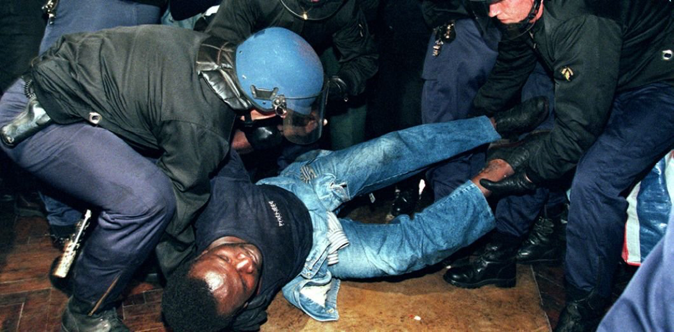
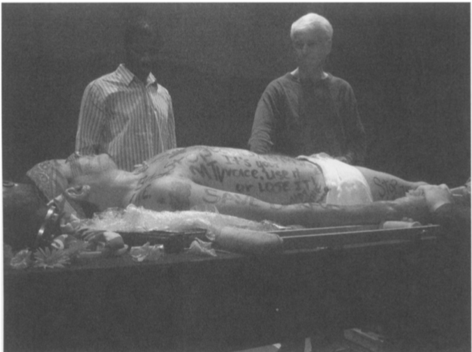
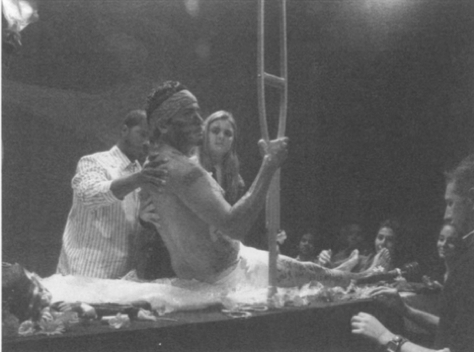
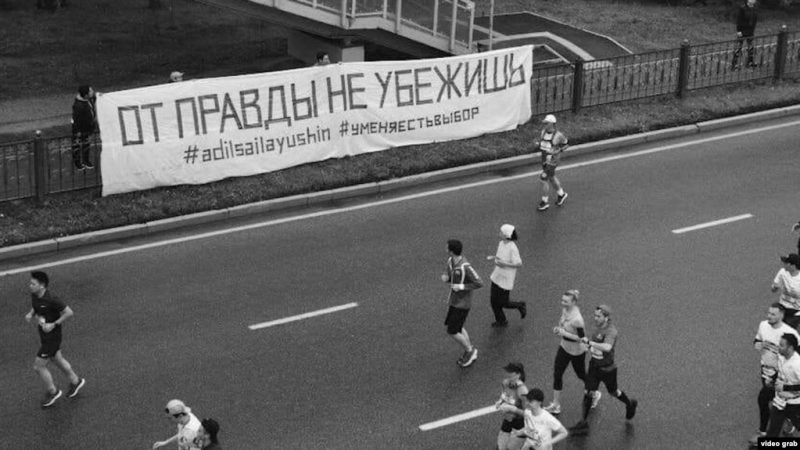
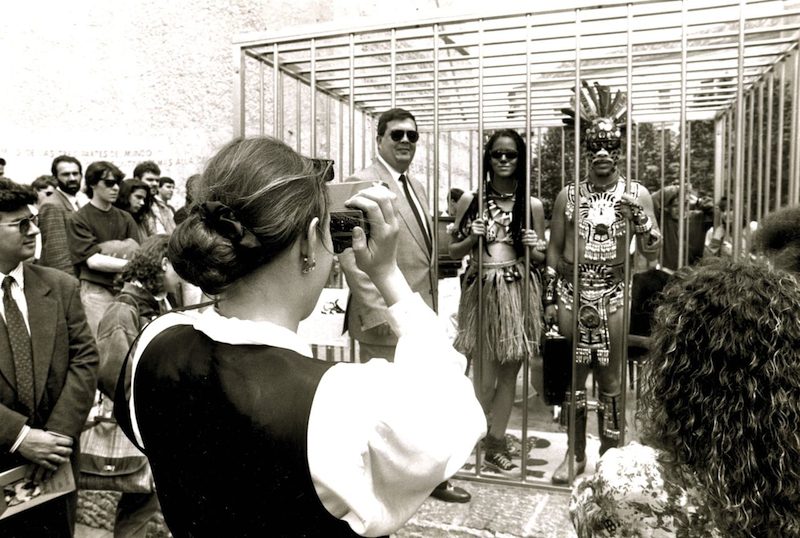
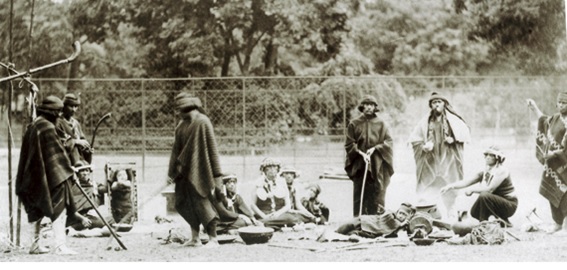
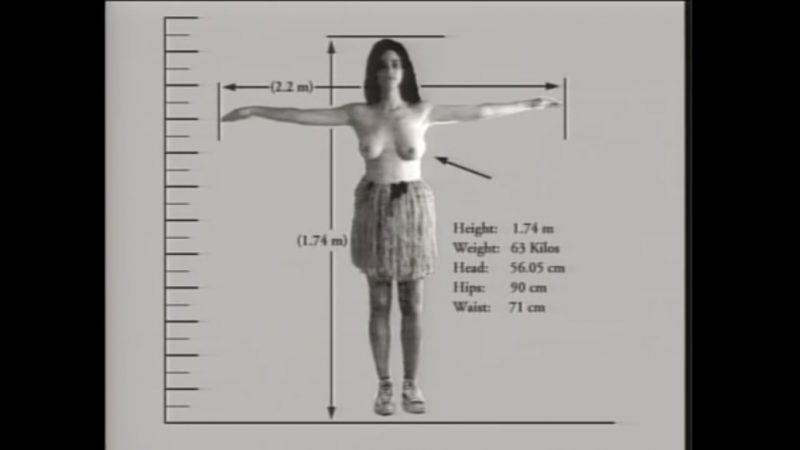
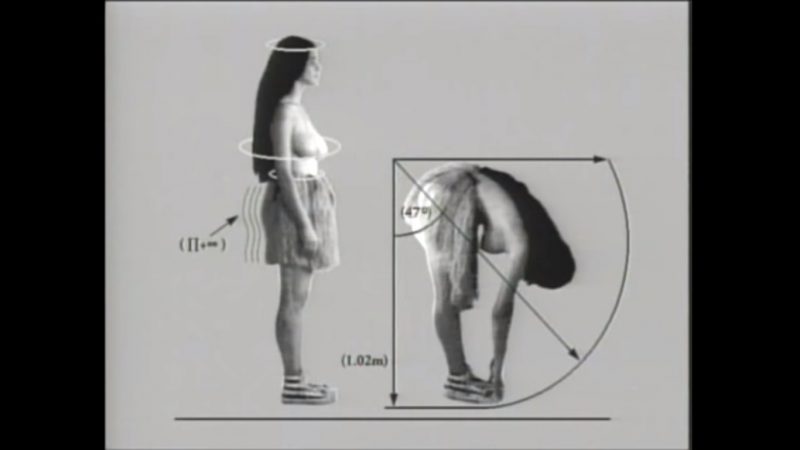
This week’s readings shed new light on the deeply political role of spectators in the face of the political spectacles of corporeal violence, namely persecution, torture/execution, and disappearances.
In The Scapegoat, Girard defines the
practice of scapegoating as both transcultural and transhistorical, mapping the ways in which cultural, religious, and
physical stereotypes whip up public mentality into violentmobs, and how
certain bodies are inscribed as the source of the plague which must be expiated
from the centripetal corpus of society. For the analysis of political
spectacles, this provides a framework for identifying how political actors commodify
the spectacle of persecution into the theatrics of politics by igniting mob
mentalities and discordant affective inclinations towards minorized polulations.
The spectators, then, mobilized through prosecution, become persecutors; we cannot forget that these
mobs, invariably, thirst for the spectacle of corporeal violence—lynching,
guillotines, stoning, etc.
In Discipline and Punish, Foucault traces the development of the modern European penal system and, in judicial practices, the foregoing of the torture of the body in favor of the reformation of the soul. Foucault identifies the body as the locus of political subjectivation, where the authority of the sovereign is (re)inscribed through judicial torture and gruesome public executions. Spectators were meant to cower and acquiesce to the spectacle of violence, in the face of tortured bodies reaching their final scaffold; by shifting towards a shadowing of torture and execution, now the invisible investigations and uses of torture and execution offer the spectators, the public, the guarantee of punishment for their criminal activity. In this shift from the hypervisibility of corporeal violence to its invisilibization, from public torture of the body to private interventions on the soul (through psychiatry, medicine, criminology, etc.), a more efficient form of population control is achieved.
In “Percepticide”,
Taylor analyzes a similar shift in the gaze of the spectator. In the public’s reaction
to state violence during Argentina’s Dirty War, the overwhelming omnipresence
of repression and disappearance, spectators were taken aback, aghast, “silent,
deaf, and blind” (123). This self-blinding in the face of extreme state
violence, defined as percepticide, turned
populations silent, ever-wary, of unexpected attacks, and made witnesses turn a
blind eye in the hopes of not being involved or swept up in the waves of
violence. Percepticide is useful in the analysis of political spectacles by
foregrounding how the state, in moments of crisis, manipulates bodies into
being complicit through the spectacle of in/visible corporeal violence, and by
reminding us that terror, therefore, is in principle artificial (in the sense
that it is theatrics, artifice),
reminding us, therefore, that we need only fear fear itself and what it can do to populations: to mob it out, or to
look the other way.
In her account of the distinction between public and
private, Hannah Arendt claims that “the experience of great bodily pain is at
the same time the most private and least communicable of all” (50). For her,
the site of the body is firmly situated within the private as its experiences
cannot be transferred or shared. Pain, in particular, prevents the victim for
speaking or acting, removing an individual’s potential from participating in
the public realm. The readings assigned for this week develop a very different
account of pain and torture. Both Foucault and Taylor consider the nuanced ways
in which violence, pain and visibility can interact to sustain political
regimes and to produce a particular sense of terror or control among its
subjects.
In her chapter “Percepticide”, Diana Taylor advances the
idea that torture carries a distinct intention, not merely for the victim, but
for the spectator. While Taylor makes reference to make performances, plays and
images throughout, the text is primarily structured around an analysis of
Griselda Gambaro’s 1973 play Information
for Foreigners. This allows for the author to draw parallels between
theatre’s conventions and its demand of the gaze with the particular ways in
which terror and torture operated in Argentina in the 1970s. The way the
audience followed the guide through graphic and violent performances in Gambaro’s
play is also the complicit way in which the Argentinian people lived through a
regime of terror. In the same way as the victim of torture is rendered
powerless, so is the spectator. In Discipline
and Punish, Michel Foucault sets up the body as a concrete site for the
exertion of power. For him, the body is “directly involved in the political
field; power relations have an intimate hold upon it; they invest it, mark it,
train it, torture it, force it to carry out tasks, to perform ceremonies, to
emit signs” (25). Foucault develops a genealogy of practices of punishment to
ultimately present the mechanics of power as operating within a ‘political
economy’ or ‘political technology’ of the body.
Despite dealing with similar themes, the two texts diverge
in several significant ways. I am interested in particular in the ways in which
they might account for a critical position or some kind of resistance to the exertion
of power through direct corporal violence. While Foucault’s account seems to
exclude any exteriority to the discursive constructions of the body through
punishment, by centering her analysis on the analysis of a particular theatre
piece, Taylor might point us towards a potential site of critique and struggle.
Although these two texts
operate very differently, I was struck by the account of invisibility and
secrecy that each presents as a necessary complement to the hypervisible
spectacles of violence. The parallel between the terror of a violent regime (especially
one characterized by regular disappearances) and theatre is also significant in
this respect. Taylor tells us that “dealing in disappearance and making the
visible invisible are also profoundly theatrical. Only in the theatre can the
audience believe that those who walk offstage have vanished into limbo” (132).
Foucault, on the other hand, discusses the ways in which the criminal procedures
in much of Europe were completely secret up until the moment of sentencing. Neither
the accused nor the public had access to the identity of the accuser, to the
evidence presented, or to other information which might point to the legitimacy
of the case. Both Taylor and Foucault are accounting for the role of what is
not known, the opaque processes that rule violence, as key ways of exerting
power and developing an environment of terror.
René Girard’s “Stereotypes of Persecution” develops a
slightly separate account of the ways in which extreme and visible violence
becomes legitimized socially in times of crisis. This text particularly seeks to
identify the key elements that consistently leads to the persecution of
particular groups. His account of the patterns of collective violence is striking
because of its lack of differentiation between those enactments that are widely
considered to be broadly emancipatory (like the French Revolution) from those
associated with tyranny and genocide. Given our previous class conversations on
the power of assembly and the mobilization of individuals in the context of
resistance, I was struck by Girard’s account of assembled masses as “mobs”. Is
there some substantive difference between a group collectively claiming rights
against power and a mob mobilizing against a scapegoated group? Can we account
for the mechanics of political persecution (and, in the case of our project,
the mechanics of political spectacle) without distinguishing between cases of
resistance and those of authority? Just some questions to keep in mind as we
move forward in our project together.
Doom is a sentiment that glides over individuals to create immovable bodies. Doom is a “judicial condemnation or sentence” as much as it is an “unhappy destiny” bonded to death and ruin. Doom revels in the “holy revolt” of the oppressed, it is the contour that gives “unauthorized seeing” its grim bent, and it is the “modern soul’s” incidental preoccupation. Doom is the anxiety in the mishandling of biopower, and in turn, the affirmation used by those in power to dictate the terms of public life as always out of reach of the individual. Our readings this week speak on the strategies of power in spaces of appearance where Doom is both underlying and overarching, a promise as well as a deferment, taking place in the now in preparation for the later, banking on ties to the past.
Within Percepticide, Taylor asks “What do we learn to focus on? What are we trained to overlook? How do we get these signals?” She goes on to define a “self-blinding of the general population” that can be conflated with Doom. If this percepticide “blinds, maims, kills through the senses,” then human faculties are being usurped and replaced with Doom; an ease with death; an eternal peace of mind. Doom is a tool used in the strategy of power, which is comprised as a system. Interestingly, systems are generally puzzles, there is more to them than meets the eye, making their totality difficult to realize. Therefore, the most accessible cause will “appease crowds appetite for violence,” since natural causes are of no interest.
Girad’s assessment of the crowd as spectator and prosecutor brings us to questions of audience in judgements of power. Prosecutors look to an audience to join in on the game of persecution as a means to spread the Doom. Why should a single individual be complicit in acts of persecutory violence when the spectacle can be used as a strategy to differentiate? The crowd inevitably helps to reinforce this culture of krino, or the way in which a collective persecution satiates a thirst for condemnation. What Girad calls an “engagement in a form of repression,” I will call an abdication to Doom.
So if spaces of appearance bend to the will of power, we rigidly come to rely on a script or a Theatre of Terror that makes Doom common-sense or natural. Theatre begs for an audience to its spectacle. The audience warrants meaning to the spectacular ceremony, but also becomes co-conspirators, teammates, or potentially silent symbols in agreement. Here, power becomes inscribed on the body, as the voyeur chooses to victimize, lest they become victims themselves. The objective of this corporeal Doom State is akin to terrorism and torture, for it aims to “prove to the population at large that the regime has the power to control it.” In identifying more readily with the victim, the spectator is doing themselves a disservice, opting to remain in the dreadful bondage of terror as a means to escape the potentiality of livelihood. In this way, Taylor contends, “torture also threatens to reduce the world of public.” This public destabilization is enacted through threats of violence that have managed to seep into the private. Its amplification is the adornment that gives power its controlling features. And, as Foucault contends, “power relations operate through people,” which in turn flings criticism back on the spectator, who must decide what role they wish to play in the “pathetic drama” in which they have inevitably been cast.
Michel Foucault’s “Discipline and Punishment” traces a “genealogy of the present scientifico-legal complex from which the power to punish derives its bases” (23) “against the background of a history of bodies” (25). According to the author, the function of the penal system is to maintain social order and to reinforce “sovereign power”, by preserving the pre-existing power structure. More importantly, as Foucault notes, in the penal and juridical system, “the body is invested with relations of power and domination” and inserted in a system of subjection, where “the body becomes a useful force only if it is both a productive body and a subjected body” (26). That is why “the sentence that condemned or acquits is not simply a judgment of guilt, a legal decision that lays down punishment; it bears within it an assessment of normality and a technical prescription for a possible normalization.” As René Girad also notes, the “difference that exists outside the system is terrifying because it reveals the truth of the system, its relativity, its fragility, and its mortality” (Girad 21).
If “torture is a technique” (Foucault 33), its objective is to exert the “sovereign power” by means of revealing the “truth” (Foucault 44) of the crime and the criminal – the abnormality of it -, as well as “the operation of power” (Foucault 55) that established this dissymmetry of forces and its mechanisms – “its visible manifestations” (Foucault 57).
As a “political ritual”, the public execution sought to “recharge” (Foucault 57) the “sovereign power”. The spectacle surrounding it had the effect of educating the people on the consequences of disturbing the social order and defying the “sovereign power”; that is the consequence of acting abnormally. This was possible because the people were to “take part in it” (Foucault 58) both as spectators and witnesses of this power, dismantling any possible trace of solidarity with those who had been condemned, for “[I]t is not enough for the social bond to be loosened; it must be totally destroyed” (Girard 15).
The political problem posed by solidarity was that it led to the intervention of the people in the spectacle of the executions, questioning the “right to punish” attributed to the “sovereign power”: If the execution “spectacle” was poorly performed, it carried with it the danger of turning into a “carnival” (Foucault 61), where roles were flipped, and so was power – authorities were mocked while criminals were transformed into heroes.
The threat posed by “solidarity” is then neutralized in the modern penal system, where visibility turns into secrecy. Diana Taylor addresses this operation of power in her analyze of Griselda Gambaro’s play Information for Foreigners, where the theatrical representation of Argentina’s violent politics is made visible. By staging this visibility in a “theatre” setting, Gambaro’s confronts the spectator’s position as a passive bystander, also calling into question the lack of solidarity in the face of political repression. Gambaro not only de-normalizes the spectator passivity but by “showing” what was intended to be “invisible” to the public, she also exposes the “percepticide” (Taylor 123) that prevents kinship to take form as a political affect.
¿Cuál es la relación entre castigo y espectáculo?, ¿de qué manera el público lee tanto su relación con el poder como su relación con quien es castigado dentro de un régimen punitivo o dentro de un régimen dictatorial, los dos leídos más que desde una perspectiva de legitimidad desde una perspectiva de relaciones de poder?. Cada una de las tres lecturas propuestas se aproxima de manera particular a la espectacularidad del castigo o de las puestas en escena del poder que lo anteceden o rebasan y al lugar que ocupa la población en este espectáculo.
Los suplicios, y la tortura dentro de ellos, como parte del sistema punitivo occidental europeo operaron de manera permanente hasta el siglo XIX, ya fuera de manera pública o bajo el secreto del procedimiento penal. Pero pese a la desaparición paulatina de la legitimidad de los suplicios, el control sobre el cuerpo se ha mantenido. En este contexto, Foucault propone estudiar los métodos punitivos a partir de una tecnología política del cuerpo permite revelar las relaciones de poder que operan en él y a su alrededor. Esas relaciones dan cuanta, además, de que lo punitivo no sólo reprime, sino que conlleva “una serie de efectos positivos y útiles a quienes tienen por misión sostener.” (24) A partir de este enfoque propuesto por Foucault, surge una primera pregunta, ¿Para quién son positivos y útiles estos efectos? Un primer insumo para contestar lo da el mismo autor situar el sistema punitivo como parte de una “economía política de los cuerpos”(25). En efecto el cuerpo no puede escapar de las relaciones de poder entre las que el opera, por ejemplo, como fuerza de trabajo. Otra pista para contestar la pregunta tiene que ver con la espectacularización del castigo, y la publicidad de la sentencia, y el papel de esta espectacularización y publicidad en el sostenimiento de estructuras económicas y políticas de poder, esto es, ¿qué se está transmitiendo al público, a la población, con estos espectáculos?. Me parece importante tener estos dos aspectos presentes en la aproximación a la lectura de “Percepticide”. Este texto, desde el particular caso de las torturas perpetradas la dictadura argentina, indaga por el rol de la población en este tipo de contextos. Parte del punto de la alteración de la percepción de la realidad por parte de la población, es decir, hay algo en el discurso del régimen, en su forma de imponerse mediante el terror, que lleva a la población a ignorar o a preferir no ver lo que está pasando a su alrededor. Gran parte de esa imposición tiene que ver con el espectáculo que en este caso para por lo visible / invisible, –si bien las torturas no se dan a la vista de la población, las detenciones, los bombardeos, los allanamientos sí–. La autora entonces se pregunta si la alteración de la percepción, el hecho de “ignorar” estos hechos que pasan al otro lado del vidrio, no lleva a algún tipo de connivencia con el régimen que contribuye a que este se mantenga. Me parece interesante volver a esa pregunta desde los dos puntos planteados por Foucault que resalté al comienzo de este escrito. De manera que un análisis del rol de la población en la permanencia de un régimen dictatorial involucre la pregunta por quién se beneficia de los efectos positivos, quién saca provecho o utilidad de esa permanencia y, por ese mismo camino, si las relaciones de poder no siguen siendo inmensamente desiguales entre un régimen que ha capturado todo el estado y sus instituciones y una población que aunque no ha sido torturada vive bajo el miedo permanente, amplificado por el espectáculo, de ser víctima de ese régimen, el miedo de ser vigilada y, además, la total desconfianza en las autoridades.
Un punto en común de las lecturas de esta semana es el castigo como espectáculo y el efecto que este tiene en quien mira (o esconde la mirada) como ejercicio coercitivo de poder. En “Percepticide” Diana Taylor propone que uno de los objetivos del despliegue escénico de las fuerzas militares en la calle durante la última dictadura en Argentina no era precisamente esconder el terrorismo de Estado sino volver cómplices (mediante la mirada) a las grandes porciones de la sociedad de clase media despolitizadas que no eran blanco de la represión. La autora llama “percepticidio” el fenómeno a través del cual las personas eran sometidas en la arena pública a escenas de violencia y, por miedo, desviaban la mirada, al mismo tiempo que así se volvían partícipes pasivas del terrorismo de Estado, de los crímenes de lesa humanidad y del genocidio[1].
En los primeros dos capítulos de Vigilar y Castigar, Foucault analiza a través de un minucioso trabajo de archivo cómo en el siglo XVIII una serie de reformas penales hacen desaparecer al cuerpo como blanco mayor de la represión penal y borran al suplicio como espectáculo de escenificación del poder. Si anteriormente a esta fecha era el ensañamiento de la tortura en el espacio público la manera en que el poder soberano infligía a quienes miraban el terror y la disuasión a quebrantar la ley, posteriormente ciertas tecnologías e instituciones trasladan el castigo, como dice Foucault, “del cuerpo al alma”, metáfora que resume un nuevo marco disciplinario en el que ya no se intenta castigar sino corregir, adiestrar, normalizar, y la mirada como fenómeno de poder se vuelve omnipresente mediante el panóptico, técnica que produce el efecto en los ciudadanos/as de que están siendo mirados permanentemente y autoregulan así su comportamiento.
[1] Pongo estas palabras en negrita sólo para marcar una tensión política que se define en la manera en que se denominan los hechos ocurridos en la última dictadura militar argentina. El dictador Videla llamó a la tortura y a la desaparición sistemática de personas “guerra sucia” (“dirty war”, palabra que usa el texto de Taylor) como eufemismo para justificar tras la fachada de una supuesta confrontación simétrica dichos crímenes. Como las condiciones para la existencia de una guerra nunca estuvieron dadas en la Argentina, ya que se trató del accionar del Estado contra poblaciones civiles, todos los tribunales internacionales y gobiernos democráticos argentinos (a excepción del de Macri) convinieron en denominar el accionar del gobierno de facto “crímenes de lesa humanidad” y “terrorismo de Estado” en lugar de “guerra sucia”.
In the chapter, “the body of the condemned” and “the spectacle of the scaffold” in Michel Foucault’s Discipline & Punish: The Birth of the Prison, he starts out with the idea of a corporal punishment, then shifting to the punishment of the soul, where inflicting harm and wounding the body is excluded from the picture. Foucault uses the example of a public execution to construct his theoretical argument about the current prison system and public executions of the past. The fabrication of a new embodiment that is not the physical body, allows for news forms of punishment that goes beyond the limits of the physical body. This inherent shift from the body to the spiritual realm of the body, creates a space that is more private, closing off the public aspect of the execution. Therefore, “the disappearance of public executions marks therefore the decline of the spectacle; but it also marks the slackening of the hold on the body” (p. 10). Also that, “in our societies the systems of punishment are to be situated in a certain ‘political economy’ of the body: even if they do not make use of violent or bloody punishment, even when they use ‘lenient’ methods involving confinement or correction, it is always the body that is at issue- body and its forces, their utility and their docility, their distribution and their submission” (p. 25). Thus, there are many aspects to the imprisonment of the body that involves the judgement of the body, where other bodies are playing the role of the judge, even when that role is not certain, this in turn creates for discourses that traps the body. The distribution and the role of power then takes on a strategic perspective, where there are multiple players in a societal setting where there is not a specific individual controlling it. As Foucault mentions in chapter 2, “of all the reasons why punishment that was in the least ashamed of being ‘atrocious’ was replaced by punishment that was to claim honour of being ‘humane’ there is one that must be analyzed at once, for internal to the public execution itself: at once an element of its functioning and the principle of its perpetual disorder” (p. 57). As atrocity represents the most terrorizing part of a crime, it is seen as a necessity to reveal the truth of the crime. Even though, it is a representation of the violence present in the crime as a whole, it also demonstrates the violence that is inherently present within the crime.
On the other hand, in the article, “percepticide” by Diana Taylor and Chapter 2 of the book The Scapegoat, “Stereotypes of persecutions” by René Girard, tackles the different acts of violence in persecutions and different spectacles of power. Taylor talks about the acts of terror in the Argentinian society that create a spectacle, that involved the society as a whole, and presented the atrocities that lies within violent acts, while portraying a theatrical presentation of such events, though it was not meant to be such. Thus, “the house theatrical space, like the junta’s appropriation of the domestic, subverts the lines of demarcation between public and private” (p. 127). The presentation of the private spaces is shown through the lens of the juridical systems, that has created such a private space that eliminated the spectacle of public prosecutions. Therefore, showing how public perception is controlled by the different systematic power holders. The manipulation of power and its various forms draws upon the spectator’s role in the system, while the authority uses fear and terror to shape its control. In Girard’s book, he mentions, “ultimately the persecutors always convince themselves that a small number of people, or even a single individual, despite his relative weakness, is extremely harmful to the whole of society” (p. 15). This alludes to the creation of certain bias and development of stereotypes for a specific group of people, which becomes part of the prosecution. To add to this, Girard talks about how, “the rich and powerful exert an influence over society which justifies the acts of violence to which they are subjected in times of crisis. This is the holy revolt of the oppressed” (p. 19). This speaks to the boundaries that demonstrate the different faces of persecution. The intention is to provide a specific idea of collective violence that intersects with different cultures, but not necessarily providing an idea of what is seen as good or bad in a social context. Therefore, the idea of scapegoating connects directly to the cultural aspect of culture and create some sort of calmness in the society. The unconscious side of this makes room for the continued presence of this scapegoating and shows the different forms in which society address and represents power.
The force of a political entity has often been divided into two main categories: soft power and hard power, each with their own relationship to the body. Hard power is brutal force, what the Taylor reading talks about as torture or what Foucault speaks about when he refers to the public execution. Soft power is along the lines of persuation and ideology, and is the careful crafting of the subject as a particular actor by the particular forces. Each reading focuses on the intersections and complications between these two types of power. Taylor discusses both the violence inflicted as well as the willing “percepticide” of the general populous in response. Harkening back to Arendt’s ethics of visibility, the populous upon seeing that one of their own has been maimed can simply go on as if they haven’t seen or experienced this, so their happens to be a failed uptake (to use Austin’s term) of the act in the mind of the viewer. “Perhaps the fact that we know what is going on and yet cannot see it makes the entire process more frightening, riveting, and resistant to eradication” (Taylor 132). The result of this failed uptake, the inability for the sight to cause change, is part of a larger fallacy that “the public, local as well as international, can miraculously avert violence by watching it” (134). The hard power of violence then shifts to the soft power of persuation, but always backed by the potentiality for escalation. This is emphasized in Foucault as he outlines in his history of the prison. Opting to go away from the spectacle of the public execution, Western societies move toward a prison system that gets not only at the body but at the soul- pathologizing and moralizing the inner part of a person’s being. By transcending the body itself, but always with the shadow of violence lurking behind, one is able to start corrective force instead of punitive force. The body, to Foucault, holds a kind of knowledge, what he calls the ‘political technology of body.’ These actions of the body, part of a larger scheme of normative rules, constitute ourselves and thus are able to be more effective at subduing the population. Then, the power is spread out among all of us and not centralized in an easily toppled governmental hierarchy. We are all the wardens policing each other based on norms, alluding to Girad’s conception of persecution as a uniquely social crisis where the general population are all “potential persecutors, for they dream of purging the community of the impure elements that corrupt it, the traitors who undermine it” (16). The body then is a vehicle for politics in a particular way. Subject-hood becomes constituted by systems but also a sight of resistance and a moment to create new systems, as within Girad’s and Foucault’s theories is the assumption that there is power within the individual. I am particularly interested in the ways that we can harness that power to create new political realities.
In his chapter “Stereotypes of Persecution” in The Scapegoat, Rene Girard discusses a form of targeting or, further, mobilization of the affects; specifically, the mechanism of the accusation and the interaction between representation and acts of persecution. Focusing on a process of creating uniformity through negative reciprocity, especially in time of crisis (which is spoken of in this essay along similar lines of Habermas’ “legitimation crisis”), Girard details the movement from the identification of a particular group or individual as a threat, based on appearance, to the stereotypical accusation which circulates through crowds, in the form of “They are going to harm our society!”. Girard’s concern is to show that the pattern of collective violence crosses cultures and that its broad contours are easily defines; his shows this through an enumeration of the qualities that tend to polarize violent crowds against those who possess them.
Michel Foucault, in his investigation of torture as a mechanism of punishment in Discipline and Punish, expounds upon this interaction between stereotypical accusation (representation) and acts of punishment (persecution). Foucault positions the body in direct involvement with the political field: power relations have an immediate hold upon it; they invest it, mark it, train it, torture it, force it to carryout tasks, to perform ceremonies, to emit signs. In line with Girard, Foucault sees the body (although Girard speaks not so much of ‘the body’) as bound up, in accordance with complex reciprocal relations (where Girard focuses exclusively on negative reciprocation). Foucault extends this idea of the body–the ‘body-politic’–to the mechanisms of interrogative torture, where the body constitutes the point of application of the punishment and the locus of extortion of the truth.
In his genealogy of the penal spectacle, Foucault demonstrates the movement from the theatrical public execution to the tendency of punishment to become the most hidden part of the penal process. A few consequences of this movement are that it leaves the domain of the “more or less everyday perception and enters that of abstract consciousness; its effectiveness is seen as resulting from its inevitability, not from its visible intensity; it is the certainty of being punished and not the horrifying spectacle of public punishment that must discourage crime.
Diana Taylor, in her essay titled “Percepticide,” extends some aspects of Foucault’s arguments and challenges others. Like Foucault, Taylor also regards punishment as a political tactic, a complex social function. She agrees with Foucault that everyday perception enters abstract conscious, but challenges it by positioning this ‘percepticide’ as existing also as a survival strategy. She agrees effectiveness is connected to perceived inevitability, but challenges Foucault’s assertion that this perceived inevitability is not always lacking in visual intensity, positing instead that the theatrical visual demonstration of power (public arrests rather than public executions) give weight and force to that invisible penal process which dances around our anxious imaginations. Further, it is this argument of Taylor’s that gives added support to Foucault’s argument that it is the certainty of being punished and not the spectacle that must discourage crime. Though this seems hard to fully grasp, I think what is being argued is that, in the theater of penality, it is not that the public spectacle of execution has been removed from the plot, but that the public spectacle has been demoted to the role of support for the new mechanism of punishment: that which is invisible. Are we more afraid of a terror we can’t see or a terror we can see?
This week’s authors posit three fundamental questions: When is a body persecuted? Under what conditions is a body persecuted? What role do we play in the persecution? In respective order, Girard, Foucault, and Taylor’s texts create a triptych where concepts such as abnormality and difference, torture and punishment, and concealment and spectatorship are fleshed out in order to understand what Foucault identifies as the “Political Techonology of the Body (Foucault, 26).” Understood as the knowledge and ability to conquer the forces of the body, these tactics and techniques of power permeate judicial and non-judicial forms of punishing, controlling, and subjecting a body.
As the authors touch on ideas of visibility, or lack thereof my mind quickly travelled to one of the most famous cases of modern torture which has been concealed, but not eliminated: the 2003 Abu Grahib report of torture and prisoner abuse. Deeply intertwined with the United State’s historical use of torture to profit from marginalized bodies, the images released in 2003 showed the choreographies created by the US soldiers in order to punish, humiliate, and dehumanize Iraquí subjects: in one of the most famous released images one can see US solider Lynndie England, a white woman, standing proud wearing her military uniform, while holding a leash, which is attached to the naked, tortured body of a prisoner who is on the floor next to her. : “The body becomes a useful force only if it is both a productive body and a subjected body (Foucault, 26).” This case raises interesting questions which stand in dialogue with Taylor’s reflections on spectatorship and our relationship to seeing, viewing and surveillance. The audience of this photos was meant to be controlled, the photos were meant for the sadistic enjoyment of the US military members only, but how does the scope of “an audience” change in a time when technology rearranges the possibilities of visibility and surveillance? As Taylor says on page 131 of Percepticide, “Old maps no longer correspond to, or guide us through this world.”
In “Stereotypes of Persecution,” René Girard analyzes the mobilization of hatred in collective persecutions (mob formation) during times of crisis, what he delineates for his study as “acts of violence…that are legal in form but stimulated by the extremes of public opinion” (12). In giving one example of crisis, Girard includes an extract of Portuguese monk Fco de Santa Maria’s writing, from which I’d like to locate a few key terms that characterize a spectacularization of crisis as well as apply to the texts this week more generally.
The first is confusion; “Everything is reduced to extreme confusion” (13). The second, pity; “No pity is shown to friends since every sign of pity is dangerous” (13) (I’d like to extrapolate to distance and empathy here as well; “All the laws of love and nature are drowned” (13)). Here specifically, I am interested in how crisis propels egocentrism at the same time that it precludes empathy: in its stead, there are processes of othering. And the third, blindness; “Men…act like desperate blindmen, who encounter fear and contradictions at every step” (13). These terms are not distinct but interrelated; for example, within confusion is also the element of distraction that leads to blindness and the location of blame within targeted populations (the notion of scapegoats); “[Men] are disconcerted by the immensity of the disaster but never look into the natural causes” (14).
Taylor takes up this point of “never looking” concretely in her chapter “Percepticide.” In examining the Argentine population’s reaction to spectacles of power during The Dirty War, Taylor argues that people were “forced to focus on the given-to-be-seen and ignore the atrocities given-to-be-invisible” (119), that is to say, vision and visibility operated within certain frames dictated by the State, destroying kinship bonds by forcing people to look away from the atrocities committed and rendering the population blind (122-3). However, Taylor also distinguishes percepticide as “self-blinding,” that is, individuals chose not to look out of fear, colluding as spectators who disavowed their spectatorship. It is interesting to note that within the context of crisis, a communal identity was shaped, but one that positioned the “us” vs. the “them.” I’d like to briefly linger on positionality because it is from there that the logic for political action, whether moblike or resistant in nature, often derives. Girard writes that in choosing the persecuted, “the persecutors always convince themselves that a small number of people, or even a single individual…is extremely harmful to the whole of society” (15). The formation of the mob is interpellative for Girard –”The crowd’s act of becoming a crowd is the same as the obscure call to assemble or mobilize, in other words to become a mob” (16)– he shows how hatred can also mobilize a call to assembly. Here, the “othering” of the victimized is rationalized along infectious lines because to the mob, the preservation of society itself is at risk. Taylor’s analysis of photographs during the Malvinas/Falkland Islands war illuminates how the construction of an “us” during wartime is also performed in the name of national unity; “Spectators are encouraged to enter into the narrative…in the staging of a singular ‘body'” (121).
Taylor’s analysis of Griselda Gambaro’s Information for Foreigners is fascinating in working through how the playwright stages the techniques of “blinding” and the perception of this process together. One of the central aspects seems to be how Gambaro forces the spectators to see, and towards the recognition of their complicity in what is seen, eliminating the possibility of deniability. In the play, the “audience is being invited to transgress, to see that which should never be seen” (126), namely, staged scenes of torture and terror in practice. Gambaro’s work also invites the audience beyond the theatrical frame (that also operates along Taylor’s visual frame of the given-to-be-seen and given-to-be-invisible) to the offstage: our Brecht reading on alienation effects came in handy here, and Taylor notes that Gambaro doesn’t allow for close identification in the play (130). At the same time, The Guide in Information acts as a figure of authority, censoring what the viewers can see, demonstrating how sight is imbricated in relations of power. An important contribution of Taylor’s text is not only how it brings forward the audience’s role in systems of terror (129), but also how it explicates the population’s role as audience in State spectacles of violence meant to “prove to the population at large that the regime has the power to control it” (130).
The photos in Taylor’s text that depict military violence in broad daylight seem to challenge Foucault’s argument for the disappearance of punishment as a spectacle. However, Foucault is working specifically within the context of penal law; it is worth noting that public State repression is often justified as extrajudicial during “states of emergency” (Chile immediately comes to mind), although some have argued that we now live in a permanent state of exception along Agambenian lines. Foucault also argues that the body mediates power relations and a system of subjection (here there is an intersection with Taylor’s text); “the body becomes a useful force only if it is both a productive body and a subjected body” (26). What is critical for me in Foucault’s text is how punishment is disappearing from visibility –it becomes the “most hidden part of the penal process” and leaves “everyday perception and enters that of abstract consciousness” (9)– under the guise of a State handling of justice in respectable terms by not explicitly and publicly targeting the body, a transformation that resembles a distraction; “justice no longer takes public responsibility for the violence that is bound up with its practice” (9). Foucault argues that this distraction is achieved through distancing (that is becoming increasingly inverse to recognition and responsibility through this week’s texts): autonomous sectors carry out the penalty for example, “bureaucratic concealment” is at work (10). In the age of mass incarceration and migrant detention centers, we should not be fooled that this distribution of visibility and concealment of bodily harm means that justice is operating upon the premise of universal rights.
The readings for this week focus on the technologies used to control and exercise power over populations. Taylor (1997) focuses on how systems of terror use the spectacle of violence to petrify people’s reaction. Taking the dictatorship in Argentina, Taylor analyzes the power dynamics between spectacle and spectatorship where seeing helps to construct the nation’s identity; “Complex exchange of look and gaze contribute to the simultaneous formation of the individual and social subject” (121). Here, she uses the term “percepticide” which is the self-blinding of the population that, because of the fear imparted on them by the state, pulled back and did not react. The theatricality of terrorism has the effect of making people react in their minds, but not physically. With this split, populations are controlled to see torture but not react. Taylor sees the necessity of getting empowered by seeing and confronting the spectacle of terror, not as a way to find pleasure or to construct ourselves as moral subjects, but rather as to “confront the monster without turning into stone and being petrified” (137) Foucault (1975) analyzes the appearance/disappearance of the body in relation to penal repression. The abstraction of the law is necessary for the justice system not to be responsible for the physical pain that the body suffers when imprisoned. This system of punishment then is one that creates a relation of power and domination where knowledge and strategy are essential; “in our societies, the systems of punishment are to be situated in a certain ‘political economy’ of the body: even if they do not make use of violent or bloody punishment, even when they use ‘lenient’ methods involving confinement or correction, it is always the body that is at issue – they body and its forces, their utility and their docility, their distribution and their submission.” (25) Finally, Girard (1986) uses the image of the scapegoat of the nation to exemplify how the persecutors convince citizens that a small group signifies a big threat for the entire society, where minorities and the “abnormal” are used as the ones to be blamed and to exercise violence on.
Para reflexionar sobre la tortura, las lecturas de esta semana buscan llevarnos por diferentes interrogantes que problematizan los actos violentos, de tortura y deshumanización que aparecen en las sociedades. Por supuesto, el trabajo de Foucault es central para pensar en los actos de castigo que remontan siglos atrás y que en el presente continúan operando desde otros niveles que también pueden ser considerados como actos violentos y crueles: “Punishment had no doubt ceased to be centered on torture as a technique of pain; it assumed as its principal object loss of wealth or rights” (15).
En principio, me llamó la atención pensar en el
poder que tiene el discurso a la hora de justificar los actos de tortura: el
discurso provee el aparato que funciona como excusa para sostener los actos
crueles sobre los que reflexionan las lecturas. Dice René Girard: “The
persecutors always convince themselves that a small number of people, or even a
single individual, despite his relative weakness, is extremely harmful to the
whole society.” (15). Taylor también
reflexiona sobre este auto convencimiento desde la perspectiva del torturador: “They can maim
or kill their victims by convincing themselves that they are doing something
else: they are defending themselves and the country from the dangerous enemy or
they are carrying out a “necessary” scientific experiment” (129).
Empieza así a difundirse
una justificación contra este ‘enemigo’ fabricado, al cual hay que imponerle un
castigo: “its appetite for violence (…) for they dream of purging the community
of the impure elements that corrupt it, the traitor who undermine it (…) The
search of people to blame continues but it demands more rational crimes” (Girard, 16). Entonces, En la retórica de estos regímenes
autoritarios, los actos contra este ‘culpable’ o enemigo se realizan en nombre
del ‘bien común’ de una sociedad más amplia.
Por su parte, Taylor
también reflexiona sobre el trabajo de la dramaturga argentina Griselda
Gambaro, en el que de alguna manera se nos invitar a ampliar la mirada
alrededor de los actos de tortura, y no solo pensar en términos de ‘víctima’ y
‘victimario’ sino también en reflexionar sobre cuál es el rol del espectador
cuando suceden dichos actos, cuando se es testigo de situaciones de violencia y
tortura. A través del teatro, Gambaro involucra al espectador de tal forma que
éste pueda reflexionar a través del escenario (la casa) las diferentes tácticas
del terror y la tortura, ver cómo se produce la manipulación en sistemas de
represión, con qué elementos opera el terror: “signals that terror play
with potent images of the unknown, the pit, darkness” (Taylor, 131) y lo crucial que resulta ser quien
mira y es testigo de esos actos, ¿qué debería hacer el espectador en ese contexto?
En un contexto en el que al final “watching, in and of itself, never saved
anyone.” (134).
Job Title: Actor for punishment spectacle. Role of a condemned.
Reports To: The actor will report to the casting director, scriptwriter, director of terror and the audience.
Job Overview: Acting of punishment became easier than ever. Your body will not be torn apart and you will not be executed in front of the audience since “the disappearance of torture as a public spectacle” . “Punishment, if I may so put it, should strike the soul rather than the body”. The spectacle “has shifted to the trial, and to the sentence; the execution itself is like an additional shame that justice is ashamed to impose on the condemned man”. Also, who knows, maybe the audience would intervene and set you free during a public execution. “Confronted with the reality of torture, tendency of audience is to identify with the victim”. We don’t want them to sympathize with you and change the focus of their anger on the executioner. So it is decided. You will play in the penal ritual and get a psychiatric examination. In the prison, you will get up “at the first drum-roll”, work “for nine hours a day throughout the year”, pray for less than an hour a day. Workshops, school, accommodation, and meals are provided.
Responsibilities and Duties: Although you won’t be publicly tortured in a court, you will participate in terror staging of real life. “Theatrical convention allows for splitting of mind from body, enabling the audience to respond either emotionally or intellectually to the action it sees on stage without responding physically”. We will reveal corpses, torture on streets, create own media narratives so that the audience will get blindfolded with their emotions and fear.
However, you must be noted that we have rivals in real theatres who “turn the gaze back onto the blinding apparatus itself”. They invite the audience “to transgress, to see that which should never be seen”. It reminds them that “terror deterritorializes” and they are all foreigners in their houses. But they “are not being victimized”; they “have a capacity for choice and for action”. For you, it means that your acting in terror and court structures must be flowless to make people feel powerless against them.
Qualifications: You will be accepted to the role based on the following stereotypes.
• Stereotype of social crisis, moral causes or natural disaster. 14 “Rather than blame themselves, people inevitably blame either society as a whole which costs them nothing, or other people who seem particularly harmful for easily identifiable reasons.”
• And “thanks to poison, it is possible to be persuaded that a small group, or even a single individual, can harm the whole society without being discovered”. So even you an individual can be blamed for society-wide harm.
• You will get even more chances to be selected is you “belong to a class that is particularly susceptible to persecution rather than because of the crimes you have committed” . You are welcome to be condemned if you are an ethnic and religious minority.
• But mainly you will be judged on whether you are as different as expected and blamed “in the end for not differing at all”.
How persecution and violence came into being in human society, how does it work against human bodies, and what are the possibilities of resistance, consist of the main themes of this week’s reading. Foucault’s Discipline and Punish provides a historical, thorough analysis of how bodies became the target, the object, of painful torment, as well as how such torment became the apparatus of executing power, whether it is the sovereignty power of making die and letting live, or the biopower of making live and letting die. Making flesh suffer–especially in a way that is of humiliation and alienation–against its initial willing, shows absolute domination over “others”. Therefore there is not only the visible method of persecution, which is violence, but also a hidden logic of racialization–the creating of “us” against “them”.
Girard pointed out this dangerous yet constant phenomenon, or even the need of division within human society as the root of stereotypes of persecution. According to Girard, there are always the same key elements that motivate persecution. First is the eclipse of culture that causes social crisis, which makes people “blame either society as a whole… or other people who seem particularly harmful for easily identifiable reasons” (Girard, 14). It is almost alarming to realize such vicious instinct of looking for scapegoat to take the blame, ruling out the “abnormal”, in order to somehow ease the pain of life, or simply the feeling of being disconcerted. Then there comes an absurd move towards scientific reasons, such as poisoning, creating a myth that overlooks the personal insignificance and believes in the great danger small group can pose to a vast society.
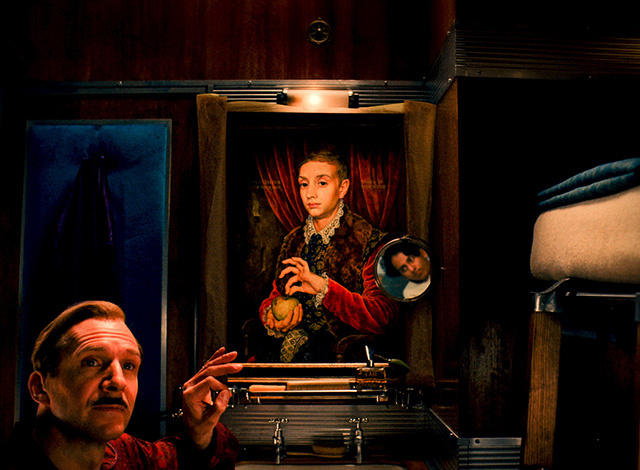
The “us and them” discussion continues in Percepticide while Taylor focuses on the what it means of seeing and being seen. The strong temptation people feel to see is due to the voyeuristic pleasure, which is largely a sexual desire in its own form, and can be manipulated by either letting see or leaving an absence in theatre, with a precondition of distancing. However, once such scopic pleasure is smushed, as in Gambaro’s work, seeing gains an enormous power and it transmits within the crowd, bouncing back and force, connecting everyone as a whole so there is no escape for only one side. Victims are seen closely but can also “returns our look” (Taylor, 135). This duality of mutual visibility reminds me of the very classical scene in Wes Anderson’s The Grand Budapest Hotel (2014), where the M. Gustave, Zero and the Boy with apple in the picture all stares at each other, while at the same time drawing the audience in despite the existence of a screen. It in a way represents the complex relationship between persecuted Jews, the silenced people of kinship (maybe as potential allies of persecutors) , mirroring the tragedy of history as a warning of today, of what tragedy might happen when people turn away from the fact and refuse to see.
The Grand Budapest Hotel 2014
Foucault, Michel. Discipline and Punish: The Birth of the Prison. Second. New York: Random House.Inc, 1995.
Taylor, Diana. “Percepticide.” In Disappearing Acts: Spectacles of Gender and Nationalism in Argentina’s “Dirty War,” 119–281. Durham: Duke University Press, 1997.
Girard, René. “Stereotypes of Persecution.” In The Scapegoat, 12–23. Baltimore, Maryland: The John Hopkins University Press, 1986.
The disappearance of torture as a public spectacle, Foucault claims that punishments that touched the body were no longer in practice but, punishment was now aimed at the soul. For example, the trials and sentences that are supposed to improve humans. Foucault goes into adding how penalty targeted the soul, judgments targeted the motives of humans, and offenses were targeting scientific knowledge. “The body now serves as an instrument or intermediary: If one intervenes upon it to imprison it, or to make it work, it is in order to deprive the individual of a liberty that is regarded both as a right and as a property.” The body is now out of the question to punish, Foucault explains that in order to reach something other than the physical body, it would be through imprisonment, confinement, deportation, and prohibition from entering in certain areas (pedophiles?) but, the body will be affected by punishment because, according to Foucault, we cannot escape a corporal punishment. To further his argument, he elaborates on how the body is used as a political technology and the body as an object to be used for others, he believes that there is a connection between the sound and punishments due to the fact that the soul can allow for new possibilities. The soul acting as a prison itself because is now in control of the sciences, specially in medicine (perhaps doctors, psychiatric, me medical field?). In the spectacle of the scaffold, Foucault mentions that an audience must exist in order for a an execution to appear, it establishes order, he sees them as economies of power. Torture and executions are a communal system with a truth-power relation through the body of the condemned as punishment mechanism. Girard on The Scapegoat, is offering a way of listing the stereotypes of persecution, for example, distinctions are necessary to maintain social order; the victim; as well as accusations made against victims and those existing outside the system. The signs of the victims, and the systems complex differences (foreigners) may become objects of persecution, for example, the attack on the Jews in the Black Death as he mentions in the book.
Taylor affirms in her book that much of the history of Argentina became a product of nation-ness and gender. Authoritarianism, audiences, and state terrorism and the practices against “the other” along with performance, are necessary in the oppression of women. A connection exists between gender and nation, that is, they become a product of performance “doing one nation-ness/gender correctly promises privilege and a sense of belonging, yet involves coercive mechanisms of identification” Taylor says on pg 92. This public spectacle is part of a performance style in constructing national identity, political actors persuade their audiences through seduction, leader use this power dynamics as Taylor calls it, the patriarchal view. I find that it was masculinity to the main performer throughout the history of Argentina with the feminicides, something that is prevalent in Mexico, too.
Foucault’s painting of the modern legal system can be seen in the police murders of unarmed black people. As we see videos of black men being harassed and killed by law enforcement we begin to normalize the spectacle of black death. A new study finds killings are now the leading cause of death for young men, particularly, young black men (Edwards et al., 2019). Though Foucault argued “punishment, then will become the most hidden part of the penal process” (p.9) I would push back and point to these very public (thanks to social media) spectacles of discipline and punishment. We have become the spectators to legal death (or execution) as we see black bodies parish at the hands of police in the name of justice or perhaps the protection of others. Judgement and examination is then had on a very public and legal level. We see police officers and black bodies become adjudicated as we all become spectators to the violence and trials online and in our city streets. Even more, we begin to see how judicial power and punishment affects the officer, the condemned, and the viewing public.
As Taylor notes, “in order to be empowered by seeing, to be able to look back at the monstrous gargoyles without turning into lifeless stones, we must see beyond the theatrical frame and decode the fictions about violence, about torturers, about ourselves as audience” (p.137). To reject the role of the passive spectator, we must look beyond any manipulations of the realities in front of us. The thing about the Black Lives Matter movements and those alike is that they typically bring the police officer under persecution. It makes us (re)consider our relationship to justice and it’s affiliated systems. Instead of bringing the black body to question, the mob turns to look at the enforcer (the police officer) as the cause for violence and injustice. In this case, crowd mobilizes against the toxic officer and against the penal process to fulfill “the dream of purging the community of the impure elements that corrupt it” (Girard, p. 16, 1986).
Edwards, F., Hedwig, L., Esposito, M. (2019). Risk of being killed by police use of force in the United States by age, race–ethnicity, and sex. Proceedings of the National Academy of Sciences of the United States, 116(34). doi: 10.1073/pnas.1821204116
”Is watching itself a form of violence? Is it a form of in which we must look on as someone we love is humiliated or destroyed before our eyes? Or is watching the unauthorized or even criminal scopophilia of voyeurism?” The spectacle of persecution has always repeated in the history— the cultural revolution during the 60s of China.
The people who announced to be sentenced,
was showed to the audience for several
days. This is the most of persecution method
during the cultural revolution. It becomes the scene of torture. Students and
Red Guards celebrated to the persecution scene. The victims are like actors,
presenting the play to the audience. Watching itself becomes a punishment for
the alerting people.
According to Foucault,
as the sovereignty power of making die shifts into biopower ((Foucault 2003, 255), The cruel
punishment acts against the human body have become a discipline. Biopower
enacts through technologies of power to humanize the penal system and the
knowledge of man: i.e. the stereotypical persecution is the consequence of
these techniques. (Girard,17) These stereotypies work in the logic of racism:
by creating caesuras within a
population”, a confrontational relationship is built up between “us” and “them.
(Foucault 2003, 255)
In
meanwhile, as the system of punishment are to be situated in a certain
“political economy” of the body… it is always the body that is at the
issue.”(Foucault, 23)The
authority uses terror to subject the body and make invisible space in public
life. People become percepticide and fail to recognize certain aspects of the
society and the self, as their psychological ability to humanely response to
the reality is killed by horror.In Taylor’s article, she mentioned how Population is manipulated to see and not to see,
and how Propaganda acts on the population level, and build up an ideology, a
collective imaginary(Taylor, 122) by The mutuality and the reciprocity of the
look, the recognition between “ us and them” happens. The case study about the
Argentinian artist Gambora’s work the information for foreigners is used
to explain how percepticide could be used for specactors to see, to admit and
finally, to act. A theatrical presentation of terror could be the Caution for
us not to think of nonvisible spaces as nonspaces. (Taylor, 131) Through the
illusionist quality, theatre can be a space for people to transform.
Taylor, D. 1997. Disappearing Acts: Spectacles of Gender and Nationalism in Argentina’s “Dirty War.” Disappearing Acts: Spectacles of Gender and Nationalism in Argentina’s “Dirty War.” Duke University Press.
Girard, R, and Y Freccero. 1989. The Scapegoat.
Johns Hopkins University Press.
Foucault, M, A Sheridan, and A M S Smith. 1995. Discipline
and Punish: The Birth of the Prison. Peregrine Books. Vintage Books.
Foucault, M. 2003. “Society Must Be Defended”: Lectures
at the Collège de France, 1975-1976. Jeff Borrow List. Allen Lane.
Working from Jacques Rancière’s description of what constitutes politics proper, Étienne Balibar, in his book Politics and the Other Scene, argues that there is a paradox inherent in the predication of politics on “the part of no part.” The part of no part can neither be a subject in nor of politics; therefore, the part of no parts, the ‘have-nots’, existence, which is the condition of the possibility of politics, is at the same time the condition of its impossibility. Using Rancière’s formulation as a point of departure, Balibar advances three theses: all identity is fundamentally transindividual (it is a bond validated among individual imaginations); rather than identities, we should speak of identifications (no identity is ‘once and for all’); every identity is ambiguous (no individual has a singular identity). Interpreting the title of Balibar’s essay along these lines, I believe that what Balibar was getting at was a formulation of ‘politics’ and the ‘other scene’ as mutually constitutive and codependently materializing economies: the ‘other scene’ is distinctly named apart from ‘politics’ and simultaneously its conditions of emergence. They are not isolated events, strung together by narrative threads, one acting and the other reacting: endlessly. They are circulations of energies, coalescences and dissipations, cool fogs and hot, dense balls of gas. We cannot mean politics without also meaning performance; we cannot mean appearance without also meaning disappearance—what we have, then, is surplus rather than positive and negative; duality rather than binary.
My reference to ‘duality’ is based on the quantum-mechanical property of being regardable as both a wave and a particle. There is much more we can do with more recent quantum theory concepts, but this early-discovered property made a significant impact on the field of physics, and I think it can have similar effects on understandings of politics and performance in discussions of the digital (and the posthuman in general, but that’s for another essay). Using ‘duality’ as an anti-binary framework, it is interesting to discuss politics and performance as two different measurements of the circulation of power, of the economy of affects and the sensory, of the coalescence and dissipation of bodies oriented towards desires.
Jacques Rancière, in his book titled Politics of Aesthetics, introduces us to his concept of ‘the distribution of the sensible’: the system of divisions and that define, among other things, what is visible and audible within a particular aesthetico-political regime. For Rancière, the essence of politics consists in the distribution of the sensible, asserting that these aesthetic regimes are simultaneously theoretical discourses—that is, sensible reconfigurations of the facts they are arguing about. The distribution of the sensible is one interesting articulation of the energy circulations and materializations of politics and performance, which demonstrates the systematic definition of divisions and boundaries, rather than its predication on ever-fixed divisions and boundaries. The essence of politics (performance) is, then, perception, which we feel as excitations of senses and affects—not isolatable phenomena, but economies, series of practices (Balibar here, again). To move against a distributive understanding of performance (politics) is to contribute to the maintenance of what Diana Taylor calls ‘percepticide’: The American Way.
Chantal Mouffe, in her book titled Agonistics: Thinking about the World Politically, refers to ‘politics’ as the ensemble of practices, discourses and institutions that seeks to establish a certain order and to organize human coexistence in conditions which are always potentially conflicting—there is a reduction of passions and a distillation of identities. It is not, for Mouffe, the prime task of democratic politics to eliminate passions or to relegate them to the private sphere in order to establish a rational consensus in the public sphere. Rather, it is to sublimate those passions by mobilizing them towards democratic designs, by creating collective forms of identification around democratic objectives. The celebration of politics of disturbance, according to Mouffe, ignores the “other side of the struggle” (another scene; and, another duality). What Mouffe wants to get across, then, is that to predicate an articulation of politics (performance) on disappearance, absence, nothingness; or, to conjecture that politics and performance (often assumed to be a regime vs. a resistance), appearance and disappearance, power and powerlessness, operate as binaries is to “eliminate the passions,” to define borders between bodies, ignoring any leakage, any transference, any bleeding. Those passions, rather, demand our orientation towards them, as an assembly, as a collective body.
In her book, Performance, Diana Taylor argues that “people
absorb behaviors by doing, rehearsing, and performing them” (13). Performances “operate
as vital acts of transfer, transmitting social knowledge, memory, and sense of
identity through reiterated actions” (25). Taylor advocates for what I’ll refer
to as ‘trans-spacetime’ in her engagement with the digital, explaining that “the
digital has become an extension of the human body”: we all have ‘data-bodies’
(108). Taylor concludes that “Experience can no longer be limited to living
bodies understood as pulsing biological organisms. Embodiment, understood as
the politics, awareness, and strategies of living in one’s body, can be
distanced from the physical body” (138).
Working through these theories in constellation, I want to
introduce stimulating concepts from Stephen Hartman’s essay “The Poetic
Timestamp of Digital Erotic Objects.” In this essay, Hartman describes ‘cyberobjects’
and ‘technogenesis’ as constitutive elements (performances) of ‘screen
relations’ in what I’ll name ‘cyberspacetime’. Objects in cyberspacetime are ‘introjected’
by someone—that is, one comes to identify with a cyberobject and takes it into
oneself—and, as groups interact with these cyberobjects, these objects become ‘groupal
objects’. In other words, these cyberobjects become the basis of a ‘technogenesis’:
what Mouffe would see as a mobilization of passions. In the spirit of Butler’s acknowledgement
of vigils as performative assemblies, I want to look at two performative assemblies
in cyberspacetime, which mobilized affects and passions towards a democratic
design (specifically, mutual support and interdependence).
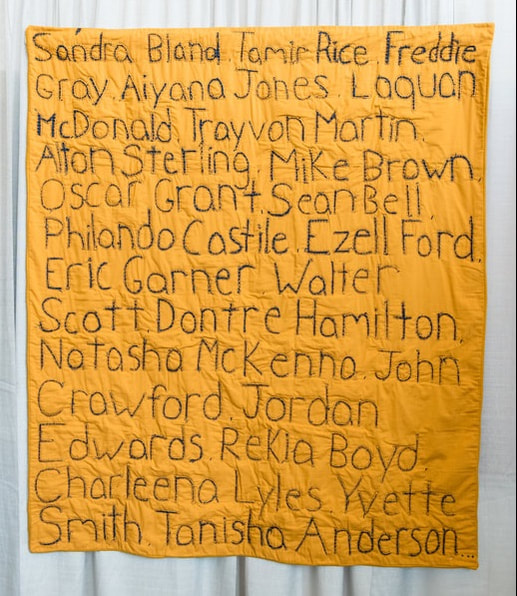
Say Their Names, Sara Trail, 2017.
The SayTheirNames Movement and the MeToo Movement are examples
of performative assembly/collective politics which grew in the soil of cyberspacetime
to spread roots in what I’ll name ‘trans-spacetime’. SayTheirNames was borne
from The Social Justice Sewing Academy, performed in the sewing and
embroidering of a quilt with the names of Black people who have lost their
lives unjustly, often as “invisible victims of police brutality” (artist: Sara
Trail 2017). The idea was inspired by the social media hashtag #sayhername;
likewise, MeToo blossomed from the viral #metoo hashtag which brought a vital
conversation about sexual violence to national attention. In circulations of affective
economies in cyberspacetime, performative assemblies formed which were oriented
towards democratic designs.
In her articulation of this process of orienting our body,
Sara Ahmed comes to define a larger picture of Queer Phenomenology. She tells
us that the queer was always already in the phenomenology; it is a matter of
orienting ourselves towards it. For Fred Moten, the queer in the phenomenology
is the dialect in the dialectic; for Diana Taylor, it is the ‘spect-actor’ in
the spectacle; for Bertolt Brecht, it is the pleasurable and entertaining in
the terrible and never-ending labor which should ensure one’s maintenance. Orienting
towards these things, we create those ‘desire lines’, which Ahmed borrows from
landscape architecture to describe the formation of new norms.
These repeated behaviors, these performances, are found in Hannah Arendt’s theorizing of actions in the ‘space of appearance’ in her book The Human Condition. Judith Butler, in Notes Towards a Performative Theory of Assembly, rethinks ‘action’ as well as the discursive and performative practices shaping subjecthood as spaces of appearance, where assemblies come to materialize both matter and meaning, which are always performative. Butler engages with Arendt’s theory, acknowledging that she shows that “the body or, rather, concerted bodily action—gathering, gesturing, standing still, all of the component parts of ‘assembly’ that are not quickly assimilated to verbal speech—can signify principles of freedom and equality” (48). Both Arendt and Butler use the language of a kind of thermodynamics in describing ‘power’ and ‘popular assemblies’ (respectively), highlighting their understanding of the experimental nature of concerted action as well as their understanding of the role of environment in the process of meaning, mattering, materialization. The environment, the space of appearance, is historicized, and is a coalescence of historicized bodies in concerted, historicized action, predicated on the mobilization of the passions, the orientation towards collective identifications and desires.
The space of appearance is a new spacetime (which is also
cyberspacetime): one that is inherently a trans-spacetime (in the sense of the ‘trans-‘
prefix, meaning ‘across’, ‘beyond’, ‘changing thoroughly’, and also in the
sense of my own personal orientation towards inscribing the trans body with
power). This trans-spacetime is seen in Arendt’s “Irreversibility and the Power
to Forgive” and “Unpredictability and the Power of Promise.” It is also seen in
Balibar’s assertion that all identity is trans-individual, and in Diana Taylor’s
“acts of transfer.” SayTheirNames and MeToo show that the space of appearance
also must acknowledge a cyberspace of appearance with ‘actions’ or ‘performances’
mobilized around cyberobjects. These introjections of cyberobjects by groups is
also performative assembly, orientation of a collective body, mobilization
towards democratic designs. To conclude, I would like to reintroduce ‘duality,’
as my central thesis is that performative assemblies, in our time, are not constituted
separately in the cyberspace of appearance and the space of appearance, but
that these are actually just different measurements of a trans-spacetime, and
are mutually constitutive and deeply entangled: like politics and performance,
like appearance and disappearance, like coalescence and dissipation, like
matter and energy.
Sara Ahmed, “Orientations: Toward a Queer Phenomenology,” in GLQ: a Journal of Lesbian and Gay Studies
Fred Moten, Black and Blur
Diana Taylor, Performance
Diana Taylor, “Acts of Transference” in The Archive and the Repertoire
Etienne Balibar, “Three Concepts of Politics: Emancipation, Transformation, Civility” in Politics and the Other Scene
Jacques Ranciere, The Politics of Aesthetics
Chantal Mouffe, “What Is Agonistic Politics?” and “Agonistic Politics and Artistic Practice” in Agonistics: Thinking the World Politically
Bertolt Brecht, “Short Organum for the Theatre” in Brecht on theatre: The Development of an Aesthetic
Hannah Arendt, “Action” in The Human Condition
Judith Butler, Notes Toward a Performative Theory of Assembly
Look harder and longer. This simultaneity, up to a certain point, is only apparent: a surface, a spectacle. Go deeper, dig beneath the surface, listen attentively instead of simply looking, of reflecting the effects of a mirror. You thus perceive that each plant, each tree, has its rhythm, made up of several: the trees, the flowers, the seeds and fruits, each have their time. […] In place of a collection of fixed things, you will follow each being, each body, as having its own time above the whole. Each one therefore having its place, its rhythm, with its recent past, a foreseeable and a distant future. Henri Lefebvre, Rhythmanalysis, 41
I am interested in
escaping anticipation and control (of individual reactions) of political
strategies, by finding ways of becoming less predictable. “There is an inextricable link between power and rhythm. What power
imposes in the first place is a rhythm (rhythm of everything – life, time,
thought, discourse)”, Roland Barthes wrote. I am suggesting to rather consider the
link between power and meter and to look at how meter emerged as a transversal
concept across the arts, poetics, philosophy, and social science. For me, the meter
subjugates, not rhythm, and I see the notion of polymeters and polyrhythms as a
way to abolish the hegemony of meter that is imposed upon us as constraint and for
becoming more unpredictable through that. It is important to first shortly
explain the three basic modes of temporal organization in music – pulse, meter
and rhythm and I mostly refer here to the important book The rhythmic
structure of music by Cooper. Pulse is one of a series of regularly
recurring, precisely equivalent stimuli. Like the ticks of a metronome or a
watch, pulses mark off equal unites in the temporal continuum. Meter is the
measurement of the number of pulses between regularly recurring accents. Within
meter pulses become beats; accented beats are strong, unaccented beats are
weak. Rhythm is the way in which one or more unaccented beats are grouped in
relation to an accented one. In most compositions, we find a hierarchy of
metric organization and some rhythmic groupings are more difficult to realize
within a given meter. Aspects
of temporal organization which measure are metric. And Foucault writes: “The
mechanisms introduced by biopolitics include forecasts, statistical estimates
and overall measures.”
Crucial is, that pulse is necessary for the existence of meter, bur
rhythm can exist without meter! Rhythm is independent of meter and
theoretically even of pulse, it can happen in any type of metric organization.
Henri Meschonnic proposes to get back to the ancient meaning of rhythm: Rhutmos
(rhéin to flow and –(th)mόs a way, a manner) is the pattern of a
fluid element (a letter, a peplos, a mood), an improvised, changeable form.
Bojana Cvejic wrote a summary of our thoughts and discussions we had in her course at P.A.R.T.S., where I mentioned my ideas for the first time: “When rhythm is wrested from the established notion of measure in music, a perplexing diversity of terms, instruments and practices unfolds, situating it between a manner of flowing (ruthmos) and an order of movement, proportioned figure (metron), in “the gray gap between black beats” (Nabokov).” The consolidation of the bar line and therefore the introduction of the hegemonic meter seems to have become a part of music only during the 17th century. (Simultaneously with the emergence of capitalism especially in Holland and England?) For example, also the blues used to be an open form with the duration needed for the story a musician was about to tell and did not necessarily have the now common 12 bars. Composer Girard Grisey worked on the relationship between change, predictability, order and disorder. “One can also imagine an oscillating rhythm in which the meter itself would fluctuate constantly.” Link to Tempus ex Machina by Girard GriseyGrisey denies the periodic considered as an ideal point of reference, the basis of a hierarchy which is for him linked to “maximum predictability” and order. He refers to Abraham Moles that says “the notion of rhythm is linked to that of expectation (1966)” and I personally think that the fulfillment of the expectation is linked to metric control and metronomic pulse. (notes from a class with Bojana Cvejic). “Sunny Murray and Albert Ayler did not merely break through bar lines, they abolished them altogether.”, John Litweiler. I had to think of Free Jazz and Swing while working on this paper. As written in the chapter 6 Innards of Time of the book “Flow, gesture, and spaces in free jazz : towards a theory of collaboration”: “The swing is one of those subcutaneous rebellions against the tyranny of the bar line.” To swing means to fluctuate between 2 and 3, to be in 2 and 3 at the same time. Breaking down all rhythmic elements into ‘twos and threes’ (8th notes, 16th notes and triplets) has its roots in nearly all folkloric traditions from Gnawa music of North Africa through the Balkan to Colombian Bata. Drummer Milford Graves: “(…) but if you’re counting like a metronome and everything is like Bamp, Bamp, Bamp just like the second hand, that is extremely dangerous. That means your body is not responding. It must respond. You cannot walk across the street in military march, you know on the beat per second on a major highway where traffic is coming. (…) your tempo is going to change. That’s what the body expects. (…)“. I need to explain, that polymetrics, as I am using the term in this paper, allow not only for different simultaneous rhythms but for the possibility of shifting and changing time and restraints. I am not suggesting to get rid of meters as it is important for the possibility of communal organization and collectivity, but of its hegemony. We do not need one meter that keeps a measured amount of beats controlled, but to share a pulse that allows for interdependency through the possible plurality of polyrhythmic shared within polymetric space and time.* To this thought I want to add beautiful quotation of Osip Mandelstam (“Government and Rhythm” 1920): “Solidarity and rhythm are the quantity and quality of social energy. Only the collective can have rhythm. (…) Rhythm demands a synthesis, a synthesis of the spirit and the body, a synthesis of work and play.(…)” I wonder- how do we free ourselves from the prison of meter opposed on us in order to be more easily controlled through the therefore established possibility of expectancy? What would it mean to live in a polymetric society? On a society based on polymetrics and the resulting less predictable poly-dictability? How would it influence the power of dictator’s unpredictable acts upon us? Would it? “The dictator must never be predictable“, Sue Prideaux in Dictators: the great performers. We still are. But we can start forgiving. I want to end this paper with another quotation of the book “Flow, gesture, and spaces in free jazz : towards a theory of collaboration” of page 52. Guerino B.Mazzola and Moreno Andreatta conclude the first part of chapter 6 with the following: “So the new thing about time was that it made the move from facticity to the level of making: time became a thing to be construed from scratch. No more tyrannic clocks, no more eternal lines, no lines at all. We make time, we are the new hands, and the clock, and the gestures, which mold time. Not surprisingly, such expressive making also changed the time’s stature: physics’ anorexic timeline was transmuted into a voluminous body of time as shaped by the powerful hands of working musicians.“
“These intimate and predatory forms of exploitation are introducing calculation through rhythms into new arenas of every day life. The question is therefore how to bridge—analytically and politically—the relationship between newer and older(re)configurations of rhythm, power, and everyday life.” Intersectional rhythmanalysis: Power, rhythm, and everyday life by Emily Reid-Musson.
*I very clearly make a differentiation between polymeters and polyrhythms, which in music is not always the case, and not in this way as I am doing it for this paper.
Conlon Nancarrow born
in the US, lived most of his life in Mexico. He is one of the most important
composers of our time and forerunner of contemporary music, but somehow strangely
unknown. He mostly composed music for player piano. “One
reason for working with the player piano was my interest in temporally
dissonant relationships. Temporal dissonance is as hard to define as tonal
dissonance.”
On December 4th, weeks after the 2016 Presidential election, Edgar Madison Welch entered a Washington D.C. pizzeria armed with an AR-15 rifle and fired multiple times (Fisher et al., 2016). After being detained Welch told officers he “read online the restaurant was harboring child sex slaves and that he wanted to see for himself if they were there” adding that he was armed to help rescue them” (Fisher et al., par. 62, 2016). Beginning with a Wikileaks rumor which claimed to publish the content of Hillary Clinton’s emails, users speculated the words “sauce” and “pizza” were codes used in a sex trafficking and pedophilia ring harbored in the pizzeria basement (Groth, 2019). However bizarre, the rumor went from hashtag, to “pizzagate,” to gunshots after the story gained traction online when former national security advisor, Michael Flynn and international news outlets shared the conspiracy online (Robb, 2017; Groth, 2019). Though “pizzagate” is an extreme example, the scandal functions to provide insights on the intricacies of the political narrative. As political strategist James Carville has noted, “a narrative is the key to everything” (Poletta, p.1, 2008). Therefore, it is crucial to understand how complex political processes can be stripped down to stories.
Political narratives organize the story by providing a clear distinction of who is good or bad and/or who just or corrupt (Maclaughlin & Velez, 2019). Take for example,Trump’s 2016 campaign video of “Two America’s” (Dumenco, 2016). In the advertisement, the narrator asks viewers to envision “Hillary Clinton’s America,” a land where crime is rampant and jobs are dwindling. This is shown parallel to “Donald Trump’s America,” where families are secure and business thrives. By creating this binary, the narrative format functions to reinforce worldviews of those who agree with their message. Polletta (2008) explains though individuals typically process messages with intense scrutiny, there is a tendency to immerse oneself in the story. Be it for entertainment or political purposes, people strive to vicariously live out the emotions and events of the character’s experience (Maclaughlin & Velez, 2019). The narrative works to captivate the audience who are encouraged to view themselves as the central character in the story.
Narratives are powerfully transportive forces. Research explains, this transportation is possible because from a young age people learn to rely on imagination to make sense of their social worlds by gathering information and creating representations of their surroundings (Green & Brook, 2000; Maclaughlin & Velez, 2019). Essentially, because humans learn to imagine in the mind, they can picture themselves taking certain actions or views in reality. Hence, when people confront a political narrative they create a “mental model” to understand that narrative world (Maclaughlin & Velez, p.24, 2019). Take for example a presidential race. In this case, a citizen will create a character representation (the candidate), assess their motivations, and create assumptions for how certain actions (voting for someone) can affect their reality and the larger political realm (Maclaughlin & Velez, p.24, 2019). When individuals engage with mediated political narratives, they (re)construct the model provided by the narrative.
One key to the narrative in the current digital age is its ability to spread online (Maclaughlin & Velez, 2019). Much of the narrative’s force is in how it can get someone who agrees with it to act, or in the online case, how it can get someone to “share”. The more a story is disseminated, the more people try to make sense of it in computer mediated and face-to-face communication. Further, the more frequent a message is seen, the more likely someone is to believe the information is true (Pennycook & Rand, 2019). Simply put, people aren’t likely to believe a false narrative because they are particularly gullible, rather it is how often they are inundated with a message and how open minded they are to receiving it. As Groth (2019) highlights, this is especially problematic as “in its most radical form the motivation to act can take the shape of a shooter intruding into the alleged sex traficking headquarters in the basement of the pizzeria with an assault rifle, seeking to directly fight the conspiracy” (p.2).
Liberal and conservative voters are both vulnerable to a good story (Pennycook & Rand, 2019; Harper & Baguley, 2019). Generally, people are more likely to believe narratives they are familiar with (Harper & Baguley, 2019; Polletta, 2008). When individuals are transported into a story they don’t concern themselves with critically evaluating beliefs rather, they are focused on the transportive experience; Instead they ask, “Can I picture myself in this narrative?” (Maclaughlin & Velez, 2019; Polletta, 2008). Liberals and conservatives approach political narratives similarly. Harper and Baguley (2019) find people on both sides of the traditional right-left divide are equally likely to believe political stories that are in line with their current ideologies, and cast aside narratives that are inconsistent with their views. In either case, narcissism plays a pivotal role in whether or not someone will initially choose to believe and be transported into the narratives presented; there is a stronghold on political beliefs (Harper & Baguley, 2019). When someone can envision themselves in a narrative the more successful the story becomes as a strategy for engaging in politics.
As audience members feel like they are directly experiencing an unfolding story that speaks to their ideology, they are prone to welcome and internalize the views of reality offered by the narrative. Rather than engaging in a critical evaluation of information, transported individuals tend to readily adopt the depicted attitudes and experiences as their own (Maclaughlin & Velez, 2019). That is, immersed partisans internalize the story line, characters, and causal relationships as an accurate reflection of their own reality. As the American Presidential race is underway, it is crucial that we (re)examine the stories deeply embedded in US politics. Groth (2019) points out, “great writers don’t write simple stories. They write stories that tap into our expectations and defy them.” (p. 30). This election season, political writers continue to construct narrative models in an attempt to reel in potential voters. While storytelling remains at the helm American politics it is crucial to ask, what would happen if the fights seen in the political arena were based on real action instead of character narratives? What would happen if we refuse to tell stories at all?
Dumenco, S. (2016, August). New Trump TV ad: ‘In Hillary Clinton’s America, hundreds of thousands of jobs disappear. Advertising Age. Retrieved from http://adage.com/article/campaign-trail/trump-tv-ad-clinton-samerica-jobs-disappear/305640/
Fisher, M., Woodrow Cox, J., Hermann, P. (2016). From rumor, to hashtag, to gunfire in DC, Washington Post. Retrieved from https://www.washingtonpost.com/local/pizzagate-from-rumor-to-hashtag-to-gunfire-in-dc/2016/12/06/4c7def50-bbd4-11e6-94ac-3d324840106c_story.html
Green, M. C., Brock, T. C. (2000). The role of transportation in the persuasiveness of public narratives. Journal of Personality and Social Psychology, 79, 701–721. doi:10.1037/0022-3514.79.5.701
Groth, S. (2019). Political Narratives/Narrations of the Political, Narrative Culture. (6)1, 1-18, doi: 128.122.149.96
Harper, C., Baguley, T. (2019). You are fake news: Ideological (A)symmetries in Perceptions of Media Legitimacy. Doi: https://doi.org/10.31234/osf.io/ym6t5
Maclaughlin B., Velez, J.A. (2019) Imagined politics: How different media platforms transport citizens into political narratives. Social Science Computer Review, (37)1, 22-37. Doi: 10.1177/0894439317746327
Pennycook, G., Rand., D. (2019). Who falls for fake news? The roles of bullshit receptivity, overclaiming, familiarity, and analytic thinking. Journal of Personality. 1-64. Doi: 10.1111/jopy12476
Robb, A. (2017). Anatomy of a fake news scandal, Rolling Stone. Retrieved from https://www.rollingstone.com/politics/politics-news/anatomy-of-a-fake-news-scandal-125877/
The backs curve, the knees bend, and the footwork shuffles to the swaying melody of the accordion. The hands twist into sharp and angular signs representing la cruz de sus parroquias: M for Monterrey, I for Colonia Independencia, V for Villanitas. In el baile de gavilán, whether your hands show affiliation to the city, a neighborhood, or a gang, you will be moving to the right, pasito a pasito, following the footsteps of other Colombias, while others follow you. One after the other we shuffle to the right, led by the chik-chika-chik-chika-chik of the guacharaca, creating a large circle of bodies in motion. The dance floor is now an ocean, and at the center, like a school of fish, bodies are gracefully tossing, turning, and shuffling in unison riding the slow tumbado of the cumbia rebajada. If for Hannah Arendt the political realm where power and the space of appearance come into being, rises directly out of the “sharing of words and deeds” for the Colombia’s it rises out of communing in motion, out of the collective pride de ser colombia.
I. In the 1950’s Colombian cumbia and vallenato music landed in Monterrey, Nuevo León via Mexico City. Due to Monterrey’s geographic position which marks it as a crucial migratory point, mas pa’ allá que pa’ acá, the afro-caribbean rhythm found a home on its way to Houston, Texas, and other U.S. border cities. Rapidly, Sonidero’s popularized hits such as La Cumbia Sampuesana and La Pollera Colorá. The popularity of colombian cumbia and vallenato music led to the formation of a subculture that prevailed for decades and eventually became an essential part of the cultural makeup of the Northeastern of Mexico.
Socio-economic inequality is particularly palpable in the industrial city of Monterrey given that it houses Mexico’s largest multinational companies, as well as the richest neighborhood in Latin America: the luxurious and conservative San Pedro Garza. This stark disparity, combined with the city’s proximity to the United States, its violent history as a Drug War epicenter, and its position as a migration point, has made of Monterrey a place rife with racial and economic disparity, discrimination, and segregation. Given that the Colombia movement is mostly integrated by impoverished and working class people who live in precarious conditions within Monterrey, classist and racist policies and social norms have attacked Colombia culture since its inception. In these conditions of marginalization, Colombia culture has created a social practices and actions that battle isolation: “Action, as distinguished from fabrication, is never possible in isolation; to be isolated is to be deprived of the capacity to act (Arendt, 188).” Thus, the ser Colombia, translated to“being Colombia” became not only a crucial cultural identity formation, but an important source of power for working class regiomontanos.
In the early 2000’s Colombia culture went through a crucial aesthetic transformation. Young Colombia’s created a new form of sartorial expression which mixed Cholo aesthetics, DIY garments, religious accessories, gel-heavy hairstyles, and the Regio-Colombia musical tradition. This aesthetic expression was quickly rejected by the dominant Regio culture, which criminalized and thus further marginalized Colombia youth. Colombias aesthetic and cultural actions have solidified an important cultural political practice within the city of Monterrey. By the late 2010’s, the aesthetic phenomenon within Colombia’s, known by foreign entities as Cholombianos, had been “eradicated” thanks to the lethal combination of criminalization, marginalization, and violence.
Although it is rare to find the youth of Colonia independencia flaunting the looks that brought them together in the early 2000’s, Colombia culture is still thriving. Thus, I wonder, what is the political significance of popular cultural practices? In this particular case, how can we understand the political power within manifestations such as the Colombia’s in Monterrey? What does it mean to gather in motion and in music in a city which is constantly seeking your eradication? Or to echoe Judith Butler, “What does it mean to act together when the conditions for acting together are devastated or falling away? (Butler, 23).”
According to Etienne Balibar political action must be understood in terms of strategies (Balibar, 16). Thus, I’d like to break down two of the main strategies which conform the political spectacle which makes the Colombia’s phenomenon possible. For the purpose of this short essay I will briefly focus on the aesthetic and the choreographic, which can be understood in terms of freedom of expression and freedom of assembly respectively.
“If we consider why freedom of assembly is separate from freedom of expression, it is precisely because the power that people have to gather together is itself an important political prerogative, quite distinct from the right to say whatever they have to say once people have gathered. The gathering signifies in excess of what is said, and that mode of signification is a concerted bodily enactment, a plural form of performativity. (Butler, 8).”
To powerfully assert one’s identity by claiming prideful ownership of aesthetic preferences which have been classified as “tacky”, “poor”, “vulgar” is to appropriate the assertion and delineation of one’s difference. The understanding of identity I posit here aligns with Etienne Balibar’s understanding of identity as a transindividual formation, meaning its construction depends on both the individual and the collective (Balibar, 27). These practices, which are always profoundly bound to practices of resistance and politics of excess, tend to be originated within communities which have historically created culture that is first rejected and then appropriated by hegemonic cultural producers. The aesthetic choices of the Colombia’s, which I understand mainly as their sartorial practice, have facilitated the creation of an alternative polis. “The polis, properly speaking, is not the city-state in its physical location; it is the organization of the people as it arises out of acting and speaking together, and its true space lies between people living together for this purpose, no matter where they happen to be (Arendt, 198).” This process of identification and recognition must be understood as a fundamental political practice of marginalized communities which use their self-fashioning as a form of claiming visibility and occupying public space which is often denied from them.
Lastly, and more importantly we must focus on the choreographic assembly of the Colombias. Because as Judith Butler notes, “forms of assembly already signify prior to, and apart from, any particular demands they make. (Butler, 8).” The assembly of marginalized youth which identifies with Colombia culture has a noteworthy choreographic strategy which consists in forming a large circle when they’re dancing. Unlike other forms of popular dance, where the circle is formed in order to provide space for a moving body which will occupy the center, this circle does not prioritize the space at the center. The purpose of the circle is not the centering of an individual but the circumference itself. This choreographic action embodies a collective political practice. It is a choreographic structure which allows everybody to claim individual identification, which is expressed via hand signs and shout-outs, while remaining within a collective structure. This choreographic practice reminds us that: “No one body establishes the space of appearance, but this action, this performative exercise, happens only “between” bodies, in a space that constitutes the gap between my own body and another’s. In this way, my body does not act alone when it acts politically. Indeed, the action emerges from the “between,” a spatial figure for a relation that both binds and differentiates (Butler, 76).”
It is important to conclude with a reminder that the Colombia practice of the early 2000’s which I speak off was quickly eradicated by the lethal combination of local criminalization and the violence of the Drug War that profoundly attacked the social fabric of Monterrey. Today, the Colombia’s have found new forms of expression. Like many cultural practices, its survival has depended on its ability to transform. I end on this note to remind the reader that historically cultural and aesthetic practices which have been targeted in this way present a danger to the state of domination of the status quo. Therefore, it is a civil duty to protect and respect practices like the Colombia’s, as in doing so we will be protecting political practices which are essential to the social fabric. We will be protecting those bodies that “dance on the line.” We will be protecting the Colombia assembly which enacts “by the embodied form of the gathering, a claim to the political (18).”
Key Words 1. Assembly 2. Precarity 3. Choreography
La naturalización de comportamientos sociales que
perpetúan las desigualdades basadas en las diferencias sexuales y de género, impregna
todos los escenarios de la vida pública y privada estableciendo regulaciones difícilmente
visibles y cuestionables. Las desigualdades se traducen en relaciones de poder
que se reproducen no sólo en el escenario político por excelencia sino en los
campos artísticos, culturales, sociales, familiares, desde dónde a su vez se perpetúan
narrativas unidireccionales que dan por inamovibles los roles que ocupamos en
la sociedad y, por tanto, mantienen el poder político, cultural, social en unos
sujetos específicos (generalmente hombres cis, heterosexuales, blancos o blanco-mestizos
y pertenecientes a las élites económicas y culturales). En este contexto, me interesa aproximarme a manifestaciones
artístico/políticas que irrumpen o intervienen eventos promovidos desde la
industria cultural, en los que se evidencian y promueven estas relaciones desiguales
de poder basadas en las diferencias sexuales y de género, promoviendo cambios
culturales que se manifiesten en decisiones de la industria cultural y la
adopción de políticas públicas encaminadas a transformar las relaciones de
poder en el sector cultural, esto es, al final, en maneras de erosionar la
incuestionabilidad del poder masculino.
El performance, en tanto es práctica, corporalidad,
hacer creativo, forma de transmitir memoria e identidad, así como de entender
el mundo (Taylor, 39), ha sido utilizado como herramienta para hacer evidentes
las desigualdades de sexo y género, y para deslegitimar en el campo cultural el
poder masculino como validador de las expresiones artísticas que surgen desde las
disidencias sexuales y de género. A la vez, pensar el performance como un encuadre
nos permite aproximarnos a los acontecimientos, particularmente en este caso, a
los realizados en el marco de la industria cultural, como puestas en escena en las
que cada cual desde identidades – ya sean asignadas socialmente o adoptadas-
actúa roles específicos. Un ejemplo del
tipo de performance e intervenciones que me interesa analizar es el siguiente https://www.youtube.com/watch?v=U-IrWZeAHO0
Fecha: 19 de septiembre de 2019
Lugar: Feria del libro de Barranquilla, Colombia.
Situación: En un evento anunciado con el nombre
“Marvel Moreno, un legado”, dos hombres cómodamente instalados en un escenario
conversan. El hombre de la izquierda es escritor
y periodista, el de la derecha es escritor y además es el exesposo de Marvel
Moreno. La conversación, de acuerdo con los videos que pueden verse en internet
transcurre de la siguiente manera:
– (…) tuve ocasión de conversar con ella, no puedo decir
que conocí a Marvel, pero todas las personas que la conocieron sostienen que
tenía muy claro lo que quería hacer y que cuando tomaba una decisión no la
detenía absolutamente nadie- dice Mauricio Vargas.
-Exactamente, exactamente. Y a los cinco meses, no,
menos, nos casamos- Responde Plinio Apuleyo Mendoza
La conversación continúa
entre anécdotas sobre amigos escritores mientras doce mujeres en silencio
caminan y forman una fila entre los dos hombres y el público, se paran de
frente a este, se toman de las manos, se sueltan, se abren las chaquetas para
dejar a la vista sus camisetas estampadas con la palabra “ES”. Para este punto
con un cambio elocuente en la entonación y el ritmo del discurso Apuleyo
Mendoza dice
-Ahora hablemos de su obra, en qué sentido. Realmente
yo pensaba en ese momento que el afán de escribir era simplemente contar un
poco de su vida, su experiencia personal, esas cuestiones…
Las mujeres se han quitado
sus chaquetas, han dado media vueltas y en sus espaldas se lee “El tiempo de
las amazonas”, referencia directa a la novela que Marvel Moreno escribió antes
de morir y que permanece inédita.
–Leí unos textos muy interesantes en un libro que
publicaron en Toulouse sobre ella- dice Apuleyo Mendoza
Las mujeres caminan y
nuevamente queda el espacio vacío entre los dos hombres y el público. Se escuchan
urras y aplausos. Pasan de mano en mano copias con el primer capítulo de El
tiempo de las amazonas y un manifiesto que complementa el sentido de la
intervención.
Nos podemos aproximar a esta situación desde aquello
que nos permite ver, experimentar, teorizar y desde su compleja relación con el
sistema de poder (Taylor, 6). Podemos,
por ejemplo, pensar en la intervención del colectivo El tiempo de las mariposas
como la creación de un tercer espacio o la emergencia de un espacio liminal. Uno
de las ideas que discutimos en clase se relacionaba con la instalación de un “nosotros”
que implica necesariamente un “ellos”; lo vimos en Balibar como uno de los
problemas del modelo emancipatorio (7) y lo vimos en Mouffe quien al comprender
toda identidad como relacional, concluía la existencia de la diferencia: el otro
y su exterior constitutivo. (24). Esta ubicación en el espacio de lo público
que podría entenderse en términos generales como una confrontación, es
desarticulada en el performance que traigo como ejemplo, en la medida en que
desarticula la distribución espacial y los roles inherentes esa distribución. Las
mujeres se sitúan en un espacio liminal entre el público y el escenario. Es
decir, se niegan a ser público pasivo en la medida en que entienden el rol de
espectadoras, en este contexto, como una aceptación de la autoridad masculina que
no consideran legítima.
“La acción
conjunta puede ser una forma de poner en cuestión a través del cuerpo aspectos
imperfectos y poderosos de la política actual. (17). “Cuando los cuerpos se
congregan en la calle, en una plaza o en otros espacios públicos (virtuales
incluidos) están ejercitando un derecho plural y performativo a la aparición,
un derecho que afirma e instala el cuerpo en medio del campo político, y que,
amparándose en su función expresiva y significante, reclaman para el cuerpo
condiciones económicas, sociales y políticas que hagan la vida más digna… (18).
Pienso en estas dos citas de Butler en relación con la ubicación de las mujeres
del colectivo El tiempo de las amazonas en este espacio liminal entre el
público y el escenario. Al no irrumpir en el escenario, deciden no “tomarse el
espacio del otro”, optan por evidenciar –con la disposición de sus cuerpos y el
texto de sus camisetas–, como en ese escenario está operando un reparto histórico
de roles que debe ser puesto en duda, transformado. Este acto es más potente en tanto, no es en el
escenario (en el que se conversa de anécdotas, como se dijo) sino en sus camisetas,
en donde aparece la referencia a la obra de la escritora Marvel Moreno.
Es esta
capacidad de evidenciar las desigualdades basadas en el sexo y el género,
mediante, en palabras de Butler, el ejercicio del derecho de aparición, y sus
efectos en la industria cultural y las políticas públicas culturales uno de los
temas en los que me interesaría profundizar en el proyecto final.
Keywords:
Identidad; disidencias sexuales y de género; políticas públicas; aparición
Fashion Week has an interesting history with political spectacle as some shows send garments down the runway conscious of their cultural critique, while other shows are infiltrated by spect-actors in protest. Just this season, model Ayesha Tan Jones, staged a protest against Gucci’s straight-jacket inspired collection as they walked down the catwalk, hands held eye-level, with “mental health is not fashion” scrawled on their outward-facing palms in pen. The same London Fashion Week was commemorated by a staged die-in by climate campaign group Extinction Rebellion outside its venue, thrashing about in buckets of fake blood to symbolize the fashion industry’s role in the deterioration of life on earth as well as its negligent accountability towards a more sustainable model. And elsewhere, during Paris Fashion Week, comedian and performance artist Marie S’Infiltre crashed Chanel’s latest show in a vintage Chanel outfit (her grandmother’s), as a means to not only enliven the infamously serious affair, but also partake in a spectacle that promises glory, basking in the eternity of the Chanel brand. These examples act as critiques of an industry whose preservation depends on the constant reiteration and belief in itself.
All of the mentioned spect-actors take on the role of party crasher, breaching an assembly by satirizing the imaginary borders installed around the spectacle. However, my interest is in Rihanna’s Savage x Fenty Show, a political spectacle in its own right that did not seek to exclude, but instead invited all of us to crash the esteemed party of Fashion Week.
If fashion shows hope to inspire possibilities in its spect-actors, then one that strives for inclusivity should facilitate an entrance point of empathy everyone can align themselves with. Rather than encouraging a prohibited breach of spectacle, it encourages self-actualization through socialization; it is equity in action, spilling off the catwalk and into the capacities of the individual.
Art executed through performance is innately political for it displays the potential for radical transformation. Boal contends that if art is to be sovereign, then it should deal with all humans, their actions (or inactions), as well as what is done to them. Performance spectacle accomplishes this through a catharsis of the senses that depicts a correction of humanity; in a purposeful alteration, a new way of orienting the body is enacted and there is potential for the viewer to find emancipation.
Performatic theatre is often called an artistic form of coercion. The spectacle of Fashion Week is a great example of placing commodities on display in artistic sequence. This is essential if we are to agree with Brecht that theatre in the scientific age should strive for the joys of liberation; liberation from the confines of history; liberation from present conformities of daily life; liberation from precarious potentials of the future. Thus, theatre begs its actors to move in the style of a man who wonders as opposed to the man who knows the truth. Judging performance through issues of true/false or those of being/pretend becomes futile; what gives these mediated acts their effectiveness is in their affectations, or even more precisely, the inspiring potential in the emotional weight of their movements.
That being said, Brecht would not want us to ignore the contradictions of our given world when tempting this intersection. This season’s Savage x Fenty is cognizant of Brecht’s appeal, so, unlike the initial acts of protest described here, this political spectacle strives to deconstruct the fashion show format rather than puncture its beloved iterations. In this way, it establishes a new world of expression that is not totally dismissive of the power structures it critiques, but instead works within its bounds of artifice, simultaneously challenging its norms and expectations.
The show introduces new performatic possibilities for a fashion show by highlighting the brand’s inclusive ambitions and blowing them up in a colorful display of lingerie, sleepwear, dance, and song. Interestingly, the audacity of this political spectacle makes each choreographed song or dance number seem more like performance of protest, seamlessly oriented around a multiplicity of body types and gender identities marching before a fashion world that does not typically champion their body or existence. Thus, Fenty x Savage reasons with the idea of fashion as a protection from human nature’s more restrictive tendencies in an attempt to promote modern nature (and all its inconsistencies) at its most cathartic.
If we consider Arendt, political action can only take place on the condition that the human body makes an appearance. In being witnessed, various perspectives concerning the body depend on such displacement in order to establish coherence. Butler contends that this is how political action persists- the space in between actors. The emancipation we feel does not emit from the individual, but the relation among individuals. Thus, political revolution by way of spectacle cannot be commenced by a single instance, but by the radical solidarity of the “us.” Both Arendt and Butler concur that human dignity is championed by social relations that strive towards acceptance in the name of equality.
Butler adds that, “The claim of equality…is made precisely when bodies appear together, or, rather, when, through their action, they bring the space of appearance into being. This space is a feature and effect of action, and it works, according to Arendt, only when relations of equality are maintained” (Butler, Notes Toward a Performative Theory of Assembly, p. 88-89). The life that emits from a body, although it may not be as readily apparent as a garment, must still seek out means of perseverance, especially when it is at odds with a domineering hegemony. Such queered conditions of perseverance inevitably depend on sociality, and in turn, ask for radical reorganization of established mores in order to carve out space to thrive. In light of this, I ask: If fashion has become a means of simultaneous protection and expression, notably for minoritarian subjects who are disenfranchised by the industries’ historicized limitations, then it is in turn a political sphere where we should not only make room for such bodies to exist, but also make this a paramount objective, in the name of equality for all.
By opening up the fashion discourse to include traditionally excluded bodies in a realm that champions political post-structuralism, Rihanna’s Savage x Fenty Show aims to provide a forgotten (or disposable) population within the confines of fashion a right to be seen. This generosity of the human spirit is exemplified by the opening moments of the show, where the pop star and mogul takes center stage on a platform surrounded by other dancers; she is not alone, even though her larger than life persona almost calls for her alienation. Instead, she concedes to the role of conductor, facilitating an assembly that is not all about her, but in fact all about us.
In the performance entitled after the homonymous work of Brazilian fiction writer Conceição Evaristo (in: Olhos D’água, 2014) and intentionally misspelled as “A gente combinamos de não morrer” (“We agreed not to die”), transgender Brazilian artist Jota Mombaça (Monstra Errática) carefully manufactures handmade knives with precarious materials such as branches, shards of glass and red string. With the performance’s title, also inscribed on the artist’s forearm, Mombaça proposes a form of “pact of surviving”, articulating through afro-diasporic lenses issues of violence and resilience among non-normative and non-white bodies. The performance ends with the artist surrounded by a variety of newly crafted objects that resemble, at the same time, both weapons and tools (see Fig. 1). Mombaça wields each one of them and points to the spectators, staring firmly and forward, ready for the attack to come, but also, and strategically, in position to counter-attack (see Fig. 2). Vulnerability here becomes a twofold position: a set of knowledge gained through shared experiences and a form of power that guides a practice of survival.
Figure 1: Branches, shards of glass and red string give shape to a precarious form of weapon-tool. Jota Mombaça (Monstra Errática). “A gente combinamos de não morrer”. Performed at Goethe Institute in Salvador, Bahia, 2018. Source: Taylla de Paula.Figure 2: Jota Mombaça (Monstra Errática). “A gente combinamos de não morrer”. Performed at Goethe Institute in Salvador, Bahia, 2018. Source: Taylla de Paula
“A gente combinamos de não
morrer” intersects matters of race and sexuality in a combined manner in order
to create a network (“A gente” / “us”) brought together by the precariousness
of life and the possible responses it may invoke in the context of political
cultures in post-colonial worlds; where norms, social and political
organizations have developed in contexts of power that maximize precariousness
for some and minimize it for others. In the post-colonial world, the one that
Mombaça claims not to exist[i], “death has become the
most profitable business in existence”[ii], and “life” can only be
ethically articulated in the plural tense. Through an alliance, Mombaça’s pact
of survival establishes a nonidentitarian and transnational lineage, where the
historic memory of the minoritarian becomings surfaces as strategies of
resistance and social transformation in the context of a “death-world”[iii].
Similarly, the political
practices that take shape inside contemporary feminist movements in Latin America,
such as the “Ni una menos” and “Vivas Nos Queremos”
movements, confront the necropolitics that systematically murders trans
and cis women, and that excludes them from the
opportunities of life. These movements mobilize alliances through the
performative exercise of rights, demanding “the right to have rights”[iv],
to follow Hanna Arendt’s axiom. And even though there performativity surfaces
in a linguistic manner – “Ni una menos”, “Vivas Nos Queremos” –, it gains
visibility, hence political intelligibility, through corporal movements, acts
of resistance and the creation of improvised and ephemeral assemblies.
I’m especially interested in how these feminist alliances are taking shape within the expansion of what Sayak Valencia calls the “necro-liberalism”, in a moment when far-right politicians are surging to power around Latin America based on platforms of ethno-economic nationalism, Christianity, and patriarchal family values. More specifically, in the case of Brazil, this call for alliance takes place in face of the recent elect government of Jair Bolsonaro. Bolsonaro’s rhetoric is not strange to what Valencia identifies as the “hetero-necro-patriarchy”[v] and its reliance on the neocolonial governance, “where death is a kind of civilizing technology that persists until today and connects the current context with colonial intermittency”[vi]. Through the suppression of certain people produced as disposable or unwanted, the neocolonial governance also radically denies their “right to appear” (Butler 2015). Violence and death become common elements, where necropolitics create the state of emergency in which trans women, cisgender women, and other minoritarian becomings have to survive.
In order to counterpose the neocolonial governance of contemporary far-right governments, Valencia proses the incorporation of transgender discourse into feminism as an epistemological tool, generating strategies of common resistance between cis and trans women that refuse altogether the biological model of womanhood, while also potentially creating bridges in communities highly exposed to social and state necropolitics, “in spaces where vulnerability and damage to the bodies of women and nonbinary people and injustice are the norm”[vii].
This perspective calls into question the idea of demanding rights as separate and exclusive claims to separate identitarian groups, divorced from the violent web of relationships that concede or cease these rights in the first place. As Butler explains: “Even as located beings, we are always elsewhere, constituted in a sociality that exceeds us. This establishes our exposure and our precarity, the ways in which we depend on political and social institutions to persist”[viii]. However, transfeminist alliances like the one proposed by Mombaça’s performance are not necessarily directed towards “political and social institutions” represented by the power of the State. Rather, it’s a gesture that, from the start, recognizes the State apparatus’s participation in the differential allocation of vulnerability, and therefore, it is not an ally. The objective of Mombaça’s pact is first and foremost to enhance the potentiality of survival for those who are considered unintelligible[ix], for those whose vulnerabilities are maximized by the action or absence of the State. Ultimately, it is a critical form of alliance, one that proposes a participatory and interchangeable practice of resistance in the present and not the claim of a right.
Keywords for the final project: Alliance; Transfeminism; Space of Appearance; Resistance
Political Spectacle: In 2019, traditional samba school Mangueira won the Rio Sambadrome competition parade with a show that paid tribute to Rio councilwoman Marielle Franco, who was assassinated the year before. The lyrics talked about the unsung Brazilian heroes, many of them indigenous, black or females, such as Franco. The parade’s last image is of a Brazilian flag in the samba school’s official colors (green and pink). Instead of the traditional national motto “Ordem e Progresso” (“Order and Progress”) , the flag had a curved band inscribed with the phrase “Indians, blacks, and poors” —> https://youtu.be/scKZBmi3-F0?t=3071
[i] In another performance entitled “The Colonial Wound Still Hurts” (Venice, 2015), Mombaça writes on top of a map with the artist’s own blood: “The colonial wound still hurts. The post-colonial world doesn’t exist”. Not only the phrase is inscribed with the red liquid, but also the national borders of territories such as the US, Europe, Russia, Israel, Brazil, India, China and South Africa are highlighted with blood. As it asserts itself as a bodily fluid with the potentiality for tainting everything it touches as it spreads around the geographically constructed body of the world, blurring and redefining its borders, Mombaça’s bloody inscription emphasizes the correlations between territorial conquest and violation (both corporal and geographically), challenging the euro-centered cartographic representation of the world through its modes of visibility. Mombaça’s intervention operates in order to redefine this visibility, for there can be no postcolonial world while the colonial bodies still bleed.
[ix] See Butler, Judith. “Política de gênero e direito de aparecer”. In:
Corpos em aliança e a política das ruas: notas para uma teoria performativa
de Assembleia. Translated by Fernanda Siqueira Miguens. Rio de Janeiro:
Civilização Brasileira, 2018, p. 57.
“In my grandparents’ time, in my mom’s time, Spanish was looked down upon. You were punished in school if you spoke Spanish. You were not allowed to speak it. People, I think, internalized this oppression about it, and basically wanted their kids to first be able to speak English. And I think that in my family, like a lot of other families, that the residue of that, the impact of that is that there are many folks whose Spanish is not that great.” – Julián Castro
Performance, once people get in the door (or in the space), can be a tool for mass communication and education, however, I think of political spectacle as one that performs to distract, instead of performing to inform. For a political spectacle that engages the spectator, there must be a sense, or an “appearance,” of truth and narrative.
The words I am left with that create political spectacle are: narrative, truth, transformation, participation, and struggle.
Texas, as an aesthetic, is nothing but a spectacle. The hair is bigger, the plates are bigger, the hats are bigger, the mouths are bigger, the arenas are bigger – and the politics are no different. The large and lavish American Airlines Center recently held a political rally for Donald Trump, and it was definitively, “marked by enthusiasm,” according to Fox News.
This political (and Fascist) campaign, in particular, is fueled by an antagonistic (or agonistic), us versus them concept, and the tension inherent in this binary is echoed throughout many of our readings as constituting the “stuff” of politics. For instance, Chantal Mouffe takes the idea of a binary, of an “us/them” dichotomy in politics and moves it toward a productive view of the conflict. “My claim is that it is impossible to understand democratic politics without acknowledging ‘passions’ as the driving force in the political field” (Mouffe 6). Her view is that politics should provide the “arena” for a productive and passionate conflict, which in itself constitutes politics. In this model, it seems that the people become the subject(s) on which politics operate; politics and the political spectacle specifically operates and impose itself on the people.
However, if we are to look at politics within the performative framework, and move toward viewing performance as an ontology, the political subject, the spectator (spect-actor), is demanded to take more of a responsibility in their participation. One is not simply mean to sit back and enjoy (or not), be entertained (or not), and quietly pass the time during a performance. If theatre scholars such as Augusto Boal and Berlot Brecht are encouraging their audiences to be a more active participant in the theatre, this translates to those “subjects” in the political arena to take a similarly active role in their participation, or to take active responsibility for their complacency.
The subject – the subjected, the object, the subjugated – presupposed as either an us or a them, is usually placed somewhere on the dichotomous hierarchy of agency within the political arena. The minoritarian subject in particular is free to actively disidentify with their placement on this hierarchy, as we will discuss later with minoritarian political figures in the spotlight. Looking at the American Airlines Center specifically, that space makes itself accessible only to a small portion of the population. Not everyone has the “right” to appear in this space.
Texas is known for its vast and diverse geography (or, perhaps, not known), and population. The “space of appearance,” as discussed in Judith Butler’s Notes on a Performative Theory of Assembly, is no different. Butler asks: “Which humans are eligible for recognition within the sphere of appearance, and which are not? What racist norms, for instance, operate to distinguish among those who can be recognized as human and those who cannot? – questions made all the more relevant when historically entrenched forms of racism rely on bestial constructions of blackness” (Butler 36). The sphere of appearance performed at the American Airlines Center on Thursday, October 17th is, perhaps, a direct contrast to the sphere performed at many of the Democratic National Debates held thus far this election season – primarily due to the choices of two Texas senators.
Beto O’Rourke and Julián Castro (though I could also include Cory Booker and Pete Butteigeige in this discussion, I am choosing not to), two politicians from Texas on the campaign trail toward the presidency, have both diversified the sphere of appearance through their use of code-switching from English to Spanish during debates.
I have approached code-switching in my previous work as a dramaturgical and literary exercise; it happens in the moment of choque, or when one is not quite able to grasp what comes next in the source language. That tension produces the code-switch. It also appears in, though is not exclusive to social situations, when expressing and negotiating power dynamics, sexual dynamics, and workplace politics. Though it is not exclusive to switching between linguistic codes, I am focusing on this instance of linguistic code-switching.
The code-switching performed by O’Rourke and Castro actively invites non-English speakers (yet active voters) into the typically Western hegemonic political sphere of “whiteness.” Though this is not the lavish spectacle of the American Airlines Center, it is still is a form of political spectacle. This active code-switching inherently implies a narrative, there is a “truth” expressed in it, and there is an element of transformation. I believe this is more of a long game, as the spectacle itself continues after the code-switching has taken place. As translation is an inherently political act, this code-switching is also politically driven and begins to negotiate the politics of “appearance” within the code-switching subject in the afterlife of the debate.
We see this afterlife negotiated in the perception of O’Rourke and Castro, respectively. One article from USA today reads:
“Some social media users criticized the candidates for attempting to appeal to Latino voters by speaking in Spanish — or “Hispandering,” a term used to describe a politician trying to pander to the Hispanic community. Others, such as those who watched the debate on the Spanish-language broadcast network Telemundo, appreciated that the candidates were trying to connect with them on that level.” O’Rourke, defined in many articles as a fluent Spanish speaker, is overall praised for his code-switching, especially in the face of his whiteness.
Julián Castro however has faced harsh criticism for not being “fluent” in Spanish. The term “monoglot” is referenced almost as a derogatory term when referring to Castro. The critique of Castro’s monolingualism, especially when placed next to the reaction of O’Rourke, is rooted in the problematic pressure placed on the minoritarian subject to be “true” and “authentic”; it emphasizes the Jose Muñoz’s burden of liveness for the minoritarian subject in the political field. Castro is still demanded to perform as a “Latino,” though the linguistic code of Spanish is only one small part of that multi-faceted identity. An example of arguments supporting Castro’s monolingualism, positing it as inherently American, appears in a Washington Post article online, reading: “Because, while bilingualism is for many Latinos a treasured aspect of maintaining community in the United States, Castro’s monoglot experience is just as authentic — and even more uniquely American….Castro revealed more about his family’s history with Spanish. “In my grandparents’ time, in my mom’s time, Spanish was looked down upon,” he said. “You were punished in school if you spoke Spanish. You were not allowed to speak it.” He said many Latinos have “internalized this oppression” and desired their children to only speak English.”
For the final project, I am interested in excavating this phenomenon of code-switching in the political arena, yet expanding the sphere of observation to a larger understanding of code-switching which is not limited to linguistic codes. I see one of the core elements of political spectacle as living in the narrative of the political performance, of the appearance of “truth,” which makes the spectator “believe.” I am curious about code-switching in the way that it can (or not) mobilize bodies, create affect, and where it is placed within the political spectrum.
As a last note, (and though it lands us in New Mexico instead of Texas) the ad for “Valeria Plame for Congress” is a strong example of narrative, truth, transformation, participation and struggle. (For me, it also has a Texan aesthetic.) I would argue employs a type of rhetorical and visual code-switching throughout in an effort to engage the spectator. It is also quite entertaining.
The
construction of queer memory and identity in Peru goes in hand with the claim
of neglected rights; “…if one is to claim that sexuality as a right over and
against a set of laws or codes that consider it criminal or dishonorable, then
the claim itself is performative. This is one way of naming that exercise of
the right precisely when there is no local law to protect that exercise.”
(Butler, 57) With these words Butler explains how one has the right to occupy a
space and reclaim the right to exercise one’s sexuality, even if this one is
codified as non-normative and as a consequence punished. In this way, the right
is then prior to our forms of relating and being intimate with one another;
gender and sexuality here are not the only performative instances –as Butler
explained in previous works- but also the right to claim the freedom to engage
in the sexualities we prefer that becomes then political.
An
important aspect of my research and interest in the final project is linked to
the ideas we have reviewed during class, specifically thinking about the
possibilities to collect queer memory and to reclaim one’s rights through
performance and theater. As part of my personal history and different levels of
my identity as a queer Peruvian, I am specifically interested in the recovery
of unofficial queer memory of the times of political violence in Peru
(1980-2001). One question posted by Butler relates to what I seek to untangle; in
a nation that does not consider one as a citizen because of their sexuality and/or
ethnicity; “what does it mean to lay claim rights when one has none?” (57)
Moreover, how can a dead body speak and reclaim its rights? An approach to
these questions is related to Taylor’s idea of the possibilities to leave a
trace with the body, both as presence and non-presence and creating an affect
that is about “past, present and future” (Taylor, 10). In performing queer
memory, the body multiplies and becomes the performers and spectators’ bodies,
as they perform a different way of knowing; performance here is “a practice and
an epistemology, a creative doing, a methodological lens, a way of transmitting
memory and identity, and a way of understanding the world.” (39) The performing
body then acts as a way to make visible what is invisible to the institutional
and normative national memory, using the poetic language of the performance
that implies that the regular normative use of language is not enough, or as
Boal would put it; where the “Oppressed are let to have their own languages,
symbols, time” (Boal, 155)
As
Peruvian national memory leaves aside non-normaive bodies, it seems urgent to
construct a counter-history that comes from a personal perspective, to speak
about memories and voices that were/are left outside of the narratives of what
constitutes a national history of trauma. Peru is a country that struggles with
“forgetting its past and repeating it” and where the institutional forces keep
working on disrupting, institutionalizing and invading versions of the past
that serve to the continuity of the conservative wing –fujimorismo- and that
neglect the rights of oppressed populations as sexual dissidents. For this
reason, numerous activists, artists and sexual dissidents are working to create
collective memory while reclaiming their rights to exist. Groups like Trenzar,
No Tengo Miedo, and Transhistorias, among others, are working to create
interventions inside and outside theaters to use testimony as a way to collect
contemporary queer memory, but also to link the current situation of LGBTIQ
people to a history of state violence that spans through the years of political
violence. These interventions then act as both rehistorization of the violent
effects and memory process of queer bodies, and as an epistemology that seeks
to educate the population on queer identities. Here, “Performances operate as
vital acts of transfer, transmitting social knowledge, memory and a sense of
identity through reiterated actions.” (Taylor, 25) These interventions not only
summon bodies to be visible, but also they become a way to reclaim political
power or as Butler explains; “Contestations are enacted by assemblies, strikes,
vigils, and the occupation of public spaces; on the other hand, those bodies
are the object of many of the demonstrations that take precarity as their
galvanizing condition.” (9) These interventions then open the idea of the
creation of a queer future that “includes the possibility of change, critique,
and creativity within frameworks of repetition.” (Taylor, 15) These
interventions also imply and create a sense of belonging as they make visible
identities that have been erased by state forces. As Taylor explains then, the
performance becomes an enactment of memory, a collective testimonial that makes
visible the scars left in the social body” (22).
The performances of queer activists become a queer gesture; one that documents the emotional and that reviews the past and makes us think about the possibility of a future. These interventions not only make evident the regulatory charater of sexualities and the trauma caused to non-hegemonic identities as part of the system that constitutes the nation, but also subvert the power by enunciating themselves from the space of the abject body to reclaim freedom and sexual agency. This is why the gathering, and appearance in public space becomes an important tool to recover the agency of minoritatian populations. As Butler explains, “they are exercising a plural and performative right to appear, one that asserts and instated the body in the midst of the political field, and which, in its expressive and signifying function, delivers a bodily demand for a more livable set of economic, social and political conditions no longer inflicted by induced forms of precarity” (11) The performance, the ritual and the assembly of bodies here becomes a way to belong, to occupy a space that invisibilizes the non- normative body and to activate memory. Through performance also the lost bodies that suffered violence haunt us, and these haunting is produced by the performer’s body that reclaims their rights to exist as well as to produces a way of a symbolic reparation.
In The Distribution of the Sensible, Rancière claims that “politics revolves around what is seen and what can be said about it, around who has the ability to see and the talent to speak, around the properties of spaces and the possibilities of time” (Rancière 2004, 13). It is through a metaphor of visibility, what is “seen”, that he defines the realm of the political. In Notes towards a Performative Theory of Assembly, Butler considers and extends Arendt’s idea of the space/field of appearance as the political realm where humans recognize one another as such and take action. She significantly emphasizes the fact that not all human subjects are equally recognizable and, hence, the differential conditions of appearance which govern the political. For both theorists, the space of appearance or the realm of the political is exclusive (for Ranciére because of the particular demands on the working class and for Butler given the historical systems of colonial and patriarchal power that govern it) but their aspirations are ultimately oriented towards their expansion not their dissolution.
The benefits of
visibility, of recognition, of representation can easily be taken for granted.
Social justice discourses regularly deploy these terms as a way to expand the
“protection” of the State (i.e. the legal system) or to alter the political
sphere through the introduction of new actors. Many of the established discourses
and conventional practices of resistance within neoliberal democracies today
rely on the visible intervention onto “public space”. While theorists consider
the significance of a space of appearance and recognition, activists
consistently rely on protests, occupations, strikes, boycotts, or other interventions
on public space to act and intervene on unjust social/legal formations. The
current dynamics surrounding migration, particularly the precarious conditions
faced by undocumented immigrants in the US, however, might force us towards
alternative theorizations of the visible and its politics.
The legal charging
document that initiates the removal proceedings against undocumented immigrants
in the United States is called a “Notice to Appear” (NTA). The document
specifies one of three reasons for the initiation of deportation proceedings:
being an “arriving alien” stopped at a port of entry, an immigrant already in
the US who has not been formally admitted or an immigrant who was formally
admitted but is now deemed deportable. Receiving an NTA means that one must
appear at Immigration Court on the date specified, it represents the enactment
of “due process” where migrants have the right to have their cases heard before
a decision is made. This appearance, or making visible, of the undocumented migrant
before the legal system might be considered an instance of recognition (or
misrecognition) within the public sphere. It can be considered in terms of
potential for action or an otherwise political encounter, but would those
migrants not be better served by a claim to the right not to appear? While being undocumented clearly represents a
precarious existence, isn’t it so partly because of the persistent threat of
exposure, the threat of being forced to “appear”?
In March 1997, Balibar delivered a speech in solidarity with the Sans-Papiers of Saint-Bernard, a group of around 300 African migrants who in June 1996 occupied the Saint-Bernard Church in Paris to demand legal residency. He begins by saying that the French are “greatly indebted to the ‘sans-papiers’ who, refusing the ‘clandestineness’ ascribed to them, have forcefully posed the question of the right to stay”. Through the organization of the movement and their appearance within the political sphere, the sans-papiers were able to make the claim to the right to legal residency as well as the right to have rights. Balibar further emphasizes that this is revealing of the nature of democracy as “an institution of collective debate, whose conditions are never imposed from above” where “people must always conquer the right to speak, their visibility and credibility, running the risk of repression.” The risk of repression, however, proved to be a significant one given the turn of events for the sans-papier movement and the occupation of the church. Towards the end of August 1996, the French police brutally evicted the sans-papiers from the church. Many of them were subsequently deported from France.
August 23, 1996 – The sans-papiers are forcibly evicted
What, then, does visibility actually do?
These examples do
not seek to discount the political potential of resistance based on visibility.
They do, however, raise questions about the necessity for alternative
conceptualizations of resistance through “clandestineness”, deliberate invisibility
or a rejection of appearance. Considering the contemporary conditions of state (and
corporate) surveillance, as well as the history of policing which defines their
logic, how can we consider the limits of visibility as emancipatory? How can
visibility itself produce precarity? Can performances of resistance be
fragmented? Can they resist their own impulse to monopolize the gaze?
While I question
Balibar’s premise of an absolute democratic benefit to visibility (Were the
sans-papiers not already forced into a
kind of new legal visibility by the enactment of Pasqua
laws in 1993?), his speech further gives us a foundation for alternatively
conceptualizing resistance. From these events, Balibar theorizes the concept of
citizenship, not as an institution or as a status, but rather as “collective
practice”. This concept is also briefly pointed to in his essay Three Concepts of Politics in an account
of the concept of equal liberty:
[Rights] cannot be granted, they have to be won, and they can only be won collectively. It is of their essence to be rights individuals confer upon each other, guarantee to one another…There is autonomy of politics only to the extent that subjects are the source of ultimate reference of emancipation for each other. (Balibar 2002, 4)
I am interested particularly in the latter part of this claim – the recognition of rights between individuals. Subjects as the reference of emancipation for each other. Rather than performing resistance through action in public space, through protests or strikes which reinforce the State as the entity capable of granting or recognizing rights, how can we resist differential governance by protecting, shielding or hiding our neighbours from the threat of visibility, of a necessarily exclusive (legal) public sphere? How do we reimagine solidarity so that precarity is not further reproduced and intensified towards those most vulnerable? What tactics of resistance should we adopt to face a State which demands formal appearance and visibility?
Balibar, Etienne. 2002. “Three Concepts of Politics: Emancipation, Transformation, Civility” In Politics and the Other Scene, 1-39. London: Verso Books.
Butler, Judith.2018. Notes Towards a Performative Theory of Assembly. Boston: Harvard University Press.
Rancière, Jacques. 2004. The Politics of Aesthetics: The Distribution of the Sensible. New York: Continuum.
Since ancient to postmodern theatre, we, as theatre scholars and artists, have been striving to improve what theatre is and what theatre should be and do. Theatre was recognized as ritual, as a practice for change, or celebration, or even advocacy for something, whether that be resources or action. In a postmodern era, we are still fighting for rights of people who have been colonized and oppressed by those who still benefit from their ancestor’s actions. Beyond being a tool to entertain or to teach, theatre should be a vessel, an “incubator” (Parks 4) to create new perspective, alternate histories, and allow bodies to decolonize and recover from trauma within their ancestral memory stored in DNA. By looking at performances from Guillermo Gomez Peña, we can then discuss how performance can be used as a way to decolonize and create new history, a reclaimed self. I am interested in body politics and how through political protest, bodies transform from objects to subjects and back again.
Peña’s Mapa/Corpo 2 is an example of how theatre is being used as an incubator to change our society’s opinions and functions of diverse bodies based on ethnicity, race, gender, sexuality, ability, and size. A new truth is being created on stage and actors are standing in for characters who aren’t actually there, the post-colonial subject stands in for the colonized, a person who has been oppressed or discriminated based on race, gender, ability, or even size.
Audience members in Mapa/Corpo 2 becoming involved in the performance piece. Audience members used bodies of performers as canvases as well as helped them relieve pain and to even move. Seda and Patrick 2009.
This is exactly what is occurring during Guillermo Peña’s Mapa/Corpo 2: Interactive Rituals for the New Millennium, a performance piece that allows the participation of the audience to help those characters emancipate from colonization, trauma, and violence.
When both bodies have been decolonized with the audience’s help, the performers look each other in the eyes, as if recognizing and acknowledging each other. The performers’ bodies in Mapa/Corpo 2 become La Pocha Nostra’s artistic canvas. They function as intentional instruments of artistic agency that display the effects of colonization and violence. Thus, the bodies represent the memory of violence against the Other; they create a narrative of resistance to violence and colonization. This resistance can be understood from the multiple perspectives of gender, ethnicity, and nationality. If, as Richard Schechner has argued, “There are no clear boundaries separating everyday life from family and social roles or social roles from job roles, church ritual from trance, acting onstage from acting offstage, and so on, ‘the per formers’ genders and multiethnic backgrounds also contribute to the overall meaning of Mapa/ Corpo 2’. Thus, the individual body becomes emblematic of everybody that has endured pain, violence, discrimination, and colonization. In other words, the performers’ bodies play a vital role in this cross-cultural analysis of violence and colonization in which art becomes a holistic weapon aimed at decolonizing the body politic. Seda and Patrick 139
In this performance, bodies become objects that represent subjects that need to be decolonized. Peña is making a comment that by witnessing, you are taking responsibility to what has and will happen to these people. Therefore, it is only with action by those who have power (the audience) that these people can be relieved of oppression, trauma, and colonization. Though not to forget, these decolonized people will remember a new version of their existence henceforth. This memory and experience will rewrite what is their past history.
In Guillermo Peña’s Mapa/Corpo 2: Interactive Rituals for the New Millennium, everyone in the performance space is involved in creating a new history for the artists and the people the artists represent. “This is evident from the moment the audience enters the performance space and sees two bodies lying motionless on gurneys. These are part of a visual code that refers to pain and, simultaneously, to healing. The actions throughout the performance unfold as a metaphorical healing ritual enacting the decolonization of the bodies lying on gurneys” (Seda and Patrick 135).
When the acupuncturist begins to insert needles topped with small flags of occupier countries, the woman’s body on the other gurney becomes a metaphor for colonized and occupied territories. [I]t becomes clear that the fear and pain caused by colonization and the violenced inflicted on the bodies by means of the weapons has left on them without verbal language. The performance aims to restore voice and agency to the suffering, colonized bodies through the audience, as they help to heal the bodies by writing on them and removing the needles… By removing the needles from the woman’s body and writing on the man, the audience engages in a personal and communal act of ritualistic healing of the body politic, empowering themselves. Seda and Patrick 136-139
Through witnessing the trauma and harm of bodies, audience members are more likely to carry that empathy they feel within their own bodies to the outside world. New stories and perspective of both the performing and the witnessing will help rewrite the cultural memory of these diverse bodies in society. The audience member was an observer, never immersed, blinded to the suffering in order to feel relief and comfort. Colonization occurs when there is a restriction on the body, an inability to look or act a specific way according to the rule or conformities set on by society or the colonizer itself. Therefore, decolonization is a political movement allowing the individual agency and citizenship, these bodies are no longer objects but subjects of society.
Works Cited
Parks, Suzan Lori. “Elements of Style.” The America Play and Other Works. Theatre Communications Group, 1995. 6-18.
Seda, Laurietz, and Brian D. Patrick. “Decolonizing the Body Politic: Guillermo Gómez-Peña’s ‘Mapa/Corpo 2: Interactive Rituals for the New Millennium.’” TDR (1988-), vol. 53, no. 1, 2009, pp. 136–141. JSTOR, www.jstor.org/stable/25599456.
3 Key Terms:
Make Believe vs Make Belief
Archive (what is remembered in the body and in “history”)
Dragonfly Eyes Trailer, Presented by Xu Bing’s Studio
In the year of 2017, a contemporary art piece called Dragonfly Eyes made its debut and led to heated discussion. Dragonfly Eyes isan eighty-minute indie film created by a New York City based Chinese artist Xu Bing and his team. Xu Bing has worked decades with visual art and installations and had developed a rather intriguing approach towards symbols and representations, while this is the first time that he ever makes an attempt to involve human beings and real bodies in his artistic work. The film focuses on the tragic life story of a woman who lived a marginal life. She endured great precarity, from poverty, betrayal of love, to sexual harassment, body shaming and sexism. After several plastic surgeries, she ended up being a cyber star selling her sexuality. However, things went downhill quickly and the story ends where she vanishes suddenly, leaving no trace at all.
Although this is a film, I still consider it a performance — mediated performance might be more precise — due to its content of bodily actions and nature of liveness. Xu Bing’s studio made a straight forward statement at the very beginning of the video, clarifying that “this is a film without actors or camera crews. All the visual materials has been taken from public surveillance videos” (Dragonfly Eyes trailer, 2017). Statistic shows that up until the year of 2017, over 17 million surveillance cameras have been installed and actively working throughout China, and the number may accelerate to 45 million by 2020, making China the country with the highest density of CCTV and least privacy. Xu Bing’s team had no professional photographer but the whole country’s cameras working 24-7 for them. This is a unique film where all 11000 hours long footages come from “live records” of daily human performance captured by CCTV. It is also made through an utterly reversed filmmaking process, as the team first collected the footages of surveillance security cameras all over China, examined closely and categorized them, then developed a script based on what they have seen. Finally the selected recordings were edited into a narrative and also fictional film tinged with absurdity.
Dragonfly Eyes is neither a conventional film made for movie theatres, nor a film that can be approved by Chinese National Radio and Television Administration under current censorship because of its graphic representation of sensitive subjects. However, Xu Bing chose to add a logo of dragon on a grass green background to the beginning himself, which is the symbol that would be given to all films if they are approved by Chinese government for public release. This is a clear irony of censorship with in a cultural context, but it also refers to political civility in universality. Censorship in a way is enforced to make sure that all conversations happen in the social political environment subject to what is considered correct by the established dominion or authority. The surveillance cameras are installed initially to serve a similar purpose, to secure the dominance of a governing system and a common (or greater) good. However, its appliance are not always upright. It is disturbing to see them turning into apparatus of violence that constantly intrude privacy of people, recording images of nudity and intimacy.
In the book 1984, George Orwell warned about the terrifying violence censorship can cause. He depict a world of worst scenario, where every single person’s behaviors are kept under Surveillance “for the benefit of the country”. People spy on other’s daily performance, pry into their privacy, and turn those misbehaved in. There is a clear and absolute subject when it comes to censorship and surveillance, excluding enemies as well as the disqualified. This is an action bonded by so called civility, the hegemonic social settings that limits and rules the public, bonding citizens to its strict contract under penalty. Its initial intention is to sustain the very condition of democratic politics for mutual respect and thus equal conversation. But with time it associates with identification, advocating “an identity totally exclusive of any other, one which imperiously commands its self-realization through the elimination of any trace of otherness in the ‘we’ and in the ‘self’” . Thus civility is turned into a a filter on the path to political privilege. This is also why as soon as these images and videos are taken outside the context, people are instantly aware of its absurdity. All images seem inappropriate and become real matters of delicacy. Looking closer, a power transfer would emerge, as the power hold by authorities took a unwitting but also problematic shift into the hands of artist, leaving behind the question whether it is legit for art to go far beyond the its artistic realm and mold the truth or reality as it wishes. The both political and ethnic question of how shall art interfere the world and people’s life needs to be deliberated. When an artist take advantage of private/personal actions to pose against the authorities, he might also be using his privileges to deprive the inherent power of people. This is probably where identification comes in a draw its line.
Whether a political art work is intruding inherent right of people partially depends on where identification is oriented. Identification possess the power to alienate or align, and it projects through performance through the relationship between actors and spectators. Editing raw materials excerpted from documentary videos into a narrative film is an act that alters the idea of contemporary performance and spectatorship. Boal believed that spectatorship restrict people in a passive position that is at a higher risk to be oppressed. He proposed the idea of spect-actor in stead of spectator to encourage participation from the context of performance to daily political scenes. While Xu Bing took a step further, turning every single person into a complex combination of both actor and spectator. Consciously or not, our bodies are conducting actions throughout life. People live as live performances. On the flip side, people also live as spectators all the time. As Taylor inferred, “the debates about what can and cannot be known through vision, and how spectators evaluate what they experience, continue into the present and are now further complicated by the prevalence of mediated spectacles and interactive digital technologies” (Taylor, 75). Bodies are manipulated into spectacles that appeal to the public eyes and minds, and because of its kinship with feelings and emotions, opinions opposed to truth can be projected and inserted all the way through, making the identification dangerously political.
With the advent of Dragonfly Eyes, the power retained within seeing has never been so amplified. “Dangerous seeing, seeing that which was not meant to be seen, puts people at risk in a society that polices the look. The mutuality and reciprocity of the look, which allows people to connect with others, gives way to unauthorized seeing” . Similar things happened during our workshop of Boal’s Theatre of the Oppressed, where several actors chose to gain more power by positioning themselves in certain distance, as witnesses or commenters. When surveillance cameras are installed across the country, or even all over the world, the slightest trivia can be exposed to certain eyes — eyes of the authorities. Then the inevitable but problematic question of who is allowed to see and who should be seen follows. The ability to see empowers the spect-actors by creating a distance while at the same time offering them the opportunity to deliberate, report, discuss and comment, or even interpret or distort the fact as they wish. It then leads to an ethical aspect of truth and lie.
While Xu Bing took a step further, turning every single person into a complex combination of both actor and spectator. Consciously or not, our bodies are conducting actions throughout life. People live as live performances. On the flip side, people also live as spectators all the time. The power retained within seeing has never been so amplified. “Dangerous seeing, seeing that which was not meant to be seen, puts people at risk in a society that polices the look. The mutuality and reciprocity of the look, which allows people to connect with others, gives way to unauthorized seeing” . Similar things happened during our workshop of Boal’s Theatre of the Oppressed, where several actors chose to gain more power by positioning themselves in certain distance, as witnesses or commenters. When surveillance cameras are installed across the country, or even all over the world, the slightest trivia can be exposed to certain eyes — eyes of the authorities. Xu Bing was the first to try and break down that one-way round routine. His work activated the power of seeing the unseen through a peeking hole that he created. Therefore, empowered and affected by the bodily storytelling, audience naturally align with him. Then the newly born spect-actors would have the opportunity (or capability) to further deliberate, report, discuss and comment, or even interpret the fact as they wish, as in a spiral circle.
Bibliography:
Balibar, Étienne. 2002. Politics and the Other Scene. New York: Verso.
Taylor, Diana. 2016. Performance. North Carolina: Duke University Press.
Boal, Augusto. 2006. The Aesthetics of the Oppressed. Florence: Routledge.
Case Study of Activism in Kazakhstan in Spring 2019
Preface
7 pm, March 19, 2019. Nursultan Nazarbayev made an urgent announcement on national channel saying that he resigned after 30 years of presidency.At that moment, phone lines and messengers collapsed from people discussing the long-awaited political change in Kazakhstan, sharing hopes and fears about the future. Within the next few days, the government made statements about the status of the first president as a military leader and “the father of the nation”, about K. Tokayev temporally (later officially) taking the place of the second president, about Nazarbayev’s elder daughter becoming the government spokesperson.That news brought the population back to reality where the replacement of roles didn’t change the structure of power.
Stage Directions
Local activists decided to act upon expected presidential elections and influence what Ranciere called “the distribution of the sensible” .“The distribution of the sensible reveals who can have a share in what is common to the community based on what they do and on the time and space in which this activity is performed.” The time choice for the acts was undoubtedly significant, but so were the spaces for expression or, to be precise, their absence. Although “freedom of speech and art is guaranteed, and censorship is prohibited”under the constitution of the Republic of Kazakhstan, “any form of protest, picket, demonstration or march that expresses social, group or individual opinion must get a permission of government 10 days prior of the act if it wants to be legal.” The regulations might remind those of Greek polis for citizens: “before men began to act, a definite space had to be secured and a structure built where all subsequent actions could take place.” However, the modern Kazakhstani limitations do not secure space, hardly ever permitting sanctioned protests. Arendt stated that “to be deprived of it[space] means to be deprived of reality, which, humanly and politically speaking, is the same as appearance.”With their appearance, the activists took back the power to create own reality because, as Butler formed it, plural actions allow to “rethink the space of appearance”. Let’s look at those actions.
Act I
Sign: “You can’t run away from the truth” #AdilSailayUshin (Kazakh: #ForFairElections) #уменяестьвыбор (Russian: #IHaveaChoice). (Photo: Aigul Nurbolatova.)
The first activists in the Spring 2019 banner series got a 15 days’ detention for “carrying out a public action without agreement of permission from the local authorities to express their interests”.Asya Tulesova and Beibarys Tolymbekov’s personal and civil interests were fair elections. They named their act ‘peaceful flash mob’ (the term “flash mob” is not mentioned in the legal restriction). They made a sign “You can’t run away from the truth” with the hashtag “#AdilSailayUshin” (Kazakh: #ForFairElections) and put it along the Almaty marathon on April 21, 2019.Other participants, who weren’t sentenced but fined, captured the moment on cameras. Thanks to them, we can see images of people running along and away from the call for truth.
Discussing the effect of the statement I cannot ignore Austin’s performative utterances because it induced the action claimed with the words.Asya and Beibarys were detained but the case and the photos were all over the internet under #AdilSailayUshin. Within a month, more activists spoke up in ‘the banner manner’, which I will discuss later, resulting in a similar police reaction. Collectively those events got into international press and archived in so much digital and printed evidence that they cannot disappear. Indeed, no one could run away from the truth, that Asya and Beibarys stated: fair elections were wanted in Kazakhstan. Therefore, they made their “happy” performative sentence – the action that was done.
Act II
Sign: “The people shall be the only source of governmental power.” (Photo: instagram.com/freekazakhs/)
The same cannot be said about the next act/sign I want to mention (there were other detained activists between two events). On April 29, Roman Zakharov hoisted a sign with a direct quote from the Constitution of Kazakhstan: “The people shall be the only source of governmental power.”His performative utterance was “unhappy” as it did not make the action true.Instead, he was jailed for 5 days for “intentionally littering the city’s public places” (this accusation deserves a whole independent essay).Both banners (by Asya&Beybarys and Roman) oppose the function of writing and painting defined by Plato. For him, “writing and painting were equivalent surfaces of mute signs, deprived of the breath that animates and transports living speech. The mute surface of depicted signs stand in opposition to the act of ‘living’ speech, which is guided by the speaker towards its appropriate addressee.”In the reality of art within legal limitations, signs become vocal and stand ‘instead of’ living speech, which is muted. Ranciere claimed that “politics revolve around what is seen what can be said about it, around who has the ability to see and the talent to speak, around the properties of spaces and the possibilities of time.”The Kazakhstani acts reversed politics towards themselves taking on the visual, vocal, temporal and spatial potential of people that realized them.
Act III
Aslan Sagutdilov holding a blank sign. (Photo: Sagutdilov’s Facebook page.)
I also cannot ignore the pure aesthetics of Kazakhstani activists. “Aesthetics can be understood in a Kantian sense – re-examined perhaps by Foucault – as the system of a priopri forms determining what presents itself to sense experience. It is a delimitation of spaces and times, of the visible and the invisible.” I’ve already discussed space and time in two acts. For visibility and invisibility, I would like to introduce another activist who wanted “to test the limits of his right to peacefully demonstrate” after the previous events. On May 6, Aslan Sagutdinov “stood in a public square holding a blank sign, predicting he would be detained. He was right.”With his act, he pushed the aesthetics of activism and “forms of visibility” even further.He decided “to depict and portray instead of instruct”, his image was blank but understandable for people.What was wanted the whole time were not statements but a right to make them. The blank sign that has a space for expression. This potentiality of space, which was not sanctioned by law, led to the reaction of the police. So the invisible hopes and fears of all participants became visible with the blankness.
I state the police as the participants of the acts because without their reaction there would be no creation of “the space of appearance”. None of those bodies, individuals, could establish that space alone, it happened “only ‘between’ bodies.” Each act led to the reaction of police, attracted supportive bodies to the courts, created virtual bodies discussing the events online. I discussed those acts together because one body “does not act alone when it acts politically”. As Butler stated: “Indeed, the action emerges from the “between”, a spatial figure for a relation that both binds and differentiates.”
Epilogue
The space of appearance that was created over this summer hasn’t been destroyed as Arendt would predict. She said that “unlike the spaces which are the work of our hands”, those created by action “do not survive the actuality of the movement which brought them into being, but disappear not only with the dispersal of men” “but with the disappearance or arrest of the activities themselves.” Kazakhstani activists prove the irrelevance of that limitation. They not only made statements but also fueled collective actions among citizens who gathered for public talks, became observers at the election, three times got a sanctioned physical space for protests and created civil rights organizations. The elections were still highly violated, and people get detained for non-sanctioned protests these days. A preliminary conclusion might not be ‘happy’ but now the potential space of appearance seems real for people as it has been repetitively activated. So words, signs, and blankness create spaces as long as they are created between bodies. “A space of appearance comes into being wherever men are together in the manner of speech and action.”
Key terms: sanctioned, protest, space of appearance, aesthetics, speech
Dis/Identification: as a general tendency in the readings, for there to be politics, there needs to be an us and a them. The various forms of identification coalesce large populations into electoral groups: these can be either agonistic or antagonistic, depending on how closed the us is and how dangerous or undesirable the them is conceived. I add the dis- prefix to allude to José Esteban Muñoz’s concept of disidentification to underscore how marginalized populations take hegemonic symbols and queer them to their will and for their own benefit and/or transgression.
Spectatorship: politics, like theater and performance, would not be possible without a spectator. Active versus passive spectatorship seems to be a critical point of influence, like all audiences can be. Understanding what politicians want of their spectators, therefore, is crucial.
Power: it has been defined and re-defined in so many ways. Where does power really reside, in what instances, under what conditions? How does power shift from the head of state to the assembling populations? How can popular power be cemented in the same way state governments centralize power through institutions?
Resistance: Balibar defines resistance as the limit to power, that is, the force which resists power at its margins. However, what if power resides in the people: is government the resistance? I believe we should define resistance more thoroughly if we are to consider power as an indispensable concept.
Emancipation: the great take-away from modern liberal politics. Though a vast concept, we should be able to come up with a working definition for emancipation that encompasses the concept both as an embodied practice and as an inalienable right.
Both videos (the one on the left shorter, the one on the right queer-er) showcase the moment of perreo combativo (a rebellious/transgressive/combative twerk-a-thon) held in Old San Juan on 24 July 19, the night former governor Rosselló resigned after fifteen days of intense protests.
When I walked from school to home at 7 pm everyday in Beijing, I always saw several groups of middle-aged or senior women dance together on the street, square and other public spaces gracefully. They worked very organized with creativity. They are so disciplined –look like professional dance artists. They were so concentrating on what they are doing. I can clearly see an order among them. This is “Square Dance” in China, which becomes a very universal cultural phenomenon in the mainland China especially.
Firstly, Square Dance can be seen as a form of rebelling and feeding back of the elite culture due to its resource and presenting result. As Ranciere said: “These forms define the way in which works of art or performances are ‘involved in politics’, whatever may otherwise be the guiding intentions, artists’ social modes of integration, or the manner in which artistic forms reflect social structures or movements.” The square dance can be seen as a potential politics voice as they create assembly together on the street. The elements of the square dance come from the classical dance and folk dance repertoire/elements from Beijing Dance Academy(BDA), which represents the highest dance education hierarchy and elite dance taste in China. In the country. In the process of urbanization, the indigenous folk dance has disappeared in the urban area for a long time. Square dance people absorbed the dance from BDA, and merge their own understanding, favor and movements, to form a novel ‘folk dance’, which is a rebelling of upper structural culture in my perspective. They simplified the original elite dance with an unspeakable logic, and other laws have been added to form a new and completely different style. For example, they simplify the technique of Silk Belt Dance and reconstruct it into Yangko rhythm to form a novel aesthetics. As a result, sometimes, the elements of square dance are also absorbed by the elite dance education institution. Therefore, there is an interesting wave: when the government is promoting ballet to penetrate the ideology to the grassroots, Square Dance People`s changing elite concert dance elements is a form of agonistic and redefining the power.
Secondly, Square dance make middle-age women to be visible. There are very few people who really watch at Square Dance. Who are they dancing to? If it is just a practice, why do they have clothing requirements occasionally? Why does the managing of dance groups is so organized? I thought that It is more than “just a dance”, it silently calls the idea that “everyone is an artist”. Square Dance is always related to the spectacle, they hope to be seen by society. In the Aesthetics of the Oppressed, Boal states: “Spectacle is not confined to a fifteenth birthday party at which the young woman dances her first waltz with her father, or the dance of the commoner Angelica with the Prince in Visconti’s The Leopard, which opens the doors of nobility to her, or the marriage ceremony of a bride all dressed in white; nor is it only when the president of the Republic lays wreaths on the tomb of the Unknown Soldier, or a new road is officially opened. Spectacle is not just these moments of extravagance and pomp; it also embraces the hearty family Sunday lunch, where people eat and talk according to established rules, as in any piece of theatre. Spectacle has the function of revealing who is who, as if planting a legend on the brow of each protagonist or supernumerary”. These women want to be identified. Today’s China society gradually becomes an individualized society. Even the living conditions of young in the big cities have begun to “atomize”. They have a very high sense of borders and strong self-awareness. However, In the process of the growth of the “square dance generation”, the collective personality was shaped very strongly. Thus, when they retire or are at the age of retirement their focus shifted from family or profession to the blank, they lose the mental support of the relationship of their children’s family and profession, their time-consuming blanks will come out. The ideas of the previous generation and the new generation are almost faulty, and there are very few ways to provide such people with a spiritual world, so they are more willing to find their own sense of presence and importance through collective activities. Most importantly, from a social perspective, these “square dance” people are mainly the 50s and 60s, they have experienced a profound social structural change in their life. Therefore, they need to be in groups, they need their music, they need to stand in the square/stage that everyone can see, remind themselves and others, they can still adapt to today’s society and have not been thrown away. As Ranciere pointed out: “It is a delimitation of spaces and times, of the visible and the invisible, of speech and noise, that simultaneously determines the place and the stakes of politics as a form of experience. Politics revolves around what is seen and what can be said about it, around who has the ability to see and the talent to speak, around the properties of spaces and the possibilities of time”.
Finally, Square Dance is also a form of feminism activism in my opinion. Chinese scholar Zhang Zhaoxuan has summed up the three common experiences of the participants of the square dance: from the individual point of view, these women are mainly the middle-aged or older who have withdrawn or are about to withdraw from the professional field; from the perspective of family life, these women are mainly during the separation for intergenerational relationship and decreasing the expectation of sexual experience and marriage life. In some sense, women are re-establishing their own presence in an open traditional way. The former female sexual identity and even the maternal sexuality are no longer important. They begin to establish a special female social identity.
Can Square Dance be a tool of challenging public order? Chantal Mouffe thinks everything related to politics and is always relevant. Art practice also shows its radical potential to influence social and political connections from the inside. Jacques Rancière redefined the politics and aesthetics by the distribution of sensible—Through the involvement of perceptual images, those invisible people obscured by power can emerge and get more possibilities, thus challenging the original public order. The distribution of sensible is also a division between visible and invisible, arguable and incomprehensible, understandable and incomprehensible. Ranciere suggests that: “Artistic practices are ‘ways of doing and making’ that intervene in the general distribution of ways of doing and making as well as in the relationships they maintain to modes of being and forms of visibility”.
Reference:
Étienne Balibar, “Three Concepts of Politics: Emancipation, Transformation, Civility” Jacques Rancière, The Politics of Aesthetics Chantal Mouffe, “What is Agonistic Politics?” and “Agonistic Politics and Artistic Practice”
Crear espacios de visibilidad, seguridad y resistencia es sumamente importante. La revolución es queer.
@tacha-rola, Queer Puerto Rican (Drag) Performer and Promoter
Summer of ’19 in Puerto Rico was spectacular for all the right and all the wrong reasons. After a contentious, storm-laden quadrennium; and after 889 pages of private (and unencrypted) text messages between former governor Rosselló and his closest political allies were leaked, the entire Puerto Rican community (insular and diasporic) was racked by two weeks of protests and police clashes centered on the governor’s mansions, La Fortaleza, in Old San Juan. The end result: the first ousting of a head of state in Puerto Rican history, without a single death. Both an achievement widely considered unlikely (if not inaudito or insólito) for any country in Latin America, let alone a US colony that has never once been a modern, independent nation state; and an exemplary feat of participatory democracy and political spectacle–from above and from below.
Puerto Ricans across the board had every excuse to feel outrage: the governor himself and his all-light-skinned-affluent-cismale cabinet, thinking themselves above private scrutiny, aired out there sincerest opinions–slaked with misogyny and homophobia, toxic machismo and macharranería, criminal activity, and political depravity–going as far as trumpeting nepotism and making fun of the deceased during hurricane María. The spectacle that La Fortaleza (metonymy for the Executive Branch, similar to The White House) unleashed as damage control deserves its own analysis: I would rather frame my analysis from the resistance itself, and the LGBT community that occupied a protagonist role as political actors vying for revolution. Yes, revolution. #RickyRenuncia became a viral trending topic on social media during the entire protest cycle.
For our purposes, I would rather hone in on the bottom-up (no pun intended) queer spectacles unleashed by the youthful resistance, and how a queer subject (usually out of time, out of place) occupies public spaces in protest and in solidarity with the larger normative cisgender community. The most marginalized and downtrodden communities on the island banded together for an ephemeral moment of plurality, of absolute power, in a frontal assault against tyranny. By creating for themselves a space of appearance in an Arendtian sense, they lay a claim for futurity by speculating over and embodying a new island they demand for themselves and for future generations–decidedly anti-neoliberal, anti-racist-misogynistic-homophobic, and anti-Rosselló. In the following three instances of queer resistance, the frame is occupied front and center by queer subjects, but gradually pans out to encompass, I dare say, every Puerto Rican on Earth.
La Resistencia Ball
https://www.instagram.com/p/B0EkJJVgBCD/
https://www.instagram.com/p/B0EkeBqh9Aw/
If we consider that “hegemonic confrontation is not limited to traditional political institutions” (Mouffe 89), a queer ball inaugurates its own space of transgression by definition–even more so when it is held in Plaza de Armas, a main square in Old San Juan, a centuries-old symbol of colonialism and subjugation, steps away from La Fortaleza and City Hall.
One of our goals was to make people uncomfortable… Because we know if we’re making someone uncomfortable, we’re doing our job. We’re making ourselves visible.
Queer balls are spectacles in and of themselves, the campiest of gender performances steeped in traditions of queer resistance and creative expression, that is, critical art in how balls challenge the constitution and maintenance of a symbolic order (Mouffe 91). We could digress into the racial and gendered systems of oppression that pushed LGBT communities (particularly Puerto Ricans) to establish balls in the first place, but I would rather concentrate on the fact that the ball was not held underground, isolated from mainstream society. Through La Resistencia Ball, this young group of queers dared to create an agonistic public space in the heart of it all, in broad daylight, surrounded by a sea of protesters: they wished to, first and foremost, make people (muggles, rather) uncomfortable; to bring to the fore “conflicting points of view” concerning gender expression and transgressive sexuality (92); to expose “alternatives to the current political order” and add their voices to the maelstrom of creative protests and public demonstrations (93).
By naming themselves collectively as the Haus of Resistance, they are establishing for themselves parameters for open agonistic dialogue, inaugurating a space of queer appearance to disclose a futurizing discourse, speculating amongst the masses a possible nation, a different nation, in which systemic corruption is extirpated and queer bodies are celebrated. By naming themselves the resistance, they create an Us that exists in contraposition to a Them: the heads of the Puerto Rican colonial government. These queer youths embody the future they want to see and live, and by establishing this moment of appearance, they perform the equality and the respect they exige not only from the government against which they protest, but also from the popular masses protesting in tandem (and not in opposition, as would happen any other day, probably) with them.
On 22 July 19, the entire island shut down. The closest guestimates count over half a million islanders congregating on a huge twelve-lane highway in front of the largest mall in the Caribbean bopping rain or shine to the beat of #RickyRenuncia. With Ricky Martin spearheading the movement, the symbols have changed. After being mentioned by name in homophobic comments in Rosselló and friends’ leaked messages, he and other prominent members of the Puerto Rican artistic class, including rappers Bad Bunny and Residente, took on a protagonist role and convened the country’s most multitudinous political protest in its history. Furthermore, in a similar manifestation of critical art, Bad Bunny, Residente, and iLe released “Afilando cuchillos”, which calls for outright revolution and public displays of violence against La Fortaleza. Despite both Ricky Martin’s homonormativity and Bad Bunny’s consumer-friendly gender-bending deserve their own tangents–not to mention the despicable misogynistic (yet seductively rhythmic) reggeatón lyrics that Residente and others are known for–I would like to rescue that fact that thousands upon thousands of Puerto Ricans cheered (and not jeered) at a gay man waving a pride flag together with a Puerto Rican flag, two overtly political symbols of resistance unfurling proudly in the hopes of effectuating revolutionary change in our colonial administration.
Plurality has never been more closely achieved for the Puerto Rican community. Every single Puerto Rican living off the island would have wanted to be there–yet still made their presence known on social media, adding to the foray. At this point, Rosselló had been rejected by the highest members of his political parties, the calls for his resignation have turned unanimous, and he still holds steadfastly to his seat, unflinching and unwilling to become the Rosselló that failed (unlike his father, who was governor for two consecutive terms in the neoliberal nineties). Protected by the police force in La Fortaleza, utterly powerless in his isolation, he has become a tyrant: when the National Strike occurs, the power has shifted to the people–a plural mix of every social strata imaginable, of members of his own political party as well as his political antagonists, cheering and raging for his resignation. For Arendt, power in a political sense surges forth from the people when they are united for a common cause; public assemblies are powerful in that individuals make their senses and subjectivities known in a way that seems boundless, limitless, infinitely potential.
In a country wracked by homophobic and transphobic violence, in a colony steeped in political inertia if not indifference, the resistance is suddenly led by a light-skinned cis gay male and his allies. Under the ephemeral veil of public assembly, under the inebriating allure of infinity, queers and muggles walked as equals. For Butler, equality has to do with how we treat each other, and power comes from the bond. Equality does not come from The Rights of Man, but “from what is between us, from the bond we make at the moment in which we exercise freedom together, a bond without which there is no freedom at all” (52). Therefore, the political of equality (like emancipation) is different from the daily practice of equality; therefore, equality is an embodied practice, a performative. When Ricky Martin jumps on top of the 18-wheeler and waves the rainbow pride flag together with the Puerto Rican, a new nation is suddenly possible right then and there. If over half a million Puerto Ricans (and even more abroad) can all unite under the double banner of a gay (queer, rather) Puerto Rico, then Rosselló has lost all his power: his adversaries, united, have made a spectacle of themselves, and call for bloody justice.
https://www.youtube.com/watch?v=7Ia84oaEHnI
Queers Host ‘Twerk-A-Thon’ on San Juan Cathedral Steps
Perreo Combativo Cuir en la Catedral de San Juan
(Images courtesy of Nahira Mancourt / Noticel.)
In a truly Caribbean spectacle, the masses were convened to Old San Juan for a twerk-a-thon event on 24 July 19, the fifteenth day of massive protests. This mingling of participatory democracy and cheerful festivities is in no way contradictory: when bodies assemble on the street, in the square, or in other forms of public space (including virtual ones), they are exercising a plural and performative right to appear, one that asserts and instates the body in the midst of the political field, and which, in its expressive and signifying function, delivers a bodily demand for a more livable set of economic, social, and political conditions no longer afflicted by induced forms of precarity (Butler 11). If action (in Arendtian terms) occurs whenever humans come together in a concerted effort to appear to each other and to discuss the terms of a possible shared future, and if polis is not a localizable place but a queer spacetime phenomenon in which unequal bodies assemble to propose an embodiment of political equality, then it should be no surprise that a convocation for un perreo combativo (that is, a combative twerk-a-thon) would sprout various parallel manifestations all across Old San Juan. Including a queer one held on the steps of the Metropolitan Cathedral Basilica of Saint John the Baptist, the second oldest cathedral in the Americas, originally constructed in wood in 1521.
Butler claims that actions are invariably bodily, and needs supports to lay a claim at all: at this point, in neoliberal times, these supports are what we are all fighting for. The fortnight of protests were initially sparked by the leaked text messages, but it was the final straw in a long line of injustices committed against the population–which we will not get into for sake of time and space, but which also galvanized the people in opposition to the neoliberal precarity that Rosselló’s political maneuvering had caused on the island. Therefore, to understand political demonstrations, we need to better understand the bodily dimensions of action–what the body requires, what the body is allowed (or not) to do in public and in private. Puerto Rican queers, especially (queer) femmes, share with the rest of the population (though obviously in relative terms) precarity as a galvanizing force, as well as a penchant for perreo‘s power of convocation. Faced with generations of violence, the most precarious of bodies invite their fellow protestors to join them in dance, to break down the barriers that divide us usually and to bring down Rosselló once and for all. For the first time, all sectors of society can come as one plurality.
But the most spectacular and transgressive of the cuir interventions in Puerto Rico’s fortnight of protest was El Perreo Intenso, a kind of competitive dance-off that featured twerking contestants unashamedly flaunting their assets on the steps of Old San Juan’s most cherished Catholic cathedral. They left no doubt that Puerto Rico’s new political freedom could not happen without free sexual expression.
Perreo combativo is but another example of the creative power (that is, their potentiality for political action) that Puerto Ricans outraged are capable of summoning and utilizing: crisis breeds creativity. En masse, Puerto Ricans speculated over the meaning of political agency, of resistance, of national unity, and broke off into so many groups to establish their own spaces of appearance, spreading Arendtian action in its wake–jet skis, horse rides, queer balls, yoga classes, motorcycles and banshees, even twerk-a-thons. Every act was suddenly and unmistakably an act of resistance, every meeting a polis embodied. Power undulated all about us–even about those of stuck on the continent staring into their phones for live updates.
To twerk in front of a trans flag duct taped to the entrance of the oldest cathedral in the United States embodies a plural performativity which “seeks to produce a rift within the sphere of appearance, exposing the contradiction by which its claim to universality is posited and nullified. There can be no entry into the sphere of appearance without a critique of the differential forms of power by which that sphere is constituted, and without a critical alliance formed among the discounted, the ineligible–the precarious–to establish new forms of appearance that seek to overcome that differential form of power” (Butler 50-1). Arendt claims that politics requires a space of appearance, the very space which makes politics possible. Therefore, plural action creates space for dialogue. To paraphrase a common queer chant, “La revolución será afro-trans-cuir-feminista, o no será“. Queer bodies force the muggle masses to face their difference, to watch them create an agonistic public space of the very space which rejects and condemns them, the seat of power upon which La Fortaleza founds its paternalistic authority. In the whirlwind of twerk-a-thons, feminists took to the streets with trans and queer activists, queer bodies touted their difference with showmanship, and the spectators embodied a newfound equality which–despite being later rejected because of the the supposed desecration of religious symbols–was nonetheless celebrated as a spectacle of the bodies coming together for a common purpose.
Needless to say, the governor resigned that same night. Perhaps twerking has more political power than it ever could have anticipated.
On LatinXTransfer, host Núria Net interviews queer DJs Kaya Té and Perra Mística on their participation during the Perreo Combativo held on the night of former governor Rosselló’s resignation.
Footage of the Perreo Combativo on the steps of the San Juan Cathedral.
The Im/Possibility of a (New?) Nation
The Boricua Summer of ’19 is a prime example of the spectacle of emancipation. And here spectacle takes on its ultimate performativity as an ephemeral performance of national sovereignty by a nonsovereign nonnation. After the governor resigned, his cabinet pretty much stayed the same. Instead of open elections, Rosselló’s same political party (pro-statehood) suddenly turned constitutionalist and vied to activate the constitution’s line of succession (yes, line of succession) in order for the highest seat on the island to stay within the same party. There was never a complete shift of circumstances, no relief to the precarity: it was three-hundred and sixty degrees of revolution in fifteen days.
Despite this, a substantial percentage of the population waded in the life-giving spring of emancipation, an explosive first step towards liberation of the island and the subjects who inhabit it from the shackles of neocolonial neoliberalism. Even though the main goal of the protests was to oust Rosselló himself and his closest allies (some of whom have not resigned to this day), the leaked messages were the final drop in a generation’s-worth of neoliberal policies and criminal public debt and austerity. In the meanwhile, the entire population (not just the queers) managed to recover the smallest glimpse of the prideful nationality that they were denied, which according to Fanon is at the root of colonialism. This possible new island already feels a lot more open than the one depicted by the former governors’ leaked messages. These images of a burgeoning queer emancipation are revolutionary spectacles in and of themselves, and will be studied and remembered for a long time. As Butler mentions, power can spring forth at any moment, at any time, from the people. It’s only a matter of time.
(As an extra, I attached a video of former governor Rosselló just before midnight on 24 July 19. Notice how many bullets he sweats. You can almost hear, in your heart, the crowd scream to the heavens when he announces his resignation.)
In his video
installation Disguise[i](Yang,2015), Chinese artist Yang
Zhenzhong scans the faces of 50 workers with 3D technology and asks the workers
to wear masks while working. In the video, each worker still has his/her own
face, but their expressions freeze as they are working on the assembly line as
usual. Facial expression is the main method for human beings to disclose their
feelings and desire, either on stage or in daily life. As the faces are hidden
behind the masks, the working bodies of those workers are signified.
The artist
also uses a high-speed camera to enhance the theatrical sense of this video by
presenting these workers’ daily life in slow motion. This technique adds a
dignified and solemn attitude to the labors as if they were actors with Noh
masks. Furthermore, the live sound has also been distorted into the effect of
echo in the nightmare because of the speed change. The solid perception of the
labor scene, combined with these simple artistic treatments, presents a limited
absurdity and strangeness, therefore an uncanny sensation. This also
constitutes the tone of many of Yang’s works: both witty and humorous which
shows a streetwise of contemporary art.
I find this
work interesting because it is ambiguous in the ways how it can be interpreted:
On the one hand, the application of masks has made the workers more thinglike, as
Merleau-Ponty calls “objet historique”,[ii](Pietz,
14)On the other hand, the mask they have is individualized, because each of
them has a mask with his/her own characteristics, and they act in passive yet
active ways like they do in real life.
The paradox
lies behind these two interpretations are obvious: The labors in the production
mode are oblivious and are considered to be subversive bodies, they are silent
and have been hidden behind certain masks like in this video. In meanwhile, as
China steps into late capitalism, the mobilization of labor -like other advanced
capitalist countries-has made the labor process more performative.[iii](Mouffe,86)
Contemporary production has made productive labor in its totality similar to
performing artists like is shown in the video.
It is hard to
tell if the masks of these workers are a satire on the alienation of laborers by capitalist
machines, or a reminder of workers as performers.
Who is watching?
It is
worth mentioning that Yang’s sponsor is an art fund of an international enterprise,
which produces kitchen utensils, and Yang’s project is completed under the
support of this Italian company, furthermore, the video is taped in the Chinese
factory of this company. The exhibition of Yang’s Disguise is divided
into three parts: the 3D mask exhibition; a 30-minute video; and a photo
exhibition about the production process of the video, which all belong to this
art fund, and stored in three different galleries in Shanghai and Italy. After
the 30-minute video is completed, the artwork was sent to the company’s
exhibition hall in Italy and was to be exhibited with the products produced by
these workers to advertise for the company. As it was strongly opposed by the
artist, the art fund agreed to package the product with plastic wraps,
“camouflage “it into a static sculpture to match the exhibition of the video.
What
happened in this exhibition venue can be viewed as the reiteration of “Disguise”:
The products are concealed in a deliberately wrapped way to highlight the scene
of the workers working on line, which is a dramatic perversion of daily life. In
advanced capitalism, the products are everywhere, while the workers who made
them are oblivious. Arendt makes distinctions between work, labor, and action,
and believes that homo faber is the only kind of laborer who can take
action and get power through laboring because they communicate with each other
through their labor,[iv](Arendt,
208) in other circumstances, the labors in the society are merely making a
living because they are far away from what they are fabricating. In the
exhibition process of Disguise, the artist makes this absurdity more
obvious by juxtaposing the products and the workers in the same space.
The
actions of the workers, even though represented through the media, have also
occupied this joint venue through this exhibition, therefore, make their
appearance in the social space, which has been neglecting them purposefully. And
this kind of appearance has not been less powerful because of the mediation. Judith
Butler believes that when the body enters a certain place, even if there is no
violent resistance, the appearance itself is an action.[v](Butler,74-75)
From this point of view, whether the viewer is a retailer preparing to buy
Italian kitchen utensils or an audience who is ready to enjoy the high art,
Yang has helped the workers to take action and complete a certain degree of
presence. Nevertheless, like many of Yang’s works, a relaxed subversion and a
tease of the public seem to strengthen the performance of these producers and in
turn their resistance.
Labors in performance
When putting
the artwork into the context of his career, we will find that Yang’s works have
similar deep thoughts about people or laborers in plural forms. The Story of
Spring[vi]
is an early work of Yang’s made in 2003. He divides Deng Xiaoping’s southern
tour speech[vii]
into countless pieces, and asks each of the people who worked in Shenzhen Siemens
AG at that time to speak out one word, and in turn, reconstitutes the speech
through the editing. The reinterpretation of the speech is also a
reinterpretation of political performance. Unlike the empty propaganda of the politician,
the laborers change the political gene of speech in the form of individuals; by
reiterating the performer from singular to plural, they make a solid action, without
being silenced. When putting these two art pieces together, the development of
China’s economy in the past two decades is clear: labor-intensive production
mode remains the same but as the capitalist form continues to develop, the totality
of workers has changed dramatically.
From the
semi-underground state to the display of works in dozens of countries, Yang has
been using labor to make his art for decades. A Chinese critic Lu Mingjun calls
Yang’s works ” illusions of revolution”[viii]
because Yang seems to avoid weighty expressions by being playful. To some
extent, Yang’s artworks are political and revolutionary because politics and
performance are connected after all. By forming “fictions”, politics and
performance produce symbols to rearrange what is seen and said, between what is
done and what can be done.[ix](Rancière,35-36)Performance and politics
are both iteration and repetition of certain modes[x](Schechner,33)
and performance can also be a kind of preparation for politics[xi].(
Taylor, 3) (Boal, 20)
Although being witty and sometimes cynical, Yang’s
works should be considered as political spectacle for sure.
Political spectacle recommendation:Exam and other video installations which appear at Yang’s personal exhibition called Still life and Scenery provoked Hutong Rectification in Beijing, which makes another perfect example of Yang’s artworks as political spectacles.[xii]
[i] Yang zhenzhong.com.
Disguise. last modified in May 2015
[ii] Pietz, William. 1985.
The Problem of the Fetish, I. Res: Anthropology and Aesthetics 9 (2):
5–17.
[iii] Chantal Mouffe. 2013. Agonistics:
Thinking the World Politically. London: Verso.
[iv] Arendt, Hannah. 1998. The
Human Condition. Edited by Margaret Canovan. Chicago: The University of
Chicago Press.
[v] Butler, Judith. 2018. Notes
Toward a Performative Theory of Assembly.Santiago: Pléyade.
[vi] Yang zhenzhong.com. The story of spring. last modified in March 2008http://www.yangzhenzhong.com/?p=250&lang=zh-cn
[vii] Dengxiaoping’s speech
in his southern tour is a milestone for China’s economic reform and opening, Shenzhen
is the harbor of economic reform.
[viii]artron.net. Panorama:
Vision – the politics of theater and surveillance
[ix] Rancière, Jacque. 2004.
The Politics of Aesthetics. Gariel Roc. New York.
[x] Schechner, Richard. 1985. Between
theatre and anthropology. University of Pennsylvania
Press Philadelphia.
[xi] Taylor,
Diana. 2003. The archive and the repertoire: Performing cultural memory in the
Americas. Duke University Press Durham, NC.
On another level, performance also constitutes the methodological lens
that enables scholars to analyze events as performance. Civic
obedience, resistance, citizenship, gender, ethnicity, and sexual identity, for
example, are rehearsed and performed daily in the public sphere. (p. 3)
Our mandate’s project is to bring into the centre of political
action—the centre of decisions—by making theatre as politics rather than merely
making political theatre. In the latter case, the theatre makes comments on
politics; in the former, the theatre is, in itself, one of the ways in which
political activity can be conducted. (p. 20)
[xii] Panorama: Vision – the
politics of theater and surveillance
Yang zhenzhong.com. Exam. last modified in August 2012 http://www.yangzhenzhong.com/?p=2237&lang=zh-cn
Video: Mientras
en la ciudad de La Plata ocurría el Encuentro Plurinacional de Mujeres y
Disidencias al que concurrieron medio millón de personas reclamando por la
legalización del aborto y el fin de los femicidios y los travesticidios, los cinco
candidatos presidenciales de Argentina (todos hombres y varones) discutían en
un debate televisivo, entre otros temas, sobre diversidad y género. La opinión
de uno de los candidatos: https://www.youtube.com/watch?v=Cbek_6p_CX4
Keywords:
Performing
the archive- Race and gender AS/IS a performance- performance as a political
tool to re-read norms and conventions
1000-word
synthesis: The couple in the cage, una performance del archivo colonial
I
Entre los textos teóricos leídos, a
los fines de analizar la obra escogida (The couple in the cage, de Coco
Fusco y Guillermo Gómez-Peña), me resultaron particularmente significativas las
siguientes propuestas del libro de Taylor: por un lado, la potencia de pensar
como una performance las tecnologías (raza, género) que se introducen al cuerpo
como si fueran verdades biológicas, ya que esta forma de leer dichas prácticas
permite revelar su carácter contingente e históricamente situado (Taylor, 13);
por otro, en relación a esa propuesta, concebir las exhibiciones de indígenas
en parques antropozoológicos y ferias universales como las primeras prácticas
performáticas de los países coloniales (Taylor, 34); por último, la
posibilidades de hacer del archivo (científico y artístico) una performance
como manera de impugnar sus verdades y democratizar la discusión de su
contenido (Taylor, 189). En cuanto al texto de Rancière, me parece relevante la
noción de “distribución de lo sensible”, es decir, una legalidad estética que
divide lo visible de lo invisible, lo decible de lo indecible, y cómo la
esencia de toda práctica política es interrumpir ese límite poniendo en
evidencia aquello que fue omitido de las coordinadas perceptuales de la
comunidad (Rancière, 3). De las prácticas en clase me interesa la reflexión que
mantuvimos sobre el cuerpo como un vehículo de memoria, conocimiento, y prácticas
de poder incorporadas a la que la reflexión teórica solo puede acceder a partir
del ejercicio corporal
En el año 1992, con motivo de los 500 años de la
conquista de América, Coco Fusco y Guillermo Gómez-Peña realizan The couple in the cage, una performance
en la que interpretaron, dentro de una jaula de oro, la supuesta cotidianeidad
de una comunidad indígena apócrifa llamada Guatinaui. Fueron exhibidos por
Museos de Ciencias Naturales de Europa y Estados Unidos, con el fin de proponer,
según declara Coco Fusco, una “intervención satírica sobre el concepto
Occidental del Otro exótico y primitivo” (Coco Fusco,143). La obra buscaba, por
un lado, revisar un fenómeno de masiva popularidad en el siglo XIX, que fueron
los zoológicos en los cuales se exhibían como animales personas de las colonias
europeas, y por otro, indagar cuántos de los prejuicios visuales instalados por
el discurso científico decimonónico sobre los indígenas y lo latinoamericano
aún pervivían en la “distribución de lo sensible” de lxs ciudadanxs
estadounidenses y europexs.
Performance de Coco Fusco y Gómez-Peña
Mapuches en el Jardin de Plantes de París,
1883.
El archivo que Coco Fusco y Gómez-Peña recuperan traza,
de alguna forma, dos maneras de entender la raza, en tensión y casi en
contradicción entre sí. Por un lado, la “raza” como identidad biológica y
tecnología disciplinaria reconocible en valores visuales y métricos, que los
antropólogos que atendían a las exposiciones establecían a partir de prácticas avaladas
científicamente. Por otro, la “raza”
entendida como una puesta de escena teatral, ya que los organizadores de los
zoológicos humanos montaban enormes escenarios que supuestamente figuraban las
condiciones de vida en lejanas e imaginarias geografías, pero que en realidad
sólo reforzaban los estereotipos europeos sobre lo que era el “salvajismo”. Les
performers operan sobre estas dos nociones de “raza” del archivo, ya que hacen
una performance de las supuestas verdades biológicas para revelar su carácter pseudocientífico
y contingente, al mismo tiempo que parodian las puestas escénicas de estos
parques, que grotescamente hacían del salvajismo racial indígena una
teatralidad farsesca.
Las anteriores imágenes eran unas tarjetas que se
entregaban a los asistentes a la performance, que describían las
características físicas de la tribu apócrifa Guatinaui, y que parodian la tesis
de que las medidas anatómicas sean una verdad biológica que determina la
identidad y la raza de un individuo. Valores absurdos como la irrupción del
número PI en la circunferencia de la cabeza, el torso y la cintura de Coco
Fusco, y el ángulo formado por su cuerpo al flexionarse, eran mostrados a los visitantes
como evidencias métricas de que las personas exhibidas efectivamente
pertenecían a la raza Guatinaui.
Cuadro cromático
de pieles diseñado por el antropólogo alemán Félix Von Luschan
Caja cromática de
iris diseñada por el antropólogo suizo Rudolf Martin
Caja cromática de
cabello diseñada por el antropólogo alemán Franz Rosset
Las exhibiciones de humanos durante el siglo XIX y
comienzos del XX eran ante todo espectáculos con fines de lucro, y por eso un
fenómeno común era que los visitantes, por un pago extra, tuvieran acceso a
otro tipo de interacción con las personas exhibidas. Es famoso el caso de Sarah
Baartman, a quien unos antropólogos raptaron de Sudáfrica en 1810, a los 21
años, y exhibieron en shows de circo y cabaret por Inglaterra y Francia. Los
eventos en los que Sarah Baartman era exhibida reunían masivas convocatorias
porque los asistentes, por un dinero adicional al de la entrada, podían tocar
sus genitales y glúteos. Tan atroces eran las condiciones de cautiverio de
Baartman, totalmente normales en la época para una mujer indígena, que murió
apenas 3 años después de llegar a París, a los 24 años, tras sufrir múltiples
violaciones y golpizas.
La performance de Coco Fusco y Gómez Peña repitió
estas terribles experiencias en la posibilidad que tenían los asistentes, por
el pago de un dólar extra, de dar de comer bananas a los Guatinaui, sacarse
fotos con ellos, y observar sus genitales. La obra, de esta manera, denunciaba
la participación activa de los visitantes europeos en esas prácticas de
deshumanización, ya que así como la
mayoría de los participantes tomaron con naturalidad la presencia de los Guatinaui
en una jaula, también pagaron para verlos desnudos o darles de comer.
En cuanto a la crítica al papel cómplice de la ciencia
en este fenómeno masivo que atravesó el siglo XIX, no es un tema menor que la
performance haya tenido lugar en Museos de Ciencias Naturales, espacios que
ocuparon un lugar fundamental en la narración de las identidades colonizadas
como razas biológicamente inferiores al europeo. En ese sentido, la
performance, que quizás en otros espacios hubiera revelado su carácter
ficcional y paródico, en el contexto de un museo de ciencias naturales se
volvía verosímil para los espectadores. Es esa verosimilitud, la de humanos
encerrados en jaulas, que una institución científica posibilita y avala, la que
Coco Fusco y Gómez Peña pretendían denunciar.
Con motivo de los 500 años de la Conquista de América,
Coco Fusco y Gómez-Peña convierten el material de archivo de las exhibiciones
de indígenas del siglo XIX en performance. Por un lado, para denunciar y
conservar memoria de las atrocidades cometidas por el imperialismo europeo en
sus colonias. Por otro, para indagar cómo los prejuicios visuales instalados
por ese imperialismo, aún pasados siglos, todavía perviven en la “distribución
de lo sensible” occidental. La obra trabaja con la tensión de dos maneras de
entender la raza: como puesta en escena teatral de los prejuicios europeos
sobre el salvajismo, y como identidad biológica reconocible en valores visuales
y métricos. Mediante la parodia y la exageración performática de esas dos
nociones de raza, The couple in the cage
revela que todo discurso racial, siempre, encubre arbitrariedades e intereses
políticos.
Bibliografía
Fusco, Coco. “The Other History of Intellectual Performance”.
TDR (1988-), Vol. 38, No. 1. (Spring, 1994), pp. 143-167.
Rancière, Jacques. The
Politics of Aesthetics. Continuum, Great Britain, 2006.
Taylor, Diana. Performance. Duke University Press,
London, 2016.
Walter
Mignolo wrote that, “imagery of the modern/colonial world system located the
production of knowledge in Europe”, signaling the monopolizing tendencies of a
colonial power during and after the colonization of a specific space. Many
former colonial lands suffer from colonial traumas, from a tangible and
intangible standpoint. Thus, there are many physical representations of these
scars in the places that were colonized while the less obvious scars are
narrated through a hegemonic lens. These disenfranchised lands constantly place
the power of their progression through the perspective of their colonizer, thus
giving them the superiority that they established as the oppressor. The issue
that lies in many former colonies does not have to with its progress, but the
perpetuation of colonial power structures, that were set in place to create a
separation between the subjects that formed part of that given society. The
aftermath of the colonial domination presented knowledge production as
something that could only be help by the superior, a European subject. By this
notion, the colonized subjects will not be able to obtain this form of
knowledge, since they are kept outside of this epistemological circle.
Therefore, the former colonized societies have transformed into a state of
colonized knowledge, that unconsciously reiterates colonial power structures
through an institutionalized realm.
In class we
have looked many political theories that address the performative factors of a
political spectacle. Political figures and government representatives often
portray a version of things that carries out their narrative. The political
spectacle in a former colony such a Jamaica, carries out the task through the
reiteration of the colonial mentality, which created political structures that
is based on inferiority and superiority. Therefore, linking this colonization
of knowledge in Jamaica to Judith Butlers, Notes Towards a Performative
Theory of Assembly, gives a more obvious view of the physical aspects of
this political spectacle and the underlying unconscious perpetuations of these
colonial societal hierarchies. For Butler, the body is a physical perspective
of the act of a political stance. However, if the body is not conscious of its
role in continuing a discriminatory form of thinking, then it further
complicates a change in mentality on a national level. Thus, there is a
creation of dominance over the ethic, social, and ecology of political spectacles
and the politics of performativity. The isolated induvial from the assembly is
representative of the continuous colonial power, and the force that they carry
is the act of propagating this epistemological force that looks to a hegemonic
ideology of knowledge. According to Butler, “we miss something of the point of
these public demonstrations if we fail to see that the very public character of
the space is being disputed, and even fought over, when these crowds gather”
(p. 71). Therefore, many bodies in the same demonstration are not fully aware
of their roll in this reencounter with the new temporal space, that is
disputing the ancient regimens.
In Jamaica, the political scene is dominated
by corruption and continuing the colonial political regimen that existed for
centuries. Even though the country was emancipated in the early 60s, it is as
if the nothing has shifted to represent the country for what is isolated from a
mother country. It is with this backwards mentality that the colonization of
knowledge is able to dominate the society. Looking from a racial perspective,
the Jamaican society still subscribe to the idea of a color spectrum. Hence,
promoting the racial division that existed during the years of colonization on
the island. There is a societal understanding that the lighter you are the more
intelligent and well-spoken you are. The darker skinned members of the
population, which is the majority, occupy the last position of the hierarchy in
the Jamaican population. This system dates back to the one created with the
governance of the colony. Though, many subjects in Jamaica are conscious of
this centralized discrimination, the society does not react in a way to eradicate
this mentality and create a philological base that reflects the diversity of
the society. Consequently, the society has retaliated against this racial issue
by ironically turning to bleaching. Bleaching is the act of lightening one’s
skin using different creams made with various chemicals that will make the skin
lighter. This epidemic in the Jamaican society is a now a cultural movement, and
a way of style. This is a direct link to the colonial mentality that was established
in the island, that lead to an epistemological dominance that made the
population of European descendants and racial mixed families superior to the African
descendant population. As result, this has now become the new face of the
colonial mentality that is present in the Jamaican society, and one that
continues to perpetuate a system that produced and created a new culture that
is then placed outside of the hegemonic European epistemology.
This
structure of racial hierarchy is not only upheld in the society but also in the
political spectacle of the country. By the same token, the members of parliament
that are the face of the society are that of European descent. They are elected
because they are seen as the people who hold the superior knowledge in Jamaica,
therefore they can represent the country on an international level. Comparatively,
Butler states that, “we see some ways bodies in their plurality lay claim to
the public, find and produce the public through seizing and reconfiguring the
matter of material environments; at the same time, those material environments
are part of the action, and they themselves act when they become the support
for action” (p. 71). In this political climate based on colonial undertones,
the bodies that are participating in the political spectacle are aware of the hierarchical
system, however they are helping to uphold it, while placing themselves outside
of the assembly. On one side, there are subjects acknowledging the political
problems in the society but there is not a united front, since the popular
mentality is the colonial mentality. The same bodies that are affected by the
problem are the same bodies that refuses to work together to solve the problem.
Again, sustaining the political structure that actively exclude them from the
political representation. Likewise, in Notes Toward a Performative Theory of
Assembly, the author states, “this time of the interval is one in which assembled
bodies articulate a new time and space for the popular will, not a single
identical will, not a unitary will, but one that is characterized as alliance
of distinct and adjacent bodies whose action and whose inaction demand a
different future” (p. 75). This in turn is a portrayal of performative power,
that goes beyond the natural law of things, since it is not yet forged into
that system. Therefore, there is a demand for action using the body as its main
focus and creating this performativity. In the case of the Jamaican society,
even if the bodies come together and congregate, there is a rift between the
understanding of the political and societal problem linked to its colonial
history since the majority of the population believes that that system is the
correct formation for a society and its inhabitants.
In conclusion,
due to the strong colonial past of Jamaica the societal understanding of the
world is defined through a hegemonic lens that was created by the colonial
powers, Europe. Though the subjects in the Jamaican society represent a new
form of culture and understanding of their world, they unconsciously and consciously
perpetuate the epistemology of the former colonial bodies. Not just on an epistemological
standpoint but from a political perspective. Judith Butler suggests that
gathering bodies can bring about political change, where demands are made to
create a change that is needed. But what happens when these bodies gather but
are no insisting upon a change but rather sustaining the problem that needs to
be changed? This is the case in my home country, the mentality of the society
is so deep-rooted in colonial principles that is merely impossible to congregate
and bring change towards a dominating epistemological presence that is the
coloniality of knowledge.
Key words:
Reiterated Power, conferring of rights in politics, and Identification
Tres
conceptos claves: Resistencia,
Comunidad y Migración
Para nuestro proyecto final me interesa poder
explorar la relación que tienen estos tres conceptos, la cual también ha
funcionado para mí como hilo conductor de las lecturas que nos han acompañado
en lo que llevamos del semestre. Incluyo la palabra Migración porque es central
en mi investigación, pues trabajo alrededor de la reflexión de los migrantes como
sujetos políticos capaces de transformar y resistir en tiempos en donde las instituciones
les dan la espalda una y otra vez, y son ellos como sujetos emancipados,
quienes juntos, son capaces de decir: aquí estamos, aquí seguimos avanzando, nosotros existimos, estamos organizados
y queremos una nueva vida.
Esta idea de un
‘nosotros’ ha sido también central en las lecturas y ha funcionado como eje
para pensar en la creación de una comunidad, la cual comparte identidades,
objetivos comunes, pues como decía Mouffe: “we can understand why
Politics, which always deals with collective identities, is about the
constitution of a ‘we’ which requires as its very condition of possibility the
demarcation of a ‘they’” (5). Por
eso, lejos de ver al migrante como un sujeto pasivo, es importante posicionarlo
como sujeto organizado, que se moviliza acompañado y que a través de distintas
instancias comunitarias es capaz de resistir y de avanzar. Por eso considero
que sería muy útil reflexionar sobre lo que significan las caravanas migrantes
como performance político, entendidas como acción y resistencia.
Cuando hablamos de la
categoría de ‘ciudadano’ para pensar al migrante, vemos cómo es un concepto que
en muchos de los gobiernos contemporáneos es una categoría brutalmente
desterrada. En el ideal político que mencionaba Balibar: “To be a
citizen, it is sufficient simply to be a human being (4)”, el migrante, completamente deshumanizado,
pone en quiebre los principios de base en los que en teoría se sostienen las
sociedades modernas. Esto también es posible relacionarlo con la idea de
‘poblaciones descartables’ que planteaba Butler en su texto. Me resulta muy
útil conectar estas ideas con el trabajo de Didi-Huberman, pues el autor señala
que cuando se habla de ‘crisis de refugiados’ o ‘crisis de migrantes’, en
realidad, de lo que debería hablarse es de una crisis de las instituciones
incapaces de proveer las condiciones mínimas de apoyo, ayuda, solidaridad y
reconocimiento para quienes necesitan abandonar sus lugares de origen y empezar
una nueva vida en otro territorio, aquí la cita exacta de Didi-Huberman: “«La “crise des
refugiés” dont on parle tant aujourd’hui pourrait être considéré, plus encore,
comme une crise politique des institutions juridiques de l’hospitalité
occidentale » (Passer Quoi Qu’il En Coute, 2017:78).
¿Qué hace entonces el
migrante ante esta negativa explícita?, ¿qué hacen los migrantes quienes saben
que son vistos como amenaza a la seguridad de los territorios nacionales? Se
organizan, resisten y avanzan. Por eso, las caravanas migrantes como
performance político son un excelente ejemplo para ver a una comunidad unida,
resistiendo juntos y generando una visibilidad que de manera individual jamás se
habría alcanzado. Así también lo plantea Butler: “I want to suggest only
that when bodies assemble on the street, in the square, or in other forms of
public space, they are exercising a plural and performative right to appear,
one that asserts and instates the body in the midst of the political field, and
which, in its expressive and signifying function, delivers a bodily demand for
a more livable set of economic, social, and political conditions no longer
afflicted by induced forms of precarity” (11).
Este ‘derecho de aparecer’ en plural es el que dio una enorme visibilidad a uno
de los problemas contemporáneos más áridos y que necesita seguir generando
mayor visibilidad, mayor empatía y mayor solidaridad por múltiples espectadores
localizados en diferentes posiciones/lugares.
Dado que la crisis
migratoria contemporánea ha supuesto un limbo para definir a los cuerpos que
durante un tránsito físico quedan despojados de identidad jurídica, ciudadanía
y persona, es importante analizar y reflexionar sobre lo que ha significado
para el mundo y para los propios migrantes la posibilidad de moverse con otro,
en compañía, en comunidad, en unidad, como un ‘nosotros’. En Reunión (2017), el escritor argentino Dani Zelko reúne una colección de historias
que se contaron oralmente y son convertidas en poemas. Se trata de trayectorias
de migrantes y gira en torno a una vida articulada a ese viaje, ese viaje de
expulsión y refugio al mismo tiempo. En el libro se pueden leer los testimonios
de múltiples voces de diferente procedencia con puntos en común alrededor de la
supervivencia, me interesa destacar un fragmento del relato de Maritza, una
mujer Trans de Guatemala que subraya lo significativo que fue viajar en
comunidad, resistir en compañía: “Fue cuando estuve en Tapachula que me enteré
de la caravana y me encontré con mis amigas y el viaje cambió por completo.
Ahora somos un grupo de treinta y cinco chicas trans, nos hacemos compañía las
unas a las otras, en el tren nos ayudamos muchoy créeme que viajar en tren es menos que una estrella, hambre,
sed, agresiones, violaciones, el viaje en tren sí que es peligroso de veras (…)
te piden cien dólares por persona solo para pasar y si no les pagas te violan y
te matan y a veces si les pagas también (…) Por suerte nosotras éramos parte de
la caravana, éramos mil quinientas personas subiendo, hace tiempo que no pasaba
así y gracias a que fuimos un grupo grande llegamos a Tijuana, no fue fácil
pero llegamos.”
Como el caso de Maritza,
existen miles de voces de otros migrantes que reconocen lo vital que es
resistir en comunidad y la importancia de la caravana migrante como
manifestación política de acción y resistencia, en definitiva: como performance
político. Estas ideas alrededor de la migración también me conectaron sin duda
con una de las piezas que reúne Taylor en su libro Performance, de la página 69, en donde su autor, Ricardo Domínguez,
diseña el ‘Transborder Immigrant Tool
(TBT): “a cell pone designed to help those crossing the desert of the US-Mexico
border region on foot find water and call for help if they needed it. Although
the TBT had not been developed and was never put in use, the symbolic and
political efficacy of the unrealized act was so strong that Dominguez was
demonized by right-wing politicians and the press and threatened with losing
his tenured position at the University of California” (68). Lo destaco, porque me conecta con otras
formas de seguir visibilizando, de crear empatía y de seguir repensando los
tres conceptos planteados en esta propuesta: resistencia, comunidad y
migración.
The dramatic arts have been an important avenue for self-expression, discovery, and creativity. The art of storytelling introduces us to history that relates to the present. Shakespeare, for example, helped us understand love, family drama, tragedy, and the universals of life by presenting us the romantic and tragic story of Romeo and Juliet. As a society, we also need creativity and the dramatic arts are instruments that gives us a voice and platform to perform and preserve our histories, whether it is through playwriting or poetry. Additionally, theater, music, and the other performing arts can inspire people to express themselves and mobilize politically and culturally. For example, in the musical Spring Awakening, touches on subjects of rape, abortion, and homosexuality, it relays an important message about the consequences of restricting access to information to young people; the characters in Spring Awakening are repressed teenagers trying to explore and figure out who they are in a strict and prudish yet authoritarian society. In my own work, I explore the way that dramaturgical theories intersect with activism, that is, I am analyzing how dramatists use theater as a means of mobilizing, communicating, and spreading of critical thought through dramatic writing. Furthermore, I seek to ask, is political theater an avenue for social change that provides the audience with tools to feel empowered in taking collective or individual action towards social change?
In class, we have touched on the condition of the possibility of politics and its definition to go back to “betweenness,” to those who have rights and those who think they have rights, but they have been constituted by the “not has.” It’s the consternation of the exclusivity of the has. The universality of the emancipation of the model “impossible.” If the world emancipated, we would not have the struggles. For example, being a felon, you are being deprived of rights, who can take away rights? This question is part of the “political spectacle” and a constant struggle. The whole history of emancipation is not so much beyond demanding human rights as of the real struggle to enjoy the rights that have already been declared, theoretically, we should be able to enjoy these rights. Who declares these rights? An example is migrants, they do not exist within the realm of rights, and under the United States, they are declared as criminals, it’s always an open struggle and an open debate. Resistance is a way of becoming contingent, it is opportunistic, you have to find the way to crash and push the limits and pick up on something towards as if it seems it can’t happen where you need to push and make cracks (the role of the spect-actor changing the scene in a theatrical piece) Without politics there would be no “us vs them” so, there would be no performance with no spectator. As spectators, when we watch a ‘theater piece” we give the protagonists the role, where as the spect-actors, we feel empowered to act and change the ending of a scene. Therefore, performances are neither true or false, they are either effective or not effective. In the final project, I would like to explore art as a practice for freedom, how can one bring the theatricality of politics that influence voters to engage in presidential elections to the relationship between political theater and audiences, can a theatrical performance persuade, motivate, or influence to change the spectators consciousness and act?
Following my interests for the final project. In conversation with human rights and art, I seek to ask the following questions: who constitutes these rights? who has the right to speak? With these questions in mind, art then becomes a medium that challenges us to research, to answer questions of aesthetics and actions, and provides us with the knowledge and responsibility to act for our freedoms, “we” are responsible for our own freedom and it does not depend on an ideology or institution to liberate ourselves. In conversation with Arendt in her topic of Action, she says “with the creation of man, the principle of beginning came into the world itself, which, of course, is only another way of saying that the principle of freedom was created when man was created but not before.” With this in mind, I would like to present a documentary by Juliano Mer Khamis a Palestanian peace activist and theater director in Jenin. Arna’s Children, directed by Juliano Mer Khamis and Danniel Danniel, is a film detailing the Israeli Occupation that centers around a children’s theater group founded by Arna Mer-Khamis, a legendary activist against the Israeli Occupation. Arna spent her life campaigning for justice and human rights in her homeland and founded an alternative education system for Palestinian children whose lives had been disrupted by Israeli occupation. In the Jenin refugee camp, Arna opened a theatre group where she taught the children to express anger, bitterness and fear through acting and art. In the first 20 minutes of the film we see how these children, through theater, are being trained to hate and are told what to say to the camera rather than giving them a free voice, there are questions like “what would you like to do to the Army?” and one child answers “Kill them.” In class, we have discussed art as a mode of connection and, as a vehicle that mobilizes communities towards social justice. An example we looked at was The Art Space by Alfredo Jaar, where he asked the community to build a space out of paper and he eventually burned it down, claiming that it was not his place to impose something on people. Based on this example, we see an act of transformation, art as a mode of connection, and transformation of the political as new possibilities. I encourage for this film to be watched and contextualized, I think it’s a perfect example that slightly answers my statement of art as a practice for freedom with activists resisting the Israeli Occupation. Below is a link to the entire film, the first 20 minutes provides with enough context. Trigger warning! Please be advised there is a lot of violence shown.
“Transformation” is a word that has accompanied the texts we have read and our own discussions from week 1, from Rancière’s disturbance of the sensible (63) to Mouffe’s call for an agnostic politics that constructs new “articulations” and “institutions” (11), Taylor’s text which shows us the many ways in which performance “allows us to see” that change is possible (6, 21), and Arendt and Butler’s emphasis on the importance of appearance. For our final endeavor, I would love to collaborate on a project that explores how resilient bodies make themselves present in acts of political spectacle that challenge existing “modes of visibility” that leave certain subjects outside of the frames of recognition. This is evidently a very Butlerian enterprise, however it also traces a line of continuation among our readings as a whole in terms of the acknowledgment of how politics excludes as much as it includes; as Mouffe argues, “every order is predicated on the exclusion of other possibilities” (2), or, as Rancière proposes, recognition is differentially distributed through hierarchies; or frames, according to Butler. But, instead of focusing on collective forms of assembly as a way to contest the hegemonic distribution of recognition, I would like to explore how individual bodies can also assert themselves and their histories through performance.
In my own work, I investigate cross-cultural transmissions between China and Latin America, and Chinese migration to countries like Mexico, migratory patterns that were primarily formed around the need for cheap labor. I would like to frame my contribution to our final project through the work of the Cuban, Chinese, and Nigerian artist María Magdalena Campos Pons, who I very recently discovered, and I believe will allow me to consider some intersections in experience that I had not previously investigated. In her diverse artistic practice, which spans photography, performance, and painting, to only name a few, Campos-Pons draws upon her multicultural background (her Nigerian ancestors were brought to Cuba as slaves in the 19th century, the Chinese side of her family worked as indentured servants in sugar mills) that is cut by intersecting histories of displacement, survival, defiance, and celebration, narratives that she seeks to preserve in her works which engage in the labor of memory.
“When I first started doing public performances in the 1990s, I wanted to express something I couldn’t express in my paintings and sculpture. I wanted to put my body in a particular space in a particular moment.”
-Campos-Pons
In the project, I’d like to specifically explore how we can approach Campos-Pons’ performances through Taylor’s concept of “performance as ontology.” My preliminary thoughts are that this operates on many levels in Campos-Pons’ work. First, the level of the autobiographical: the artist’s oeuvre is shaped by her own experience and the histories of her ancestors, it expands past her personal identity to the collective memory of the communities of the African diaspora. But, as Taylor, following Gómez-Peña, asserts, performance does not merely indicate the act or action; it is an existential condition (3), it is an ontology. In this way, by putting her body forward, Campos-Pons performs a subjectivity-in-flux, she answers the revelatory question “Who are you?” not in Arendtian terms, through speech, but rather using her body.
Campos-Pons aspires to bring us closer, not to the recovery of something pure or essential, but rather to the circumstances and adaptations shaped by the hybrid spaces of the cultures that she brings into her work, which are, in turn, the result of the separation, memory, and fragmentation produced by her upbringing in Cuba and her relocation to and residence in the United States.
-Octavio Zaya, “Becoming FeFa”
I follow this quote to underline how the primary question, “Who are you?”, cannot have one answer. Campos-Pons’ grappling with the question, a process characterized by tension and negotiation in her performances, through which she participates in continual self-transformation, brings me to a note on ambivalence that I draw from Taylor and Gómez-Peña once again, that “For [Gómez-Peña] performance art is a conceptual ‘territory’ with fluctuating weather and borders; a place where contradiction, ambiguity, and paradox are not only tolerated, but also encouraged” (3). Campos-Pons’ work allows us to approach performance as territory in one sense, as process, but also in a spatial sense; the open borders in her performances are often inscribed on her spectacularized body, as she wears traditional Chinese dress while holding a long sugar cane in hand, or her movement between these territories is performed as she physically weaves between performance spaces with a history of racial violence while soliciting personal narratives from her audience.
One of the questions I will seek to address is how Campos-Pons does not merely present her body discursively. Rather, she activates its transformative potential in acts of doing that reconfigure the materiality of hegemonic spaces and relationships between actor and spect-actors. As in Poetformance mentioned above, Campos-Pons regularly adopts the character of FeFa in her performances, a mother figure whose name stands for “familiares en el estranjero” (Fe) and “family abroad” (Fa). I call FeFa’s body transformative not only because of what it represents, a gendered body bearing the legacies of colonialism and global labor, but because of what it does in the performance space, which is “to re-establish a connection—not merely in order to seek a different intellectual commitment, but in order to…encounter a new way of imagining the world” (Zaya). I believe Campos-Pons –and FeFa– illustrate beautifully the responsibility behind political work (of identity, appearance, memory, to name a few), and the relationality inherent in it, that we discussed last class. Having just discussed Achille Mbembe’s Critique of Black Reason in another class, the idea of the importance of humanity in the work is on my mind– this is something I’d like to further think with in the project.
FeFa Venice Biennale (2013). Photo by Marie Cieri/Peggy Reynolds.
Campos-Pons also frames her own body as spectacle in relation to the spaces she installs herself in. In her 2014 intervention “Habla la madre”, performed at The Guggenheim, she dressed herself as the institution itself, donning a white hooped dress and leading a procession through the building while shouting incantations and accompanied by an Afro-Cuban band. I believe that performances such as this do the political work Mouffe calls for; by taking on the institution, Campos-Pons engages in an activism that confronts the “always striated and hegemonically structured” public space (Mouffe 91). This is the video of political spectacle that I’d like to share, in which a “bodily demand” (Butler 11) is being made in relation to its own portrayal (or absence) in the museum space, at the same time that the performing body is creating new relationships through the spiritual and the festive.
In The Human Condition, Hannah Arendt establishes the guidelines for her political project by valuing, first and foremost, participatory democratic processes and collective deliberations of public ails. Facing the contemporary demons of homogeneity and conformity that lead to the World Wars, Arendt purports action —as opposed to work or labor— as the vehicle by which humans make a claim for themselves in the political sphere. Through word and deed (speech and action), we insert ourselves in the public sphere. Even though we are all bound to our material and physiological needs as living beings, speech acts distinguish ourselves from the rest of our brethren, speaking to the predetermined plurality of human affairs. Surpassing the adage that actions speak louder than words, Arendt claims that there is an indivisibility between speech and action —that some actions need clarification and historization to be made significant, just as some words need actions to back up the person who speaks— just as there is an indivisibility of the individual from the collective —that is, that we never signify by ourselves, but are made visible and intelligible in the public sphere, in that space of appearance where one can appear before others and others appear before one. Therefore, in this interdependency lies the roots for power which, in Arendtian terms, appears wherever there is a polis—not a specific localizable geographic point on a map, but any space and time in which humans come together to debate a common grievance.
Butler comes into the foray in Notes towards a Performative Theory of Assembly by recognizing the limits of some of Arendt’s claims, recognizing that bodies assembled “speak” for themselves without the need of speech. How can the speechless, the stateless and the otherwise unprotected masses make a claim for themselves? By contributing her own theories on gender performativity, Butler localizes the differential distribution of precarity as the zone where the body speaks precisely as it acts. By recognizing the bodily dimensions of Arendtian action, by recognizing how bodies are themselves categorized and differentiated intersectionally, by also recognizing the material and infrastructural conditions necessary for a space of appearance to exist at all, Butler brings to the fore the myriad of ways in which bodies inscribe themselves in political struggles by way of appearing and congregating, by demonstrating their collective power in a concerted front against neoliberal conditions of precarity that threaten to eliminate all possibilities of political action.
Therefore, to protest precarity is to perform
that very precarity. Contemporary public assemblies showcase an intersectional
union of bodies, plural in form, whose predetermined living conditions make
self-sufficiency nearly impossible. To act in the name of eliminating precarity
means to recognize the common neoliberal struggle of so many bodies huddled
together yearning to be free, and to show up in that stead despite the precarious
conditions that limit our capacity to speak and act out.
In our social lives, to be visible, to be intelligible is to exist. As Judith Butler (2015) points out, for those who are considered unintelligible, for those whose vulnerabilities are maximized by the action or absence of the State, the struggle to forge alliances must be fundamental for establishing a plural and performative intelligible proposition. A proposition capable of producing a “rift within the sphere of appearance” (Butler 2015: 50), exposing the contradictions already present at the core of the claim for a “universal” right to appear and exist in public. This right, Butler states after Hanna Arendt, is undermined by different forms of power that act as to qualify who can and who can not appear in public. These structures of power can only be questioned by a critical alliance that seeks not to guarantee for themselves the right to appear in the public sphere but to overcome altogether the differential allocation of vulnerability through its modes of visibility, and therefore, its political intelligibility.
Thinking about the networks of solidarity mobilized by contemporary transfeminist movements, where the main slogans in circulation center around the demand to not be killed, it’s possible to say that these movements rely on the performative exercise of rights, demanding “the right to have rights”, to follow Arendt’s axiom. And even though this performativity surfaces in a linguistic manner – “Ni una menos”, “Marielle Presente!”, “Vivas Nos Queremos” –, it gains intelligibility, hence visibility, through corporal movements, acts of resistance and the creation of improvised and ephemeral assemblies. Their appearance within the public sphere is an act that exposes the inefficiency of a right (the right to live and not be injured or murdered by another) in order to reclaim that same right.
The imagination and political practices that take shape inside these social movements confront the necropolitics that systematically murders trans and cis women, and that excludes them from the opportunities of life. As Butler notes: “we are already within the political when we think about transience and mortality. (…) a commitment to equality and justice would entail addressing at every institutional level the differential exposure to death and dying that currently characterizes the lives of subjugated peoples and the precarious, often as the result of systematic racism or forms of calculated abandonment” (2015: 48).
Both of our texts this week explored the ways in which humans come to exist, notably within the political context of the public sphere, an ongoing process of performances between accepted participants who are in on the joke of reality. Hannah Arendt’s The Human Condition is a feverish championing of natality and action which depends on speech to actualize. Arendt raises power as the thread holding together this discursive web of human interconnectedness. To not join in on this game of life is to “forfeit” the potential to power, in turn becoming “impotent,” regardless of personal strife or reasoning (201).
Arendt highlights the tradition of the polls as a means to distinguish oneself as well as remedy the seeming futility of action and speech. If politics is to spring forth from the polls, they should then strive to embolden the good promises of action, making speech immortal, like an exercise in an organized remembrance. There is a need to be together to fully understand the gravity of the human experience.
Arendt argues that reality is only as real as we dare to comprehend it. When minoritarian groups are banished from the realm of the public sphere, they risk losing a say in the very essentialities of life. In this struggle of power, action is hungrily squashed, for it is the underlying actuality to the human experience, with no foreseeable end. And yet, we attempt to untether ourselves from the inane perpetuity of action by confirming each others existence; We see each other and in turn continually give birth to our potentialities to do what we want (can?) with the world we have between us; we show up when we turn up.
Within Judith Butler’s Notes Toward a Performative Theory of Assembly, she more directly confronts this idea of togetherness. Examining the performative right to appear, Butler wonders who constitutes the “people” of “we the people.” She links the concept of precarity to gender and other limiting social constructions. Butler’s sees the fight to assemble as the fight against becoming the “dispensable” within a society, one without a presence on the frontlines of the making of mankind, championing precarity as the saving grace of the relation of man.
Butler is constantly in discussion with Arednt’s notion of bodily action igniting principles freedom and equality, upholding an interdependency of being that Arendt hints at but refrains from fully encapsulating. This “push” against Arendt is defiant when Butler further explores exactly who constitutes the “we” of “we the people”. She is deeply concerned with who gets to enter this arena of fabrication and by what toll they can enter. In this “push”, Butler contends that Arendt is too dismissive of the perplexities involved when one group is excluded from publicity. Yet, Butler accepts the Arendtian characteristic that freedom transpires not necessarily from the individual, but due to the relation between individuals. Thus, espousing an equality that makes capable the conditions for bodily materialization as an essential component of a politics where everyone has a right to rights.
Reading
only one chapter of Arendt’s “The Human Condition” for this week I found it
hard to elaborate on Butler’s extensive discussion and critique of Arendt’s
works, especially since Butler herself underlines how the arguments of the
former transformed through time. The clash of ideas that I feel more comfortable
addressing based on my readings involve the juxtaposition of human plurality
and individualism. Arendt starts her chapter with a statement:
“Human plurality, the basic conditions of both action and speech, has the twofold character of equality and distinction.”
With this sentence, she assumes that action requires a group of people. She later adds that action cannot be performed without speech as it “would not only lose its revelatory character, but, and by the same token, it would lose its subject.” Therefore, in her terms, to act humans must gather together and vocalize their ideas. She excludes bodily aspect of actors as she claims that “physical identities appear without any activity of their own in the unique shape of body and sound of the voice.” On the other hand, Butler proposes her argument of alliance with own self including own body, voice, and existence itself. For her stating the “I” is itself an action as it “refuses to background one minority status or lived site of precarity in favor of any other.” I believe these differences in views of action and actors arise from the context two authors prioritize. Arendt focuses on communal discussions starting from “polis” in Greece, the topic within which her “action” arises is connected to the idea of collective power. She does not erase the inner strength of individuals but says that when it is united into one power it becomes effective. Butler’s “action” comes from gender studies where the primary conflict arises between the social stigmas and individual feelings. Therefore, for her actors, it is important to be able to express themselves on an individual level. The problem I had with Butler’s argumentation is that even though she advocates for the importance of individual experience, she herself falls under overgeneralization and refers to a group of audience by “we” as in this sentence:
“As we know, not everyone can take for granted the power to walk in the street or into a bar without harassment.”
Does that mean
that she calls for support to make her action? Or that the distinction between private
and public is somehow arbitrary?
Reading Arendt and Butler this week, as bodies of students covered the Plaza de las Tres Culturas in Tlatelolco in remembrance of the Tlatelolco Massacre, felt particularly fitting. As a daughter of two survivors, the understanding of the relation of power to the space of appearance has been incredibly important in my work both as a thinker and a doer. Arendt’s analysis of power was incredibly helpful as I continue to try and understand in my own work how do popular cultural forms, specifically dance forms, establish collective power within the space of appearance. “Power is that keeps the public realm, the potential space of appearance between acting and speaking men, in existence. (…) While strength is the natural quality of an individual seen in isolation, power springs up between men when they act together and vanish the moment they disperse (Arendt, 200).” It is this moment of acting together, and furthermore, dancing together, that carries particular importance for me. As Arendt points out early in her text: “Action, as distinguished from fabrication, is never possible in isolation; to be isolated is to be deprived of the capacity to act (Arendt, 188)”. Collective action and collective movement can establish difference without separation while simultaneously asserting a political claim. As Butler points out, the acting and living of the body: “is always conditioned acting.” So if our acting is always conditioned, even within the powerful framework of the collective, how is it that action and movement establish a positioning of the body against, within, and beyond these conditions? This question still rings in my head, however Butler’s analysis and insistence of how bodies are informed by the conditions of precarity is incredibly helpful: “́Precarity ́designates that politically induced condition in which certain populations suffer from failing social and economic networks of support more than others, and become differentially exposed to injury, violence, and death. (Butler, 33).” So, I wonder, how do forms of popular cultural and creative expression oppose precarity? How does dance transform the space of appearance? How is it that the actions of combos reggaetonero in Mexico City, a Colombiano crews in Monterrey, established such a powerful presence within the space of appearance that they were persecuted and eliminated? Even when their lives already existed within a state of precarity, and thus a state of elimination. How does this double extermination of humans that are not eligible for recognition within the sphere of appearance operate and affect a body politic?
It was fascinating for me this week, to read Judith Butler and Hannah Arendt next to each other; to see the relations, shared – and differently developed ideas. I am interested in how the two authors bring time and rhythm into play. On p.75 Judith Butler poses the question: “How do we understand this acting together that opens up time and space outside and against the established architecture and temporality of the regime? (….)” “This time of the interval is one in which the assembled bodies articulate a new time and space for the popular will (…) as an alliance of distinct and adjacent bodies whose action and whose inaction demand a different future.” What exactly is this new time, this opposing temporality that Butler is talking about? Hannah Arendt (p.214): “Where the biological rhythm of labor unites the group of laborers to the point that each may feel that he is no longer an individual but actually one with all others, (…) this eases labor’s toil and trouble in much the same way as marching together ceases the effort of walking for each soldier.” I think the established architecture of the regime could be seen as the notion of “meter” in music. Also Hannah Arendt might actually be talking about the facism of meter and not rhythm. The meter that is imposed on the biological rhyhtms (plural) of labour and frames the pulse. Judith Butler is talking about the interval, Hannah Arendt about the “Erscheinungsraum- the space of appearance (Nabokov about the grey gap between black beats). Maybe we do not need one meter that keeps a measured amount of beats controlled, but to share a pulse that allows for interdependency through the possible plurality of polyrhythmic shared space and time.
Maybe as for many others this week, the dancer and performance artist Erdem Gündüz was constantly in my mind while reading, mostly because of the exactly this “new” time and space he created, this unpredictable, out of meter temporality through the standing man. ( We met him just shortly after the protest when were in Istanbul with the conservatory for dance). I wanted to share these videos, even though unfortunately I could not find such good material online
Butler cited and criticized Arendt`s opinion about Action, she revised Arendt`s suggestion about the function of bodies in the politics. Butler demonstrates the meaning and method of assembly. She thinks togetherness is a form of performativity, and precarity is a motivation of gathering.
Arendt said that the plurality of human is the basic situation of action and speech, and it is characterized by equality and difference. Actions and words reveal who someone is and reveal their belongingness—” Speech and action reveal this unique distinctness. Through them, men distinguish themselves instead of being merely distinct; they are the modes in which human beings appear to each other, not indeed as physical objects, but qua men.”
Arendt
concerned, the result of action is irreversible and uncontrollable. So, why do
we still need action? Many people regard the essence of politics as ruling.
Among the threats brought by totalitarianism, Arendt discovered the value of
action. Participating in action is a new beginning, and the disappearance of
the action space means the beginning of a totalitarian society. Arendt’s
criticism of Marx is based on the distinction between the three concepts of
labor, work and action, and points out that replacing the other two concepts in
active life with labor is the reason why Marxism has become the cause of
totalitarianism.
In addition to Arendt`s theory, Butler thinks beyond the bodies gathering, speech also performed an important role in the action—”Embodied actions of various kinds signify in ways that are, strictly speaking, neither discursive nor prediscursive. In other words, forms of assembly already signify prior to, and apart from, any particular demands they make. Silent gatherings, including vigils or funerals, often signify in excess of any particular written or vocalized account of what they are about”. She suggests speech and action are both “performance”.How performativity embodied with the notion with people? –“Not everyone can appear in a bodily form, and many of those who cannot appear, who are constrained from appearing or who operate through virtual or digital networks, are also part of “the people,” defined precisely by being constrained from making a specific bodily appearance in public space, which compels us to reconsider the restrictive ways “the public sphere” has been uncritically posited by those who assume full access and rights of appearance on a designated platform“.
Action and speech are surrounded by and in constant contact with the web of the acts and words of other men
Arendt (188)
In this week’s readings I came to focus in on the ideas of action and appearance in public. Arednt posits, one of the fundamental characteristics of the human condition is action. For the author, an essential feature of action is freedom and plurality. Arendt does not mean freedom like American apple pie or the ability to make life choices, rather the principal of freedom lies in human ability to begin something new (177-178). Arendt furthers by pairing action with speech and notes, words allow for a type of “second birth”- new beginnings brought out of our own initiatives (176). Plurality then refers to the fact that in order to truly act, it has to be done in the presence of others (188). Just as theater necessitates a spectator, action requires the presence of others. The “space of appearance” therefore becomes a public sphere where “men are together in a manner of speech and action” (199).
Butler takes takes on Arednt by postulating these spaces are built by political action but first she confronts some limitations to Arednt’s analysis. She argues, the philosopher’s perspective is muddied by it’s inherent gender politics. Arendt’s body in public is presumptively male leaving the body in private to be female (75). While Butler recognizes the gender politics was not was at the helm of Arednt’s argument, she highlights, “the sphere of appearance is not that simple, since it seems to arise only on the condition of intersubjective face-off” (76) Butler aims to reimagine the “space of appearance” to consider embodied practices. She highlights, political action is also present in the ways one establishes the body to act between other bodies (a nod to the earlier chapters where she discusses social construction) (77). The coming together in itself is both a political and a bodily enactment.
Esfera pública, acción y discurso son los conceptos que pueden guiar la lectura de los textos de Hannah Arendt y Judith Butler. Esfera pública entendida como el lugar en el que se lleva a acabo la acción política, como el lugar por excelencia de lo político. Para la Butler existe una relación quiásmica entre performatividad linguística y performatividad corporal. La autora centra su análisis en el lugar de los cuerpos y su accionar colectivo y coordinado, en sus palabras hay formas de expresar y manifestar la precariedad que se imbrican de manera importante con la acción corporeizada y con formas de libertad expresiva que pertenecen más bien a las asambleas públicas, de esta manera las constantes en su propuesta son los conceptos de precariedad y performatividad.
Por su parte, Arendt nos habla del espacio de aparición, aquel donde aparezco ante otros y ellos ante mí. Este espacio precede a la esfera pública y cobra existencia cuando las personas se agrupan para el discurso y la acción. En este marco surge el poder que es la potencialidad para la acción conjunta, la fuerza que mantiene unido este poder una vez las personas se dispersan se concentra en el contrato, entendido como una doble promesa. Si en Butler, la precariedad tiene la potencialidad de congregar y llamar a la solidaridad, en Arendt ese elemento, esta potencia está en la natalidad, en el nacimiento de nuevos seres humanos, es esta experiencia, esta capacidad para la acción, la que confiere fe y esperanza.
Differences in Political Action Between Arendt and Butler
This weeks readings focused around action and the role of the performative in the political sphere. Arendt focuses on the polis as a site of action, which is an independent change in the political sphere. For Arendt’s conception of politics, I took it to be understood that real possibilities of change were possible only within the realm of politics that already exist. I see Butler as disagreeing, saying that the edges of the political realm inform and thus redefine through their performative actions the definitions of the political and the non political, the human and the nonhuman, and the parameters of the right to have rights. Thus, Butler rightfully notes that Arendt’s conceptualizations fall into the categorizing traps such as the masculine public versus feminine private spheres while also defining political action within those confines. Butler, then, in expanding the definition to include those on the margins and those who perform often outside of those categorizations or ascribe to those categorizations at great cost, is able to see action in a broader view in the assembly. Assembly in Butler’s view redefines these categories, making new political realities for subjects possible towards a similar goal of Arendt of equality among “humans”.
Speech and action and their relationship to power in appearance is discussed in both Arendt and Butler’s writings. Action is clearly a core concept to Arendt as she states straight forward, “A life without speech and without action, on the other hand—and this is the only way of life that in earnest has renounced all appearance and all vanity in the biblical sense of the word—is literally dead to the world; it has ceased to be a human life because it is no longer lived among men”. She also firmly believes that action is not efficient unless it is accompanied by speech, as language confirms that equality and distinction constitute human plurality.
Arendt goes on to elaborate on the relationship web of human society, and pointed to power and space of appearance, where she thinks power is power and it can only be generated through the public space and relationship established among people, as in this way the potentialities of action are consistent to retain power . Therefore social movements or resistance that express popular will are the very practice of power.
On the other hand, Notes Toward a Performative Theory of Assembly introduced its theory through popular will and mass social campaigns but leads to a different direction. It feels strange to me at the beginning that the performativity of bodies has to be proven under the premise that language can be performative, as the sequence shall be reversed in nature.
Butler pays great concern to the “precarity” experienced by minority (a relatively minority, not only defined by gender and sexuality but also anyone excluded and made “dispensable” by certain democratic system). She resists Arendt’s idea to some extent as the power in performativity is not unidirectional by stating “… performativity does not just characterize what we do, but how discourse and institutional power affect us, constraining and moving us in relation to what we come to call our “own” action.”
The readings this week – it was as if I did not completely understand Hanna Arendt’s piece until Judith Butler came into the picture. The interaction between these two texts is much more interesting than either of them alone, in my humble opinion. The greatest takeaway from the readings was tackling questions on the body, the (act?) of speaking, and agency. Hanna Arendt clearly delimitates between acting and speaking, making the “act” a concerted action, or an action that represents the beginning of something – perhaps a revolution. She attributes this as well to speaking, “If action as beginning corresponds to the fact of birth, then speech corresponds to the fact of distinctness and is the actualization of the human condition of plurality, that is, of living as a distinct and unique human being among equals” (Arendt 178). Arendt inextricably links speaking and action, as both of them, in her view, are required to answer the question [from every newcomer], “Who are you?” (178). It translates to identity. It communicates identity.
Arendt continues to nail down this point with, “In acting and speaking, men show who they are, reveal actively their unique personal identities and thus make their appearance in the human world, while their physical identities appear without any activity of their own in the unique shape of the body and sound of the voice” (179). There is an element here where Arendt marries speech and action, or that action is a condition of speech, or vice versa, that also represents the plurality of the human condition, that acting and speaking bring people together and, for lack of a better term, is the stuff of revolution.
I think immediately of the trans actress MJ Rodriguez, who stated recently in an interview, “Simply being trans is activism.” Simply, her physical condition and attributes, not her actions nor speech, but simply that “physical identity” Arendt refers to – that is now activism, which does require a form of action. Judith Butler delves into her Arendtian critique on this issue in chapter 1 of Notes Toward a Performative Theory of Assembly. She problematizes the Arendtian view of “action” and “speech” particularly, and actually references trans politics:
“As we know, not everyone can take for granted the power to walk on the street or into a bar without harassment. To walk on the street alone without police harassment is precisely not to walk with the company of others and whatever nonpolice forms of protection that supplies. And yet, when a transgendered person walks on the street in Ankara or into McDonald’s in Baltimore, there is a question of whether that right can be exercised by the individual alone….To walk is to say that this is a public space in which transgendered people walk, that this is a public space where people with various forms of clothing, no matter how they are gendered or what religion they signify, are free to move without threat of violence. To be a participant in politics, to become part of concerted and collective action, one needs not only to make the claim for equality (equal rights, equal treatment), but to act and petition within the terms of equality, as an actor on equal standing with others” (Butler 53-54).
MJ Rodriguez could walk through the grocery store, and it would be seen as inherent activism; it could be seen as action, as the concerted act at being treated or seen as equal. This is the greatest divergence between the two texts; however, it is understandable as each was writing from her own specific political moment. It leaves me with questions of affect – what is the most effective form of action? Does it involve speech? The element of performativity is not contingent upon speech, as we have seen. How can we trace, measure or answer these questions of embodiment and action through the history of “performative assemblies?”
Action, for Hannah Arendt, which is never possible in isolation, generates the emergence of a neo-nascence, a new birth, for the actor, constituting and composing their subjectivity. It is in these actions, which are always interactions, that the subject emerges, using speech to construct their distinctness as well as their identifications with collectives. Judith Butler, in Notes Towards a Performative Theory of Assembly, rethinks ‘action’ as well as the discursive and performative practices shaping subjecthood as spaces of appearance, where assemblies come to materialize both matter and meaning, and which are always performative. She expands her theorizing of performativity, specifically how it is related to gender, drawing on Arendt, but also pushing back against her, noting that the ‘in-betweeness’ of subjects formulated by Arendt still carries Arendt’s own gender and racial politics, and questioning Arendt’s presupposition that the body does not enter the speech act and that the public and private spheres are always already separated. Despite this, Butler engages with Arendt’s theory, acknowledging that she shows that “the body or, rather, concerted bodily action–gathering, gesturing, standing still, all of the component parts of ‘assembly’ that are not quickly assimilated to verbal speech–can signify principles of freedom and equality” (Butler, 48).
Butler articulates this becoming part of “collective or concerted action” as being synonymous with becoming a participant in politics (maybe we could consider this as one of the points of our main project?). In this ‘becoming’ (Arendt would say ‘birth’), one needs to make a claim for equality as an actor on equal standing with others. This making of a claim is part of the performativity of the assembly, and the root of its power–it is interesting to note that Arendt described ‘power’ and Butler described ‘popular assemblies’ in the language of a kind of thermodynamics or electromagnetism, highlighting their understanding of the experimental nature of concerted action as well as their understanding of the role of environment in the process of meaning, mattering, materialization (see Arendt p. 200 and Butler p. 7). This ‘environment’ was articulated by Arendt and drawn on by Butler as the ‘space of appearance’. For Arendt, to be excluded from the space of appearance was to be denied the right to have rights, and, as Butler tells us, “the people” are not just produced by their vocal claims, but also “by the conditions of possibility of their appearance… and by their actions” (Butler, 19). Butler elaborates this to be true not just of “the people” but of “the person,” positing the entanglement and mutual constitution of these bodies–indeed, Butler goes on to tell us that “the body is less an entity than a living set of relations; the body cannot be fully dissociated from the infrastructural and environmental conditions of its living and acting” (Butler, 65).
The action of the body is always conditioned action (twice behaved behavior!), which marks part of the historical character of the body. The coalescence of historicized bodies into a historically and future transformation–that is, an assembly–is an interesting play with our naturalized invention of time. It seems that in an assembly, where one must make a claim for equality as an actor on equal standing with others, one must also make a claim for a new temporality and spatiality: a spatiality and temporality which, because of its orientation in relation to the naturalized spatiality and temporality, is inherently queer (and I would add also ‘trans-‘ in the sense of the prefix–meaning ‘across’, ‘beyond’, ‘changing thoroughly’–but also in order to inscribe the trans body with power in the ‘space of appearance’). This queer spacetime is seen in Arendt’s “Irreversibility and the Power to Forgive” and “Unpredictability and the Power of Promise” though it is not articulated. As bodies–through identifications and disidentifications, through orientations and disorientations–we are already assemblies, and, as assemblies, we persist. In this way, ‘assemblies’ are flows and coalescences of energy, creating and conditioned by location, historically rooted and oriented toward the future; in this way, assemblies are performative/political.
Las dos lecturas de esta semana coinciden en la potencialidad que tienen los humanos de crear y transformar por medio de la acción y sobre todo si se trata de una acción colectiva: “The fact that man is capable of action means that the unexpected can be expected from him, that he is able to perform what is infinitely improbable”. (Arendt, 178), “Action is never possible in isolation; to be isolated is to be deprived of the capacity to act. Action and speech need the surrounding presence of others (188), “(…) the bodies assembled “say” we are not disposable, even if they stand silently.” (Butler, 18).
Esta idea de transformación por medio de la acción nos lleva a pensar en momentos en la historia en que los cuerpos organizados de manera colectiva, actuando en la esfera pública, lograron cambios significativos de su lugar sociopolítico. Arendt, por ejemplo, recupera lo que significaron las manifestaciones de los trabajadores, las luchas sindicales que dieron lugar a que una determinada población fuera, de alguna manera, reconocida. Por el lado de Butler, la autora destaca la importancia y visibilidad que alcanzan los cuerpos reunidos demandando una causa compartida: “only that when bodies assemble on the street, in the square, or in other forms of public space, they are exercising a plural and performative right to appear, one that asserts and instates the body in the midst of the political field (11)”. Sin embargo, Butler deja muy claro en qué se distancia su pensamiento con el de Arendt, y que considero importante mencionar (al menos señalar una de las diferencias) para que no se malinterpreten los puntos en común que logré leer en ambas autoras. Dice Butler: “I push against Hannah Arendt even as I draw upon her resources to clarify my own position. Her work supports my action here, but I also refuse it in some ways. Arendt’s view is confounded by its own gender Politics, relying as it does on a distinction between the public and private domains that leaves the sphere of Politics to men and labor t women. If there is a body in the public sphere, it is presumptively masculine” (76).
Frente al pensamiento neoliberal que promulga un individualismo –Neoliberal rationality demands self-sufficiency as a moral ideal (Butler)–, o en el caso de Arendt: “The modern age’s conviction that man can know only what he makes (…) he therefore is primarily homo faber. (228)”, ambas autoras quieren decir: NO.
En contra de esta mirada egoísta e individual, en donde por ejemplo en la perspectiva de Arendt, se asocia más ‘la fuerza’ con el hombre individual y el ‘poder’ a los hombres en comunidad (While strength is the natural quality of an individual seen in isolation, power springs up between men when they act together and vanishes the moment they disperse (200); resulta imperativo destacar esta potencialidad de la acción comunitaria: “no one mobilizes a claim to move and assembly freely without moving and assembling together with others (…) Human action depends upon all sorts of supports –it is always supported action.” (Butler, 72). Así, los verdaderos cambios se producirán solo cuando se realicen con otro en pos de lograr un fin compartido.
El tema que el texto de Arendt propone y que el de Butler reelabora es la intersección entre cuerpo, agencia, discurso, y la aparición de lo político. En Actions, Arendt teoriza que la palabra y la acción abren la esfera de lo propiamente humano y de lo intersubjetivo, ya que son actividades que no se pueden poner en práctica sin la existencia de otrxs, a la vez que no tienen ningún otro medio ni fin más que interpelar a otras personas. La palabra y la acción son políticas en tanto fundan un espacio de iguales. Sin embargo, para Arendt, la historia de la política de Occidente se caracterizó por divorciar ambos términos de manera que quienes eran portadores de discurso y de pensamiento fueran los gobernantes y quienes ejecutaran las acciones, en forma de órdenes, obedecieran. Para la autora, es la noción de “regla”, la que quiebra un espacio de iguales y determina que los humanos solo pueden vivir políticamente entre sí si algunos son intitulados de la función de gobernar y otros forzados a obedecer.
Butler reelabora estas nociones para
pensar cómo las protestas contemporáneas masivas contra regímenes neoliberales
de gestión de la vida son formas emergentes de soberanía popular. La autora,
por un lado, postula que las condiciones laborales del neoliberalismo subyugan
a gran parte de la población a la precariedad, a la vez que postula que las formas
en la que las normas de género vuelven ininteligibles a las minorías sexuales
(y las someten a todo tipo de riesgos y violencias) son semejantes a las
estrategias neoliberales de precarización del trabajo. Si estos grupos, en
cierta medida, son invisibilizados, el ensamblaje de sus cuerpos en la calle, su
irrupción reclamando visibilidad y condiciones vivibles para la vida es de
acuerdo a Butler la aparición más auténtica de lo político en la esfera pública
mediante el uso del cuerpo, la acción y la palabra en una performance colectiva.
Through
the distinction between labor, work, and action, Arendt
highlights the non-utilitarian nature of action, and even calls action
the real nascent of a man(Arendt, 177); Butler re-examines the gender performativity
theory, in closely observing the activities of the minority groups, she partially
opposes, and partially develops Arendt’s theory of action through philosophical
deduction.
The
biggest difference between the two theorists is that Arendt starts from the
tradition binary opponents of words and deeds, and opposes the
overrated importance of thinking in ancient philosophy; while Butler’s
argument derives from her theory of gender studies, which emphasizes the
embodiment of action.
In
developing her argument, Butler also used Chantal Mouffe’s antagonism approach
of democracy, introducing the concept of “recognition”, which explores
the definition of “the people”, and also puts the “precarity” of action into
the light. (Butler, 36) Through a Derridian argument, Butler comes up with her
definition of human and life and frames the embodiment of humans in relation
into “network” in a biological sense, which echoes Arendt’s concept
of “net”.(Butler, 43) Butler claims that the human body is the
junction of the public and private sphere. As the ontology of action, the body also
determines that the action cannot be absolutely public, as Arendt has
distinguished. (Butler, 43)
From
the perspective of gender assignment, Butler maintains that even if people do
not actively choose, as long as the body goes to the street, this is already performative,
and it is, therefore, an action. The deduction broadens the view of freedom
comparing to Arendt’s. (Butler, 58)
The two theorists’ points of view have a lot in common, i.e. they both explore
the concept of action from the plural aspect. Although she pushes some points
to extremes, it is clear that many of Butler’s views are echoes of Arendt’s
point of view, for example, Butler’s precarity is the transformation of uncertainty
in antagonistic pluralism.
But several questions haunt me while reading these two theorists, especially about Arendt’s:
i.e. 1, According to her, when actions are purposeful, they are bad actions. Isn’t it a purposeful gathering to gain freedom?(Power corrupts indeed when the weak band together in order to ruin the strong, but not before. Arendt, 203)
2, Is she against Machiavellianism? Is the valorization of forgiveness the reason why she was interpreted as a Nazi sympathizer?
“Without action to bring into the play of the world the new beginning of which each man is capable by virtue of being born, ‘there is no new thing under the sun’; without speech to materialize and memorialize, however tentatively, the ‘new things’ that appear and shine forth, ‘there is no remembrance’; without the enduring permanence of a human artifact, there cannot ‘be any remembrance of things that are to come with those that shall come after.’ And without power, the space of appearance brought forth through action and speech in public will fade away as rapidly as the living deed and the living word” (Arendt 204).
Both Arendt and Butler in these quotes above and below are talking about performance in regards to the live–the living and the livable. The living is looking at those who are participating, existing. The living is a condition of a subject. The livable describes the environment or conditions of the environment of the subject. In addition, the livable is the likelihood of existence. Also, when thinking about the live, it brings the idea of participation and who has the right to live. Political performance is a tool and cry for those to live in order to become the living and have the livable. Arendt believes without this action, there is no possibility for the living. Butler argues that bodies are “still here and still there” but it is through performance that there is presence. If there is no recognition, then these bodies are seen as objects rather than subjects that have a right to exist, to speak, to move through space, to be recognized. What about those bodies who don’t have the resources to perform politically? Are there specific spaces and environments that were made for bodies to not exist in the live? Perhaps examples of this are where bodies are meant to be permanently objects–prisons, concentration camps, etc.
“So when people amass on the street, once implication seems clear: they are still here and still there; they persist; they assemble, and so manifest the understanding that their situation is shared, or the beginning of such an understanding. And even when they are not speaking or do not present as set of negotiable demands, the call for justice is being enacts: the bodies assembled ‘say’ ‘we are not disposable,’ whether or not they are using words at the moment; what they say, as it were, is ‘we are still here, persisting, demanding greater justice, a release from precarity, a possibility for livable life” (Butler 25).
In exploring the question of how spaces of appearance are generated,
Hannah Arendt first connects action and speech in the natal scene, proposing action
as that which brings the subject into existence anew and speech as what allows
this subject to establish itself as a distinct individual in a plural world: “If
action as beginning corresponds to the fact of birth, if it is the
actualization of the human condition of natality, then speech corresponds to
the fact of distinctness and is the actualization of the human condition of
plurality, that is, of living as a distinct and unique being among equals”
(178). Interestingly, by tying speech to the revelatory question “Who are you?”
–that is to say, speech signifies–, Arendt further establishes a link
between speech, action (which is necessarily meaningful), and subject, when she
states that without speech, action “would not only lose its revelatory
character…it would lose its subject” (178). Arendt takes up as one of her main stakes,
the human relevance of action, action as being, speaking, and acting together.
Her reading of the Greek polis establishes the political realm as “the ‘sharing
of words and deeds’” in which action constitutes the public (198). Thus, as she
elucidates below, the space of appearance is not limited to a physical
location, rather, it is the materialization of the organization of people who
act and speak to one another and together, always a potential space that has no
guarantees of permanency, but rather is always on the verge of dispersal and disappearance.
The polis, properly speaking, is not the city-state in its physical location; it is the organization of the people as it arises out of acting and speaking together, and its true space lies between people living together for this purpose, no matter where they happen to be.
(Arendt 198)
Like Arendt, Butler does not presuppose that public space is
given; rather, these spaces are produced through political action, one of which
can be acts of assembly that “reconfigure the materiality of public space and
produce, or reproduce, the public character of that material environment” (71),
a proper transformation of space. But while Arendt closely links speech
to action, Butler argues that embodied practices can also signify meaning and
provide the potential for and actualization of political action. Butler also concerns
herself with questioning the unequal conditions of emergence of “beings
disaggregated from the plural” (77). She posits the question, “who really are ‘the
people’?” (3), from the perspective of the present.
This inquiry is situated within a historical time in which the question emerges: How is precarity enacted and opposed in sudden assemblies?
(Butler 22)
Within the context of the contemporary neoliberal reality in which certain populations are framed as “nongrievable lives” or “disposable,” that is, in which precarity is differentially distributed and often through biopolitical strategies (15), Butler focuses exactly on how those bodies who are excluded gather to contest a false notion of equality –here, the “indexical force of the body” (9) is what signifies– and, crucially, to argue that when bodies assemble (either bodily or virtually), they can do so as a form of resistance against State strategies of erasure and disappearance; a “bodily demand” is made (11). Butler also follows Arendt in that freedom happens as a relational act (88); she proposes a performative theory of assembly that moves beyond the individual to the collective, a move she argues is all the more important considering the ways in which capitalism is built upon the facets of individual self-sufficiency and competition, eroding communitarian values such as care. Butler takes as one of her stakes, the renewal of the meaning of “responsibility” in ethical terms and within the context of collective forms of assembly (14), a responsibility that is accompanied by a recognition: that we are always already implicated in relationships with others. I find her body of work on relationality to be extremely important to thinking about political work in our time.
Hannah Arendt’s
concept of action (as related to the human condition of plurality) delineates a
particular space for the enactment of politics. According to Arendt, it is
through action and speech that humans distinguish themselves from each other
and disclose their agency. It is in this sense that speech and action are
revelatory and inherently reliant on the condition of human “togetherness”. Action
is described as a beginning, an act that initially discloses its agent. Although
this “beginning” is an enactment of agency, its consequences are beyond the
subject’s control – they are distinctly boundless and unpredictable. Arendt
says that “action has no end” (233), and we can only resort to the faculties of
promise (a kind of contract) and forgiveness to gain some semblance of sovereignty
over the events set in motion through action. It is in the “space of appearance”
(the space for action, as opposed to those for fabrication or labor) that politics
emerges – from the spaces in-between actors and out of their respective
actions. It is then in the (willful) misinterpretation of this space, the
alternative association of the political with the realm of fabrication (associated
with control and molding), that Arendt situates the emergence of fascist and
otherwise oppressive regimes.
The opening chapters of Judith Butler’s Notes towards a Performative Theory of Assembly already establish the book’s direct engagement with Hannah Arendt’s conceptualization of action, speech and the space of appearance. While these concepts are developed and discussed throughout, Butler also presents a critique of the Arendtian conception of public space and distances herself from what she regards as a masculinist ordering of particular human activities. For Butler, Arendt’s reliance on the distinction between the public and the private “leaves the sphere of politics to men and reproductive labor to women” (75) and restricts the potential political considerations that may surround labor of keeping oneself alive. Arendt’s distinction between action and speech is also questioned in Butler’s text through the ideas of “speech acts” and the performative. Despite these points of divergence and Butler’s more persistent emphasis on the particular conditions that allow for spaces of appearance, Arendt’s elaborate conceptualization of action and her particular account of the relationship between politics and power remain central to Butler’s conceptualization of assembly and resistance.
The readings for
this week go over the power and mechanisms of popular demonstrations. Arendt
(1958) emphasizes how action and words become a way to speak and show ourselves
by becoming a “who” that performs their agency; “To act, in its most general
sense, means to take an initiative, to begin… to set something into motion.”
(177) This mobility finds its power in their unpredictability and plurality;
“The fact that man is capable of action means that the unexpected can be
expected from him, that he is able to perform what is infinitely improbable.”
(178) For Arendt, action takes more power when enacted in collectivity. She
sees also the power of the individual moving the collective even in the
smallest action that can create a movement; “the smallest act in the most
limited circumstances bears the seed of the same boundlessness, because one
deed, and sometimes one word, suffices to change every constellation” (190).
Butler (2015) examines the idea of
public assemblies moved by fear or chaos that can produce what she calls a
“radical hope” To analyze this, Butler adds to the conversation of who is
considered “the people” and how this category implies the exclusion of others
and the building of a demarcation as; “the body politic is posited as a unity
it can never be” (4). Here, Butler, same as Arendt, recognizes the
performativity and power of people gathering together on what she calls “bodies
assembly” moved by their same realization of precarity; a body that acts and
enacts its presence stating a “we are here”. Butler talks about different types
of assembly and asserts that when bodies assembly in any part, even if its
virtually like in the #NiUnaMenos movement, they are exercising a plural and performative
“right to appear, one that asserts and instated the body in the midst of the
political field, and which, in its expressive and signifying function, delivers
a bodily demand for a more livable set of economic, social and political
conditions no longer inflicted by induced forms of precarity” (11) These
disposable bodies then have the potential to express even if its silently.
Yes, the readings were difficult to read that, I built an outline. Dissecting Hannah Arendt’s writings I came with the conclusion that action is: Disclosing identity of an individual, freedom to appear, creating and sustaining a public space to appear, and make power, narrative and remembrance articulating action by means of storytelling to preserve memory. Ardent emphasizes that action is fundamental to humans because of its relation to activities like labor, however, action simply reaffirms its reality.Butler talks about the concept of public gatherings and human togetherness and how these bodies when “being together” is a form of politics. When togetherness occurs itself becomes a form of resistance based on persisting. Butler writes that an assembly has its own political form, a form of survival and equality. “Acting in concert can be an embodiment form of calling into question the inchoate and powerful dimensions of reigning notions of the political” pg 9
If you wish to read more, please see below my breakdown of the readings.
Notes on: The Human Condition/Action
Freedom
Is the place of birth, new beginnings, the moment the human is born freedom begins, human beings are given freedom the moment they are born giving them the capacity to act.
Plurality
Arendt mentions that in order to act, we need plurality the same way that a performing artist needs an audience. Action being public, known, and consented through deeds and words. Action as human togetherness.
Speech
Through speech and action human beings disclose of their identities. Ardent says that individuals reveal themselves as who they are. She also makes a clear distinction pointing out the “who” and “what” they are. Therefore action and speech when humans interact with each other through words, it becomes a moment of revelation of who they are. Ardent claims that speech is crucial in action because it will loose in which one reveals oneself to the other.
Narrative
Storytelling, significance of being, truthfulness, and maintaining archives and historical contexts
Remembrance
As a historical and archival tool to immortality
Power
According to ardent, “power” does not necessarily mean strength or a source deriving from violence, though it is not excluded from this acts. On page 200-201 she says “human power corresponds to the condition of plurality” Action communicates and speech discloses. Power comes from human togetherness, acting in concert through persuasion. “Power is what keeps the public realm” pg 200
Power is unchangeable, measurable, reliable where this is always available for actors.
The space of Appearance
Gathering politically? Voting booths, protests, assemblies, without the help of speech, humans humans cannot act through performance of deeds. Acting in concert
Unpredictability
The power of promise, there is no power that can control the outcomes and consequences of words of individuals.
Consequences are boundless
Action as a reaction
Irreversibility
The power to forgive, one cannot retrieve what they have done, there is no control, yes, one can construct by the work of a hand and deconstruct, and do it again , but actions cannot be undone.
Notes on: Notes Toward a Performance Theory of Assembly
Gender and Politics
Situations of precarity
A common understanding of individuals through shared experiences in a socio-economic and political system.
The Right to Appear
On the subjects, Butler questions who has the right to appear as human and what we call the other, or who cannot appear within the hegemonic discourse
“When bodies assemble they are exercising a plural and performative right to appear are that asserts and instates the body in the midst of the political field, and which, in its expressive and signifying function, delivers a bodily demand for a more livable set of economic, social, political contributions no longer afflicted by induced forms of precarity”. Pg 11
Bodies in Alliance and Politics of the Street
Perform activity of mass demonstrations
The United Stares Black Lives Matter
The role of media reporting on ‘who’ the people are and Butler touches on the topic of “the people” as well as “we the people” where she mentions that these statements are not inclusive because to which “people” do they refer to when this statements are used in a political space. “a) those who seek to define the people (a group much smaller than the people they seek to define), (b) the people defined (and demarcated) in the course of that discursive wager, (c) the people who are not “the people,” and (d) those who are trying to establish that last group as part of the people.” Pg 4
While reading the chapter labeled “Action” of The Human
Condition by Hannah Arendt, there was a quote that stood out to me, which
follows, “action, as distinguished from fabrication, is never possible in
isolation; to be isolated is to be deprived of the capacity to act” (p. 188).
This closely identifies Arendt’s presentation of the importance of action in
the human condition. The idea of an action goes hand in hand with speech, to
fully portray the action that is being presented. Therefore, there are two important
forms of action which is plurality and unpredictability. The plurality of
action is fundamentally linked to equality and distinction, where she links
these two ideas to language. From her perspective if men could not understand
each other they would therefore not be equal, and if there was not a distinction,
there would be no need for a language for common understanding. Therefore, she
mentions, “no other human performance requires speech to the extent as action. In
all other performance’s speech plays a subordinate role, as means of
communication or a mere accompaniment to something that could be achieved in
silence” (p. 179). Overall, it is impossible to create action in isolation,
there is an initial point that may begin with an individual, which will result
in some kind of achievement, this achievement is the representation of a
collective force. On the other hand, Judith Butler in Notes toward a
performative Theory of Assembly, takes a more physical perspective of the
understanding thee body as an act of political stance. Thus, the materiality of
these bodies in a public sphere. This links to the dominance of ethic, social,
and ecology of politics of performativity, that is intricately interdependent. Butler
mentions that, “so then, if performativity was considered linguistic, how do
bodily acts become performative? This is a question we have to ask to understand
the formation of gender, but also the performativity of mass demonstrations” (p.
29). Which suggest an intersection of feminist political theories that is resistant
and refuses a the “we” as a whole rhetoric. In that notion, the “we” seen as
interdependent establishes a force and encompasses the individual that is isolated
from the assembly.