Connecting The Dots

Key-words, concepts and questions for our final project:

1) Democracy: What are the limits of representative democracy?
2) Dissent: Should all art be responsible for creating dissent?
3) Hegemony: can representative democracy exist without hegemony?
4) The political X Politics
5) Is performance always political? Is politics always a performance?
6) How current political actors have mobilized performances from the past in their public appearances? What has been “hunting” current political affairs?
7) Bodily participation X Non-bodily participation in the political debate: This comes to mind in relation to Balibar’s text (on page 17 he mentions “the bodily disposition of individuals”). The differences between “bodily participation” and “non-bodily participation” in a moment when political campaigns focus so much on our digital interactions, bring to the fore the importance of non-bodily participatory politics.
8) “Resistance is always opportunistic”. How contemporary social movements can be thought in relation to this axiom?
9) Does contemporary art still have the potential for “turning society upside down” (Brecht 185)?
10) If spectators are “taught to refrain from intervening or resisting the hegemonic vision of persuasive drama” (Taylor 77), what happens when the political debate is staged to look like a spectacle?


6)

10 Points

Below find 10 points that I found noteworthy that have been developed throughout our readings thus far:

  1. Power Relations
    1. Foucault calls a society that does not have power relations merely an abstraction. This obscuring of relationships between a dominant ideological force and its subjects is present in performative acts. 
    2. Performance functions “within systems of subjugating power in which body is just another product” (Taylor 96), using the body as an interruption to the status quo. This highlights Balibar’s point in calling speech a power relation. 
  2. Transformation
    1. Performance is a means to transmit knowledge  by means of the body, thus constructing an epistemology that does not rely on writing, but still operates as a vital act of transfer; transmitting social knowledge, memory, and a sense of identity (Taylor 25, 37).
    2. If politics signals a change within change, than performance is innately political (Balibar 12).
    3. Witnesses serve as a catalyst to this kind of political transformation. Theatre encourages feelings to develop within witnesses in order to transform the field itself (Brecht 190). 
    4. In light of this, theatre is here to present “a vision of the world in transformation and therefore is inevitably political insofar as it shows the means of carrying out that transformation or delaying it” (Boal). 
  3. Identifications
    1. Brecht did not want an audience to necessarily identify with his characters, for they were merely representations. This correlates with Balibar’s hope for performances to speak to identifications rather than identities (27).
    2. Balibar also claims every identity to be ambiguous, thus open to leagues of different interpretations. Because performance can be in this way world-making, merely seeing or witnessing can be a form of knowing or digesting information or potentialities in the ephemeral.
  4. Mimesis
    1. Taylor argues that performance is about the past, present, and future (10). It approaches historical context as experimentation; it is a fragmented testing ground for what was, what is, and what can be. 
    2. Boal contends that art is a copy of created things, thus an imitation of nature.
  5. Real vs Unreal
    1. Mimises opens up the question of the importance  of make believe vs make belief
    2. Theatre is classically a place to theorize, or to interpret one’s surroundings in order to draw conclusions. Here, the reenacted can become “real”. However, Taylor contends that performance does not suggest actions are “real,”  instead it gives a voice to what is nameless or invisible by design, further blurring the lines between the real and the unreal (24).
    3. That  being said, Brecht further argues that theatre must be geared into the reality if it wants to effectively represent the reality it seeks to critique. 
  6. Spect-actors
    1. There are many types of voyeurism in the process of performance, but what has been discussed throughout our readings is the relationship between action and spectator (or, spect-actors). Performance challenges the limits of artists and viewers, and in this way is social and relational (Taylor  73). 
    2. Doing nothing (as a spectator is noted to do when in an audience) is a form of doing something. Thus, we can never break outside of theatre as spectacle. The goal is to answer “what am I responsible for?” within this scenario.
    3. In light of this, Brecht defines the one important point for spectators is “that they should be able to swap a contradictory world for a consistent one.”
  7. Anti-Normative
    1. “Breaking norms is the norm of performance” (Taylor)
    2. Performance is unstable and irrational
    3. There is something potent in a definition that requires the breaking of rules and preconceived notions. I feel like this implies a notion of perpetual unrest, aggravating temporality, and encouraging critical thought.
  8. Affectation 
    1. Usually the affective is labelled as adversarial because it does not necessarily operate in the realm of rationality, which is championed within society. However, performance is not judged on rationality’s terms; the affective  is the effective (Taylor 92). 
    2. This speaks to the alienation effect mentioned by Brecht. By alienating the familiar, the public is in turned amazed, or enlivened, stirred by complexities regardless of their truth.
  9. Passion into Pleasure
    1. Brecht asks us to treat theatre as a form of entertainment and we should attempt to discover when it is relevant to our emotions (180).
    2. Brecht also calls pleasure the most noble function for theatre; “nothing needs less justification than pleasure”.
    3. Theatre then strives to show us the feelings that are possible within the realm of humanity (Brecht 198).
    4. Boal calls Happiness the supreme good of man. Thus, one’s desire to be happy, to be entertained, to find pleasure, cannot be undervalued in performance.
    5. Faculties given to us by nature, once enacted, become passions, which are more likely than not reiterated to become  habitual.
    6. “Pleasure comes from solving the challenges of our times”
  10.  Empathy
    1. Brecht names empathy as a method of observation
    2. Because theatres were once observed as places of healing, this innately empathetic quality is fueled not by identification, but by emotional engagement.
    3. Empathy is to understand what is happening with another creature. It is used to survive. 
    4. Catharsis as a means to correct and purify what nature has given us and what we may have manipulated (Boal). 

Ten Points

  1. “The power of art”, art can invoke a change and create the affect with a performance or a political spectacle.
  2. “Be a critical Spectator”, it is important to be a spectator that critiques their surroundings and the current political moment that they are living in. Do not just be a bystander in the turmoil.
  3. “Identification”, being too connected to a performance can be dangerous, because it goes further than just engaging. In grooming a political candidate a narrative/scenario is created and it is combined with an “origin story”.  
  4. “Empathy”, empathy is a very problematic emotion because it is very easily manipulated, we could often give up our emotional strength to someone else, this is why Boal deems “empathy” as a dangerous tool.
  5. “invading the spectacle”, it is important to penetrate the spectacle in order to become more active and responsible spectators.
  6. “Creating a Us and a Them”, creates certain political structures that manipulates a spectator’s emotion to sway them in the direction that they would like.
  7. “liberal thought”, a liberal thought process in the political spectacle is blind to the politics because it is very individualistic.
  8. “conferring of rights in the politics”, politics is an ongoing struggle between who has rights and the people that think that they have these rights.
  9. “Reiterated power”, we have all seen everything that has already happened in politics, all things in political performance has been done before, how it is always reiterated with more power (“twice behaved behavior”).  

A few thoughts on performance and politics

Reflecting on the readings from the past two weeks, a couple of connections are beginning to emerge which can be related to the concept of political spectacle. I’m including and discussing five potential points for further discussion here:

1. Visibility and Public Space

“The distribution of the sensible reveals who can have a share in what is common to the community based on what they do and on the time and space in which this activity is performed. Having a particular ‘occupation’ thereby determines the ability or inability to take charge of what is common to the community; it defines what is visible or not in a common space, endowed with a common language, etc.” (12)

In Politics of Aesthetics, Rancière discusses the distribution of the sensible through the metaphor (or perhaps the literal state) of visibility. The visible then refers to those activities which can intervene politically in virtue of participating or being enacted in a common or public space. Through his account of the aesthetic regime of art, he situates a particular kind of artistic intervention that can transcend the barriers of an occupations (it’s possible restriction of access to the common space) and act politically. This seems to resonate with many elements of performance and theatre which are highlighted in the readings of the second week. For Boal and especially for Brecht, theatre should work to intervene in the particular distributions of the sensible that can prevent many from acting in public space. The concepts of visibility, public space and occupations can then be important ones to consider moving forward in our collective project.

2. Affect

Much of our discussion last week centered on the potential as well as the limitations of empathy as articulated by Boal, Brecht and Taylor. The question of empathy opens up the affective dimension implied in the experience of spectatorship as well as the experience of political action.

Catharsis serves an important role in Aristotelian theatre as a form of purification. Despite Boal’s critique of Aristotelian theater, the critique is based on the form’s effectiveness in producing emotional responses not its failure. For Balibar, hatred is a significant element for fascist identification and for the process of exclusion. For each of these thinkers, the affective is indeed effective (though perhaps negatively so). The question is, then, how can affect be mobilized or reimagined within a framework of resistance such that it produces a material or structural defiance to systems of power.

3. Identification

Balibar’s account of a politics of civility has been helpful in allowing me to think through a differentiation between empathy and identification. For him, “identity is the product of an invariably uneven, unfinished process, of hazardous constructions requiring greater or lesser symbolic guarantees. Identification is received from others and continues to always depend on them” (28). Although identity can be perceived to be something personal or internal, Balibar points us to its inherently social and (hence?) political nature. The movement between identification and disidentification becomes central to his conceptualization of civility. He emphasizes the violence implied in this process, calling it a “disincorporation” or a “dismemberment” (32). The constant potential for change in this processes of disidentification-identification are reminiscent of Butler’s account of performativity (as presented in Diana Taylor’s book) – which emphasizes the recurrent enactment of particular normative behaviours as the basis for gender difference. How can these two texts help us think about the rhythms of identification and the external sources which influence them? How does political spectacle intervene in this process?

4. Agency and Spectatorship

“Performance asks the spectator to do something, even if that something is doing nothing.” (Taylor, 86)

The passivity of spectators in traditional theatre (the adherence to particular conventions implied) and Boal’s theorization of the “spect-actor” point us towards different kinds of spectatorship, which differently theorize the agency of spectators in interpreting and intervening on a particular action. What are the dynamics of majority/minority implied in spectatorship and how do those construct power (as well as affect)?

5. Potential

If performance need not be true or false, real or pretend, how do we contend with it within the contemporary “distribution of the sensible”? How is “potential” a political force? How can it enact resistance?

Politics as…

The following are some starting points for a greater conversation on performance and politics stemming from our last two weeks’ readings:

Politics as contention By definition, politics is adversarial. A classic(al) example: Plato, an aristocrat, expels the Poet from his Republic. Balibar contends that a necessary condition of politics is the existence of an us and a them: an inherent by-product of politics is a hierarchy of have-nots that are neither a whole subject nor an integrated part. Similarly, Mouffe adds that every identity is relational and that politics deals with collective identities, that is, a we and a they. In response to these conditions, for example, Boal’s Teatro do oprimido aims to reverse roles and have oppressed subjects act out possible futures with different outcomes than their immediate reality.

Politics as exclusion Through the distribution of the sensible, Rancière reveals the internal political mechanisms that determine who can have a share in what is common to the community based on what they do and how and when they do what they do. He asks, Who gets to be political, who has the time to be political? Boal’s analysis of the Greek system of tragedies as a means of political coercion establishes the aristocracy –whose means and state control allowed for the theater to flourish in the first place– as the determiners of the ultimate goods and virtues of their cultural and political contemporaneity.

Politics as passion Mouffe claims that we cannot understand democratic politics without acknowledging passions and affect as driving forces in the political realm. Through Boal’s breakdown of tragic(ist) coercion, we come to understand the apparatus of politically motivated emotional manipulation established at the base of Western theater whose ultimate goal is to control passions and purge dissident conducts. Brecht recognizes contemporary theater goers as sleepers whose passion for the arts has been reduced to aimless gawking, therefore rendering them malleable.

Politics as specatorship Through Boal, we come to understand how the aristocratic citizens of Ancient Greece manipulated the masses through coercive spectatorship. Recognizing this, Brecht calls for a more critical spectatorship, in which alienating effects from the actors on stage would spark interest and an awakening in the audience. On the other hand, just like in commercial theater, Taylor claims that spectators in politics are meant to sit there and watch, to absorb passively; state violence and political spectacles render citizens speechless, blinded, enthralled, incapable of responding. Performance art can call spectators to action, even if it happens in circumstances or conditions the spectator doesn’t fully understand. Spectatorship functions within systems and relationships of power, undoubtedly, and Rancière reminds us that, in the collective realm, only a few are allowed to determine for the whole. Rancière also reminds us that seeing is also a doing: spectators are able to refashion and reinterpret what they see.

Politics as emancipation Balibar provides a succinct summary of the conditions necessary for political emancipation and the subjects who achieve their own emancipation as opposed to the subjects whose previous emancipation confirms their place and rights within the political realm. Noticing the inconsistencies, Boal proposes specific theater practices as a way of emancipating spectators from their lack of political agency, therefore planting the seeds for further, more generalized political subversion.

Politics as transformation Balibar defines politics as change within change, that is, within a capitalistic system defined by (ex)change, politics is a dialectics of change. Boal proposes his theatrical practices as a way of preparing the subject for political change through artistic inquiry and performance. Taylor’s analysis of various forms of performance art reminds us that all art is political and expresses an artists’ desire for change by making possible an interaction between the artist, the spectator, and their worldviews.

10 concepts

  1. Whether is be the influence of the performer or the revolutionary action of the spectator authors expand on viewership as functioning under systems and relations of power
  2. Artistic practices have the ability to bring to view unjust political ideologies. Through Taylor’s analysis of various performances we can see how performance functions as a call to attention for the spectator and the politics being critiqued.
  3. Pleasure is the passport. Though many audiences see live performance as a form of entertainment, pleasure often acts as the entry point for critical discourse.
  4. Performance is neither true or false, it is either effective or ineffective. Does the performance make you feel? Does it bring the spectator to act? 
  5. Art acts as a representation (i.e. the platonic model). There is the idea of the table; the material, the table itself; the interpretation/representation, the painting of the table. 
  6. Theatre does not want distance. It wants to create a actor-spectator relationship. Boal highlights the viewer is capable of responding and interrupting what is on stage. Though Brecht and Boal both agree that “western theatre” requires passivity from the audience.
    1. The requirement of passivity spotlights how theatre can act as colonization.  
  7. The body is acts as a site of transfer for knowledge. It is a creative doing which illuminates that which was not seen before. 
    1. Boal highlights through his exercises that to control one’s body is to make is capable of being more expressive.
  8. Political art is a confrontation to the hegemonic practices that rule societies. 
  9. Struggle often activates performance. Be it through the tension that exists between the proletariat and the bourgeois (or from the spectator and the actor) this struggle pushes individuals to react to what is happening
  10. Art is dangerous. It’s emotional engagement with the spectator can be coercive insofar as it encourages the spectator to take revolutionary action.  

Ten bullet points

1. Make believe and make belief. “make believe” is pretending the unreal to be real consciously and it happens so often in performance, especially in theatre that we tend to forget its existence. But isn’t that how “make belief” happens? When things start to feel spontaneous and then snick into our subconsciousness. It is a level higher above and much more powerful, touching upon people’s passion and irrationality.

2. The making of they and us. By which I mean spectator-ship and retro spectator-ship, particularly in the contemporary theatre and other performance fields.

3. Identification. This is something implied by Brecht when he talks about the roles actors should play in theatre. I also want to expand its context to find out how we identify with one another and how we revel against others. In other words, how is ally and enemy formed with intention.

4. Truth and representation (and fiction). It is of common knowledge that theatre is not a copy of reality. Aristotle states that it should be the recreation of the creative principles in nature and help nature to right its wrongs. Therefore, it should contribute to something true although itself is fictional. I wonder does truth matter or even matter as the core value in performance? If so, then how far can representation go without running into distortion?

5. Entertainment and Education. I do agree that theatre should be joyful, it should reach out with emotion and speak to the souls, make them akin. However, it then inevitably becomes educational. And that is exactly what Brecht did with his own theatre work. Theatre is used to achieve sublimation, to inspire greater admiration or awe and to make a difference, which I find fascinating and hope to explore more. Also, which is the true core and which is the tool, or candy coat? That is also something worths thinking.

6. Empathy. It is called the dangerous thing by Boal, as it’s manipulative, encouraging people to give up part of their emotion to another being and enable that person to lead or even act on behalf of themselves. He cast it away because of its potential power, very much likely as what Plato did with art. I have always understood empathy as one of the greatest gift in human, and I wonder if it is a merit of humanity, or a instinct all mammals have (According to Taylor). Moreover, is empathy only about emotion and sensory feelings, or it’s bonded with the most instinctive and trust worthy judgement that involves ration, which happens so fast that we barely realize.

7. Emancipation, freedom and equality. The question of nature right versus legal right still haunts me from the first day. Emancipation refers to some people being deprived of their natural right (freedom and equality) and become the object to be freed, which infer to different class structures. Schiller even states that art should be used to educate and make people more qualified to their right of freedom. However, as nature right, it should not be earned but given by birth, and having to earn it already indicate an established solid structure of politics that is somehow paradoxical and against its original motto.

8. Alienation. Something seems a method in theatre but a core reflecting the social and political construction in fact.

9. Civility. A complicated concept, especially when associated with political correctness. It helps build a bridge for all political discussions, but also create complexity through regulations, sometimes even covers up the most pressing issues.

10. Activism. It concerns “doing” in transformation on a large scale and requires the cluster to turn passion into strategy, which then ideally involves ration.
10 [Potential] Concepts

• Statecraft as Spectacle

How does the State use political spectacle and performance to achieve its own ends: maintain authority, discipline and control bodies, create boundaries between us/them, and victimize certain populations?

• Affective politics

What are the dangers and potentialities in a politics that is always affective? How are our passions mobilized against us, and how can performance, art, a politics of resistance activate passions in the pursuit of other ends? Should we reject identification?

• Performing truth, making belief

What is truth and how is it performed? Does truth exist? Why do we believe the things we do or align ourselves with certain politics? How do we negotiate contradiction?

• Political performance & resistance

What are the possibilities for political performance in our time? How does resistance include and extend past artistic practice, protest, and performance?

• Spec-actors

How do we move from spectators to spec-actors? What is a participatory politics? Where does embodiment come into play?

• Assembling Together

How do we overcome the binary of us/them in order to be together? Do gatherings have political power? How can we reclaim/transform/create space? What can bodies achieve together?

• Performance as ontology

Following Taylor, how can performance transcend action and be “an existential condition,” an ontology? (3). How is performance a process of becoming and subjectivization? Does this performance have a duration? In the contemporary condition of extreme precarity/precariousness, how does sustaining, following Joshua Chambers-Letson, become a practice of survival?

• Transformative potentialities

How can we re-imagine the spatial, epistemological, and other orderings of the world? What alternative worlds are possible to make? Following Rancière, how can we change how we see to work towards new modes of visibility?

• Civility & Citizenship

How do we preserve both civility and debate in a democratic (agonistic?) politics? How does citizenship both include and exclude? What are the limits of civility and citizenship? What makes a good citizen?

• The Work is Never Done

What is the horizon of an emancipatory politics? What are its temporalities? How do we work between the liminality of performance, its lives, and its afterlives?

The work is never done; sanctuary always needed.

Steve Paxton

List of words, concepts or ideas

This is the list of words and phrases that I chose, I tried to put together concepts from the readings on political theory and those more related to art and the place of artists in society, trying to propose opposing words and concepts that show the crossroads between politics and performance.

Representation vs Participation
Political moment
Space and time
Estrangement or distancing efffect / identification
No spectators and Ideal spectators
Spectacularization of politics
Acts of transformation / Transformation of Reality
Breaking norms is the norm of performance
Resistance
Art / Activism / Artivism  

Mouffe and the Monterrey Colombias: Artivism and Social Cultural Practices

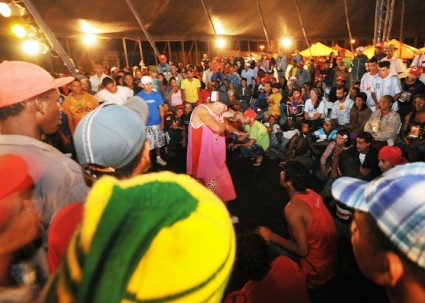
In Agonistics Chantal Mouffe claims “If artistic practices can play a decisive role in the construction of new forms of subjectivity, it is because in using resources which induce emotional responses, they are able to reach human beings at the affective level. This is where art’s great power lies–in its capacity to make us see things in a different way, to make us perceive new possibilities (97).” This statement is made after a thorough analysis of Alfredo Jaar’s work, which incites conscious transformation by intelligently affecting people’s sensations and emotions. Mouffe, Bailbar, Taylor, Boal, and Brecht all appeal to political and artistic platforms that activate the subject. The following words keep coming to mind: action, activation, activism. Positioning these authors together is a reminder that political performance, or political art forms, are necessary to highlight our obligations as citizens: as critical, active, political subjects. In insisting upon the role of the “spect-actor”, Boal and Brecht break theatrical and performative power structures located within the forms of the theatre and the rehearsal in a way that functions as a metonym for a larger social system. This action echoes Mouffe: “Envisaged as counter-hegemonic interventions, critical artistic practices can contribute to the creation of a multiplicity of sites where the dominant hegemony can be questioned.” I’d like to interpret those sites as slumbering bodies of subject-citizens and think of the creation of those sites more as an activation, an invitation, an awakening. Furthermore, I’d like to think through these ideas while centering not only artivism or artistic political practices that identify themselves as such, but also practices that may not be classified as political by their creators, or their spectators, but which are still political in nature. I am specifically thinking through movements such as the Colombia’s in Monterrey, Nuevo León. Better known by foreign entities and media as “Cholombianos” a term imposed on this local practice, Colombia’s are groups of marginalized youth who adopt aesthetic practices of Chicano/Cholo communities in Texas and California and marry them with a love for Colombian music and culture. Thus, creating a hybridization which pertains to the urban landscape of the Northern Mexican state of Nuevo León. How can a group of marginalized youth engaging in social dance practices be as powerful or even more powerful than art which is specifically created as political art forms. What changes in the way we receive, perceive, and absorb cultural political practices that are not created with the intention of being “political”? How does this self-awareness change the creation, reception, and perhaps the types of politics each cultural form activates? 

https://www.youtube.com/watch?v=IF3Oof6lOd8

Connections

unpredictabile / unfamiliar On page 17 Balibar brings about a very important concept for me, that political strategies are finding schema for the anticipation and control of individual reactions. Therefore, they become predictable and controllable. I wonder, how can we find ways of inserting unpredictability, of becoming and being unpredictable? Brecht is talking about alienating the familiar. Resistance is a way of becoming contingent, of being a subject to chance. Jaar having the built paper Konsthall be burnt down the next day, a good example, I find.

empathy / identification A political performance intends to have as many people as possible identify with it. When Boal talks about the danger of empathy, he might have been talking about the danger of identification that is being misused. Nevertheless, we need empathy as a shared emotion. When Mouffe talks about Jaar she says how new forms of subjectivity and new modes of identification can be constructed through the aesthetic means of art.

interdisciplinary / hegemony Brecht implies the importance of the independence of different art forms when uniting them (e.g. music not only as background, ornament,…). I had to think of relating this to artivism, explained by Mouffe, that as she writes “can be seen as counter-hegemonic moves against the capitalist appropiation of aestethetics”, by establishing a new hegemony. I think that the giving the same power to each art form in an interdisciplinary approach (does not have to be a collective one) leads to a different hegemony.  

becoming Boal says that theatre is change, it is becoming and not being. (Also considering the efficacy of transformation taking place before spectators eyes.) Balibar writes that “in a becoming one is detorrialized”, talking about the minoritarian as a becoming or process-  “all becoming is a becoming- minoritarian.” Do we, in order to be anti- facist, have to become minoritarian?

emotions Brecht emphasizes strongly the importance of emotions of pure knowledge and not emotions out of ignorance. Because it is also the emotions evoked through knowledge that are making transformations possible. Mouffe also mentions that it is through the affect the intellect can be reached-“the effect of our aesthetic experience should be to move us “through our senses and through our reason”.

passive / active Mouffe writes that also cultural producers, not only consumers, we all have been transformed into passive functions of the capitalist system. Boal and Brecht focus attention on the importance of the character’s free spirit and his mobility within the form, as well as the action driven spectator, spec-actor. Belonging by doing not through falling. I like that Diana Taylor opens the notion of “scenario”, which see says can function as the framework within which thinking takes place. I like that Diana Taylor opens the notion of “scenario”, which see says can function as the framework within which thinking takes place.

rhythm Brecht differentiates between climatic rhythm or linear narrative rhythm. Again, in relation to Balibar’s predictable individual, we could maybe think of rhythmic structures, such as polyrhythmical or polymetrical that could break expectations (such as a regular pulse is creating) and have contingency arise from other forms of rhythm. Scenarios could be considered as meters that create spaces for polyrhythms.

Ten keywords

10 keywords I found can be divided into two categories, the first five are the characteristics of political spectacles, which explain “what” is political spectacles; the rest five focus on “how” to do political spectacles.

1, “us and them”

Art is political. Like in politics, to let art happen, there has to be an “us and them”,the power of “us” is predicated on the exclusion of the “them”.

2, “plural”

Political action is always plural, there is an anticipation for the control of adversity. Performance is by nature plural because it cannot happen without audiences.

3, “civility”

 The idealism of hatred is the seeds of fascism, and the solution is to create a place for politics/performance, adding adversaries, not enemies. The political field has a nature of antagonism, so the notion of civility is to moderate the adversaries in this field.

4, “identity”

 Identity is fluid and it is possible that everyone had multiple identities at different points in life. To become an anti-fascist, one has to become minoritarian.

5, “empathy”

Empathy is what Boal opposes in his writing, also consents the idea of Boal, Taylor thinks we should not equal empathy to illusion, but to take it as an essential way of approaching communication between performers and audiences.

6, “mimesis”

Aristotle’s interpretation of mimesis is representational, as the participatory politics is in contrast with representational politics, We have to get away with mimesis, and find an art/performance to do things that are not already done.

7, “alienation“

According to a more literary translation from its German origin, “alienation” means anti-illusionistic, the illusion Brecht aims at confronting is not only in theatrical terms but also the representative regime of art itself. Because Brecht thinks the representative art is something which confirms the existed social setting.

8, “animation/passion”

Political activities are for people with passions, so are performances. Based on her interpretation of empathy, Taylor developed the idea of “animation”, which is the core value of the performance and can be generated from both the audiences and the performers.

9. “Spect-actor”

Boal argues the fourth wall has not been torn down by Brecht because spectators are still on their seats. The spect-actor should get involved in the theatrical work by going on stage and does the symbolic trespass.

10, “feeling/affect”

Brecht claims that to realize the epistemological function of theatre in a scientific age, the “old affect “should be replaced by “alienation”, but in Taylor’s opinion, all kind of feelings provoked by performance is possible.

Fragments

1.     Ranciere suggests that: “Artistic practices are ‘ways of doing and making’ that intervene in the general distribution of ways of doing and making as well as in the relationships they maintain to modes of being and forms of visibility.” Boal`s theatre practice is actually a revolution of being and the way of making.
2.      “it is possible to challenge a good many imaginary stories about artistic ‘modernity’ and vain debates over the autonomy of art or its submission to politics. The arts only ever lend to projects of domination or emancipation what they are able to lend to them, that is to say, quite simply, what they have in common with them: bodily positions and movements, functions of speech, the parceling out of the visible and the invisible.” Ranciere`s idea about visible and invisible actually can be seen as the relationship between audience and performers.
3.      “The important thing is that the question of the relationship between aesthetics and politics be raised at this level, the level of the sensible delimitation of what is common to the community, the forms of its visibility and of its organization”. In Ranciere`s perspective, the relationship between politics and aesthetics is a form that can be revealed in an artist`s practice. Brecht`s alienation can demonstrates his Marxist inclination.
4.      Mouffe states: “Conflict in liberal democratic societies cannot and should not be eradicated, since the specificity of pluralist democracy is precisely the recognition and legitimation of conflict”. What is the role of arts in the legitimation of conflict? Diana Taylor writes: “Breaking norms is the norm of the performance”.
5.      Mouffe pointed out that Adorno believed in the possibility for art to provide a space for autonomy. While Boal uses practice to certify this point view.
6.      Mouffe suggests that the importance of artistic and cultural practices in the counter-hegemonic struggle. Diana Taylor embodied this perspective more detailly. She thinks performance is an epistemology—“a way of transmitting memory and identity”. The identity certainly contributes to our understanding of the society.
7.      Mouffe pointed out: “Artistic practices can contribute to unsettling the dominant hegemony. The address this issue requires scrutinizing the role of critical artistic practices in the public space”. Placing a piece out of its familiar context can be seen as an act of intervention to dominant power.
8.      Mouffe said: “Envisaged as counter-hegemonic interventions, critical artist practices can contribute to the creation of a multiplicity of sites where the dominant hegemony can be questioned.” The dominant hegemony can be seen as a repetitive framework. Thus, the function of the artist is as Diana Taylor`s written: “Performance is not limited to mimetic repetition. It also includes the possibility of change, critique, and creativity with frameworks of repetition”. 9. Question about tragedy: Boal points that: “transforms itself to docile Mimicry. In Tragedy, the physical violence is carried out off-stage”. We may can understand this way, the climax of theatre/play need to approach extreme. This is why we can see, great love stories always end with death. Does the climax of tragedy can also be seen as a rebel to the hegemony? 10. Brecht talking about the relationship between art and science “in the age to come art will create entertainment from that new productivity which can so greatly improve our maintenance” amusement centre of class. Theatre can show the structure of society. Actually, it may depends on who is the audience. In the traditional theatre, performers seem have great statues, but spectators are the people who can be a critic and own the power of arts.


Asociaciones

El otro: así como Balibar planteaba la idea de que la emancipación no iba a venir desde un lugar ‘superior’, sino únicamente en la medida en que exista un reconocimiento mutuo del otro/desde el otro; pienso que en los textos de la última semana, el espectáculo, el performance, la puesta en escena necesita del ‘otro’ para funcionar. Me hace pensar en estas citas de Taylor: “A performance implies and audience an audience or participants, even if that audience is a camera”, “There is no such thing as a “solo” or one-person performance.”
Audiencia
Espectador
Público

La comunidad: Lo colectivo, lo comunitario entonces resulta clave para pensar lo que hemos visto hasta el momento, para relacionar la política y el espectáculo. Una de las críticas de Mouffe al racionalismo liberal es su individualismo: “Liberal thought is also blind to the political because its of its individualism, which make it unable to understand the formation of collective identities”. En la medida en que se forjen esas identidades/identificaciones colectivas, ese ‘nosotros’ capaz de involucrarse, es el arma de la que habla Boal, del espectador como ‘spectactor’, es el arma capaz de resistir y transformar.
Identidades colectivas
Nosotros

La protesta: pensar la protesta como un tipo de performance y como algo legítimo del sujeto político es otro punto de conexión que pude anclar entre los textos. Dice Balibar: “All protest can then turn into legitimation since, against the injustice of the established order, protest appeals not so something heterogeneous to that order, but to identical principles” (7) La protesta permite la visibilización de un conflicto común y compartido y a su vez pone en funcionamiento distintos cuerpos que pactan y a su vez que transforman el escenario.
Visibilización
Escenario

El arte: ¿cuál es el lugar del arte en la transformación y la práctica política? El arte ha estado orbitando en las lecturas de ambas semanas. Se me ocurre conectar con la potencia que tiene el arte (ya sea el teatro, ya sea el performance, ya sea una manifestación de artistas callejeros o todas juntas y a la vez) para transformar y para ser una forma de resistencia, como lo dice Mouffe: “I am convinced that artistic and cultural practices can offer spaces for resistance that undermine the social imaginary necessary for capitalist reproduction” (88) o si pensamos en Brecht y su fe en la capacidad del teatro para movilizar profundamente a sus espectadores, en donde tanto actores como espectadores, de manera crítica, producirían un cambio en su respectivo contexto político: “The theatre can only adopt such a free attitude if it lets itself be carried along by the strongest currents in its society and associates itself with those who are necessarily most important to make great alterations there”, que a su vez lo conectamos con esta idea de Taylor: “Artists have used their bodies to challenge regimes of power and social norms”
Resistencia

List of ideas

  1. des-identification as a way of questioning social convention
  2. fascism and representative politics as theatrical illusion
  3. mimesis(adoption) of the norm/repetition(desnaturalization) of the norm
  4. spectator polliticaly pasive(representative model)/spectactor politically active(participative model)
  5. breaking catharsis, awakening of social consciousness
  6. theater and performance, a weapon of the people in the public sphere
  7. reiteration in performance, a way of transmit social knowledge,memory and sense of identity
  8. performance as/is
  9. performance as a political tool to re-read norms and conventions
  10. performing the archive=reinventing the archive

connecting performance and politics

  1. Politics is a determinate series of practices, just as performance is in its rehearsals and reiterations.
  2. The ‘conditions’ of the political and the ‘roles’ shaped through reiterative performances are both ‘social relations’.
  3. Rancière’s ‘distribution of the sensible’—that is, the system of division and boundaries that define, among other things, what is visible and audible within a particular aesthetic-political regime—is much like the colloquial use of the term ‘performance’.
  4. In the political narrative, the real must be fictionalized in order to be thought: the logic of stories and the ability to act as historical agents goes together. Politics and performance construct ‘fictions’—that is, material rearrangements of signs and images, relationships between what is seen and said, between what is done and what can be done.
  5. A theoretical discourse (political narrative) is always simultaneously an aesthetic form, a sensible reconfiguration of the facts it is arguing about, an identificatory performance.
  6. Art (performance) has been subsumed by the aesthetics of biopolitical capitalism and autonomous production is no longer possible, the production of symbols has become the central goal of capitalism. With the development of immaterial labor in advanced capitalism, the labor process has become performative, and it mobilizes the most universal requisites of the species: perception, language, memory, feelings. Contemporary production is now ‘virtuosic’, and productive labor in its totality appropriates the special characteristics of the performing artist.
  7. The rhapsodist narrates the story of his character by vivid portrayal, always knowing more than it does and treating its ‘now’ and ‘here’ not as pretense made it possible by the rules of the game but as something to be distinguished from yesterday and some other place, so as to make visible the knotting together of the events. This is a way of treating society as if all its actions were performed as experiments—rehearsals.
  8. People absorb behaviors by doing, rehearsing, and performing them. The prime task of democratic politics is not to eliminate passions or to relegate them to the private sphere in order to establish a rational consensus in the public sphere. Rather, it is to sublimate those passions by mobilizing them towards democratic designs, by creating collective forms of identification around democratic objectives—invoking catharsis, like the theater. Performances operate as vital acts of transfer, transmitting social knowledge, memory, and a sense of identity through iterated actions.
  9. Performativity must be understood not as singular or deliberate act, but, rather, as the reiterative or citational practice by which discourse produces the effect it names. Much like the political mobilization of affects to align political actors (spect-actors?) through identifications aligned with democratic objectives.
  10. In performance, in politics, context is all.

Sanctioned protest: act of emancipation or a rehearsal?

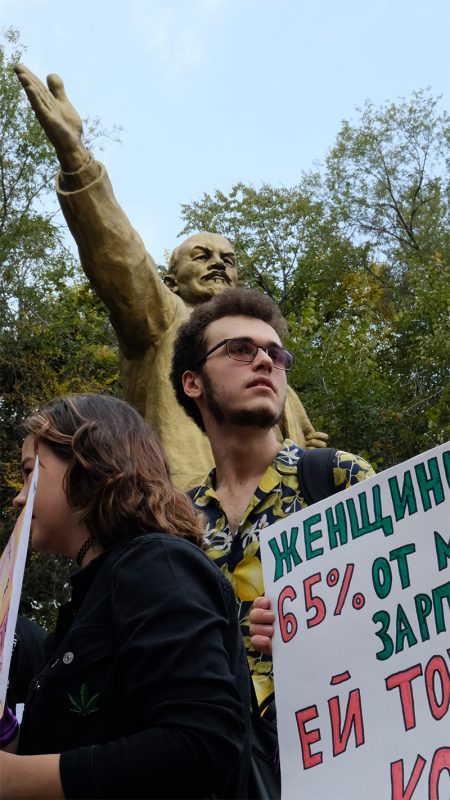
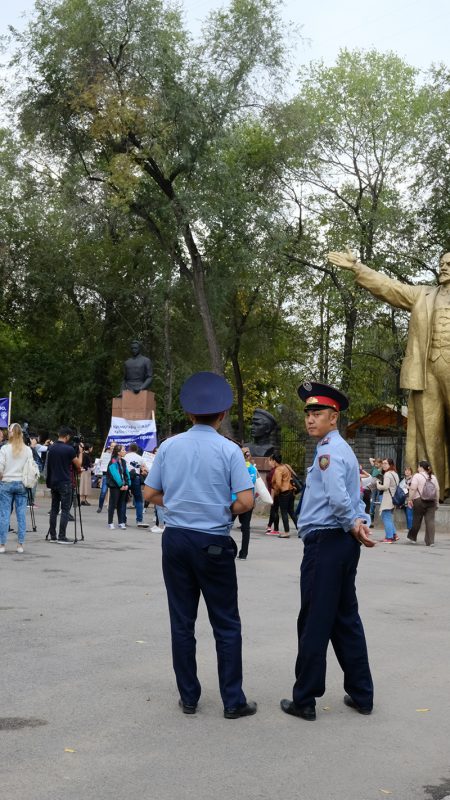
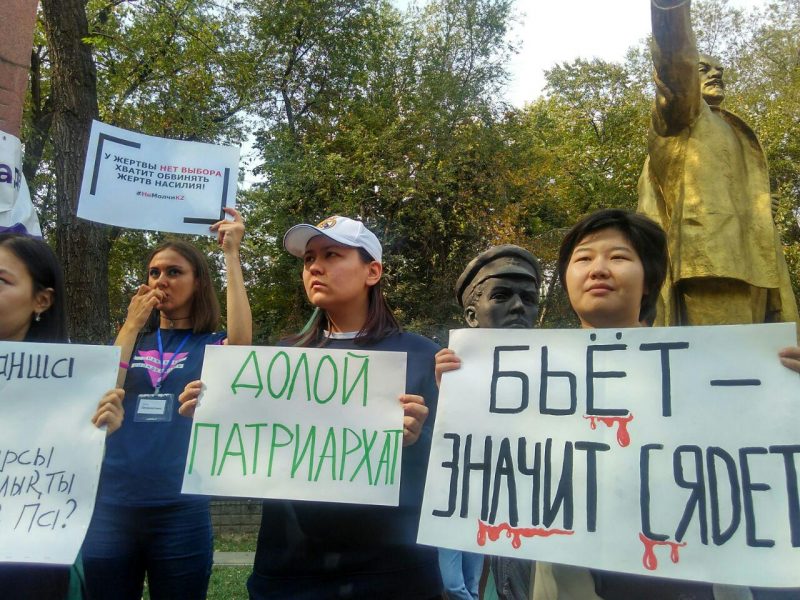
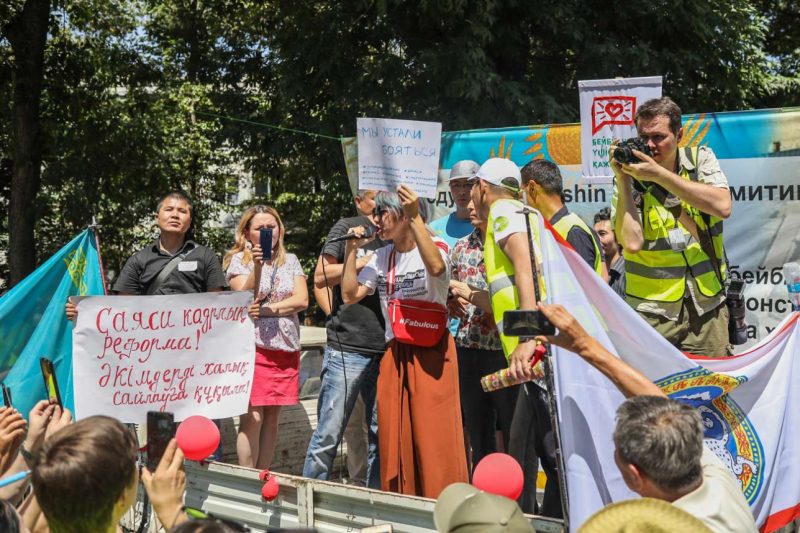
The use of ‘sanctioned’ and ‘protest’ in one context could be absurd if it is not normal. Article 20.1. of the Constitution of the Republic of Kazakhstan states that “Freedom of speech and creative activities shall be guaranteed. Censorship shall be prohibited.” However, the Law of the Republic of Kazakhstan N 2126 circumstances that “any form of protest, picket, demonstration or march that expresses social, group or individual opinion must get permission from the government 10 days prior of the act if it wants to be legal.” By September 28th, 2019, only 3 protests were legalized and got a status of ‘sanctioned’ in the history of independent Kazakhstan. All of them happening within the last 3 months. With this short essay, I want to put forward the idea that what is claimed as an act of political emancipation, in this case, is its failed rehearsal. I respectively use works of Étienne Balibar and Augusto Boal to address this riddle.

Sanctioned protest for equal rights. Sept 28th, 2019. Almaty, Kazakhstan. Photo by Daniyar Musirov. https://vlast.kz/fotoreportazh/35447-v-almaty-prosel-miting-za-zenskie-prava.html
Sanctioned protest for peaceful protest. June 30th, 2019. Almaty, Kazakhstan. Photo by Almaz Toleke. https://informburo.kz/novosti/sankcionirovannyy-miting-v-podderzhku-mirnyh-sobraniy-prohodit-v-almaty.html

Balibar introduces the history of emancipation as “not so much the history of the demanding of unknown rights as of the real struggle to enjoy rights which have already been declared.” Ironically, the first two sanctioned (after 36 declines) protests were in support of ‘peaceful gatherings’. The demand was to be able to express the protest. In terms of Balibar, it might come under the category of pre-history of emancipation or another restriction of his model. This case further expands the problem of “equal emancipation” as it is the majority of “us” protesting for autonomy from the minority of “them”. Therefore, the autonomy of these protests become bigger than politics because ‘part’ of society “excluded – legally or not – from the universal right to politics” is the whole society. So under limited Balibar’s model, the sanctioned protests failed to be acts of political emancipation.


Sanctioned protest for equal rights. Sept 28th, 2019. Almaty, Kazakhstan. Photo by Damira Mukitanova. https://www.the-village.kz/village/city/picture-story/7645-fotoreportazh

If its not an act itself, then can it be a rehearsal? In terms of Boal’s “theater of the oppressed”, these protests could go into the category of forum theater as the participants “intervene decisively in the dramatic action and change it.” Some people led the action by submitting application for protest and getting it, while others supported by coming to it and being active participants with placards and statements. Still the rehearsal was failed because oppressed people are trying to liberate themselves within the ‘given’ theatre. It is the government that allowed a specific ‘stage’ where spectators could imitate acting. And by specific place, I mean the square behind the cinema theatre Saryarka with a golden monument of Lenin reminding participants how a communistic dream in this country covered years of external colonization and how a democracy is under an internal one now. 

Sanctioned protest for equal rights. Sept 28th, 2019. Almaty, Kazakhstan. Photo by Damira Mukitanova. https://www.the-village.kz/village/city/picture-story/7645-fotoreportazh

Ten Points

  1. Beginning with my first point, I would like to ask the question, how is theater an instrument of colonization? During class, Professor Taylor had made this statement and got me interested in knowing more about it, then I pose this, is theater an instrument of weaponazing spectators and spect actors? It reminds of museums being built in in communities where it will gentrify in the name of “art.”
  2. Performance, as we discussed during class, is a way that follows conventions, that is, it followed rules. Churches, dances, or even a class can be a performance, they have a beginning, a middle, and an end. Performance usually refers to reiterated behaviors, twice behavior, happening more than once. This is something that has been already seen or experienced and performance is “reviving it”
  3. Performance is and Performance As. Ballet is a performance, a theater piece is a performance. A political spectacle as a performance, memorials as performances, classrooms and churches as performances where there is a reiteration or twice the behavior.
  4. As spectators, when we watch a ‘theater piece” we give the protagonists the role, where as the spect actors, we feel empowered to act and change the ending of a scene. Therefore, performances are neither true or false, they are either effective or not effective.
  5. The condition of possibility of politics is the definition to go back to “betweeness” to those who have rights and those who think they have rights but they have been constituted by the “not has”. Its the consternation of the exclusivity of the has. The universality of the emancipation of the model “impossible”. If the world emancipated, we would not have the struggles. For example, being a felon, you are being deprived of rights, who can take away rights? This question is part of the “political spectacle” and a constant struggle. The whole history of emancipation is not so much beyond demanding human rights as of the real struggle to enjoy the rights that have already been declared, theoretically we should be able to enjoy these rights. Who declares these rights? An example is migrants, they do not exist within the realm of rights, and under the United States, they are declared as criminals, its always an open struggle and an open debate. Resistance is a way of becoming contingent, it is opportunistic, you have to find the way to crash and push the limits and pick up on something towards as if it seems it can’t happen where you need to push and make cracks (the role of the spectator changing the scene in a theatrical piece).
  6. During the ancient times in Greece, theater was developed as a healing practice and Artistotle talks about art about what could happen. In the previous readings we talked about how art, as a mode of resistance, mobilizes communities for social justice. Alfredo Jaar is an example of how his master piece of burning the space the community built to bring awareness of “taking space.”
  7. Dialectical Materialism: unearthing societies laws of motion treating social situations as processes, and traces all inconsistencies. The human feelings are in disharmony with themselves, opinions and attitudes.
  8. Alienation effect: A representation that alienates is one which allows us to recognize its subject, but at the same time makes it seem unfamiliar. How does it become a barrier for showcasing empathy? and why, according to Brecht, theater must alienate what is shows if, in essence, theater is a pleasurable experience ?
  9. Without politics there would be no “us vs them” so, there would be no performance with no spectator.
  10. When Boal talks about “rehearsal” I think about the conversation we had in class when politicians are trained in television, because they “repeat” (twice behavior; performance) and show to their audiences (spect actors) what they believe, making spect actors act to their “speeches”

10 Things Echoed

  1. Emancipation: of the spectator, of the oppressed, of the space
  2. Subject: what does being a subject mean and how does object and subject transform into each other?
  3. Spectator/Spec-actor: participating and participation. Who has the right to do and who is passive?
  4. Resistance: from the performers, the spectators, the resources
  5. Opportunity: space/time
  6. Process & Product (rehearsal/performance)
  7. Empathy (civility): are these two ideas connected. Both seem key in “success”.
  8. Identity & Identify: identity is shape by the political and how one identifies
  9. Danger: what is at risk and who is at risk? What is dangerous in political performance?
  10. Politics & politics: the role each plays on the other (body, economic, language on the Political)

The Ten Points

Ten points/ideas/concepts (though they may be reductive) that I see echoed in our readings thus far:

1) Spectators
a. “Spec-Actors” must take more responsibility for their “actions” during a performance and we can see how some of the political theorists demand a higher responsibility from the audience – the ones who believe the “Make belief.” Perhaps there is a way of thinking about responsibility and limitation as terms.
2) Art Activism (Artivism)
a. With limitations, a lot of the (political) art that is presented in Diana Taylor’s book forces the audience to confront their limitations and understand their limitation with performance and political acts. This “Artivism” is just one of the ways that politics and performance are inextricably linked together, and we see examples of that in all of the readings.
b. Also, every artist is responding to his or her political moment. (Almost inevitable.)
3) Transformation
a. The performance can transform an audience, and a political act can transform a nation, the population, supporters, etc. There is an element of transformation rooted in Boal’s work with the spect-actor.
4) Emancipation, or freedom?
a. We’ve read that it is the minoritarian subject’s struggle for emancipation, or the “us vs. them” dichotomy that constitutes politics. The spectators are also encouraged to free themselves from a “passive” state of being within the theater and become more active and involved.
5) Struggle is what makes politics
a. Tension between the actor and the spectator is also what activates political performance. Tension perhaps Is another phrase to kick around.
6) Resistance
a. Tying this again to the inherent struggle for equality that pervades the political theater. This resistance is also held strong in the theater itself – with (for example) the methodologies of Brecht and Boal as acts of resistance.
7) Civility – etiquette?
a. We discussed civility in the context of “knowledge of assumed spaces” and discussed the idea of tying it to political correctness. I am honestly unsure about how to approach civility, but there is definitely a way to discuss civility (and approach it through all of the readings) in the context of “who has the right?”
8) Passion, Empathy, Emotion, Affect
a. Passion makes politics (Mouffe’s assertion) – and art is dangerous because it sways a man’s emotions. Emotions, which could also be considered a form of passion, are powerful. And the art of “passionate speeches” in politics are also powerful. There is lots to unpack in this concept, but I am not sure of which term would be best, if any of them.
9) New possibilities/potentiality
a. There is definitely an echo of “potentiality” in our readings. In discussing transformation and identification within the political spectrum and “potentiality” especially in regards to world-making, within the performance realm. The potentiality within Boal’s Theatre of the Oppressed is endless, for instance.
10) Entertainment?
a. I hesitate with this one, but there is definitely a simple element of “entertainment” that resonates throughout the readings and within the realms of politic and performance. People won’t show up to the theater if they are not entertained. There is also a reason why so many “celebrities” and “reality TV starts” have successfully (relative) entered the political spectrum and stayed. Perhaps this ties into the spectators taking more responsibility for what they are consuming, supporting, and engaging with.

Changing Spectators

This week’s readings coincide in how Classical approaches to theater have established predetermined passive roles for spectators. Boal starts his Teatro do oprimido with a succinct, pragmatic background and summary of the system of Greek tragedies codified in Aristotle’s Poetics. The breakdown of the connections between politics and art reveals the coercion of a ruling aristocracy who, in Classical times, utilized public theater as a way of purging social vices through a complex of empathic identification between the spectators and the actors, achieving a climactic catharsis to modify the public’s conduct. Therefore, a spectator is a passive entity who receives an education through gut-wrenching osmosis. Boal’s revolutionary theatrical practices are aimed towards making the spectator an active participant, a spec-ator, in the play, bringing to the fore their own experiences as a way of negotiating the meaning of the play itself and their own social practices.

Through his own theatrical processes, Brecht proposes the idea that this mimetic algorithm that Boal deftly demolishes only produces passive sleepers, spectators overwhelmed to the point of numbness in the theater. While maintaining the perspective that theater’s main end is entertainment and pleasure, his theatrical practice of alienation (or estrangement) is geared towards a more critical spectatorship in which the public is pushed to react critically to the characters portrayed onstage by a process of breaking theatrical illusions of empathy and highlighting the strangeness of everyday actions, permitting spectators to engage critically with the world depicted in art with the world they navigate for themselves.

Likewise, in Performance, Taylor also postulates that, while spectators do function within a system of power relationships inside and outside of the theater, contemporary performances as embodied practices displace the role and placement of the spectator in front of otherwise dramatic acts like live performances. Seeing is a way of knowing, of reaching and even contesting power, and through the viewing of a performance, of a specific context moved by bodily actions, spectators can now be called to action in ways unanticipated by ancient Greek aristocrats, allowing for the creation of spect-actors like Boal and Brecht would have wanted.

Performance and the Joys of Liberation

Within this week’s reading, the theory of performance and its relations to politics became increasingly clear. Art played out through performance is innately political as it displays the potential for transformation. Boal contends that if art is to be sovereign, then it deals with all men, their actions (or inactions), as well as all that is done to them. Performance does so through a catharsis of the senses that shows a correction of humanity and a potential to purify the viewer, or who Taylor would label a spect-actor, highlighting the very active role of an audience member. Performatic theatre then can be called an artistic form of coercion. This is essential if we are to agree with Brecht that theatre in this scientific age should strive for the joys of liberation; liberation from the confines of history; liberation from present conformities of daily life; liberation from squashed potentials of the future. Theatre then, begs its actors to move in the style of a man who wonders as opposed to the man who knows the truth. Judging performance through issues of true/false or those of being/pretend becomes futile; what gives these mediated acts their effectiveness is in their affectations, or even more precisely, the inspiring potential in the emotional weight of their movements.

An integrated spectacle asks who is responsible for what facet of the performance and doesn’t always get a clean-cut answer. Fashion shows, types of performatic spectacles, require the consideration of a variety of actors, innately challenging onlookers to act, to buy, to change. As New York Fashion Week draws to a close, my attention is drawn to a brand whose mission statement has been summed up as inclusivity: Rihanna’s Savage X Fenty show. Streaming exclusively on Amazon Prime, I have included the show’s trailer in this post. The performance reproduces the recognizable concept of a fashion show and turns it on its head, introducing new facets of performativity, alienating its hopes of inclusivity by blowing them up in a colorful display of lingerie, dance, song, and acceptance of a multitude of body types that has been unheard of in the realm of commodified fashion endeavors. This season’s Fenty X Savage show transmits catharsis through Fashion Week’s infamous framework of exclusivity. With its ethos of body positivity strutting throughout a catwalk maximillized for universality, Fenty X Savage reasons with the idea of fashion as a protection from human nature’s more restrictive tendencies in an attempt to promote modern nature (and all its inconsistencies) at its most cathartic. 

Who transforms spectators to spect-actors?

Although Brecht, Boal and Taylor are separated by decades of technological and social changes, all of them devote a great part of their work to the phenomenon of spectators. Brecht as a true Marxist was fascinated by scientific era that can educate intellectual proletarian and blames theatre for functioning as an entertainment place raises a “cowed, credulous, hypnotized mass”. In his opinion, theatre should “not only release the feelings, insights and impulses” “but employ and encourage those thoughts and feelings which help transform the field” and society. Brecht suggests changing it to “epic theatre” by “alienation effect” when audience is aware that they are viewing a spectacle by actors with whom they do not empathizes. So he considers the transformation of a spectator as fully dependent on the practice of actors, directors and their practices rather than work with spectators.

Boal claims Brecht’s theatre as following:  

“Brecht proposes a poetics in which the spectator delegates power to the character who thus acts in his place but the spectator reserves the right to think for himself, often in opposition to the character”.

Although Boal agrees with Brecht’s critique of Aristotelian “Poetics” and idea of catharsis when “the spectator delegates power to the dramatic character so that the latter may act and think for him” , his theater of oppressed suggests more empowerment of audience when spectators participate in a performance becoming actors themselves. There comes a term spect-actors and a plan of transformation through diverse exercises for audience.

Taylor’s consideration of spect-actors is not limited to theatre, it includes diverse performance forms where spectators get to act on provocative performance even if acting means being silent. In her words, “each performance anticipates its ideal response”. Not performer, actor or director, but a form of performance itself influences the audience and makes it act. Compared to Brecht and Boal, Taylor does not suggest that transformation of spectators should be done through practice with actors or audience but through developing connection between performance and spectator. I guess it works better in the world where stage and reality are not separated anymore. Where a common action can be effectively evoked through an Instagram filter rather than ideological spectacle.

An art fit for the times (and place)

Last week, we discussed the political horizon of performance as that which proposes new possibilities of being and orderings of the world. This week’s readings further the conversation on performance and politics; while the Brecht and Boal texts take theater as their focus, Taylor’s text addresses the multivalent ways in which performance, through acts of doing, “allows us to see” (6); thus one of the ways in which performance labors can be “showing that change is possible” (20). I found her use of the concept of “frames” to be productive in considering the contexts in which performance lives and would like to discuss the other texts through this notion.

Brecht critiques the theater that represents life “according to the old recipes” (183) due to its inadequacy to “make sense” of the time period he concerns himself with in this text, which is the scientific age. Instead, he argues for the constant evolution of theater as “an art fit for the times” (186), the connection between “art” and the “times” as having a pedagogical purpose: to “awaken” its spectators from the illusion of a consistent world and make possible the recognition of a contradictory one. I understood Brecht’s text to be operating within the frame of historical condition and possibility of action, which he negotiates through a proposal of “new alienations” that work precisely towards “alienating the familiar” (192) through a materialist dialectic (193) that unveils the contradictions/inconsistencies of productive life. The politically activating potential in Brecht’s text finds itself in the transformation from “passive acceptance” to “suspicious inquiry” on the part of the audience; the techniques mentioned, from the actor who is a “character rather than a caricature” (196), to a story that is “knotted together” (201), all seek to mobilize a “higher pleasure” of performance that produces life itself.

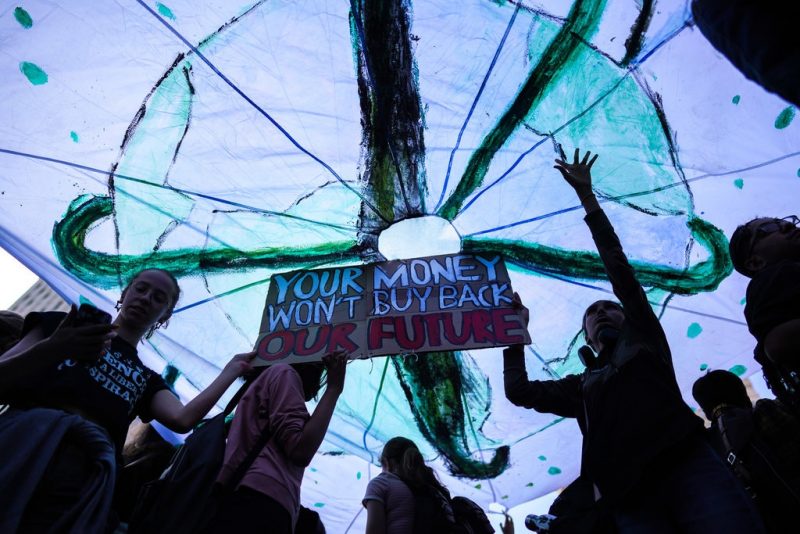
Joseph Michael, Voices for the Future. One of the questions the texts this week made me think around is: How can we evolve an art fit for the times (and place) in our present reality?

Boal’s text invokes Brecht’s work but makes the challenge that Brecht presents the subject as “objeto de fuerzas sociales, no ya de los valores de las superestructuras” (12). His contribution is to frame political theater in the Latin American context, as that which labors towards “la destrucción de las barreras creadas por las clases dominantes” (12), whether it be between actor/spectator, protagonist/chorus, or the theatrical means of production. It is in this way that Boal presents theater as a “liberatory weapon” (11), as that which has the potential to dehierarchize and promote participation when it is in the hands of the people. Embodiment, which is central to the techniques Boal proposes, also finds its way “front and center” (Taylor 1), in Taylor’s text. I’d like to discuss this idea of performance as ontology (Taylor 3) more in class as I find it very productive to think with in terms of durations and becomings.

Maria Magdalena Campos-Pons, Poetformance

commun-ator

Something that I was looking for during the readings of this week, but which I was not able to answer, is: Who are the spectators Brecht, Boal and Diana Taylor talk about and also, how do they benefit from participation? Theatre is a communal experience so the question is also what kind of community it creates- who is in and who is out? In a way, the audience is rehearsing something by being an active spectator. They are not only experiencing the unfamiliar but doing the unfamiliar. And I like this idea. doing becomes a form of belonging. (Diana Taylor) When Diana Taylor talks about Regina José Galindo, she writes: “She (Galindo) has no illusions that she can change the political situation, but she does everything in her power to make the situation known in the most forceful way possible.” Performance is creating possibilities for learning and for knowledge. And then as Boal writes about Brecht, he mentions, that the emotions evoked through knowledge are making transformations possible, not the emotions out of ignorance. So, the possible dialectic transformation of society. Diana Taylor: “Performance is a doing to, a thing done to and with the spectator.” These are not new questions and or ideas, but maybe instead of wanting to reach most people possible to be spectators of a performance, we have to concentrate more radically on deciding who is the spectator community. Whom do we want and need to be present (not, who happens to be present). With whom is this Performance being done today and with whom tomorrow?

Politics through art


Reading through this week’s materials is quite a wonderful adventurous journey. Brecht on Theatre, Theatre of the Oppressed and Performance all touched upon what should theatre (performance) do as well as its capability of affecting human society, especially in the modern age of science. The approaches and the focuses, however, did vary.

Brecht began with questioning the essence of theatre, and following the footsteps of Aristotle, he concluded that it is a representation of men’s life together in human society, and it should be of sheer entertainment, a “purification which is performed not only in a pleasurable way, but precisely for the purpose of pleasure”. However, it does not mean that theatre brings nothing but laughter to the world. It’s aesthetic meaning truly lies in its unique way of creating alienation and how it reflects on people’s inner feelings and makes a difference, as “the pleasure felt… must be converted into the higher pleasure felt when the rules emerging from this life in society are treated as imperfect and provisional”. In fact, such conclusion leads back to the first chapter in Theatre of the Oppressed, where Boal traces back to the very origin of poetry, theatre and tragedy and lands on Aristotle’s theory of art as recreation. According to Aristotle, art is the recreation of all creating principles of nature, and it even goes beyond into self perfection in order to correct where nature has failed. Based on this statement, Aristotle also developed the idea of “the sovereign art”, which is the rules above all kinds-Politics. “Nothing is alien to politics, because nothing is alien to the superior art that rules the relations among men”, therefore every art is associated to the vast horizon of politics, and bringing its education within each performance.

Performance acknowledged the fundamental theory of theatre as art, yet explored performance as well as its interaction with politics from a broader perspective, which is relatively new but also universal. As an extension of Aristotle’s “imitation”, the crucial term “doing” is brought into sight in supplement, strengthening the value of acting, repeating with difference, and transmitting memory, knowledge, cultural identities, etc. With such strong social element and bond, performance spontaneous but also legitimately enters the field of politics and activism, where its core of entertainment becomes the best strategy and method.

Week 3: Performance and Politics

The readings for this week focus in performance and theatre as transformative rather than its traditional conceptualization of entertainment. Boal (1985) reviews the coercive character of theatre through the idea of catharsis. Here, he proposes the use of theater as language that is put it in service “of the oppressed” (121) In this sense, his proposal is more near to that of the performance as it is a rehearsal for the revolution (122) The spectator takes action and create revolutionary poetics. Theatre becomes then political. Similarly, Brecht (1974) reviews the idea of theatre as a reflection the structure of society. He proposes a type of theatre which not only releases the feelings, insights and impulses but that makes “possible within the particular historical field of human relations in which the action takes place, but employs and encourages those thoughts and feelings which help transform the field itself.” (190) Both authors then call for a different understanding of theatre. Taylor (2016) defines what performance is and conceptualizes its transformative potential as it leaves a trace, acting with its presence and non-presence that aims to create affects. Performance acts in relation to the systems of power, as it aims to create a new perception of the real and new possibilities. Here, I am mainly interested in the idea that performance and theatre can create what we can understand as a queer temporality; it resists “the laws of reproductive economy and it can act “about past, present and future” (10). In all the works, the authors are aiming for theatre to be seen as a gesture towards a kind of revolution.

Transforming the Spectator

Regina José Galindo, No perdemos nada con nacer/We lose nothing by being born

Performance has the power to illicit social change from spectators through its critique of politics and everyday life. In confronting Aristotelian philosophy Boal explains, the coercive system of tragedy which plagues art does not work to engage the audience in revolutionary acts (47). The author laments, though Aristotelian systems of knowing acknowledge what already exists, it works against the spectator in that it only pushes them to conform to society rather than transform it (Boal 47). Instead of looking at theatre as a representations of nature, we must come to acknowledge it as a form of transformation. Boal suggests we make the move towards spect-actors instead of spectators as the former acknowledges the viewers and the performers potential for political and revolutionary action.

Taylor expands by noting viewership can only be understood as “functioning under systems and relations of power” (80). Though performances can often push audiences to uncomfortable and sometimes confusing spaces, it ultimately forces the witness to react and/or respond to what it being shown. Brecht points to the spectator-performer relationship as a mechanism of theatre which allows individuals to breed empathy (183). It is this characteristic that can bring the viewer to reflect on their world and subsequently take part in social change.  

Los Desechables: Us Vs Them

Balibar divides up politics into three concepts—emancipation, transformation, and civility. Throughout this discussion, he comments on the inevitable “us versus them” politics in society. Subject politics comes into play when we look at the active versus passive citizen because only subject-citizens are able to be active in society. However, Ranciere goes further to define a citizen as someone who has a right to speak, but what if they aren’t able to do that? This is where the role of emancipation comes in. Due to this disidentification, the minoritarian does not have the time or right to be political because they are los desechables. If politics revolve around what is seen and what can be said about it, the minoritarian often does not have the time due to the economic hardship to be seen or say anything. Balibar argues that there is a way to come into visibility as victims but what is the effect of this? Is there a healthy way to appropriate victimhood and is that a form of emancipation that Ranciere is calling for?

politics and performance 2

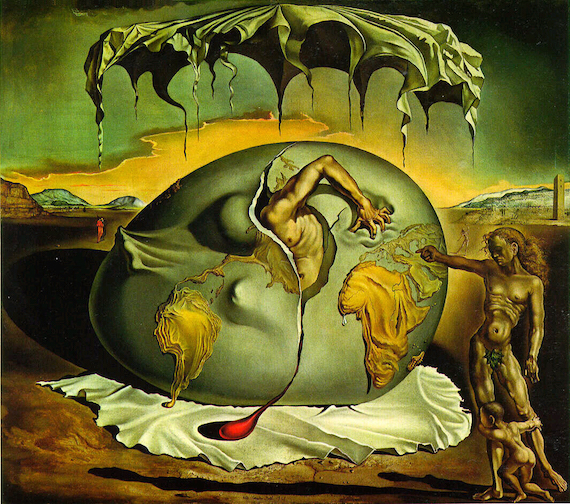
geopoliticus child watching the birth of the new man, salvador dalí, 1943. i just google searched embodiment… it looks like the human is trying to become separated from the world, being birthed from it, cutting the umbilical cord. this separateness is assumed in Brecht and Boal, but in Taylor’s more post-humanist understanding of performance, the ‘human’, the ‘non-human’, and the ‘cyborgian’ appear more interwoven.

Whereas the focus of last week’s readings seemed to have resided in an articulation of what ‘politics’ is in terms of what it does, this week’s readings of Brecht, Boal and Taylor aim to articulate what ‘performance’ is in terms of what it does, offering a sort of meta-analysis of the questions of sameness between these two concepts.

If this is the case, then the main arguments of Brecht, Boal and Taylor are located in their articulations of how, as Boal puts it, “… all theatre is necessarily political, because all the activities of man are political, and theatre is one of them” (ix). Boal describes Brecht’s poetics as “those of the enlightened vanguard” (155)—his poetics are Marxist, as they assert that social being determines social thought— ‘man’ is an object of social forces; he sees the theatre as a place for entertainment, with ‘productivity’ being the main source of entertainment (186); he wants the theatrical spectacle to be the beginning of action (106).

Boal, in many ways, picks up where Brecht left off. He points out that Brecht’s position is clear: the character is not free to act at all (92) and uses this as a launching pad in a movement that transforms the spectator into an actor. This movement, accompanied by the abolition of the private property of the characters, constitutes Boal’s proposed “poetics of the oppressed” (122).

Taylor moves us forward from this in a tremendous leap, maintaining the structure of the central theory present in Boal’s poetics—that “people absorb behaviors by doing, rehearsing, and performing them…”—while incorporating important questions pertaining to the body from the perspectives of critical race theory, feminist and queer theory, and post-humanist theory (13). This leads us to a more nuanced discussion of ‘transforming the spectator to actor’—what Taylor calls the ‘spect-actors’: people capable of acting and interrupting the performance or changing their roles they’ve been assigned (80).

Rather than getting stuck in the tussle between the Hegelian absolute subject and the Brechtian formulation of the character as the object of economic and social forces, Taylor marks the body as both the consuming subject and the object of consumption (97). This understanding of the body, which Taylor takes through complex rethinkings of experience, ‘scenarios’, and context, enables us to engage with a politics/performance that is not anti-history, anti-memory, and oriented towards percepticide, as has been the “American” way (172).

Evolution of the audience

Occupy Wall Street

” We know that barbarians have their art. Let us create another. “

(Brecht, 31)

If viewed in chronological order, the concept of the audience has been greatly developed in the arguments of the three theorists. The context and framework of the three authors are not the same:Brecht used the dilemma of reinterpretation of classic in modern theater as the foothold of his discussion. He argues that “We and our forbears have a different relationship to what is been shown .”(187)

Boal puts theatre works into the frame of social development. Taylor casts into light the performance activities from the 1960s and keeps social movements in her spectrum of research.

Brecht advocated the separation of roles and actors which sets the audience free from empathy effects and makes a transformation from the “old-affects” to Alienation possible ( 192 ).

“The audience must become the character.”

(Boal, xxi)

Boal combed the ancient theater’s Geneology and thought that the purpose of the traditional theater was to emphasize a determined social and ethos. At the same time, he thinks that Brecht’s work to break the fourth wall was not completed (xx). The invasion as symbolic trespass, audiences must be actively involved as “spec-actors”, so that the fourth wall can be broken through. (xxi)

“Performances often challenge the limits of the artists. But they also challenge those of the viewers.”

( Taylor, 72)

With the embodiment and the socialization of performance, the relationship between performance and the audience has become more complicated. Through the premise of “seeing is doing”/” viewing is an action” (82), Taylor differents the audience in these contemporary performances. The audience becomes plural in her discussion as performance is collaborative work in a social movement aspect. “The performance itself asks audiences to do something, even that something is to do nothing.” (86) She proposed that “affect” and “E-motion” as vital for the animation of the performer and audience, which opposes Brecht‘s attitude toward “old affect”.

The common characteristics of the three theorists are to recognize the epistemology value of performance/theatre, to reveal the power of art as political intervention. By putting the hierarchy essence of“catharsis” and “empathy” into question, the relationship between the performance and the audience is re-examined, the possibility of the citizen as the audience evoluted.

Go out and see things!

The three readings this week – Boal, Brecht and Taylor – highlight the intentional engagement of the social, particularly with the minoritarian subject. The result of this social engagement solidifies the ways in which we are often unable to understand politics without performance, and vice versa.

Quien puede Borrar las huellas
Regina José Galindo

“A Regina Galindo lunch break.”
– Diana Taylor, Performance

Boal argues that Aristotelian theatre, which was inherently designed intimidate the audience and eliminate “bad” or illegal tendencies in the audience, “is not the only form of theater” (Boal xiv). His chapter, “Poetics of the Oppressed,” dives heavily into examples of “theatrical” exercises which engaged (in this case) the minoritarian subject in a process of creation and narrative, and by doing so he subverts Aristotle’s Poetics to liberate the oppressed and disrupt the hegemonic ideologies of theatrical form. This engagement in the social is mapped out visually and performatively in Taylor’s book Performance. The concrete examples of performance, accompanied by striking visuals, inextricably linked the political and the performance, the performer and the spectator, and more often than not, the performer transformed the spectator into the “spec-actor” by encouraging (and often forcing) the public to engage in the performance and take responsibility for their action (or reaction). Brecht (who’s rhetoric I struggled the most with this week), in reference to representation on the stage, states that, “All that mattered was the illusion of compelling momentum in the story told…Even today we are happy to overlook such inaccuracies if we can…grasp the immense or splendid feelings of the principal characters of these stories” (Brecht 182). He is relying on the engagement of the social to further our understanding of performance as a tool within a (potential) political arena. Taylor supplements this with a more concrete example, “Political advisers know that performance as STYLE (rather than ACCOMPLISHMENT) generally wins elections. Advisers ask whether a performance is effective or memorable, not whether it corresponds to verifiable facts” (Taylor 90). Taylor’s book is a performance within itself, often directing and diverting the readers’ attention to certain words or passages through spacing, style, and size of the text and visuals. These readings leave me with questions of the power of disbelief, how to make someone believe, the power of transformation, and how important it is to engage the social – to engage the often considered, “subject” – as a necessary method to disrupt hegemonic forms and ideologies in performance. 

Cambio social, teatro y performance

Los textos de esta semana giran en torno al carácter político y emancipador del teatro y del performance. Tanto Brecht como Boal hacen una crítica a la visión aristotélica del teatro, en particular de la tragedia, en tanto consideran que su propósito, lograr la Catarsis, canaliza las posibilidades de cambio social, porque estas se depositan en la obra de teatro y por tanto no se concretan en el mundo real. Ante esto Brecht propone el distanciamiento, es decir, el extrañamiento, la no identificación del espectador, e incluso del actor, con el personaje. De esta manera el espectador puede acercarse críticamente a la obra de teatro. En palabras de Boal, en la propuesta de Brecht tenemos a un espectador que no le da al personaje el poder de pensar por él.

Boal considera que la aproximación de Brecht es reveladora al nivel de la conciencia, pero se queda corta al nivel de la acción. En este sentido, el teatro del oprimido, que es una poética de la liberación, propone recuperar para sí la acción, borrando las barreras entre espectador y actor, y entre actores con roles protagónicos y actores secundarios o coro.

Finalmente, en Performance de Diana Taylor, vemos como éste tipo de manifestación artística está ligada a los deseos de transformación de la realidad, al rompimiento de las normas que mantienen un estado de cosas injusto y opresivo, pero que también, el término performance en las últimas tres décadas ha empezado a usarse en otros ámbitos. Así, la autora nos dice que el performance no es solo una forma de arte, una forma de hacer activismo, un ejercicio militar, etc., es también un marco para delimitar y para comprender una acción.

Political Performance

While last week we focused on political theories in the abstract, the writings this week had to do with conceptions of politics within and through performance. I was drawn to Boal’s work in breaking down the numbing of contemporary audiences through Aristotelian structures of “coercion” which built upon Brecht’s disavowal of the entertainment of theatre. Through these structures, performance is a practice, rehearsal, or training ground for the “real” political sphere, a place where we are able to think critically about and try-out new strategies of disrupting economic realities and distributions. However, for both, the performance while it is political is not necessarily politics. In the Taylor text, we are introduced to a more nuanced definition of performance where art provides “a means of intervention into the political (which she cannot control) by using her body, her imagination, her training, self-discipline,” (116) and that “large or small, visible or invisible, performances create change” (10). Here, the performance is more than a practice round for the political sphere, it is the sphere in its ability to change and transform people. These works continue to make me think about the power of performance and the affect it creates, and how these tools are used in the political. When we break down the barrier and view politics and performance as the same thing, how does this help us reflect on and and analyze transformational claims (perhaps, “truths”?) being formed in either methods?

Object-Subject Bodies: Agency And Participation In Performance

Images from climate strike on September 20, 2019 in which millions of people walked through the streets of New York City. https://www.nytimes.com/2019/09/20/nyregion/climate-strike-nyc.html

“PERFORMANCE…[i]t’s a doing, a done, and a redoing. It makes visible, and invisible; it clarifiesand obscures; it ephemeral and lasting; put-on, yet truer than life itself…performance is radically unstable, dependent totally on its framing, on the by whom and for whom, on the why where when it comes into being.”[1]

Diana Taylor addresses the temporality and limitations of performance because of the liveness, the idea of doing and done. This doing and done translates into an act of belonging or striving to belong in a specific way, or rather existing, to make sense of the conditions of object-subject relations in society. In conversation with theatre artist Augusto Boal, the ephemerality of performance points at the liveness and agency of its subjects—the “spect-actor.” “In order to understand this poetics of the oppressed one must keep in mind its main objective: to change the people — “spectators,” passive beings in the theatrical phenomenon — into subjects, into actors, transformers of the dramatic action… In this case, perhaps the theater is not revolutionary in itself, but it is surely a rehearsal for the revolution. The liberated spectator, as a whole person, launches into action. No matter that the action is fictional; what matters is that it is action!”[2]This call to a new theatre gives voice and action to the people of the community, the people the piece is about. This action is a framework for revolt and reclamation. With this tool is mind, how successful is forum theatre discussing issues and reclaiming bodies (transformation of object to subject) of its “spect-actors”?

Bertolt Brecht argues that theatre should be a form of entertainment, a tool to delight, but it is also a great vessel for education and changing the way the audience believes they should function during a performance. He agrees in the active participation of the spectator through alienation. This alienation is deeply connected to object-subject relations for bodies in protest. 

[1]Taylor, Diana. Performance  (North Carolina: Duke University Press, 2016), 41. 

[2]Boal, Augusto. Theatre of the Oppressed (New York: Theatre Communications Group, 1993), 122.

Empathy and Power

Aristotle’s theory of tragedy has greatly influenced the theory of Western theatre. Brecht and Boal made a radical revolution in Aristotle’s theory. Aristotle thought the meaning of tragedy is entertaining people. As the representation of human behavior, in Poetics, Aristotle defines tragedy as a mode of imitation, to inspire ‘pity and fear’ between the spectator and characters. While Brecht argued Aristotle’s idea about ‘purification’ and ‘pity and fear’. Through stating A-effects, Brecht hope audience can be critical and rational when viewing the character, and also performer can keep a distance from the role he played — ‘At no moment must he go so far as to be wholly transformed into the character played’. Furthermore, contrary to Aristotle`s idea of Greek tragedy, Boal thinks Empathy is dangerous—’When rational foundations of physical acts are not there, Empathy turns into a relationship of pure irrational animality’. Boal states ‘when rational foundations of physical acts are not there, Empathy turns into a relationship of pure irrational animality’–In Hollywood super-hero movie, Empathy may potentially lead the audience to emerge a fascism inclination. Boal have already broke barrier between the performers and actors to create a new notion of theatre and decomposed the original power order in the theatre. For me, the idea of Boal inspired me to reconsider what is theatre? Is it presenting a work as art products or is it activism? Maybe the answer can be found in Taylor`s Performance. ‘Breaking norms is the norm of performance’. Performance allows us to see, experience and examine the power structure of society. Thus, theatre gets rid of the framework of mimetic repetition, it becomes a possibility of chance, a methodology of critics. 

Attached Video: Audience-performer co-working process in arts creation. Contact Improvisation was largely used in community dance and dance therapy. Also, Music therapy use a similar structure of composing.

I have a little confuse about Boal`s opinion about spectacle. As Boal thinks: “Spectacle is not confined to a fifteenth birthday party at which the young woman dances her first waltz with her father, or the dance of the commoner Angelica with the Prince in Visconti’s The Leopard, which opens the doors of nobility to her, or the marriage ceremony of a bride all dressed in white; nor is it only when the president of the Republic lays wreaths on the tomb of the Unknown Soldier, or a new road is officially opened. Spectacle is not just these moments of extravagance and pomp; it also embraces the hearty family Sunday lunch, where people eat and talk according to established rules, as in any piece of theatre. Spectacle has the function of revealing who is who, as if planting a legend on the brow of each protagonist or supernumerary.” He potentially agree with spectacle in some way. I would like bring dance artist Yvonne Rainer`s No Menifesto here for the discussion of politics hehind “spectacle”: As Rainer wrote here, the first and foremost of her artist idea is to anti spectacle.

No to spectacle.
No to virtuosity.
No to transformations and magic and make-believe.
No to the glamour and transcendency of the star image.
No to the heroic.
No to the anti-heroic.
No to trash imagery.
No to involvement
of performer or spectator.
No to style.
No to camp.
No to seduction of spectator by the wiles of the performer.
No to eccentricity.
No to moving or being moved.

What is the definition of “spectacle”? Does the “spectacle” potentially lead the inclination to fascism?

The affective/effective and a critique of empathy

The three readings for this week each outline alternative potentials (and now actualized roles) for theatre and performance within contemporary divisions of labor and structures of power.  Bertolt Brecht and Augusto Boal each begin with a critique of traditional or Aristotelian theatre, accounting differently for the entanglement of these practices with political interests. Boal interprets Aristotle’s definition of tragedy as a tool for political repression. He says that the catharsis elicited from the spectator in theatre represents “the purgation of all anti-social elements” (47) and provokes a realignment with the ‘moral’ expectations of the State. Brecht similarly critiques the passivity of spectators in traditional theatre: “Seeing and hearing are activities, and can be pleasant ones, but these people seem relieved of activity and like men to whom something is being done” (187). While Boal reimagines theatre’s revolutionary potential by proposing the roles of the “joker” and the “spect-actor”, Brecht instead suggests that theatre and its actors should create a sense of alienation rather than identification from the audience (“I must not simply set myself in his place, but must set myself facing him, to represent us all. That is why the theatre must alienate what it shows” (193)).

The Transborder Immigrant Tool, Electronic Disturbance Theatre 2.0/b.a.n.g lab (2007)

I was most struck by the recurrent critique of empathy present throughout the readings. In Performance, Diana Taylor asks “does the performance event have to have happened?” (66) She follows this question with a description of the Transborder Immigrant Tool (TBT) which, despite never fulfilling its intended function, produced political consequences because of its potential and its intentions. The work is significantly not reclaimed because of the empathic outcomes for those who did “experience” it, but for its role in disturbing political discourse. Still, this example of performance could be critiqued from Brecht’s perspective as it is not exactly set “at the disposal of those who live hard and produce much” (Brecht, 186). Taylor is, then, expanding the possibilities for political engagements within performance. She later says “Performance is not judged in terms of true/false; being/pretending. Instead, the affective is the effective.” To what extent does this challenge/extend the positions of Boal and Brecht in their articulations of the political potential of theatre? Is this affective mobilization related to empathy or does it produce some more profound/radical political transformation?

Finally, does the establishment of conventional practices of resistance and the categorization of performance within the realm of “art” limit its transformative political potential? Can these practices of political theatre and performance still be said to participate in Rancière’s “aesthetic regime” of art (if I understand the concept properly)?

performance and politics

As we have entered a world beyond the limit of structural violence, Balibar wonders whether our politics can be thought of as heteronomy of heteronomy, constituted by the fusion of the problem of violence and the problem of identity. The politics which takes as its object the violence of identities he terms ‘civility’, and he posits three theorems on identity in response: all identity is transindividual; we should speak of identifications rather than identity; and, every identity is ambiguous.

I’m curious about the potential connections to be made between these three theorems relating to identity and the three ways of distributing the sensible as forms of art and forms that inscribe a sense of community—the surface of depicted signs, the split reality of the theater, and the rhythm of a dancing chorus—posited by Rancière. The transindividuality of identity positions it in bonds validated among individual imaginations: is this like a sort of economy of ‘depicted’ (or, ‘embodied’) signs? “The aesthetic regime disrupts the apportionment of spaces in favor of immanence of thought in sensible matter”: as the apportionment of spaces makes “double beings” out of the worker, could ‘identifications’ be a pathway towards a disruption of current modes of doing and making? How is the rhythm of a dancing chorus bolstered by the ambiguity of individual identity? Mouffe posits that artistic and cultural practices can offer spaces of resistance: can the connections between identity and the distribution of the sensible be articulated as agonistic interventions within the context of counter-hegemonic struggle?

Actor / Observador

¿Cuál es la relación entre quien actúa y quien observa? En las lecturas de esta semana, los tres autores –Brecht, Boal y Taylor– reflexionan sobre dicho interrogante. Aunque en principio uno pensaría que desde la mirada de Brecht el teatro tendría únicamente como prioridad y meta central el divertimento o la pura producción de placer en el espectador, pues “Nothing needs less justification than pleasure” (Brecht, 181), esto no impide que a su vez se piense en una audiencia capaz de transformar y de ser conmovida por lo que sucede en el escenario: “one has to admire the theatre folk who, with so feeble and reflection of the real world, can move the feelings of their audience so much more strongly than does the world itself (…)  the spectator wants to be put in possession of quite definite sensations” (188). Sin embargo, aunque eso está consignado en este texto de Brecht, quien va más allá de esta relación activa (quien actúa) y pasiva (quien observa) y quien de hecho quiere desmontar y/o invertir estos roles es Augusto Boal, con el fin de demostrar cómo la gente (los espectadores) “reassume their protagonistic function in the theater and in society.” (Boal, 120). Para demostrarlo, a partir de unos experimentos consignados en su libro, el autor pone a prueba a diferentes sujetos para cumplir su objetivo principal: “to change the people –“spectators”, passive beings in the theatrical phenomenon– into subjects, into actors, transformers of the dramatic action.” (122). En este sentido, mientras que Brecht ve principalmente al teatro como espacio para el divertimento, Boal lo ve como una verdadera ‘arma’ de transformación.

Por su parte, Taylor, analizando los diferentes significados que se le puede adjudicar a la palabra ‘performance’, pone sobre la mesa las variables que pueden existir en la relación ‘performer’ ‘actor’ y espectador: “Performance can call spectators to action, but it sometimes puts them in very confusing, powerful, disempowering or uncomfortable situations. (…) Performance ask that spectators do something, even if that something is doing nothing. Each performance anticipates its ideal response. Performance is a doing to, a thing done to and with the spectator. (86). Como se ve en la cita anterior, la Mirada de Taylor se alinea mucho más con esta idea de ‘Spect-Actor’. Tanto lo que ocurre en el teatro como por ejemplo lo que sucede en una protesta, implica que actores y observadores se involucren bajo una serie de códigos, rutinas, gestos o comportamientos pactados, que pueden ser explicados en el momento en el que surge el performance o que de manera natural y orgánica se van dando o que incluso pueden ir cambiando: “Performance, however, is not limited to mimetic repletion. It also includes the possibility of change, critique, and creativity within frameworks of repetition” (Taylor, 15). Esta posibilidad de cambio inesperado puede surgir tanto desde el lugar de quien ‘actúa’ como de quien ‘observa’.

La marcha de las putas, 20 de septiembre de 2019


Performance and social change

Teatro do Oprimido no Movimento do Sem Terra (Brasil)

http://terraemcena.blogspot.com/2015/07/a-experiencia-do-mst-com-teatro-do.html

Os três autores dessa semana, Diana Taylor, Bertolt Brecht e Augusto Boal, destacam o potencial de transformação social do teatro e da performance. Em seu livro Diana Taylor realiza a tarefa árdua (devido a amplitude de significados) de analisar a performance: “Lo que es, lo que hace, lo que nos permite teorizar y la importancia de entender su compleja relación con los sistemas de poder” (14). Taylor apresenta as diversas perspectivas sob as quais é possível ver a performance, mas há uma ideia no livro que me parece central: a performance é “una práctica y uma epistemologia, uma forma de compreender o mundo y un lente metodológico” (31). A questão com a qual Taylor conclui o texto, “si el performance es un acto político por definición, o si lo político siempre es performance”, está diretamente conectada com as questões que os outros dois autores buscaram tratar em suas práticas artísticas. Augusto Boal via no teatro uma arma muito eficiente de transformação social. Por isso, como ele explica no livro Teatro do oprimido, dedicou a sua vida para a criação de metodologias eficazes em transferir os meios de produção do teatro para o povo, para as comunidades, para as os estudantes, para os movimentos sociais. Para Boal, o a poética de Aristóteles, que pressupõe o espectador como “vítima passiva”, é um sistema opressor de teatro, pois nele são delegados “poderes aos personagens para que atuem e pensem em seu lugar” (180). Boal propõe, portanto, que a plateia passe de espectadores para espec-atores, não só do teatro, mas de suas próprias vidas e da revolução social e política. Bertolt Brecht, por meio das suas setenta e sete proposições no Pequeno Organon para o Teatro, toca na dimensão pedagógica da cena e em como a atuação e a encenação devem se dar para que ocorra a conscientização do espectador (e não somente a identificação acrítica do teatro dramático burguês). Os três textos apresentam a performance e o teatro como práticas potentes de transformação social, mas também como lentes com as quais os artistas e os espectadores, ou melhor, espec-atores, podem perceber, como afirma Taylor, “os complexos sistemas de poder”.

Resisting The Hegemonic

Looking back at last week’s readings in light of Boal, Brecht and Taylor’s text for this week, is possible to draw a line of thought connecting political participation and spectatorial participation. The question would then be: Does contemporary art still have the potential for “turning society upside down” (Brecht 185) and redistributing the sensible? If spectators are “taught to refrain from intervening or resisting the hegemonic vision of persuasive drama” (Taylor 77), what happens when the situation staged demands for the active participation of its spectators? Brecht’s Marxist theater is one that invites the spectator to participate in a critical way – more intellectual than sensorial, also resisting the “alienation effect” – where “the rules emerging from this life in society are treated as imperfect and provisional” (Brecht 205), “impermanent” (Brecht 190) and where all “actions [are] performed as experiments” (Brecht 195).

Augusto Boal’s Theatre of the Oppressed follows similar guidelines, believing that “todo teatro é necessariamente político” (Boal 13), for all human activity is – potentially – political. However, while Brecht’s dialetical approach is based on the role of the actors as responsible to employ and encourage “thoughts and feelings which help transform the field [of human relations] itself” (Brecht 190), Boal invests the spectators with the power to transform the “scene”, and to interfere actively and critically – thus the use of the term “spect-actors” – in order to change what was previously staged. It is important to note that both texts were written during oppressive historical circumstances, Brecht in response to the European fascisms of the 1930s and ’40s; and Boal in the context of the Brazilian military dictatorship (1964-1985). Arguably, harsh political circumstances call for new artistic interventions, expanding the horizon of the visible, audible and sayable, the distribution of the sensible.

To finish, I would like to highlight the pedagogical strategy in this week’s books. The three of them seem to have not the expert, but the common folk in mind, making their points (and political views) clear and accessible, as well as practical, in the sense that they can be performed and acted out in the real world, and not only as theory.

Disbelief can Move Mountains

The works of Taylor, Brecht, and Boal converge in their insistence of performance as a tool (or to echo Boal a ‘weapon’) in which knowledge production can be used to destabilize ruling powers and facilitate political transformation. Crucial to this process is the idea of alienation which both Brecht and Boal insist upon in their texts. Brecht insists upon a degree of artifice which is so clear to the audience that it allows reflection and avoids the passiveness the hyper-real theatre expects from their viewers.  It seems that in order for the performance to affect the audience (or spect-actor) in a way that encourages them to critically question what they are experiencing, the performance theatrical tools must highlight artifice “…for character and all must not grow on the audience so much as strike it (Brecht, 197).” While in Brecht’s writing this process of disensuss, criticism, and alteration happens during a theatrical performance, and reverberates after the staging is over, in Boal we see tools that prepare the participants to act in staged and non-staged social situations. Boal, in the same way Brecht insists upon artifice, makes a case against empathy: a case against relinquishing power. In both of these theatre theorists, as well as in Taylor, we see an insistence on a mode of performance which trusts that all bodies present have an ability and possibility for action. These authors and their reflections on political performance invite, incite, and insist upon the potentiality of political action. They remind us that “disbelief can move mountains (Brecht, 189)”.

Performance and the spectator

In The Theatre of the Oppressed by Augusto Boal, the argument that is presented is that theater within itself is innately political, while showing that Aristotelian theatre adhere to an oppressive state. Therefore, the author reviews the history of theatre through the works of Aristotle, Machiavelli, Hegel and Brecht. With the old historical connections to theater the author then presents and forms a new idea of theater that breaks down the boundaries set by the old system between the performers and the spectators. In chapter one the author presents Aristotle’s philosophy while defining tragedy in the Aristotelian epistemology as a coercive system that has the viewer in conformity and not allowing room for a rebellion. He also states that the character in this philosophy has certain traits that the audience sympathizes with, which allows the audience to suppress this as the spectator. Boal moves on in the 4th chapter to reviewing his work in Peru. Through a literacy program by presenting ways in which people can become an active participant in theater rather than just being a mere spectator, who is inactive. In the program participants uses different theater related exercises to talk about their lives and confronting different issues. Therefore, the audience can actively determine the outcome of each action. On the other hand, in Performance by Diana Taylor, she explores the different dynamics of performance, while exploring the social, economic, political and sexual aspect of each performance to highlight and confronting social issues. Taylor focuses on performance but specifically performance art and reassuring readers that performance is not solely based on an imitative aspect, rather it includes change, critical context and creativity. Overall highlighting performance as a tool to do something even when it seems as if there is not much that is being done. Finally, Bertolt Bercht in Brecht on Theatre: The Development of and Aesthetic, the author discusses the development of his own theatrical aesthetic, by showing how theater can serve as a too that can trigger a social change in society, to be quite honest, I was not sure how to interpret the notes in his writings, they were at times contradictory.                   

La desnaturalización de la norma

El tema que abordan los tres textos es cómo las artes escénicas, debido a su contacto inmediato con el público a través del cuerpo, deben ejercer esa conexión para desnaturalizar las normas políticas, sociales y de género.
            En el caso de Brecht, su texto propone que la función del teatro es romper el velo de familiaridad del entorno social más inmediato de manera que se genere extrañeza y distancia respecto de él. Boal, por otra parte, reconstruye minuciosamente los componentes de la Poética aristotélica para proponer que la catársis pone al espectador en un rol pasivo, ya que le delega al actor el lugar de pensar y actuar por él (en una suerte de analogía con lo que ocurre en la política representativa entre el/la ciudadano/a que vota y el/la político/a). A partir de una serie de técnicas corporales y ejemplos, el autor contrapone al modelo aristotélico la figura del “spectator” como una manera en la que el actor y el espectador confluirían en una figura que permitiría la emancipación política del cuerpo y de la conciencia.

Shiva The Destroyer, perfórmer y drag queen argentinx

            Diana Taylor recoge algunos de los aspectos vertidos por ambos autores para pensar una teoría contemporánea de el/la performance como disciplina artística. Para la autora, es la repetición corporal (en contraposición a la representación teatral) la manera en la que el/la perfórmer crea efectos y afectos. Una de sus más poderosas herramientas es que, como manera de leer normas sociales, potencialmente toda práctica convencionalizada en el cuerpo (de raza, género, de nacionalidad) se vuelve una performance. Así, la norma de la performance es romper, o cuestionar, esas normas naturalizadas, mediante la transmisión de un saber corporal que elimina los límites entre “vida”, “arte”, “espectador”, “artista”, “política” y “estética”.

Brecht, Boal, and Taylor’s Readings

In this weeks readings, the relationship between audience and actor were prevalent in Brecht, Boal, and Taylor’s work. First I’d like to begin with Performance, where we see an expansion of the thing one is doing and something that is done. It seems that Taylor is expanding the conversation on how audiences and spectators influence performance or they also take part in performing. She also points out how politicians as well as actors in terms of theater, engaged and shape the body, for example, colonialism, capitalism, religion, and dictatorships. I think that this book, performance, is itself, an act of performance because it engages the reader through photographs of performances. Brecht gives us an understanding of the theater, he mentions that it’s a platform to experience pleasures. Brecht, Taylor and, Boal in theater of the oppressed speak about the self and reality, meaning that as spectators or audience members, even in the form of a political event, we alienate from the reality to what its our our existence. Where theater, and like the book performance tells us, as spectators or audience members , Brecht promotes art as a way to intervene with history, which my interpretation of this would be, as spect-actors, to intervene with power and transform the realities in which we live.

Colectividades

En una crítica al racionalismo liberal, el cual pregona una idea de consenso “armonioso” entre perspectivas y valores; y descarta la existencia de una dimensión antagónica, Chantal Mouffe propone pensar ‘lo político’ no desde la mirada individualista (como lo haría el pensamiento liberal) sino desde la perspectiva que reconoce la presencia de identidades colectivas y que surge a partir de diversas relaciones sociales: “The political refers to this dimension of antagonism which can take many forms and can emerge in diverse social relations. It is a dimension that can never be eradicated.” (2).

Me interesa conectar la relevancia que tienen las identidades colectivas tanto en el pensamiento de Mouffe como en el de Étienne Balibar, pues el autor también dedica una parte de su texto no solo a reconocer su existencia sino la importancia que tienen a la hora de reflexionar sobre ‘lo político’, pues la emancipación política solo se consigue en el reconocimiento mutuo del otro como sujeto político y eso solo sucede en la colectividad: “No one may be liberated or elevated to a position of equality –let us say, may be emancipated– by an external, unilateral decision, or by a higher grace. Only reciprocally by mutual recognition, can this be achieved. The rights which form the content of equal liberty are by definition individual rights (…) However, since they cannot be granted, thy have to be won, and they can be won only collectively.” (4). Es decir, si se hace un repaso por la historia (dimensión clave en el pensamiento de Balibar), solo a través de movimientos colectivos es que se ha conseguido el reconocimiento por parte del Estado: “multitudes –‘ordinary’ citizens, classes, mass parties – have come together to force the state to recognize their dignity, and to introduce norms of civility into public service or the public sphere” (33). Así, el ‘nosotros’ demarcado de un ‘ellos’, cobra una relevancia fundamental tanto en las ideas de Mouffe como en las de Balibar. 

Beware the speaking thing

In his work The Politics of Aesthetics, Ranciéré turns to Aristotle’s view of the political being as, “a speaking thing” (12). Highlighting, artisans, or the poor, do not have the privilege of overseeing a community because their work will always take priority. This marks a clear distinction between who may partake in political discourse and who may not. However, there is a disjunction between speaking things and the privilege of speaking. Balibar illuminates, citizenship can not be solely based on verbal capacity as speech is both a power relation and a skill (4). If political representation relies on the ability and privilege to speak for oneself, then there will always be subjects who go unheard. As such, communities who are governed by those that have particular functions of speech must be cautious of the “good orator”. Sophists, those who excel in and take advantage of the art of persuasive speaking, have the ability to misuse their abilities to manipulate the public. Taking from Balibar, every individual combines several identities to make one (28). If this is the case, then we must question whether the active political being inherently takes advantage of their speaking skills to serve one or more of their various identities, rather than the whole community.

Antagonismo e agonismo no Brasil atual

Enquanto lia os textos foi impossível não pensar sobre a atual situação política do Brasil. A ideia de antagonismo de Chantal Mouffe parece muita adequada para analisar o retorno do autoritarismo no país. O antagonismo destrutivo, ou seja,  radicalização da divisão entre nós e eles, a tentativa de aniquilação de tudo que é identificado por “eles” (ou por “nós”) como sendo ligado a “nós” (ou “eles”), a identificação do “outro” como inimigo, o não reconhecimento da pluralidade e a não lealdade aos princípios democráticos definem perfeitamente o que acontece atualmente no Brasil. A visão de Mouffoe sobre a importância das práticas artísticas e culturais na resistência contra hegemônica e a ideia de partilha do sensível de Rancière me levou a pensar sobre as instâncias que são os principais alvos de ataques do governo atual. A educação e a arte, assim como os seus agentes, suas instituições, seus temas, seus conteúdos e seus símbolos, vêm sofrendo constantes ataques no Brasil desde 2016. A noção de partilha do sensível como “o sistema de evidências sensíveis” que revela que pode e quem não pode tomar parte, quem pode e quem não pode participar, me lembra a ideia defendida por Jorge Larrosa da escola como “tempo livre”, ou seja, como um tempo/espaço no qual todos podem participar. O ataque a escola e a universidade pública no Brasil, assim como aos artistas, as obras e instituições de arte, tem claramente o objetivo de aniquilar os espaços da participação democrática, espaços onde a crítica e a prática do agonismo ainda parecem possíveis. Os textos me instigaram a pensar também nas formas de resistência contra o autoritarismo que surgem no âmbito educacional e artístico no Brasil contemporâneo. 

El agonismo y el espacio público según Chantal Mouffe

[en ESPAÑOL] Chantal Mouffe provee un esquema simple pero abarcador sobre sus usos de los conceptos políticos que informan sus tesis. Es crítica férrea de la política (neo)liberal contemporánea que, en sus mecanismos profundos, pone la democracia en jaque al proponer un consenso objetivo ilusorio que elimina la posibilidad de un ejercicio libre de la democracia propiamente dicho en un contexto pluralista globalizado. Al tomar una postura agonística—que reconoce un oponente político como adversario y no enemigo, que presupone un respeto mutuo en una competencia por los afectos de una mayoría del electorado—reconoce que la política democrática es una confrontación directa entre proyectos hegemónicos sin la posibilidad de una reconciliación final. En su capítulo “Agonistic Politics and Artistic Practices”, desmorona la dicotomía entre la política y el arte y presenta el quehacer artístico como un lugar de intervención, de resistencia y, sobretodo, de crítica capaz de retar el imaginario social necesario para la reproducción capitalista. Lo interesante del asunto es que el neoliberalismo es tan abarcador que también tiene la capacidad de destruirse a sí mismo: en ese afán racionalista-universalista-occidenal, las naciones-estados hipercaptalistas y hegemónicas protegen los derechos de libre expresión que posibilitan, en primera instancia, la concepción, creación y difusión de prácticas artísticas subversivas. Por tanto, el neoliberalismo ahora tendría que crear consensos ilusoriamente mayoritarios que creen oposición frente a la resistencia a la vez que defiende su derecho a resistir. Entonces, ¿cómo es que el Estado resiste la resistencia? Varios ejemplos puertorriqueños me brincan en la memoria: vayas de metal para contener las marchas multitudinarias, como las reces; apagar los micrófonos de los contrincantes en los hemiciclos senatoriales; liberar gases lacrimógenos a las once de la noche, luego de varias horas de protesta, por parte de los policías frente a la casa de gobierno en San Juan. Pero hay práticas artísticas que no se callan, que prefieren alborotar incluso en medio de las protestas, y menciono un ball queer (al estilo de Paris is Burning o de la serie Pose) que se realizó a plena luz de día en la Plaza de Armas en el centro del Viejo San Juan durante las protestas en contra del gobernador este verano pasado. Las cuerpas queer intervinieron en las protestas y aportaron sus voces y sus cacerolas a las manifestaciones, impusieron su estética y voluntad queer a las masas reclamando su derecho a la libre expresión, exigiendo el fin a toda violencia heteropatriarcal y capitalista, especialmente la del gobernador. Escogieron un espacio público y frecuentado que, según el lente agonístico, no fue para alcanzar un consenso, sino para sublimar sus preocupaciones democráticas e interceder en pos de las víctimas más marginadas del gobierno actual.

[in ENGLISH:] Chantal Mouffe is a determined critic of contemporary (neo)liberal policies that, in their deep mechanisms, threatens democracy by proposing an objective and illusory majority, which in turn eliminates the possibility of a proper free and fair democracy within the context of a pluralistic globalization. By taking an agonistic stance—which recognizes a political opponent as an adversary and not an enemy, which presupposes a mutual respect un a competition for the affection of an electoral majority—Mouffe recognizes that democratic politics is a direct confrontation between hegemonic projects without the possibility of final reconciliation. In “Agonistic Politics and Artistic Practices”, she discards any easy dichotomy between art and politics and presents artistic creations as a place of intervention, resistance, and, above all else, criticism capable of challenging the social imaginary necessary for capitalist (re)production. What is interesting is that neoliberalism is so encompassing that it also even has the capacity to self-destruct: in its rationalist-universalist-Western zeal, hegemonic hypercapitalist nation-states protect freedom of speech rights which make possible, in any case, the conception, creation, and diffusion of subversive artistic practices. Neoliberalism will now need to create an illusory consensual majority which creates an opposition to the resistance while at the same time defending their right to resist. Therefore, how does the State resist resistance? Various examples from Puerto Rico jump to memory: metal hurdle fences to contain multitudinous marches, as if cattle; turning off opponents’ and dissenters’ microphones in Senatorial hearings; releasing tear gas at eleven at night, after hours of protests, by the police in front of the governor’s mansion in San Juan. Yet there still are artistic practices that refuse to be silenced, which prefer disrupting even during the protests, and I mention a queer ball (to the tune of Paris Is Burning or the series Pose) held in broad daylight in the Plaza de Armas in the heart of Old San Juan during the protests against the governor this past summer. Queer bodies intervened during the protests and contributed their voices and their pans to bang with, imposed their queer aesthetic and will on the masses reclaiming their right to free expression, demanding an end to all heteropatriarcal and capitalist violence, especially the governor’s. They chose a frequented public space which, from an agonistic lens, not to reach a consensus, but to sublimate their democratic concerns and intercede in the name of the most marginalized by the current government.

Metaphorical Weed-Whacking

The readings this week, to be quite frank, were a struggle. However, after much metaphorical weed-whacking, it is clear that one of the ways in which these three theorists interact with one another is on the basis of equality and emancipation. Ranciére states that, “Politics exists when the figure of a specific subject is constituted, a supernumerary subject in relation to the calculated number of groups, places, and functions in a society” (51). The unrecognized party – the minoritarian subject, in this case – struggling for equal recognition is what constitutes politics. Balibar supplements an understanding of this struggle for emancipation with, “The autonomy of politics…is not conceivable without the autonomy of its subject, and this in turn is nothing other than the fact, for the people, that it ‘makes’ itself, at the same time as the individuals who constitute the people confer basic rights upon one another mutually” (4). In this sense, the political again is only “made” within the body of the subject; it is made within the struggle of the subject’s body for equal recognition and emancipation, of which can only be gained through an outside source. Meanwhile, Mouffe, (in my view) takes the idea of a binary, of an “us/them” dichotomy in politics and puts it in the framework of the positive. “My claim is that it is impossible to understand democratic politics without acknowledging ‘passions’ as the driving force in the political field” (Mouffe 6). She moves toward a productive view of conflict. Or rather, moves toward a view in which politics should provide the “arena” for a productive and passionate conflict, which in itself constitutes politics. There is an undeniable exploration of the ‘dominant’ power bloc and hegemonic ideologies within these texts, and I am left with questions of embodiment, of power, of the visual representation of the struggle for equality, and of political aesthetic in performance.

A dimension of a Placard

A ‘surface’ is not simply a geometric composition of lines. It is a certain distribution of the sensible

Jacques Rancière

That statement and Rancière’s further critique of Plato’s mute function of writing and painting reminded me of the use of placards in pickets and marches. Placard – a two-dimensional surface which combines both visual and textual aesthetics – is associated with an expression of political position in democratic society. Placards in single pickets (as group protests are prohibited) got viral in Kazakhstan this summer. Statements did not involve a direct opposition message, but were quotes from constitution or phrases as “you cannot run away from truth”. However, placards became politically significant in my country because each act led to a police detention. Those detentions brought up a hypothesis that a placard as a surface is considered political. The prove didn’t make wait for it: public appearance with an empty white placard immediately attracted attention of police. Therefore, placard might be a mute or whatever dimensional sign but it can carry a sensible political aesthetic.

Lingering question of the paradoxical premise of politics

A fundamental yet complicated question lingers in my head while reading: what is the premise to follow or assumption that we are making when we talk about politics?Where does political right comes from, or how it is constituted remains inexplicit to me. However, it is crucial as it determines the perspective from which we interpret politics as a part of human society as well as humanity.

It is indicated that “autonomy becomes a politics when it turns out that part of society (and hence of humanity) is excluded-legally or not-from the universal right to politics” (Balibar, 6), which seems to suggest that political rights only come into being with its opposite counterpart of oppression begins and politics only a form of establishment created by human but not humanity. Similarly, Mouffe used terms of “hegemonic nature of every kind of social order and envisaging society” to characterize politics (Mouffe, 2). If that is true, then the relationship between “natural right” (such as liberty, equality) and “political (or probably legal) right” becomes truly paradoxical. As natural right should be universal and independent from all different traditions, cultures, legal systems and governments, the formation of politics- although in the name of emancipation- to some extent violates the nature of human rights itself.

To be political or not

In literary theory, especial in the academia world of China, we talked a lot about how to distinguish “the art for the people” and “L’ art pour L’art“. In Rancière’s universe, none of these definitions make sense, because art is no longer about consensus or for certain purpose(14), it is autonomy. It is mind-blowing because my expectation for art was only what Rancière would call as the representative regime of art.(43)

His critics about Madame Bovary is inspiring. As we usually think Emma’s story as an ethical story, Rancière thinks Emma was trying to bring art into life, (but the rising of bourgeois and capitalism would not allow this, so she must be killed, as Rancière claims in another essay) and his idea of aesthetic of daily life merges in that part.(55 )

Chantal Mouffe is more radical, sometimes even speaks from an opposite standpoint of the other two. By putting the mode of production into question, she challenges the possibility of building up the ensemble. In Mouffe’s idea, not even Marx’s definition of class is applicable, Identity is more solid in describing the ineffable changes of modern or postmodern life. She also thinks distinguishing political and non-political art is not necessary,because it is to symbolize social relations. (91)

Etienne Balibar holds an opinion in between, he reclaims the difference between “politics” and “political”, the autonomy of politics and the politics of emancipation seams testified for the artistic concept of Rancière.(2)

Hegemony, dissent, transformation

This week’s authors share a common political vocabulary and offer a particularly critical lens for thinking about questions of democracy, although not necessarily agreeing on the purposes and strategies of political action. For Mouffe (2013), “What liberal democratic politics requires is that the others are not seen as enemies to be destroyed, but as adversaries whose ideas might be fought, (…) but whose right to defend those ideas is not to be questioned.” (07)

Dissent, in Mouffe’s agonistic political landscape, is “always present” (09) in the need for “consensus” (08), as a constitutive character of social division and as “a confrontation with no possibility of final reconciliation” (17).  Jacques Rancière, on the other hand, stresses the importance of disagreement as a perception that “simultaneously discloses the existence of something in common and the delimitations that define the respective parts and positions within it” (12). Rancière calls this apportionment the “distribution of the sensible”. And different from Mouffe’s agonistic theory that presupposes an equal political ground among peers in equal conditions of appearance, the distribution of the sensible “reveals who can have a share in what is common to the community” (12), “it defines what is visible or not in a common space, endowed with a common language” (13), and “is a delimitation of spaces and times, of the visible and the invisible, of speech and noise, that simultaneously determines the place and stakes of politics as a form of experience” (13). The “stakes of politics” is precisely what is put into the debate in Étienne Balibar’s text, where the author questions the limits of that which is politically recognizable, relating this intelligibility to pre-existing structures of power that determinate the inside and outside spaces of our political life.

As Balibar points out, it is not enough to recognize the plural, striated and hegemonic sphere of politics. One must take into account the different conditions of appearance for each individual to take space within “the political”. Mouffe’s agonist vision fails to encompass the actual consequences each “outsider” is exposed to in order to take a stand against hegemonic structures of power. To put it simply, Mouffe interpretation “sublimates” the real, material risks involved in the struggle against dominant consensus and hegemonic political violence.

The horizon of the political

I do not think that one can envisage the nature of the agonistic struggle simply in terms of an ongoing contestation over issues or identities. One also needs to grasp the crucial role of hegemonic articulations and the necessity not only of challenging what exists but also of constructing new articulations and new institutions.

(Mouffe 11)

For me, this quote from Mouffe’s text summarizes her argument for the transformative potential, and need, of the political. Mouffe locates the potentiality for the establishment of counter-hegemonies in the hegemonic structure itself, which is always subject to “undecidability” and “contingency.” The political, then, should work to “disarticulate it in an effort to install another form of hegemony” (2). Thus, political action does not end at deconstruction, but requires the proposal of other possibilities; new “modes of visibility” to follow Rancière. I found Mouffe’s argument against consensus especially pertinent to the political situation of the Democratic Party today, which is often described as having arrived at an impasse, visualizing the “safe route” as a path to electoral victory (a strategy that is not necessarily successful, as we have seen); one only needs to recall Presidential candidate Elizabeth Warren’s words in July’s debate when she questioned of her fellow candidates, “Why run for President just to talk about what we really can’t do and shouldn’t fight for?”

Regarding art’s role in the political, firstly, I agreed with Mouffe’s argument for activism to take on public spaces and institutions because they are “always striated and hegemonically structured” (91); I am reminded of Ngũgĩ wa Thiong’o’s’ “Enactments of Power,” in which the Kenyan National Theater becomes a site of struggle as well as a performance space that is “never empty,” but rather a “complex interplay of the entire field of internal and external relations…in the context of time and history” (14). I also liked Mouffe’s transition from examining the “transformation of the work process” (87), new forms of production, to her argument that critical artistic practice takes as its terrain of contestation the “agonistic production of new subjectivities” (90)– Balibar enters here in his observation that politics is “change within change, or the differentiation of change” (12).

If art is able to touch us on an affective level, its power “to make us see things in a different way” (Mouffe 97), here I connect Mouffe’s agonistic politics with Rancière’s aesthetic regime of art, which operates upon a disturbance of the sensible (63). Mouffe’s argument that “every order is predicated on the exclusion of other possibilities” (2) dialogues well with Rancière’s focus on visibility and how art can expand the field of intelligibility. For example, Rancière, citing Flaubert among others, expounds literature’s place in dismantling the representative regime’s hierarchical vision. By horizontalizing both meaning-making by leaving interpretations open, and creating new modes of visibility of who is able to be seen, literature engages in a politics that is not defined by the notion of equivalence present in the “universal exchangeability of commodities” (55); its political potential rather lies in the destabilizing of existing hierarchies of language.