Keywords: Spectator, Spect-Actor, feminism, Activism, assembly
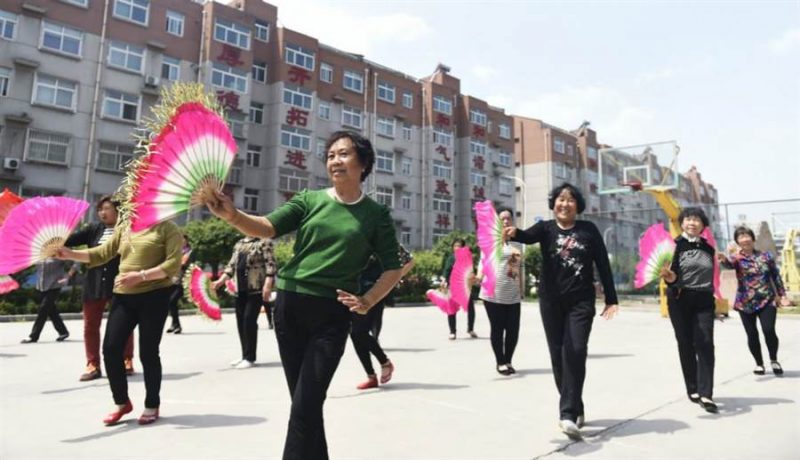
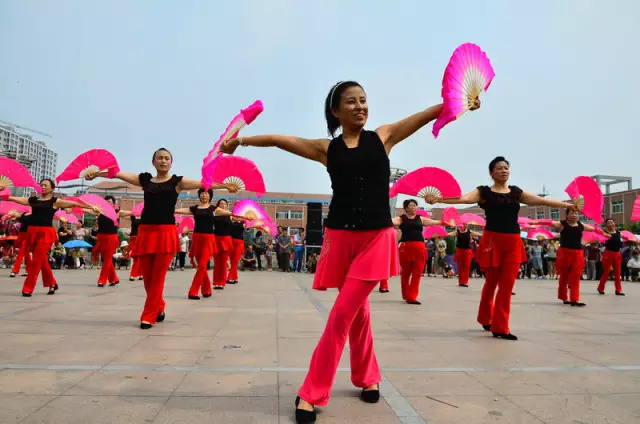
When I walked from school to home at 7 pm everyday in Beijing, I always saw several groups of middle-aged or senior women dance together on the street, square and other public spaces gracefully. They worked very organized with creativity. They are so disciplined –look like professional dance artists. They were so concentrating on what they are doing. I can clearly see an order among them. This is “Square Dance” in China, which becomes a very universal cultural phenomenon in the mainland China especially.
Firstly, Square Dance can be seen as a form of rebelling and feeding back of the elite culture due to its resource and presenting result. As Ranciere said: “These forms define the way in which works of art or performances are ‘involved in politics’, whatever may otherwise be the guiding intentions, artists’ social modes of integration, or the manner in which artistic forms reflect social structures or movements.” The square dance can be seen as a potential politics voice as they create assembly together on the street. The elements of the square dance come from the classical dance and folk dance repertoire/elements from Beijing Dance Academy(BDA), which represents the highest dance education hierarchy and elite dance taste in China. In the country. In the process of urbanization, the indigenous folk dance has disappeared in the urban area for a long time. Square dance people absorbed the dance from BDA, and merge their own understanding, favor and movements, to form a novel ‘folk dance’, which is a rebelling of upper structural culture in my perspective. They simplified the original elite dance with an unspeakable logic, and other laws have been added to form a new and completely different style. For example, they simplify the technique of Silk Belt Dance and reconstruct it into Yangko rhythm to form a novel aesthetics. As a result, sometimes, the elements of square dance are also absorbed by the elite dance education institution. Therefore, there is an interesting wave: when the government is promoting ballet to penetrate the ideology to the grassroots, Square Dance People`s changing elite concert dance elements is a form of agonistic and redefining the power.
Secondly, Square dance make middle-age women to be visible. There are very few people who really watch at Square Dance. Who are they dancing to? If it is just a practice, why do they have clothing requirements occasionally? Why does the managing of dance groups is so organized? I thought that It is more than “just a dance”, it silently calls the idea that “everyone is an artist”. Square Dance is always related to the spectacle, they hope to be seen by society. In the Aesthetics of the Oppressed, Boal states: “Spectacle is not confined to a fifteenth birthday party at which the young woman dances her first waltz with her father, or the dance of the commoner Angelica with the Prince in Visconti’s The Leopard, which opens the doors of nobility to her, or the marriage ceremony of a bride all dressed in white; nor is it only when the president of the Republic lays wreaths on the tomb of the Unknown Soldier, or a new road is officially opened. Spectacle is not just these moments of extravagance and pomp; it also embraces the hearty family Sunday lunch, where people eat and talk according to established rules, as in any piece of theatre. Spectacle has the function of revealing who is who, as if planting a legend on the brow of each protagonist or supernumerary”. These women want to be identified. Today’s China society gradually becomes an individualized society. Even the living conditions of young in the big cities have begun to “atomize”. They have a very high sense of borders and strong self-awareness. However, In the process of the growth of the “square dance generation”, the collective personality was shaped very strongly. Thus, when they retire or are at the age of retirement their focus shifted from family or profession to the blank, they lose the mental support of the relationship of their children’s family and profession, their time-consuming blanks will come out. The ideas of the previous generation and the new generation are almost faulty, and there are very few ways to provide such people with a spiritual world, so they are more willing to find their own sense of presence and importance through collective activities. Most importantly, from a social perspective, these “square dance” people are mainly the 50s and 60s, they have experienced a profound social structural change in their life. Therefore, they need to be in groups, they need their music, they need to stand in the square/stage that everyone can see, remind themselves and others, they can still adapt to today’s society and have not been thrown away. As Ranciere pointed out: “It is a delimitation of spaces and times, of the visible and the invisible, of speech and noise, that simultaneously determines the place and the stakes of politics as a form of experience. Politics revolves around what is seen and what can be said about it, around who has the ability to see and the talent to speak, around the properties of spaces and the possibilities of time”.
Finally, Square Dance is also a form of feminism activism in my opinion. Chinese scholar Zhang Zhaoxuan has summed up the three common experiences of the participants of the square dance: from the individual point of view, these women are mainly the middle-aged or older who have withdrawn or are about to withdraw from the professional field; from the perspective of family life, these women are mainly during the separation for intergenerational relationship and decreasing the expectation of sexual experience and marriage life. In some sense, women are re-establishing their own presence in an open traditional way. The former female sexual identity and even the maternal sexuality are no longer important. They begin to establish a special female social identity.
Can Square Dance be a tool of challenging public order? Chantal Mouffe thinks everything related to politics and is always relevant. Art practice also shows its radical potential to influence social and political connections from the inside. Jacques Rancière redefined the politics and aesthetics by the distribution of sensible—Through the involvement of perceptual images, those invisible people obscured by power can emerge and get more possibilities, thus challenging the original public order. The distribution of sensible is also a division between visible and invisible, arguable and incomprehensible, understandable and incomprehensible. Ranciere suggests that: “Artistic practices are ‘ways of doing and making’ that intervene in the general distribution of ways of doing and making as well as in the relationships they maintain to modes of being and forms of visibility”.
Reference:
Étienne Balibar, “Three Concepts of Politics: Emancipation, Transformation, Civility”
Jacques Rancière, The Politics of Aesthetics
Chantal Mouffe, “What is Agonistic Politics?” and “Agonistic Politics and Artistic Practice”
Augusto Boal, Theatre of the Oppressed