How persecution and violence came into being in human society, how does it work against human bodies, and what are the possibilities of resistance, consist of the main themes of this week’s reading. Foucault’s Discipline and Punish provides a historical, thorough analysis of how bodies became the target, the object, of painful torment, as well as how such torment became the apparatus of executing power, whether it is the sovereignty power of making die and letting live, or the biopower of making live and letting die. Making flesh suffer–especially in a way that is of humiliation and alienation–against its initial willing, shows absolute domination over “others”. Therefore there is not only the visible method of persecution, which is violence, but also a hidden logic of racialization–the creating of “us” against “them”.
Girard pointed out this dangerous yet constant phenomenon, or even the need of division within human society as the root of stereotypes of persecution. According to Girard, there are always the same key elements that motivate persecution. First is the eclipse of culture that causes social crisis, which makes people “blame either society as a whole… or other people who seem particularly harmful for easily identifiable reasons” (Girard, 14). It is almost alarming to realize such vicious instinct of looking for scapegoat to take the blame, ruling out the “abnormal”, in order to somehow ease the pain of life, or simply the feeling of being disconcerted. Then there comes an absurd move towards scientific reasons, such as poisoning, creating a myth that overlooks the personal insignificance and believes in the great danger small group can pose to a vast society.
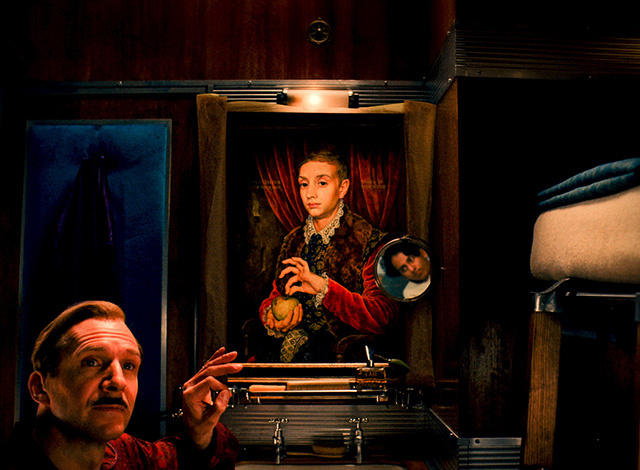
The “us and them” discussion continues in Percepticide while Taylor focuses on the what it means of seeing and being seen. The strong temptation people feel to see is due to the voyeuristic pleasure, which is largely a sexual desire in its own form, and can be manipulated by either letting see or leaving an absence in theatre, with a precondition of distancing. However, once such scopic pleasure is smushed, as in Gambaro’s work, seeing gains an enormous power and it transmits within the crowd, bouncing back and force, connecting everyone as a whole so there is no escape for only one side. Victims are seen closely but can also “returns our look” (Taylor, 135). This duality of mutual visibility reminds me of the very classical scene in Wes Anderson’s The Grand Budapest Hotel (2014), where the M. Gustave, Zero and the Boy with apple in the picture all stares at each other, while at the same time drawing the audience in despite the existence of a screen. It in a way represents the complex relationship between persecuted Jews, the silenced people of kinship (maybe as potential allies of persecutors) , mirroring the tragedy of history as a warning of today, of what tragedy might happen when people turn away from the fact and refuse to see.
Foucault, Michel. Discipline and Punish: The Birth of the Prison. Second. New York: Random House.Inc, 1995.
Taylor, Diana. “Percepticide.” In Disappearing Acts: Spectacles of Gender and Nationalism in Argentina’s “Dirty War,” 119–281. Durham: Duke University Press, 1997.
Girard, René. “Stereotypes of Persecution.” In The Scapegoat, 12–23. Baltimore, Maryland: The John Hopkins University Press, 1986.