The reading this week that addressed the issues of facts versus different fallacies in political discourses is something that is common in many political spectacles. It is not the notion that someone is necessarily lying, however it’s the presence that the political figure has, and how they command a room and a certain discourse. Many of these political figures that has a cult like following that invokes a certain level passion in their followers, are seen as a mythical figure that represents the things that may think but not necessarily do, or presents a certain discourse, factual or not, that aligns with their beliefs. It is not important for that person to have the most morally sound background because that is not the basis of their following. From many experiences in the classroom during my undergraduate career, I came across many people who followed certain political figures not because they had the same moral compass but because they ran on a certain ideology that they subscribed to. The very curious thing about that is even if the person is known to be racist or has racist tendencies, they still supported them because they upheld their political beliefs or that of their parents. For example, the idea of make belief reminds me of the reconfiguration of the history of medieval Spain, specifically Al-Andalus. This history was reconfigured and presented under the nationalistic discourse of the Franco campaign. The past discrepancies in the representation of this time period in the Iberian Peninsula is solely based on an ideological understanding of the time period. In Spain, the negation of Al-Andalus from the national Spanish Identity is reminiscent of this notion. This idea that something could return, taps into a societal fear fueled by a constructed ideology. These beliefs about medieval Spain fueled by nationalist narrative is intertwined with the religious make up of certain geographical borders, that made the understanding of them against us. This nationalistic discourse was further linked to modern terrorism in Spain, to further exclude Al-Andalus from the national identity of Spain and making sure to establish the country as a catholic nation. The modern right-wing conservative parties, especially VOX, have often latched on to certain religious discourse that points to a certain historical background and reassuring the population that they have to continue fighting against these forces that may be a threat to this catholic nation. This is the idea that one has to preserve their understanding of themselves as a nation even if the rhetoric is problematic. The contracting part about this discourse in Spanish society is that there are prized monuments that reflects a different history, the Alhambra in Granada and the mosque in Cordoba, are merely used for economic growth, while there is an active dismissal of certain part of the Spanish national identity. These are only beneficial when economic gain is involved. Overall, there is no need for having facts or accurate discourses for a political figure because their followers are still going to support what is being done since it is a reflection of their own beliefs and sometimes their fear of drastic societal changes.
Category Archives: Week 8
gaze out of time
Considering the readings of this week, I would like to continue with my thoughts and ideas of the last post. What does it do to us, spectators, and to victims themselves of them being “incapable of returning the gaze“? (Rancière, “The Emancipated Spectator” p.96)
Rancière describes it as one of the reasons for why and how horror through images is being banalized- not due to the amount of images- it is the lack of the victim looking at us; objectified bodies without names.
I deeply appreciate the way that Ariella Azoulay writes in “The Civil Contract of Photography” about the different gazes and expressions of the photographed in the daguerreotypes. ” These photographed people address someone who is not present, an addressee who opens up the space in which they are placed, who undoes – albeit very slightly – its oppressive limits. Though they know nothing of the category of a universal addressee, their gaze is addressed to someone like her whose existence they assume when they address their gaze to her, revealing something of their feelings toward their enslavers.” (p.173)
Their gaze has power as it goes beyond the very moment of being “violently fixed”; this gaze goes out of the image, and therefore out of time. Does the claimed truth carry true affect?
The spectator does not know if the gaze of the ones becoming stationary through photography has been choreographed or decided by the photographer/ director, therefore she needs to look with a “gothic lens” at the ones who became “gothic subjects”.
(gothic lens / gothic subject are concepts by Bonnie Honig, included by Christina Beltrán in her text “Undocumented, Unafraid, and Unapologetic”.)
Visión, acción y política
El tema en común que comparten las lecturas de esta semana es la relación
entre política, discurso e imagen, y de qué manera irrumpen en la arena pública los
efectos políticos de lo visible. En The civil contact of photography, Ariella Azoulay
postula que en la producción de la imagen fotográfica hay un exceso de sentidos
inmanejables por quien fotografía y que pueden ser definidos por la noción de “acción”
teorizada por Hannah Arendt, en tanto la foto produce efectos irreversibles e
indestructibles. Para la autora, el acto fotográfico carece de autor individual ya que
múltiples actores participan de su producción, difusión y recepción, y, en ese sentido,
involucrarse como espectador/a de ese acto implica una especie de contrato en el que
este/a accede a una “ciudadanía de la fotografía”.
En “Undocumented, unafraid and apologetic” Cristina Beltrán analiza el
activismo virtual de nuevas comunidades de jóvenes indocumentadxs, y cómo esos
espacios, en tanto proponen nuevas visualizaciones de lo político, posibilitan la
emergencia de disidencias. Por otro lado, Beltrán muestra también cómo esas
visualizaciones, cuando pierden su caracter disruptivo, pueden ser asimiladas por
discursos de derecha, como los manifestantes que, aunque reivindicando identidades
migrantes, enarbolan opiniones nacionalistas y pro ejército.
En “The intolerable image”, Rancière se pregunta qué vuelve intolerable una
imagen y causa indignación de un estado social de cosas, en tanto es uno de los
efectos políticos más eficaces del arte. Para Rancière este efecto no es nada más que
visual, sino que entraña una cierta conexión entre lo visible y lo decible. De acuerdo al
autor, en la época contemporánea, en la que hay una superproducción de imágenes,
aquello que anestesia los efectos políticos de lo visual es que el sistema oficial de
comunicación restringe la posibilidad de que esas imágenes sean interpretadas y por
tanto se vuelvan móviles de acción. Por eso, Rancière considera que el poder político
de las imágenes se encuentra en su capacidad de perturbar la conexión hegemónica
entre lo visual y lo verbal, proponiendo nuevas configuraciones de lo que puede ser
visto, dicho, pensado, y por ende nuevos
You Make Me Feel, Mighty Real: Image Introducing Realities
Disruption of political norms inevitably requires a queered imagining of the future. This future is never entirely contingent on present-tense conditions, but rather, becomes emboldened by what some day may be witnessed; a consequence of audacity, a notion that reality is never truly momentary, but continuously pieced together by social edits to a preconceived script handed down like tradition. These traditions strive to establish a framework capable of haunting an individual into a ritual submission, at once invisible and omnipresent. This perceived invincibility spurs a collective champing at the bit, a population ever gazing for the invisible horror they would rather bask in than subjugate.
Here- witness a population transfixed by plurality lest they risk isolation. This shared watching of the political condition has become tantamount to citizenship, in that it asks for specific membership criteria of the inevitable spectactor while depending on their renewed sanction to the agreement. This cyclical, aesthetic horror story gleams an abdication to Doom whenever minoritarian subjects encounter this hegemony and are incapable of becoming neatly fixated within its framework. Our readings this week expose what it means to exist in this zone of displacement, noticeably in relation to the image and its modes of confession.
Like an action, you cannot take photography back. In this way, Azoulay by way of Arendt, contends that photography ontologically resembles action more than work (129). Moreover, if space of plurality in necessary for a condition of action, we must expect the same of photographs. Modernity has turned the image and photography into a valuable currency capable of undermining stability in its capturing of a moment, and in turn, the perception of a reality. And yet, the dominion photography thrives on a horizontal plane, its conquest dependent on the photographer with the camera in hand, the subject within the photograph itself, and anyone who dares look (Azoulay 138).
“This is X” is the implication of an image, and at the same time, an unfeasible rendering of a moment (Azoulay 141), if we consider the vast apparatus of time and space and the mess they make of history. The image skillfully asserts its nature as gestural identification while assuming the role as mere convention, which Azoulay reminds us is “first and foremost a gathering” (143). A get-together is truly only as inspiring as the compliance of its guests, and yet, the image is clandestine, filled with discursive eruptive pockets often times only felt by specific groups or in specific instances, out of sight, but nonetheless still present.
What struck me most intensely from each reading was this concept of “BECOMING A SPECTATOR, BECOMING A CITIZEN,” bookended by Azoulay. Ranciere asks us to consider the differences between becoming and representing, differences that leave a gap wide enough for contestations of identity to be exploited for the biopolitical:
“The image never stands alone, it belongs to a system of visibility that governs the status of the bodies represented and the kind of attention they merit…Representation is not the act of producing a visible form, but the act offering an equivalent…The image is not the duplicate thing. It is a complex set of relations between the visible and speech, the said and the unsaid. Not just what is in front of the photographer/filmmaker. It is always an alteration that occurs in a chain of images which alter it in turn” (96-99).
Therefore, the image as commodification, as public conversation and agreement, is drafted in the reflection of the rulers in society, aesthetic gatekeepers who, with great nerve and audacity, keep the information machined well-oiled by churning out political spheres in which the masses should identify, lest they fall by the wayside, out of bounds, indiscernible: non-citizens.
Ranciere prompts us to “construct different realities, different forms of common sense…different spatiotemporal systems, different communities of words and things, forms and meaning” (102). This resilient queerness is exemplified in modern times by DREAMers, undocumented youth whose appearance calls into question the limitations of citizenship. Beltran describes how “coming out” for undocumented youth is “an effort to become civically legible and politically speakable” (87). DREAMers assume the role of moving image, avoiding both the promissory fragment of the photograph and its stable gaze as well as the faulty sheen of representation. In concordance with the Gay Rights Movement, “coming out” implies leaving one foot within the inverted spectacle, while the other makes a mad dash from restraint, knowing the other can soon follow with enough velocity- such successive images mark continuity. This new domain of spectactor-ship, created via routes of new media and online assembly, carves out a vantage point that anticipates a queered, future-oriented, political-consciousness, its authorship in the hands and the eyes of the oppressed, intolerability making way for emancipation.
Representing the Intolerable
This week’s readings relate to two modes of representation—speech and image—and the pitfalls, limitations, and interconnectedness of each within the field of politics.
In The Civil Contract of Photography, Azoulay rescues the original, democratic project of photography as a tool for the practice of plurality, of active spectatorship. Azoulay foregrounds an “original” conception of photography—which motivated the French state to support the creation of patents and to promote photography as a democratic tool, as a new method of civic engagement, in which anything can become an image and anyone (with the right tools) can participate. In this (Arendtian) sense, photography resembles action in that photography was originally purported as a tool available for the masses, inaugurating “a new form of civil relations… not mediated by a sovereign power” (134), which had unpredictable ends, which did not end with the click of the shutter or the printing of the surface of the image. Therefore, within the citizenry of photography, the space depicted on the surface of a photograph, every non/citizen within the frame has equal rights, establishing civil contracts of photography. This opens the potentiality of images as a political tool because photographs do not simply depict “what was there”, for there are always external factors imbuing the photographic moment with power relations. As a democratic tool, Azoulay proposes analyzing political images by becoming citizens of the citizen of photography, which means to not take the image as a finished representation of “what was there” but as a stepping stone towards changing the conditions in which a photograph was taken, the very situation which compelled the photographer to share the photograph in the first place.
In “The Intolerable Image”, Rancière dissects the political praxis of photography by asking what makes an image intolerable, under what conditions, and what are the pitfalls of photography which aims to represent the intolerable. Stemming from Debord’s Society of the Spectacle, Rancière claims that within the society of the spectacle, the image has come to represent reality itself, because which an image of appearance can be just as shocking (or intolerable) as an image of Reality, making all images complicit in the same system of images that makes them all equivalent, incapable of moving affects for political means. In my view, according to Rancière, the effect of the society of the spectacle interrupts the conquest of the world as image according to Azoulay: because so many images occupy so much of our time coming at us from so many angles and so many citizens depicted therein, “it now seemed impossible to confer on any image whatsoever the power of exhibiting the intolerable and prompting us to struggle against it” (84). Therefore, instead of “inviting the participation of others in the negotiations of what and how that image signifies” (Azoulay 143), we are trapped in the constant substitution of one image for another, never achieving a true or total image of Reality.
Therefore, this massive influx of images is enough to interrupt the civil contract of photography by bombarding us with images of an ever-increasing detachment from reality. In the maelstrom, how can we not inject ourselves with percepticide, nor be complacent in the predigested journalistic teleprompters and talking heads spewing a curated flow of sometimes violent, always consumer-friendly, images of reality? Within this framework, Rancière dissects action as the response to “the evil” of the image and “the guilt” of the spectator who is compelled to action by what is represented in certain images. If the only response to evil is action, Rancière assumes that a main goal of images interpreted as intolerable and/or political is to move affects in the spectator through guilt—which is already such a loaded term.
Therefore, this massive influx of images is enough to interrupt the civil contract of photography by bombarding us with images of an ever-increasing detachment from reality. In the maelstrom, how can we not inject ourselves with percepticide, nor be complacent in the predigested journalistic teleprompters and talking heads spewing a curated flow of sometimes violent, always consumer-friendly, images of reality? Within this framework, Rancière dissects action as the response to “the evil” of the image and “the guilt” of the spectator who is compelled to action by what is represented in certain images. If the only response to evil is action, Rancière assumes that a main goal of images interpreted as intolerable and/or political is to move affects in the spectator through guilt—which is already such a loaded term.
For her part, Beltrán purports new political movements by DREAMers and other undocumented youth that do not care for the guilt of spectators, which is motivated by a paternalistic view of pity and which moves the body to action through charity. The Undocuqueers exemplify how combativeness, visibility, unapologeticness, produce their own speeches and images, their own written and bodily languages, their testimonies, to spur action through solidarity, through the visibilization of the violence of the invisibilization of mass deportations. Her recount of undocumented youth coming out of the closet of being documented, queering democratic processes by foregrounding contestatory methods of representation through speech, text, and image, that defy normalization and assimilation in favor of a new arena of political representation. If we are to be citizens in the citizenry of photography, we are to face the same stark and intolerable reality that these noncitizens throw in our faces. If. according to Rancière, the true witness is they who share their testimony despite the horror they have faced, who are compelled by the voice of an Other to share their take on Reality, then these DREAMers are an even truer witnesses to their daily horrors of racist and xenophobic violence. Because of the injustices they have suffered, they cannot continue to tolerate their intolerable reality: they aim to move the public not through guilt, but through a collective call to solidarity, through newer and queerer bonds of kinship outside the heteronormative realm of American assimilation. In an interesting reversal, despite being compelled to not speak, they choose to speak up in so many ways, to resist and transgress. Thus, this imperative to share the intolerable, to make their story intolerable, to spur action through solidarity, could prove to be more effective a political tool than to simple make a spectacle of the horrors of society and incite action through a passive relationship to image and speech.
Images and alternative public spheres
Los textos de esta semana giran en torno a la conexión entre el espectáculo político y el ejercicio de la ciudadanía, en particular mediante el uso de las imágenes (Ranciére y Azoulay) y las redes sociales para crear nuevos espacios de discusión en una especie de ampliación de la esfera pública y añadir elementos al análisis de la relación entre arte y política.
Para Rancière, la imagen del horror está inmersa ella misma en un sistema en el que el simple hecho de mirar la imagen que denuncia la realidad denota una complicidad (85). Esto porque al mirar la imagen (o elegir no mirarla), sabemos de antemano que sentiremos culpa, pero que no haremos nada al respecto. En esta interpretación el foco se fija en el espectador y a sus al parecer opciones opuestas, ser el espectador que ve o ser el espectador que actúa. Si, de acuerdo con la propuesta por Ranciere, la estética y la política responden a un reparto de lo sensible, ¿Cómo operar una redistribución no mimética del ver y el actuar que dé lugar (tiempo y acción) a posibilidades emancipatorias? Por su parte Azoulay analiza la fotografía y su lugar en el ámbito político. Para ella la fotografía no es un simple objeto, sino que está llamada a generar una reacción. Nuevamente tenemos acá la figura del espectador como interlocutor de la imagen y el ejercicio ciudadano que ella posibilita, pero en una relación espacio temporal que supera el aquí y el ahora en la medida en que la fotografía puede ser vista en diferentes tiempos y provocar distintas reacciones, así como puede ser vista por espectadores ubicados en diversos lugares (135), generando así posibilidades de expansión del espacio de aparición.
Finalmente, Beltrán propone repensar la categoría de ciudadanía a partir del análisis el fenómeno del activismo de l*s DREAMers, su uso de las redes sociales para la publicación de sus testimonios en primera persona, y la apropiación y transformación creativa del Coming Out, como herramienta que genera espacios de aparición, muchos de ellos virtuales, en los que los DREAMers desafían las políticas migratorias de Estados Unidos al negarse a permanecer en silencio por miedo a ser procesad*s y deportad*os. Así, la declaración del status de indocument* por parte de los DREAMers habilita la lectura de la incapacidad del concepto actual de ciudadanía para dar cuenta de tod*s l*s que construyen una comunidad desde prácticas cotidianas económicas, políticas y sociales, así como denunciar la manera en que las políticas migratorias terminan reforzando un estilo de vida heterosexual (99).
photos, figures, images
“The photo… is the outcome of focus, excision and framing. Yet the image retains a direct connection with the depicted object, because it was written by the object’s own reflected light, by its aura” (Azoulay, 149).
Ariella Azoulay’s theorizing of the “horror photo,” which, in the work of Jacques Rancière, is called “the intolerable image,” is caught up in an institutional complex–of “structures, mechanisms, and positions”–that is prepared to manage it at any time and place. The “horror photo” must be more shocking every time we see it, if we are to be reconciled with death, so as not to be insensitive to it (155). This line of thinking is positioned as a point of departure for Azoulay, who, in her book chapter “The Spectator Is Called to Take Part,” orients her theory of the civil contract of photography towards the act of prolonged observation, telling us that this act by “the observer as spectator” has the power to “turn a still photo into a theater stage upon which what has been frozen comes to life” (159). Thus, following her statement quoted at this essay’s opening, we see that it is not always only the photo that is the outcome of “focus, excision and framing,” but also the “coming to life” of that which “has been frozen.” It is interesting to interpret these two outcomes as ‘photos’ and ‘figures’ (respectively), performing in various unpredictable ways, resting on the hinge of the image–that is, the futurism of the ‘world picture’, which was “photography’s vision from the very beginning” (Azoulay, 138).
According to Azoulay, the object of photography, present in the world of experience, “imprints an image on the emulsion that… always contains an element that exceeds the world of experience, thus exceeding interference” (149). I think what Azoulay is getting at here is of tremendous gravity: it is both similar and different that the transcendent experience sought after in Kant’s aesthetics, and that aesthetic experience sought after by Barthes. Here is where we begin to understand her theory of the civil contract of photography as a theory of image economy: a circulation of meaning, affect, figuration, coalescing time and time again in unpredictable ways in multitudes of performative contexts, exceeding the world of experience, bringing life to the frozen, turning observers to spectators. Her theory is of excess, surplus production, even while protecting the negative (death; dead object, addressee). It is deterritorialization: “the photo acts, thus making others act…oriented toward the future” (129).
Thus, the connection between the “horror photo” and the “horror figure” are clear. But what do some of these “horror figures” look like? Christina Beltrán, in her essay “Undocumented, Unafraid, and Unapologetic,” provides us with an account of the figure of “the foreigner” as the “truest citizen,” noting the harm this has done in public discourse as well as in its manifestations in immigration policy: “… the very attributions used to make immigrants attractive (they work hard; they value family and tradition) can easily become the same qualities that make them threatening (they take our jobs; their patriarchal and homophobic traditions threaten our capacity for progress). Rendering immigrants as forever foreign, the logic of xenophilia feeds into the xenophobia that pro-immigrant advocates are trying to overcome” (86). I am recalling here Balibar’s statement in his essay “Politics and the Other Scene” that all protest can turn into legitimation (Balibar, 7). This goes both ways and in various other unpredictable directions too though, as we return our thoughts to Azoulay’s assertion that “photography functions on a horizontal plane”: it is a tool of the masses (134, 138).
I am interested in what this all means when the “emulsion” upon which the “object of photography…imprints an image” (Azoulay, 149) is the body; when the body is also the “horror figure,” formed through an image economy of “horror photos.” In the surplus production of the image, how are bodies transformed? How do ‘we’ participate directly in image economies in ways that meaningfully address and radically transform scenes and spacetimes of horror without reinscribing or reifying it? As Jacques Rancière tells us in his book chapter “The Intolerable Image” that “there are images in language as well. They consist in all those figures that replace one expression by another, in order to make us experience the sensible texture of an event better than the ‘proper’ words would” (94). Rancière’s attention to the experience of the sensible texture of an event certainly rooted in his theory of the ‘distribution of the sensible’, but I think there is much more here. I’ll say first that my interest in the “horror figure” as it develops through economies of “horror photos” (both discursive and photographic images) stem from an interest in the genre studies that have been done within Black studies, trans studies, disability studies, and queer theory that have provided close readings and rich accounts of figures attached to bodies. For example, discourses around social death and the figuration of the living dead, the zombie; or, the trans body as a body always in transition, neither here nor there, real nor fake, like a ghost. In connecting Azoulay, Beltràn and Rancière to these discussions, I think the turning of the observer to spectator blossoms into a yet deeper investment in transforming the very process of figuration that turns a still photo into a theater stage, that brings to life that which has been frozen.
“The treatment of the intolerable is thus a matter of dispotif of visibility. What is called an image is an element in a system that creates a certain sense of reality, a certain common sense. A ‘common sense’ is, in the first instance, a community of sensible data: things whose visibility is supposed to be sharable to all, modes of perception of these things, and the equally sharable meanings that are conferred on them. Next, it is the form of being together that binds individuals or groups on the basis of this initial community between words and things. The system of information is a ‘common sense’ of this kind: a spatiotemporal system in which words and visible forms are assembled into shared data, shared ways of perceiving, being affected and imparting meaning. The point is not to counterpose reality to its appearances. It is to construct different realities, different forms of common sense–that is to say, different spatiotemporal systems, different communities of words and things, forms and meanings” (Rancière, 102). *For an example of this in action, see the queering of immigration politics in the cyber-testemonios of undocumented, unafraid, and unapologetic youth on social media (Beltràn).
The Power of the Image
The readings for this week focus on the alternative ways for the space of appearance and action that rely in the use of different tools like photography and social media and how these complicate the relationship between spectators and political actors. Beltran (2013) examines the new ways of “coming out” that permitted undocumented activists to reclaim agency and not simply be “spoken about” but instead to be “speaking subjects and agents of change” (81). She calls this peer-to peer and social media use for activist participation a “queer” vision of democracy where an open participation becomes more direct and visible and where activists are able to express “more complex and sophisticated conceptions of loyalty, legality, migration, sexuality and patriotism” (81). With the idea of representation, Beltran mentions the shift in “the politics of incorporation and inclusion” (81) that comes with performative acts and gestures that directly criticize the state unjustice. Here, participation in online practices and new forms of media challenge traditional political domains.
Azoulay (2008) discusses the capacity of action of a photograph, which does not end with the photographic act, but rather has an aftermath effect. For the author, the use of photography has the power to expand the space of action and its effect goes beyond territorial spaces; “ The photographer who found a gap in the curfew and pointed his camera towards the soldiers, deviating the sense and direction of their action, thus restored the conditions of plurality to the space of action. Although plurality cannot erase structural inequalities and discrepancies between the different protagonists, the space of plurality undermines the apparently stable conditions of domination.” (133) Here, photography becomes an object of intervention that gives the capacity of action for the spectator and the one holding the camera; “Within a new framework of time and space, the photograph creates new conditions for moral action.” (135)
Rancière (2009) examines photography as a testimony and its dialectic as image; “The stock reaction to such images is to close one’s eyes or avert one’s gaze…For the image to produce its political effect the spectator must be convinced that she is herself guilty of sharing in the prosperity rooted in imperialist exploitation of the world” (85) Here, photography does not merely represent reality or a duplicate, but has also the power to compel message and a call to action. In this sense speech and image, rather than being opposite cane be complementary.The readings complicate the idea of the space of appearance, civic relations, visibility and representation through the use of new technologies that can be used to reclaim rights and citizenship.
Seeing tears
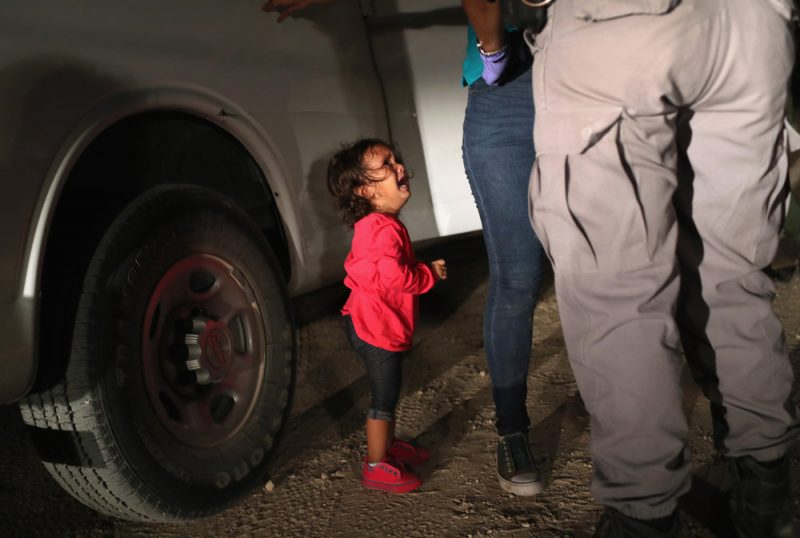
In June 2018, photographer John Moore captured a photo that unveiled the essence of asylum seeker border crossings. A 2-year-old Honduran girl stands crying in front of a border patrol agent while her mother is face to face with the authority figure. Taken from the child’s point of view, we see the young girl rendered helpless as adults tower over engaged in a legal search of bodies (Garcia-Navarro, 2018). The photos “out” the mother and daughter as asylum seekers in a call for empathy. Similar to the DREAMers in Beltran’s (2015) work, the image works to illuminate “the human face on the complex dynamics of migration as the space of economic arrangements, human desire, and community building” (p.94) After the image went viral the public responded on social media calling the current political administration a shame, people pressures lawmakers to address the separation of families, and most recently the photo won 2019 world press photo of the year (Mark & Ralph, 2019).
While many were aware of current immigration policies, the image forced its spectators to come to terms with the Realities of criminalizing asylum seekers. As Ranciere affirms images have a life of their own; “showing everything that can not be said” (p. 90). In Moore’s image the spectator must cope with harsh reality of families making the trek across the border while the agent captures kin as a part of their job. The photo of the little girl crying makes the spectator wonder, ‘is the situation created at the border just or unjust?’ ‘Will her cries be heard outside this photo or will people continue to look away?’ As Azoulay (2008) highlights, “the spectators work is that of prolonged observation” (p.159). Therefore, it is up to the spectator to do the work of looking and acknowledging the hard truths photos capture.
Garcia-Navarro, L. (2018). ‘It was hard to take this pictures knowing what was coming next’, NPR. Retrieved from https://www.npr.org/sections/pictureshow/2018/06/17/620775153/a-photojournalist-at-the-border
Mark, M., Ralph, P. (2019). A getty photographer tells the story behind heartbreaking photo he took of a migrant girl sobbing while agents questioned her mom at the border, which just won world press photo of the year, Business Insider. Retrieved from https://www.businessinsider.com/photo-migrant-girl-cries-as-border-agents-question-mom-john-moore-2018-6
Mediated images, truth and actions
Citizenry and citizenship in the era of new medias, especially imaging medias, is a thread that weaves all three readings this week together. Starting with Beltrán, it is clearly proposed that medias have been serving as mobilizing forces in order to create participatory politics modes for a long time. When conventional media such as prints, flyers, news and verbals are still dominate, it was common for undocumented to blend themselves in the crowd. Through public spaces, the undocumented enact with a larger group, while at the same time find themselves disguise and protection of some extent. However, the advent of Internet and social media no doubt took things a step forward, it helped creating an alternative queer public sphere that is highly interactive, collective and peer based, allowing the voice of the undocumented to travel far beyond the geographic or physical boundaries and transform into a real difference. They “reject secrecy in favor of claiming membership through a more aggressive politics of visibility and protest” (Beltrán, 87) that include a vast variety of social issues, with the action known as “coming out”.
This voluntary exposure of one self indicate the bold efforts to become civically legible and politically speakable (Beltrán, 89), which lead to the discussion of image and spectatorship centered in Rancière and Azoulay’s discussions. Azoulay argues that photography has provided a new logic of performance and a new method of action, of which there is never a true stopping point. Photography create a contract that binds all three parties – the objectives of the photo, photographer and spectators – into a citizenry, where the seen as well as the “unseen” deliver and generate. The interpretation does not end by the moment of capture, but gets prolonged and repeated with differences. Therefore, spectatorship should not be passive as it has been defined anymore. Spectators surely participate, and it’s their participation made the whole new citizenry a possible and accessible sphere for the unseen to be revealed, for the silenced to speak, and for actions to be encouraged. In such way, the power of a general visibility (including the seemingly missing or invisible) is highlighted within the world making of images.
This is also the reason why the intolerability of images becomes of great importance. As Rancière explains, for a certain awareness or identification to be triggered by images, for example the guilty of being part of imperialism, one has to already know what guilty is and what should be ashamed of. “For the image to convince, the spectator must already be convinced” (85) of certain premise, which largely rely on common knowledge, one’s morality and political perspective, which comes from socialization. Then Rancière poses the question of whether the images should be abolished as they do not always convey the truth as they are meant to, with the ideal answer of “what we need is images of actions, images of the true reality or images that can immediately be inverted into their true reality” (Rancière, 87). Images never stop as they are, be them still or moving ones. In the era of highly mediated images, the truth may not be presentable, but it is the framing that actually leads what is presented forward into actions, and it is the actions made that truly matters.
1. Beltrán, Cristina. “Undocumented, Unafraid and Unapologetic.” In From Voice to Influence, edited by Danielle Allen and Jennifer S. Light. Chicago and London: University of Chicago Press, 2015.
2. Azoulay, Ariella. “The Spectator Is Called to Take Part.” In The Civil Contract of Photography. New York: Zone Books, 2008.
3. Rancière, Jacques. “The Intolerable Image.” In The Emancipated Spectator. London, New York: Verso, 2009.
Construction and reconstruction
The readings this week explore how civil relations are mediated. Ariella Azoulay, following Hannah Arendt, suggests that photography resembles action because the photographic act, when reaching its final product, “is in fact a new beginning that lacks any predictable end” (129). By making others act in unpredictable ways, a photo’s afterlives continue to create its real world effects. In exploring the “civil contract of photography,” Azoulay makes many important observations. One is that while not everyone is considered a “citizen” in State terms, we are all a part of this contract; “in the citizenry of photography, one is a citizen” (134). This citizenship, like the photographic event, is always an “unfinished task” (157). In discussing the photograph of the dead Palestinian, Azoulay notes the “present absentees of this photograph,” the hundreds of thousands of Palestinians imprisoned in their homes just a few meters away (132). Photographs, while drawing our attention to what is represented in image form, can also cause us to note what is missing from the frame.
Oftentimes, we approach an artistic intervention by considering the artist’s proposals, goals, and actions. Azoulay makes the significant claim that the addresser in a photograph is not necessarily the photographer, but rather the subject represented who is making a civil address: “the presentation of a grievance” (135). Thus, the spectator is called to action because, as a citizen of photography, “she has a responsibility toward what she sees” (135); we can qualify the existence of this responsibility within the context of Taylor’s text, which explores how certain citizens actively disavow their spectatorship in acts of percepticide. Rancière also grapples with the question of recognition, complicity, and responsibility, positing that “for the image to produce its political effect, the spectator…must already feel guilty about viewing the image that is to create the feeling of guilt” (85). This guilt is tied to the construction of the image, which is always already implicated in “a complex set of relations between the visible and the invisible, the visible and speech, the said and the unsaid” (93), a dispositif of visibility (102) that make image construction an exercise of power. By acknowledging how the image comes into being through a mediated process, Rancière argues that this is why interventions such as Alfredo Jaar’s are so political, because they disturb the “ordinary regime…employed in the official system of information” (95): they question the ways we receive information, what kind of information we are receiving, and what lies outside these frames of visibility. Is this not the political action that DREAM activists are engaging in in Christina Beltrán’s piece, using social media as a “strategy of visibility” to contest the construction of citizenship and “transform (rather than simply join) the current political system”? (80). It is interesting to consider Beltrán’s focus on the digital arena. If Azoulay argues that the “civil contract of photography” was established when “photography became a tool available to the masses” (134), what kind of civil contract does the digital era create? Beltrán touches on the rise of open-source/content sites for instance and how activists have used them to create alternative public spheres (81). Within the digital context, more questions around transparency, authority, surveillance, accountability, information, and collective action are formed.
Azoulay further discusses the idea of agency within the staging of the photograph. Consider the actions of Mrs. Abu-Zohir, who “[demands] her photo be taken” and “frames the injury” (139-40), or how in Agassiz’s daguerreotypes, the imposed similarity of the slaves is “disrupted by the different looks in the eyes of each subject” (172), contesting their existence as stationary objects “accessible to immediate and exhaustive viewing” (159), a colonized gaze; interesting here to consider how “injury” dialogues with the prick of the punctum that Barthes describes as what “wounds” the spectator (152) and calls to her attention what lies outside of the studium, or context, of the frame. I found Azoulay’s critique of Barthes to be fascinating, specifically how the concept of, or rather, the expectation for, a punctum can be depoliticizing; Rancière also argues that the political potential of images of art relies on “condition that their meaning or effect is not anticipated” (103). Azoulay argues that Barthes depoliticizes the punctum by establishing it as a “stable characteristic” of the photograph (153), although I would argue for its contingent nature, as that which unexpectedly pricks, and does not affect all spectators (I believe it has to do with one’s individual experience with the photograph). Still, it is true that sometimes we, considering ourselves to be engaging with the photograph through acts of looking and perception, expect or anticipate a reaction, to be pricked, thus “[transferring] the weight from the visible event that makes one shudder to merely the possibility that one might shudder” (154). Is this merely another form of percepticide? Where one is looking, but towards a certain end?
Azoulay makes the significant observation that “the photograph does not speak for itself…its meaning must be constructed and agreed upon” (143). The element of consensus in political relations here is hegemonically structured; Azoulay introduces the term “conquest of the world as picture” (143) to elucidate the expectation for the photograph to be “true,” to be an accurate representation “based on limited epistemological criteria of identification” (143) (a representative regime, perhaps, in Rancierian terms). Thus, the spectator is called to action again, not only by a responsibility towards what is seen, but returning to what is absent in the frame: she is called to “reconstruct” the image (149-50).

Cyber-testimonios as visual claims to citizenship
In her essay “Undocumented, Unafraid, and Unapologetic”, Cristina Beltrán discusses the strategies of visibility deployed by DREAMers in their claims to political recognition. In particular, she considers the appropriation of “coming out” as a strategy originated during the gay rights movement to present the “opening up of new possibilities to imagine political membership and political claim making”, what she calls the “queering of the politics of immigrations” (88). Throughout the text, digital platforms are highlighted for their potential to produce new (and more democratic) spaces of appearance for undocumented people. Transcripts of cyber-testimonios, videos of undocumented youth declaring their legal status and claiming their right to be in the United States, clearly articulate the potential of these new of resistance to the dominant discourses which surround immigration today.
The two other readings for this week can provide valuable insight for the interpretation of the case of cyber-testimonios. In The Civil Contract of Photography, Azoulay develops a new account of citizenship based on the practices of looking associated with photography following the “conquest of the world as picture” (137). This form of citizenship is distinct as it is mapped onto models the deterritorialized spectatorship, where the witnesses of injustice might be located in distant places and yet remain accountable for this differential governance and responsible for restorative action towards the photographed subjects. In“The Intolerable Image”, Jacques Rancière seeks to collapse the distinction between the testimony and the image. In response to the critique of the circulation of photographs taken in gas chambers during the Holocaust, Rancière asks “What distinguishes the virtue of testimony from the indignity of proof?” He argues that the tensions between “having to” speak and being unable to is only possible to capture in photographs, in the expressions of those sharing their testimony.
The cyber-testimonio of Georgina Perez can be read through both Rancière and Azoulay’s accounts of citizenship and spectatorship. Georgina’s tearful expression of love, respect and gratitude for her mother directly confronts and dismisses the impulse within political discourse to criminalize the parents of DREAMers while emphasizing the innocence of their kids. The words in her testimony and the emotion we can perceive in her face during the video both clearly convey the personal depth and significance of the politics of immigration. In making herself visible, Georgina is also claiming the kind of citizenship of photography that Azoulay proposes. She is introducing herself as a political actor within an alternative space of appearance, and making us (as spectators) responsible for the differential ways in which we are governed based on formal “citizenship” status. She finally asks us “Are you going to be on our side?” (92). As witnesses to her testimony, we have to be.
Who acts through an image?
“Representation is not the act of producing visible form, but the act of offering an equivalent – something that speech does just as much as photography”. (Rancière 93)
All three authors of this week brought up the idea of what action photography and videography represent and citizenship of their actors. Azoulay starts her chapter by establishing photography as a civil action in Arendt’s term that is irreversible, without “a clearly demarcated beginning and a predictable end”(129), making others act. Both Azoulay and Rancière use examples of photographs of violence and horror as intolerable images to show the act of taking an image by its different participants. For Azoulay in the photo of two armed soldiers behind the dead body of Palestinian, the actors are not only the soldiers, the corpse, their photographer, a photographer that captured the action of taking the image, but also absent Palestinians. They are invisible in the picture, but their presence is embodied in the context where they are not even able to take care of their dead citizens. The unshown is also present in Rancière’s example of Wajcman’s gas chamber witnesses, “in whose eyes we can detect the horror we have seen” (92). Beltran’s actors are invisible and undocumented in real life but appear in social media through images, speeches, and videos, making equivalent queer space of appearance for themselves and all other migrants in a similar situation. In all these cases, participants of the image go beyond what is captured on the picture, including spectators who continue the action of a photo through the feelings it invoked in them. Azoulay states that “although plurality cannot erase structural inequalities and discrepancies between the different protagonists, the space of plurality undermines the apparently stable conditions of domination” (133). DREAM activists prove this idea making their collective appearance visible to the government. While the group fought for American citizenship, Azoulay spoke for citizenship of photography equally sharing the burden of responsibility for images among multiple participants of it. I believe no matter who is seen as a protagonist, author or spectator of an image it is important to keep in mind that everyone encountering carries the obligation to give justice to it.
The Photographer and the Subject
Larissa Martinez, the valedictorian at McKinney Boyd High School, kept her background a secret until she took the stage at graduation June 3. (Video: McKinney ISD)
Cristina Beltrán positions the subject of citizenship as the central object of study in “Undocumented, Unafraid, and Unapologetic.” She argues that “social media’s interactive and peer-based features allow DREAMers to circumvent traditional political elites and mainstream immigrant rights organizations” in the way that they approach activism and political engagement (Beltrán 81). This is a “queer” version of democracy (81). “Drawing on the precedent of the gay rights movement, DREAMers have queered the politics of migration by seeking transformation of existing social structures rather than merely accommodation within them” (Beltrán 98). While the performative use of social media and video circulation here is not for entertainment purposes, for me this echoes Jose Muñoz’s “burden of liveness,” in that these minoritarian subjects actively and publicly disidentify with their “ascribed status” in an effort to affect change and create a new space within the democratic system. This type of spectacle asserts a new truth within the political arena; it functions as a new ontology of the way to understand citizenship.
Ranciére’s “The Intolerable Image” examines the patterns in political art surrounding the production, reproduction and circulation of the intolerable image. He states, “The shift from the intolerable in the image to the intolerability of the image has found itself at the heart of the tensions affecting political art” (Ranciére 84). The critique here revolves around the spectator and their involvement with the photograph; he references Guy Debord in the examination of the spectacle and reality. “The spectacle, he [Debord] said, is the inversion of life” (Ranciére 85). The two-fold nature of looking at political images solidifies our complicity in the “reality” of the photographed subject or system. “Thus, we need images of action, images of the true reality or images that can immediately be inverted into their true reality, in order to show us that the mere fact of being a spectator, the mere fact of viewing images, is a bad thing” (87).
DREAMers, through the way they problematize the hegemonic idea of citizenship and who is allowed to appear and participate within the political sphere, uphold Ariella Azoulay’s theory of universal citizenry within the realm of photography as discussed in the third chapter “The Spectator is Called to take Part” of The Civil Contract of Photography. In their acts of “coming out,” publicly online, the videos force everyone to take responsibility for their spectatorship. Everyone is a spectator. Everyone shares the responsibility. Furthermore, it is through the act of photography – in this case, videos posted on social media – that they enact and establish their citizenship. Simply by participating within the political sphere they enact their citizenship. However, Azoulay also states, “The various practices in which photographs are used tend to relate the photograph less and less to a framework of political relations in which one becomes a citizen and more often to a distributive system of finished products” (143-144). Is the emphasis on photography as a political act then placed firmly in the circulation of that photograph?
“Becoming a citizen of the citizenry of photography means rehabilitating the relation between the photo and the photography, between the printed image and the photographic event – that is, the event that took place in front of the camera, constituted by the meeting of photographer and the photographed object that leaves traces on a visual support” (Azoulay 157). However, like the DREAMers’, what if the act of photography is exacted on the self? What does it mean to make yourself the subject through the distribution of photography and film in the digital age? If the event that takes place in front of the camera and the meeting of the photographer and the photographed is all wrapped up into one – does this change or trouble the plurality of action? Furthermore, how is this spectacle the inversion of reality? In viewing these spectacles, how are we to negotiate the space between Ranciére’s concept of “proof” and “testimony” as it relates to the reality produced (reproduced) in these videos?
What We See & What Is True
Ariella Azoulay, in conversation with french philosopher Jacques Rancierè, talks about the role spectators have, especially in regards to photographers. It is interesting to think of photographers as documents of truth. On the contrary, photographs could be manipulated like art to pursue one own’s truth.
The advocacy that is occurring by and for the “undocumented, unafraid, and unapologetic” is due to means of the new digital platform. A voice is given to these people, fighting for immigration and LGBTQ+ reform, because of the accessibility through the Internet. The internet is a vessel holding what we see and what we want to see. It is interested to thing about what is on the internet and then what is then harvested in “the dark web.” There is a fearlessness for those minoritarian, often punished, subjects when they are allotted a platform where allies can work together to “cultivate queer democratic sensibilities that are unrepentant, audacious, and fearless” (Beltrán 104). The internet is the place for this alliance to take place.
Similar to Azouley, Jacque Rancierè is also interested in a new type of spectatorship. In Rancierè’s The Emancipated Spectator, there is a new call to action for the intervention and role of spectatorship. Rancierè not only advocated for a more active spectator, but a new type of performance that the spectator digests. In order for there to be a more active spectator, Rancierè argues we need more active images.
“[W]e need images of action, images of the true reality or images that could immediately be inverted into their true reality, in order to show us that the mere fact of being a spectator, the mere fact of viewing images, is a bad thing. Action is presented as the only to the evil of the image and the guilt of the spectator. [T]he only response to this evil is activity” (Rancierè 87-88).
However, Rancierè clarifies that through the digestion of images, the spectator will only be an active spectator, not one that takes action. Therefore, we need images of action or media that advocates for some type of action so that the spectator will be an extension of that action, yet still in a passive way.
A New century Image-making
According to Azoulay, as soon as photography became a tool available to the masses, a new form of civil relations was enacted that was not mediated by sovereign power (Azoulay, 134) and as the visual creation can be converted into the conceptual, into knowledge, exposes the instrumental approach to photography that characterizes various fields of legal, political, or moral discourse that constantly make use of photography. Photography is thus perceived as a transparent means of achieving the same general, universal goals. Yet the image maintains a direct connection with the depicted object because it was written by the object’s own reflected light, by its aura. The secularization of photography, therefore, was accompanied by the creation of its transcendent standing.(Azoulay, 149)
In Rancière’s words, an image never stands alone. It belongs to a system of visibility that governs the status of the bodies represented and the kind of attention they merit. (99) What is called an image is an element in a system that created a certain sense of reality, a certain common sense. ( Azoulay, 102)
Rancière also maintains that the image is not the duplicate of a thing, it is a complex set of relations between the visible and the invisible, the visible and the speech, the said and the unsaid. It is not a mere reproduction of what is out there in front of the photographer, It is always an alteration that occurs in a chain of images which it alters it in turn. ( Rancière, 93-94) His opinion resonances in Azoulay’s criticize of Roland Barthes about the horror image: Azoulay believes that the Barthes’s unsatisfied feeling in front of a horror picture is based a conventional way of looking/ seeing, instead of blaming on the picture itself, Azoulay suggest the spectator take action to capture thing visualized by photographer intentionally and unintentionally.
Azoulay’s opinion also echoes in Rancière’s argument about the intolerable image: there would no longer be an intolerable reality in which the image could counter-pose to the prestige of appearances, but only a single flood of images, a single regime of universal exhibition. The assertion of the authority of the voice thus emerges as the real content of the critique that took us from what is intolerable in the image to the intolerability of the image. ( Rancière, 89) Action is presented as the only answer to the evil of the image and the guilt of the spectator.
In Beltrán’s case studies, the youth activists in the DREAMER community take action through establishing new relations between words and visible forms, speech and writing, a here and an elsewhere, a then and a now. ( Rancière, 100)By starting or joining a political group on a social network site,” noncitizens”engaging in political activity and take action.
Azoulay, A. 2008. The Civil Contract of Photography. Zone Books. Zone Books.
Cristina Beltrán 2015. From Voice to Influence: Understanding Citizenship in a Digital Age. Edi. Allen, D, and J S Light. University of Chicago Press.
Rancière, J. 2014. The Emancipated Spectator. Verso Books.
How to Do Things with Photography?
In the “the Civil Contract of Photography”, Azoulay discussed the ethic issue of photography through the political perspective. How is power relation revealed through photography? How is the photography involved with the responsibility of citizenship? The resistance of social injustice are established though the civil contract of photography. The spectator is called to take part in this contract, their position is the photography can be seen as a political action, Azoulay uses the definition of Arendt to demonstrate it: “ This is the precise definition of action that Arendt gives in order to distinguish it from work and labor. Even when a spectator merely glances at a photograph without paying special attention to what appears in it, the photo rarely appears to the gaze as a mere object”. (Azoulay, P129) Photo can invoke others’ action but the result is not predictable: “The photo acts, thus making others act. The ways in which its action yields others’ action, however, is unpredictable. In addition to noting this indeterminacy, which is oriented toward the future, Arendt describes action in terms of overdetermination when she contends that action is irreversible. The deed cannot be undone. Photography is bound to this description: The image inscribed within it cannot be undone. (Azoulay, P129)
To be more specific, In the “Undocumented, unafraid, and unapologetic”, Beltran describe the performativity of image (social media), which is a good example of Azoulay’s statement. Protests create political conversations through popular social media platform, which broke the traditional discussion methods in the serious institutions. The way people reacting may reform our impression of political participation as a citizenship. In the case study of the DREAM act, the power relation of being photographed is already changed from passive to positive. People want to “be photographed” to share their voice online, they want to change from objects to subjects: “The creation of such publics and counterpublics has allowed DREAMers to challenge older forms of authority and representative speech, creating new spaces in which the undocumented are not objectified members of a criminalized population who are simply spoken about but instead are speaking subjects and agents of change”.(Beltran, P81)
Similarly, Ranciere deepens the power relation between spectator and photo more profound. In The Emancipated Spectator, The spectator is no longer in the passive position, but rather in an active presence. Furthermore, Ranciere raised the ethic issue of photography also by mentioning “Intolerant image”—”Is it reasonable to present an image that invokes the feeling of suffering to people?” (P82, Ranciere) It`s a possible way to let unpolitical people to engage in political event: “it was supposed to open the eyes of those who enjoy this happiness to the intolerability of that reality and to their own complicity, in order to engage them in the struggle.” (P85, Ranciere) People tried to ignore the suffering of real-world to relief their responsibility. However, images forced them face to the injustice again: “People feel guilty for doing nothing, who lives in the wealth a and imperialism will be noticing what happens in the REAL world. People realized they have the responsibility of social struggling” (P85, Ranciere) . The relations between said and unsaid, visible and invisible, are paradoxical.
Therefore we need photos, as a spectator, the tolerance and empathy is the basic quality of being a citizenship— “we need images of action, images of the true reality or images that can immediately be inverted into their true reality. In order to show us that the mere fact of being a spectator, the mere fact of viewing images, is a bad thing.” (P87, Ranciere)
Civic Space of Gaze, Stateless, Systems of Visibility, Sovereignty/Citizenship
I would like to start with this quote from The Intolerable image; “We must challenge these identifications of the use of image with idolatry, ignorance or passivity, if we want to take a fresh look at what images are, what they do and the effects they generate.” p.95, Ranciere reveals that shocking images, those who portray an message of “truth” behind the “spectacle,” achieves more or less of its purpose. Ranciere affirms that there is no “intolerable” image, but, that an image of something intolerable can be seen within the context of an image. He claims that there is an ability to trick or deceive the spectator from the gaze. For example, Ranciere says “This opinion is widely accepted because it confirms the traditional thesis is that the evil of images consists in their very number, their profusion effortlessly invading the spellbound gaze and mushy brain of the multitude of democratic consumers of commodities and images.” This affirms, on page 96, that what we see on the media are those who control it, and those who are knowledgeable at interpreting the images that we are shown, that somehow we do not choose what to “watch” he continues “The system of information does not operate through an excess of images, but by selecting the speaking and reasoning beings who are capable of ‘deciphering’ the flow of information about anonymous multitudes.” p.96. Ranciere seems to be criticizing classism, he mentions how photography or the photograph belongs to a “system of visibility” and to me, it seems like photographers (artists) are not found within this realm. This hegemony is maintained through those who are part of the class system and those who maintain a status quo allowing to not there be a system that manages institutions of media and, on page 97, Ranciere suggests “it is overturning the dominant logic that makes the visual the lot of multitudes and the verbal the privilege of the a few. The words do not replace the images” Meaning that we must work towards eradicating the systems that allow to control what images show, a text in a image of “horror” amplifies the image’s meaning. On the other hand, Azoulay on The Spectator is Called to Take Part, through an Arendtian approach, explains how spectators, photographers, and photographed subjects treat each other as sovereigns even when one can be no less operated than the capacity of operating. She claims that the civil contract of photography is as old as photography itself and the theorierical discourses on photography belong to the visual arts literatures. But, Ranciere mentions that we need to overturn this system because the notion of photography belongs to these systems, such as the literature or visual culture. Azoulay also points out to the relations between the photographic act, the photographed person, the photographer, and the spectator, she mentions that “these subjects are not mediated through a sovereign power and are not limited to the bounds of a nation state or an economic contract.” Therefore, photographers become visible, they are seen and are identified with the power that governs them. Beltran’s essay on Undocumented, Unafraid, and Unapologetic affirms how Social Media has become a “space of appearance“ for the DREAMers, as Rancière mentions, it gave them a “system of visibility,” prior to the internet, they could not “creating new spaces in which the undocumented are not objectified members of criminalized populations who are simply spoken about but instead are speaking subjects and agents of change” Beltran says on pg 81. She also draws onto this idea to “Queer” the politics of migration where “coming out” claims sovereignty and state power, a way to defy visibilities. Beltran recognizes a connection between immigrant rights, activism, and sexuality, where both parties are “coming out of the shadows” as she claims on page 89.
Image Making in the 21st Century
The creation of the image is an attempt at the creation of movement. One can see this in contemporary political marketing of causes. Take the example of the pro-life poster created and showcased by protesters that displays the remains of a first trimester abortion (please be aware if you follow the link to the article there is graphic content) in Chicago in 2018: remnants of fetuses were scattered in a circle alongside coins that provided size reference. The images were meant to shock and provoke, and were described as “disturbing and violence.” While there were reports arguments and the protesters wore GoPro cameras presumably in case of an incident, the protest was described as “peaceful.” The “intolerable image,” to use Ranciére’s term, provided no rush to response as intended (and anticipated) by the organizers. As he goes on to point out, while an image may be “difficult to tolerate” it subsequently failed to succeed in prompting us to struggle against it” (86). Art, then, fails to create the movement that it was created to spur, so what, then, is the purpose of art? Ranciére attempts to liberate art from the constraint of potential action and instead posits that “The images of art do not supply weapons for battles. They help sketch new configurations of what can be seen, what can be said and what can be thought and, consequently, a new landscape of the possible. But they do so on the condition that their meaning or effect is not anticipated” (103). Yet, Azoulay see a different kind of potential in the image (specifically the photographic image) in its naturalization of all subjects in its citizenry, but in it citizenry creates its own demands. The kinds of violent images seen in the pro-life protest are an example of “horror” photography that Azoulay speaks to which warrants its own repetition:
“The concept of “insensitivity,” which a number of critics employ today, participates in the acceleration of the horror. If we are not to be reconciled with death, so as not to be insensitive to it, the photo must be more and more shocking each time. As if horror itself were not enough, it is called upon to assumed a new form each time” (155-156).
Within this endless consumption, we fall into the same paralyzation that Ranciére speaks to: the intolerable image that becomes a pitfall to resistive action. Azoulay adds that this isn’t a simple cause and effect pattern, but is, in fact, a cycle that citizens repeat, as “photography exposed the performative content of his [Agassiz’s] claim and documented the cyclic manner in which it produced the required results [proof the inferiority of the photographed]” (173).
Looking to Beltrán, then, we have presented to us a particularly grounded route of liberation through the image. Within the proliferation of self-made images that you subject others to, one is able to self-realize as well as shape politics. Taking the lessons of Ranciére and Azoulay, Beltrán shows the ability to create new words for DREAMers within the social media image which reverts the “acceleration of horror” into an “acceleration of humanity” in the new worlds created. The online image – mostly characterized by an attitude of regulation through algorithms and government surveillance – then creates the world and provides steps for action whose force was shown in the political work created. The image, then, is extended as not only a spur for action but is action itself, and therefore creates new political possibilities.
Images
In this week’s readings we looked at an excerpt from The Emancipated Spector by Jacques Rancière, a chapter From voice to influence titled, “undocumented, unafraid, and unapologetic” by Cristina Beltrán and Chapter three of The Civil contract of Photography, “the spectator is called to take part” by Ariella Azoulay. Each of this week’s readings addressed the role or the participation of the spectator in a certain setting. Rancière presents how an image can move from one perspective to another, the image can portray reality or the reality that a specific person is looking at. He states that, “this shift from the intolerable in the image to the intolerability of the image has found itself at the heart of tensions affecting political art” (p. 84). Many of these images can evoke a sense of guilt and puts the image displayed into questioning. Through many examples of different images that would be deemed harsh to view, the author addresses the political aspect of displaying such images and the potentiality of portraying these images. On the other hand, Beltrán discusses the different way politics is being discussed in new and innovative ways. The development of different outlets for creating political spaces for discussing issues dealing with immigration and undocumented immigrants. For many of these young activists, going out and protesting posed a risk to them, therefore creating an online space to create a political was a better way of getting their concerns and messages across, while speaking directly to the political systems. Thus, they are able to become visible in a political climate where they were made to be and feel invisible. Lastly, Ariella Azoulay points of the fact that through photography one can obtain some type of political agency. She states in this chapter that, “photographs are present in our world as objects, products of work, even though photography ontologically resembles action more than work” (p. 129). The images tell more than what meets the eye, though the object is shown through the lens of the photographer, there is still something to made visible in the same photograph, leaving room for a spectator’s participation.
La imagen que no queremos ver
Así como la semana pasada hablamos sobre aquello que nos negamos a ver, las lecturas de esta semana, y algunas en relación a la fotografía, también de alguna manera reflexionan sobre aquellas imágenes intolerables de ver y cuál es el efecto que producen esas imágenes en el espectador, quien al verlas, se vuelve cómplice de aquello que las fotografías denuncian: “The mere fact of viewing images that denounce the reality of a system already emerges as complicity with this system” (Ranciere, 85). Pero es al mismo tiempo, son un llamado a la acción, a la actividad: “It tells us that the only response to this evil is activity” (88). Esa visión de la foto como llamado a la acción es también la que leemos en el texto de Ariella Azoulay: “The photo acts, thus making others act” (129). Así, cuando estamos ante una fotografía, no estamos simplemente ante la simple reproducción de aquello capturado, la imagen, citando a Ranciere: “It is a complex set of relations between the visible and the invisible, the visible speech, the said, and the unsaid” (93).
El texto de Cristina Beltrán es un ejemplo muy claro de acción y resistencia. Aquí, la autora recupera el agenciamiento de un grupo de inmigrantes jóvenes indocumentados, quienes se reconocen como ‘DREAMers’, y que a través de las múltiples plataformas digitales anuncian su status de indocumentados (con un riesgo altísimo) y se posicionan como “speaking subjects and agents of change” (81). Así, arriesgarse es entonces resistir e insistir en ser escuchado-visibilizado: “Risking visibility and deportation in order to make their voices heard, they refused to participate in the economic and political logics that supported their exclusion and exploitation” (83). Aunque no es algo fácil de hacer “coming out is an effort to become civically legible and politically speakable” (87).
Este ejemplo de Beltrán problematiza entonces lo que tradicionalmente se le asigna al ‘noncitizen’. Retomando el texto de Azoulay, tenemos la siguiente cita: “The space of plurality, which is the necessary condition for any action in Arendt’s sense, is forbidden to the noncitizens. Once excluded from citizenship, their Access to the space of action has been restricted.” (133). Los migrantes organizados de los que habla Beltrán en su texto, en su condición de ‘noncitizens’ están creando ellos mismos la forma de invertir ese presupuesto y por el contrario, de apropiarse del espacio de la acción.