Performing Precarity

In The Human Condition, Hannah Arendt establishes the guidelines for her political project by valuing, first and foremost, participatory democratic processes and collective deliberations of public ails. Facing the contemporary demons of homogeneity and conformity that lead to the World Wars, Arendt purports action —as opposed to work or labor— as the vehicle by which humans make a claim for themselves in the political sphere. Through word and deed (speech and action), we insert ourselves in the public sphere. Even though we are all bound to our material and physiological needs as living beings, speech acts distinguish ourselves from the rest of our brethren, speaking to the predetermined plurality of human affairs. Surpassing the adage that actions speak louder than words, Arendt claims that there is an indivisibility between speech and action —that some actions need clarification and historization to be made significant, just as some words need actions to back up the person who speaks— just as there is an indivisibility of the individual from the collective —that is, that we never signify by ourselves, but are made visible and intelligible in the public sphere, in that space of appearance where one can appear before others and others appear before one. Therefore, in this interdependency lies the roots for power which, in Arendtian terms, appears wherever there is a polis—not a specific localizable geographic point on a map, but any space and time in which humans come together to debate a common grievance.

Butler comes into the foray in Notes towards a Performative Theory of Assembly by recognizing the limits of some of Arendt’s claims, recognizing that bodies assembled “speak” for themselves without the need of speech. How can the speechless, the stateless and the otherwise unprotected masses make a claim for themselves? By contributing her own theories on gender performativity, Butler localizes the differential distribution of precarity as the zone where the body speaks precisely as it acts. By recognizing the bodily dimensions of Arendtian action, by recognizing how bodies are themselves categorized and differentiated intersectionally, by also recognizing the material and infrastructural conditions necessary for a space of appearance to exist at all, Butler brings to the fore the myriad of ways in which bodies inscribe themselves in political struggles by way of appearing and congregating, by demonstrating their collective power in a concerted front against neoliberal conditions of precarity that threaten to eliminate all possibilities of political action.

Therefore, to protest precarity is to perform that very precarity. Contemporary public assemblies showcase an intersectional union of bodies, plural in form, whose predetermined living conditions make self-sufficiency nearly impossible. To act in the name of eliminating precarity means to recognize the common neoliberal struggle of so many bodies huddled together yearning to be free, and to show up in that stead despite the precarious conditions that limit our capacity to speak and act out.

Political Intelligibility

In our social lives, to be visible, to be intelligible is to exist. As Judith Butler (2015) points out, for those who are considered unintelligible, for those whose vulnerabilities are maximized by the action or absence of the State, the struggle to forge alliances must be fundamental for establishing a plural and performative intelligible proposition. A proposition capable of producing a “rift within the sphere of appearance” (Butler 2015: 50), exposing the contradictions already present at the core of the claim for a “universal” right to appear and exist in public. This right, Butler states after Hanna Arendt, is undermined by different forms of power that act as to qualify who can and who can not appear in public. These structures of power can only be questioned by a critical alliance that seeks not to guarantee for themselves the right to appear in the public sphere but to overcome altogether the differential allocation of vulnerability through its modes of visibility, and therefore, its political intelligibility.

Thinking about the networks of solidarity mobilized by contemporary transfeminist movements, where the main slogans in circulation center around the demand to not be killed, it’s possible to say that these movements rely on the performative exercise of rights, demanding “the right to have rights”, to follow Arendt’s axiom. And even though this performativity surfaces in a linguistic manner – “Ni una menos”, “Marielle Presente!”, “Vivas Nos Queremos” –, it gains intelligibility, hence visibility, through corporal movements, acts of resistance and the creation of improvised and ephemeral assemblies. Their appearance within the public sphere is an act that exposes the inefficiency of a right (the right to live and not be injured or murdered by another) in order to reclaim that same right.

The imagination and political practices that take shape inside these social movements confront the necropolitics that systematically murders trans and cis women, and that excludes them from the opportunities of life. As Butler notes: “we are already within the political when we think about transience and mortality. (…) a commitment to equality and justice would entail addressing at every institutional level the differential exposure to death and dying that currently characterizes the lives of subjugated peoples and the precarious, often as the result of systematic racism or forms of calculated abandonment” (2015: 48).

Constructing the Right to Rights

Both of our texts this week explored the ways in which humans come to exist, notably within the political context of the public sphere, an ongoing process of performances between accepted participants who are in on the joke of reality. Hannah Arendt’s The Human Condition is a feverish championing of natality and action which depends on speech to actualize. Arendt raises power as the thread holding  together this discursive web of human interconnectedness. To not join in on this game of life is to “forfeit” the potential to power, in turn becoming “impotent,” regardless of personal strife or reasoning (201).

Arendt highlights the tradition of the polls as a means to distinguish oneself as well as remedy the seeming futility of action and speech. If politics is to spring forth from the polls, they should then strive to embolden the good promises of action, making speech immortal, like an exercise in an organized remembrance. There is a need to be together to fully understand the gravity of the human experience. 

Arendt argues that reality is only as real as we dare to comprehend it. When minoritarian groups are banished from the realm of the public sphere, they risk losing a say in the very essentialities of life. In this struggle of power, action is hungrily squashed, for it is the underlying actuality to the human experience, with no foreseeable end. And yet, we attempt to untether ourselves from the inane perpetuity of action by confirming each others existence; We see each other and in turn continually give birth to our potentialities to do what we want (can?) with the world we have between us; we show up when we turn up. 

Within Judith Butler’s Notes Toward a Performative Theory of Assembly, she more directly confronts this idea of togetherness. Examining the performative right to appear, Butler wonders who constitutes the “people” of “we the people.” She links the concept of precarity to gender and other limiting social constructions. Butler’s sees the fight to assemble as the fight against becoming the “dispensable” within a society, one without a presence on the frontlines of the making of mankind, championing precarity as the saving grace of the relation of man. 

Butler is constantly in discussion with Arednt’s notion of bodily action igniting principles freedom and equality, upholding an interdependency of being that Arendt hints at but refrains from fully encapsulating. This “push” against Arendt is defiant when Butler further explores exactly who constitutes the “we” of “we the people”. She is deeply concerned with who gets to enter this arena of fabrication and by what toll they can enter. In this “push”, Butler contends that Arendt is too dismissive of the perplexities involved when one group is excluded from publicity. Yet, Butler accepts the Arendtian characteristic that freedom transpires not necessarily from the individual, but due to the relation between individuals. Thus, espousing an equality that makes capable the conditions for bodily materialization as an essential component of a politics where everyone has a right to rights. 

“I” or “We”

Reading only one chapter of Arendt’s “The Human Condition” for this week I found it hard to elaborate on Butler’s extensive discussion and critique of Arendt’s works, especially since Butler herself underlines how the arguments of the former transformed through time. The clash of ideas that I feel more comfortable addressing based on my readings involve the juxtaposition of human plurality and individualism. Arendt starts her chapter with a statement:

 “Human plurality, the basic conditions of both action and speech, has the twofold character of equality and distinction.”

With this sentence, she assumes that action requires a group of people. She later adds that action cannot be performed without speech as it “would not only lose its revelatory character, but, and by the same token, it would lose its subject.” Therefore, in her terms, to act humans must gather together and vocalize their ideas. She excludes bodily aspect of actors as she claims that “physical identities appear without any activity of their own in the unique shape of body and sound of the voice.” On the other hand, Butler proposes her argument of alliance with own self including own body, voice, and existence itself. For her stating the “I” is itself an action as it “refuses to background one minority status or lived site of precarity in favor of any other.” I believe these differences in views of action and actors arise from the context two authors prioritize. Arendt focuses on communal discussions starting from “polis” in Greece, the topic within which her “action” arises is connected to the idea of collective power. She does not erase the inner strength of individuals but says that when it is united into one power it becomes effective. Butler’s “action” comes from gender studies where the primary conflict arises between the social stigmas and individual feelings. Therefore, for her actors, it is important to be able to express themselves on an individual level. The problem I had with Butler’s argumentation is that even though she advocates for the importance of individual experience, she herself falls under overgeneralization and refers to a group of audience by “we” as in this sentence:

“As we know, not everyone can take for granted the power to walk in the street or into a bar without harassment.”

Does that mean that she calls for support to make her action? Or that the distinction between private and public is somehow arbitrary?

Power and The Space of Appearance

Reading Arendt and Butler this week, as bodies of students covered the Plaza de las Tres Culturas in Tlatelolco in remembrance of the Tlatelolco Massacre, felt particularly fitting. As a daughter of two survivors, the understanding of the relation of power to the space of appearance has been incredibly important in my work both as a thinker and a doer. Arendt’s analysis of power was incredibly helpful as I continue to try and understand in my own work how do popular cultural forms, specifically dance forms, establish collective power within the space of appearance. “Power is that keeps the public realm, the potential space of appearance between acting and speaking men, in existence. (…) While strength is the natural quality of an individual seen in isolation, power springs up between men when they act together and vanish the moment they disperse (Arendt, 200).” It is this moment of acting together, and furthermore, dancing together, that carries particular importance for me. As Arendt points out early in her text:  “Action, as distinguished from fabrication, is never possible in isolation; to be isolated is to be deprived of the capacity to act (Arendt, 188)”. Collective action and collective movement can establish difference without separation while simultaneously asserting a political claim. As Butler points out, the acting and living of the body: “is always conditioned acting.” So if our acting is always conditioned, even within the powerful framework of the collective, how is it that action and movement establish a positioning of the body against, within, and beyond these conditions? This question still rings in my head, however Butler’s analysis and insistence of how bodies are informed by the conditions of precarity is incredibly helpful: “́Precarity ́designates that politically induced condition in which certain populations suffer from failing social and economic networks of support more than others, and become differentially exposed to injury, violence, and death. (Butler, 33).” So, I wonder, how do forms of popular cultural and creative expression oppose precarity? How does dance transform the space of appearance? How is it that the actions of combos reggaetonero in Mexico City, a Colombiano crews in Monterrey, established such a powerful presence within the space of appearance that they were persecuted and eliminated? Even when their lives already existed within a state of precarity, and thus a state of elimination. How does this double extermination of humans that are not eligible for recognition within the sphere of appearance operate and affect a body politic?

polyrhythmic politics

It was fascinating for me this week, to read Judith Butler and Hannah Arendt next to each other; to see the relations, shared – and differently developed ideas. I am interested in how the two authors bring time and rhythm into play. On p.75 Judith Butler poses the question: “How do we understand this acting together that opens up time and space outside and against the established architecture and temporality of the regime? (….)”
“This time of the interval is one in which the assembled bodies articulate a new time and space for the popular will (…) as an alliance of distinct and adjacent bodies whose action and whose inaction demand a different future.” What exactly is this new time, this opposing temporality that Butler is talking about?
Hannah Arendt (p.214): “Where the biological rhythm of labor unites the group of laborers to the point that each may feel that he is no longer an individual but actually one with all others, (…) this eases labor’s toil and trouble in much the same way as marching together ceases the effort of walking for each soldier.”
I think the established architecture of the regime could be seen as the notion of “meter” in music. Also Hannah Arendt might actually be talking about the facism of meter and not rhythm. The meter that is imposed on the biological rhyhtms (plural) of labour and frames the pulse. Judith Butler is talking about the interval, Hannah Arendt about the “Erscheinungsraum- the space of appearance (Nabokov about the grey gap between black beats). Maybe we do not need one meter that keeps a measured amount of beats controlled, but to share a pulse that allows for interdependency through the possible plurality of polyrhythmic shared space and time.

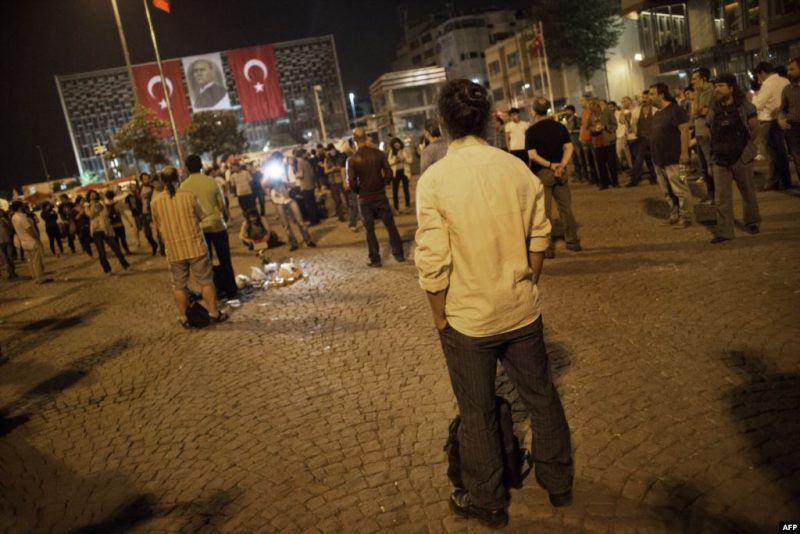
Maybe as for many others this week, the dancer and performance artist Erdem Gündüz was constantly in my mind while reading, mostly because of the exactly this “new” time and space he created, this unpredictable, out of meter temporality through the standing man. ( We met him just shortly after the protest when were in Istanbul with the conservatory for dance). I wanted to share these videos, even though unfortunately I could not find such good material online

https://www.youtube.com/watch?v=cNONsBm-bv0

https://www.youtube.com/watch?v=dO8hkU4uK2g

The Performativity of Appearance and Power

        Butler cited and criticized Arendt`s opinion about Action, she revised Arendt`s suggestion about the function of bodies in the politics. Butler demonstrates the meaning and method of assembly. She thinks togetherness is a form of performativity, and precarity is a motivation of gathering.

Arendt said that the plurality of human is the basic situation of action and speech, and it is characterized by equality and difference. Actions and words reveal who someone is and reveal their belongingness—” Speech and action reveal this unique distinctness. Through them, men distinguish themselves instead of being merely distinct; they are the modes in which human beings appear to each other, not indeed as physical objects, but qua men.”

        Arendt concerned, the result of action is irreversible and uncontrollable. So, why do we still need action? Many people regard the essence of politics as ruling. Among the threats brought by totalitarianism, Arendt discovered the value of action. Participating in action is a new beginning, and the disappearance of the action space means the beginning of a totalitarian society. Arendt’s criticism of Marx is based on the distinction between the three concepts of labor, work and action, and points out that replacing the other two concepts in active life with labor is the reason why Marxism has become the cause of totalitarianism.

        In addition to Arendt`s theory, Butler thinks beyond the bodies gathering, speech also performed an important role in the action—”Embodied actions of various kinds signify in ways that are, strictly speaking, neither discursive nor prediscursive. In other words, forms of assembly already signify prior to, and apart from, any particular demands they make. Silent gatherings, including vigils or funerals, often signify in excess of any particular written or vocalized account of what they are about”. She suggests speech and action are both “performance”.How performativity embodied with the notion with people? –“Not everyone can appear in a bodily form, and many of those who cannot appear, who are constrained from appearing or who operate through virtual or digital networks, are also part of “the people,” defined precisely by being constrained from making a specific bodily appearance in public space, which compels us to reconsider the restrictive ways “the public sphere” has been uncritically posited by those who assume full access and rights of appearance on a designated platform“.


Appearing in Public


Action and speech are surrounded by and in constant contact with the web of the acts and words of other men

Arendt (188)

In this week’s readings I came to focus in on the ideas of action and appearance in public. Arednt posits, one of the fundamental characteristics of the human condition is action. For the author, an essential feature of action is freedom and plurality. Arendt does not mean freedom like American apple pie or the ability to make life choices, rather the principal of freedom lies in human ability to begin something new (177-178). Arendt furthers by pairing action with speech and notes, words allow for a type of “second birth”- new beginnings brought out of our own initiatives (176). Plurality then refers to the fact that in order to truly act, it has to be done in the presence of others (188). Just as theater necessitates a spectator, action requires the presence of others. The “space of appearance” therefore becomes a public sphere where “men are together in a manner of speech and action” (199). 

Butler takes takes on Arednt by postulating these spaces are built by political action but first she confronts some limitations to Arednt’s analysis. She argues, the philosopher’s perspective is muddied by it’s inherent gender politics. Arendt’s body in public is presumptively male leaving the body in private to be female (75). While Butler recognizes the gender politics was not was at the helm of Arednt’s argument, she highlights, “the sphere of appearance is not that simple, since it seems to arise only on the condition of intersubjective face-off” (76) Butler aims to reimagine the “space of appearance” to consider embodied practices. She highlights, political action is also present in the ways one establishes the body to act between other bodies (a nod to the earlier chapters where she discusses social construction)  (77). The coming together in itself is both a political and a bodily enactment. 


Esfera pública, acción y discurso

Esfera pública, acción y discurso son los conceptos que pueden guiar la lectura de los textos de Hannah Arendt y Judith Butler. Esfera pública entendida como el lugar en el que se lleva a acabo la acción política, como el lugar por excelencia de lo político. Para la Butler existe una relación quiásmica entre performatividad linguística y performatividad corporal. La autora centra su análisis en el lugar de los cuerpos y su accionar colectivo y coordinado, en sus palabras hay formas de expresar y manifestar la precariedad que se imbrican de manera importante con la acción corporeizada y con formas de libertad expresiva que pertenecen más bien a las asambleas públicas, de esta manera las constantes en su propuesta son los conceptos de precariedad y performatividad.

Por su parte, Arendt nos habla del espacio de aparición, aquel donde aparezco ante otros y ellos ante mí. Este espacio precede a la esfera pública y cobra existencia cuando las personas se agrupan para el discurso y la acción. En este marco surge el poder que es la potencialidad para la acción conjunta, la fuerza que mantiene unido este poder una vez las personas se dispersan se concentra en el contrato, entendido como una doble promesa. Si en Butler, la precariedad tiene la potencialidad de congregar y llamar a la solidaridad, en Arendt ese elemento, esta potencia está en la natalidad, en el nacimiento de nuevos seres humanos, es esta experiencia, esta capacidad para la acción, la que confiere fe y esperanza.

Performing “Change” in Political Action

This weeks readings focused around action and the role of the performative in the political sphere. Arendt focuses on the polis as a site of action, which is an independent change in the political sphere. For Arendt’s conception of politics, I took it to be understood that real possibilities of change were possible only within the realm of politics that already exist. I see Butler as disagreeing, saying that the edges of the political realm inform and thus redefine through their performative actions the definitions of the political and the non political, the human and the nonhuman, and the parameters of the right to have rights. Thus, Butler rightfully notes that Arendt’s conceptualizations fall into the categorizing traps such as the masculine public versus feminine private spheres while also defining political action within those confines. Butler, then, in expanding the definition to include those on the margins and those who perform often outside of those categorizations or ascribe to those categorizations at great cost, is able to see action in a broader view in the assembly. Assembly in Butler’s view redefines these categories, making new political realities for subjects possible towards a similar goal of Arendt of equality among “humans”.

To take a walk

https://variety.com/2019/tv/news/mj-rodriguez-pose-activism-1203246568/

The readings this week – it was as if I did not completely understand Hanna Arendt’s piece until Judith Butler came into the picture. The interaction between these two texts is much more interesting than either of them alone, in my humble opinion. The greatest takeaway from the readings was tackling questions on the body, the (act?) of speaking, and agency. Hanna Arendt clearly delimitates between acting and speaking, making the “act” a concerted action, or an action that represents the beginning of something – perhaps a revolution. She attributes this as well to speaking, “If action as beginning corresponds to the fact of birth, then speech corresponds to the fact of distinctness and is the actualization of the human condition of plurality, that is, of living as a distinct and unique human being among equals” (Arendt 178). Arendt inextricably links speaking and action, as both of them, in her view, are required to answer the question [from every newcomer], “Who are you?” (178). It translates to identity. It communicates identity.

Arendt continues to nail down this point with, “In acting and speaking, men show who they are, reveal actively their unique personal identities and thus make their appearance in the human world, while their physical identities appear without any activity of their own in the unique shape of the body and sound of the voice” (179). There is an element here where Arendt marries speech and action, or that action is a condition of speech, or vice versa, that also represents the plurality of the human condition, that acting and speaking bring people together and, for lack of a better term, is the stuff of revolution. 

I think immediately of the trans actress MJ Rodriguez, who stated recently in an interview, “Simply being trans is activism.” Simply, her physical condition and attributes, not her actions nor speech, but simply that “physical identity” Arendt refers to – that is now activism, which does require a form of action. Judith Butler delves into her Arendtian critique on this issue in chapter 1 of Notes Toward a Performative Theory of Assembly. She problematizes the Arendtian view of “action” and “speech” particularly, and actually references trans politics: 

“As we know, not everyone can take for granted the power to walk on the street or into a bar without harassment. To walk on the street alone without police harassment is precisely not to walk with the company of others and whatever nonpolice forms of protection that supplies. And yet, when a transgendered person walks on the street in Ankara or into McDonald’s in Baltimore, there is a question of whether that right can be exercised by the individual alone….To walk is to say that this is a public space in which transgendered people walk, that this is a public space where people with various forms of clothing, no matter how they are gendered or what religion they signify, are free to move without threat of violence. To be a participant in politics, to become part of concerted and collective action, one needs not only to make the claim for equality (equal rights, equal treatment), but to act and petition within the terms of equality, as an actor on equal standing with others” (Butler 53-54). 

MJ Rodriguez could walk through the grocery store, and it would be seen as inherent activism; it could be seen as action, as the concerted act at being treated or seen as equal. This is the greatest divergence between the two texts; however, it is understandable as each was writing from her own specific political moment. It leaves me with questions of affect – what is the most effective form of action? Does it involve speech? The element of performativity is not contingent upon speech, as we have seen. How can we trace, measure or answer these questions of embodiment and action through the history of “performative assemblies?”

‘action’ or, ‘performative assembly’

Action, for Hannah Arendt, which is never possible in isolation, generates the emergence of a neo-nascence, a new birth, for the actor, constituting and composing their subjectivity. It is in these actions, which are always interactions, that the subject emerges, using speech to construct their distinctness as well as their identifications with collectives. Judith Butler, in Notes Towards a Performative Theory of Assembly, rethinks ‘action’ as well as the discursive and performative practices shaping subjecthood as spaces of appearance, where assemblies come to materialize both matter and meaning, and which are always performative. She expands her theorizing of performativity, specifically how it is related to gender, drawing on Arendt, but also pushing back against her, noting that the ‘in-betweeness’ of subjects formulated by Arendt still carries Arendt’s own gender and racial politics, and questioning Arendt’s presupposition that the body does not enter the speech act and that the public and private spheres are always already separated. Despite this, Butler engages with Arendt’s theory, acknowledging that she shows that “the body or, rather, concerted bodily action–gathering, gesturing, standing still, all of the component parts of ‘assembly’ that are not quickly assimilated to verbal speech–can signify principles of freedom and equality” (Butler, 48).

Butler articulates this becoming part of “collective or concerted action” as being synonymous with becoming a participant in politics (maybe we could consider this as one of the points of our main project?). In this ‘becoming’ (Arendt would say ‘birth’), one needs to make a claim for equality as an actor on equal standing with others. This making of a claim is part of the performativity of the assembly, and the root of its power–it is interesting to note that Arendt described ‘power’ and Butler described ‘popular assemblies’ in the language of a kind of thermodynamics or electromagnetism, highlighting their understanding of the experimental nature of concerted action as well as their understanding of the role of environment in the process of meaning, mattering, materialization (see Arendt p. 200 and Butler p. 7). This ‘environment’ was articulated by Arendt and drawn on by Butler as the ‘space of appearance’. For Arendt, to be excluded from the space of appearance was to be denied the right to have rights, and, as Butler tells us, “the people” are not just produced by their vocal claims, but also “by the conditions of possibility of their appearance… and by their actions” (Butler, 19). Butler elaborates this to be true not just of “the people” but of “the person,” positing the entanglement and mutual constitution of these bodies–indeed, Butler goes on to tell us that “the body is less an entity than a living set of relations; the body cannot be fully dissociated from the infrastructural and environmental conditions of its living and acting” (Butler, 65).

The action of the body is always conditioned action (twice behaved behavior!), which marks part of the historical character of the body. The coalescence of historicized bodies into a historically and future transformation–that is, an assembly–is an interesting play with our naturalized invention of time. It seems that in an assembly, where one must make a claim for equality as an actor on equal standing with others, one must also make a claim for a new temporality and spatiality: a spatiality and temporality which, because of its orientation in relation to the naturalized spatiality and temporality, is inherently queer (and I would add also ‘trans-‘ in the sense of the prefix–meaning ‘across’, ‘beyond’, ‘changing thoroughly’–but also in order to inscribe the trans body with power in the ‘space of appearance’). This queer spacetime is seen in Arendt’s “Irreversibility and the Power to Forgive” and “Unpredictability and the Power of Promise” though it is not articulated. As bodies–through identifications and disidentifications, through orientations and disorientations–we are already assemblies, and, as assemblies, we persist. In this way, ‘assemblies’ are flows and coalescences of energy, creating and conditioned by location, historically rooted and oriented toward the future; in this way, assemblies are performative/political.

Actuar ahora y con otro

Las dos lecturas de esta semana coinciden en la potencialidad que tienen los humanos de crear y transformar por medio de la acción y sobre todo si se trata de una acción colectiva: “The fact that man is capable of action means that the unexpected can be expected from him, that he is able to perform what is infinitely improbable”. (Arendt, 178), “Action is never possible in isolation; to be isolated is to be deprived of the capacity to act. Action and speech need the surrounding presence of others (188), “(…) the bodies assembled “say” we are not disposable, even if they stand silently.” (Butler, 18).

Esta idea de transformación por medio de la acción nos lleva a pensar en momentos en la historia en que los cuerpos organizados de manera colectiva, actuando en la esfera pública, lograron cambios significativos de su lugar sociopolítico. Arendt, por ejemplo, recupera lo que significaron las manifestaciones de los trabajadores, las luchas sindicales que dieron lugar a que una determinada población fuera, de alguna manera, reconocida. Por el lado de Butler, la autora destaca la importancia y visibilidad que alcanzan los cuerpos reunidos demandando una causa compartida: “only that when bodies assemble on the street, in the square, or in other forms of public space, they are exercising a plural and performative right to appear, one that asserts and instates the body in the midst of the political field (11)”. Sin embargo, Butler deja muy claro en qué se distancia su pensamiento con el de Arendt, y que considero importante mencionar (al menos señalar una de las diferencias) para que no se malinterpreten los puntos en común que logré leer en ambas autoras. Dice Butler: “I push against Hannah Arendt even as I draw upon her resources to clarify my own position. Her work supports my action here, but I also refuse it in some ways. Arendt’s view is confounded by its own gender Politics, relying as it does on a distinction between the public and private domains that leaves the sphere of Politics to men and labor t women. If there is a body in the public sphere, it is presumptively masculine” (76).

Frente al pensamiento neoliberal que promulga un individualismo –Neoliberal rationality demands self-sufficiency as a moral ideal (Butler)–, o en el caso de Arendt: “The modern age’s conviction that man can know only what he makes (…) he therefore is primarily homo faber. (228)”, ambas autoras quieren decir: NO.

En contra de esta mirada egoísta e individual, en donde por ejemplo en la perspectiva de Arendt, se asocia más ‘la fuerza’ con el hombre individual y el ‘poder’ a los hombres en comunidad (While strength is the natural quality of an individual seen in isolation, power springs up between men when they act together and vanishes the moment they disperse (200); resulta imperativo destacar esta potencialidad de la acción comunitaria: “no one mobilizes a claim to move and assembly freely without moving and assembling together with others (…) Human action depends upon all sorts of supports –it is always supported action.” (Butler, 72). Así, los verdaderos cambios se producirán solo cuando se realicen con otro en pos de lograr un fin compartido.

Cuerpo, agencia, discurso y la aparición de lo político

El tema que el texto de Arendt propone y que el de Butler reelabora es la intersección entre cuerpo, agencia, discurso, y la aparición de lo político. En Actions, Arendt teoriza que la palabra y la acción abren la esfera de lo propiamente humano y de lo intersubjetivo, ya que son actividades que no se pueden poner en práctica sin la existencia de otrxs, a la vez que no tienen ningún otro medio ni fin más que interpelar a otras personas. La palabra y la acción son políticas en tanto fundan un espacio de iguales. Sin embargo, para Arendt, la historia de la política de Occidente se caracterizó por divorciar ambos términos de manera que quienes eran portadores de discurso y de pensamiento fueran los gobernantes y quienes ejecutaran las acciones, en forma de órdenes, obedecieran. Para la autora, es la noción de “regla”, la que quiebra un espacio de iguales y determina que los humanos solo pueden vivir políticamente entre sí si algunos son intitulados de la función de gobernar y otros forzados a obedecer.

            Butler reelabora estas nociones para pensar cómo las protestas contemporáneas masivas contra regímenes neoliberales de gestión de la vida son formas emergentes de soberanía popular. La autora, por un lado, postula que las condiciones laborales del neoliberalismo subyugan a gran parte de la población a la precariedad, a la vez que postula que las formas en la que las normas de género vuelven ininteligibles a las minorías sexuales (y las someten a todo tipo de riesgos y violencias) son semejantes a las estrategias neoliberales de precarización del trabajo. Si estos grupos, en cierta medida, son invisibilizados, el ensamblaje de sus cuerpos en la calle, su irrupción reclamando visibilidad y condiciones vivibles para la vida es de acuerdo a Butler la aparición más auténtica de lo político en la esfera pública mediante el uso del cuerpo, la acción y la palabra en una performance colectiva.

Action: from Arendt to Butler

Through the distinction between labor, work, and action, Arendt highlights the non-utilitarian nature of action, and even calls action the real nascent of a man(Arendt, 177); Butler re-examines the gender performativity theory, in closely observing the activities of the minority groups, she partially opposes, and partially develops Arendt’s theory of action through philosophical deduction.

The biggest difference between the two theorists is that Arendt starts from the tradition binary opponents of words and deeds, and opposes the overrated importance of thinking in ancient philosophy; while Butler’s argument derives from her theory of gender studies, which emphasizes the embodiment of action.

In developing her argument, Butler also used Chantal Mouffe’s antagonism approach of democracy, introducing the concept of “recognition”, which explores the definition of “the people”, and also puts the “precarity” of action into the light. (Butler, 36) Through a Derridian argument, Butler comes up with her definition of human and life and frames the embodiment of humans in relation into “network” in a biological sense, which echoes Arendt’s concept of “net”.(Butler, 43) Butler claims that the human body is the junction of the public and private sphere. As the ontology of action, the body also determines that the action cannot be absolutely public, as Arendt has distinguished. (Butler, 43)

From the perspective of gender assignment, Butler maintains that even if people do not actively choose, as long as the body goes to the street, this is already performative, and it is, therefore, an action. The deduction broadens the view of freedom comparing to Arendt’s. (Butler, 58)
The two theorists’ points of view have a lot in common, i.e. they both explore the concept of action from the plural aspect. Although she pushes some points to extremes, it is clear that many of Butler’s views are echoes of Arendt’s point of view, for example, Butler’s precarity is the transformation of uncertainty in antagonistic pluralism.

But several questions haunt me while reading these two theorists, especially about Arendt’s:

i.e. 1, According to her, when actions are purposeful, they are bad actions. Isn’t it a purposeful gathering to gain freedom?(Power corrupts indeed when the weak band together in order to ruin the strong, but not before. Arendt, 203)

2, Is she against Machiavellianism? Is the valorization of forgiveness the reason why she was interpreted as a Nazi sympathizer?

The Living & The Livable

“Without action to bring into the play of the world the new beginning of which each man is capable by virtue of being born, ‘there is no new thing under the sun’; without speech to materialize and memorialize, however tentatively, the ‘new things’ that appear and shine forth, ‘there is no remembrance’; without the enduring permanence of a human artifact, there cannot ‘be any remembrance of things that are to come with those that shall come after.’ And without power, the space of appearance brought forth through action and speech in public will fade away as rapidly as the living deed and the living word” (Arendt 204).

Both Arendt and Butler in these quotes above and below are talking about performance in regards to the live–the living and the livable. The living is looking at those who are participating, existing. The living is a condition of a subject. The livable describes the environment or conditions of the environment of the subject. In addition, the livable is the likelihood of existence. Also, when thinking about the live, it brings the idea of participation and who has the right to live. Political performance is a tool and cry for those to live in order to become the living and have the livable. Arendt believes without this action, there is no possibility for the living. Butler argues that bodies are “still here and still there” but it is through performance that there is presence. If there is no recognition, then these bodies are seen as objects rather than subjects that have a right to exist, to speak, to move through space, to be recognized. What about those bodies who don’t have the resources to perform politically? Are there specific spaces and environments that were made for bodies to not exist in the live? Perhaps examples of this are where bodies are meant to be permanently objects–prisons, concentration camps, etc.

“So when people amass on the street, once implication seems clear: they are still here and still there; they persist; they assemble, and so manifest the understanding that their situation is shared, or the beginning of such an understanding. And even when they are not speaking or do not present as set of negotiable demands, the call for justice is being enacts: the bodies assembled ‘say’ ‘we are not disposable,’ whether or not they are using words at the moment; what they say, as it were, is ‘we are still here, persisting, demanding greater justice, a release from precarity, a possibility for livable life” (Butler 25).

Spaces of Appearance

In exploring the question of how spaces of appearance are generated, Hannah Arendt first connects action and speech in the natal scene, proposing action as that which brings the subject into existence anew and speech as what allows this subject to establish itself as a distinct individual in a plural world: “If action as beginning corresponds to the fact of birth, if it is the actualization of the human condition of natality, then speech corresponds to the fact of distinctness and is the actualization of the human condition of plurality, that is, of living as a distinct and unique being among equals” (178). Interestingly, by tying speech to the revelatory question “Who are you?” –that is to say, speech signifies–, Arendt further establishes a link between speech, action (which is necessarily meaningful), and subject, when she states that without speech, action “would not only lose its revelatory character…it would lose its subject” (178). Arendt takes up as one of her main stakes, the human relevance of action, action as being, speaking, and acting together. Her reading of the Greek polis establishes the political realm as “the ‘sharing of words and deeds’” in which action constitutes the public (198). Thus, as she elucidates below, the space of appearance is not limited to a physical location, rather, it is the materialization of the organization of people who act and speak to one another and together, always a potential space that has no guarantees of permanency, but rather is always on the verge of dispersal and disappearance.

The polis, properly speaking, is not the city-state in its physical location; it is the organization of the people as it arises out of acting and speaking together, and its true space lies between people living together for this purpose, no matter where they happen to be.

(Arendt 198)

Like Arendt, Butler does not presuppose that public space is given; rather, these spaces are produced through political action, one of which can be acts of assembly that “reconfigure the materiality of public space and produce, or reproduce, the public character of that material environment” (71), a proper transformation of space. But while Arendt closely links speech to action, Butler argues that embodied practices can also signify meaning and provide the potential for and actualization of political action. Butler also concerns herself with questioning the unequal conditions of emergence of “beings disaggregated from the plural” (77). She posits the question, “who really are ‘the people’?” (3), from the perspective of the present.

This inquiry is situated within a historical time in which the question emerges: How is precarity enacted and opposed in sudden assemblies?

(Butler 22)

Within the context of the contemporary neoliberal reality in which certain populations are framed as “nongrievable lives” or “disposable,” that is, in which precarity is differentially distributed and often through biopolitical strategies (15), Butler focuses exactly on how those bodies who are excluded gather to contest a false notion of equality –here, the “indexical force of the body” (9) is what signifies– and, crucially, to argue that when bodies assemble (either bodily or virtually), they can do so as a form of resistance against State strategies of erasure and disappearance; a “bodily demand” is made (11). Butler also follows Arendt in that freedom happens as a relational act (88); she proposes a performative theory of assembly that moves beyond the individual to the collective, a move she argues is all the more important considering the ways in which capitalism is built upon the facets of individual self-sufficiency and competition, eroding communitarian values such as care. Butler takes as one of her stakes, the renewal of the meaning of “responsibility” in ethical terms and within the context of collective forms of assembly (14), a responsibility that is accompanied by a recognition: that we are always already implicated in relationships with others. I find her body of work on relationality to be extremely important to thinking about political work in our time.

Performativity, Action and the Space of Appearance

Hannah Arendt’s concept of action (as related to the human condition of plurality) delineates a particular space for the enactment of politics. According to Arendt, it is through action and speech that humans distinguish themselves from each other and disclose their agency. It is in this sense that speech and action are revelatory and inherently reliant on the condition of human “togetherness”. Action is described as a beginning, an act that initially discloses its agent. Although this “beginning” is an enactment of agency, its consequences are beyond the subject’s control – they are distinctly boundless and unpredictable. Arendt says that “action has no end” (233), and we can only resort to the faculties of promise (a kind of contract) and forgiveness to gain some semblance of sovereignty over the events set in motion through action. It is in the “space of appearance” (the space for action, as opposed to those for fabrication or labor) that politics emerges – from the spaces in-between actors and out of their respective actions. It is then in the (willful) misinterpretation of this space, the alternative association of the political with the realm of fabrication (associated with control and molding), that Arendt situates the emergence of fascist and otherwise oppressive regimes.

The opening chapters of Judith Butler’s Notes towards a Performative Theory of Assembly already establish the book’s direct engagement with Hannah Arendt’s conceptualization of action, speech and the space of appearance. While these concepts are developed and discussed throughout, Butler also presents a critique of the Arendtian conception of public space and distances herself from what she regards as a masculinist ordering of particular human activities. For Butler, Arendt’s reliance on the distinction between the public and the private “leaves the sphere of politics to men and reproductive labor to women” (75) and restricts the potential political considerations that may surround labor of keeping oneself alive. Arendt’s distinction between action and speech is also questioned in Butler’s text through the ideas of “speech acts” and the performative. Despite these points of divergence and Butler’s more persistent emphasis on the particular conditions that allow for spaces of appearance, Arendt’s elaborate conceptualization of action and her particular account of the relationship between politics and power remain central to Butler’s conceptualization of assembly and resistance.

Week 5: The Space of Appearance

The readings for this week go over the power and mechanisms of popular demonstrations. Arendt (1958) emphasizes how action and words become a way to speak and show ourselves by becoming a “who” that performs their agency; “To act, in its most general sense, means to take an initiative, to begin… to set something into motion.” (177) This mobility finds its power in their unpredictability and plurality; “The fact that man is capable of action means that the unexpected can be expected from him, that he is able to perform what is infinitely improbable.” (178) For Arendt, action takes more power when enacted in collectivity. She sees also the power of the individual moving the collective even in the smallest action that can create a movement; “the smallest act in the most limited circumstances bears the seed of the same boundlessness, because one deed, and sometimes one word, suffices to change every constellation” (190).

            Butler (2015) examines the idea of public assemblies moved by fear or chaos that can produce what she calls a “radical hope” To analyze this, Butler adds to the conversation of who is considered “the people” and how this category implies the exclusion of others and the building of a demarcation as; “the body politic is posited as a unity it can never be” (4). Here, Butler, same as Arendt, recognizes the performativity and power of people gathering together on what she calls “bodies assembly” moved by their same realization of precarity; a body that acts and enacts its presence stating a “we are here”. Butler talks about different types of assembly and asserts that when bodies assembly in any part, even if its virtually like in the #NiUnaMenos movement, they are exercising a plural and performative “right to appear, one that asserts and instated the body in the midst of the political field, and which, in its expressive and signifying function, delivers a bodily demand for a more livable set of economic, social and political conditions no longer inflicted by induced forms of precarity” (11) These disposable bodies then have the potential to express even if its silently.

Notes Toward a Performative Theory of Assembly and Action

While reading the chapter labeled “Action” of The Human Condition by Hannah Arendt, there was a quote that stood out to me, which follows, “action, as distinguished from fabrication, is never possible in isolation; to be isolated is to be deprived of the capacity to act” (p. 188). This closely identifies Arendt’s presentation of the importance of action in the human condition. The idea of an action goes hand in hand with speech, to fully portray the action that is being presented. Therefore, there are two important forms of action which is plurality and unpredictability. The plurality of action is fundamentally linked to equality and distinction, where she links these two ideas to language. From her perspective if men could not understand each other they would therefore not be equal, and if there was not a distinction, there would be no need for a language for common understanding. Therefore, she mentions, “no other human performance requires speech to the extent as action. In all other performance’s speech plays a subordinate role, as means of communication or a mere accompaniment to something that could be achieved in silence” (p. 179). Overall, it is impossible to create action in isolation, there is an initial point that may begin with an individual, which will result in some kind of achievement, this achievement is the representation of a collective force. On the other hand, Judith Butler in Notes toward a performative Theory of Assembly, takes a more physical perspective of the understanding thee body as an act of political stance. Thus, the materiality of these bodies in a public sphere. This links to the dominance of ethic, social, and ecology of politics of performativity, that is intricately interdependent. Butler mentions that, “so then, if performativity was considered linguistic, how do bodily acts become performative? This is a question we have to ask to understand the formation of gender, but also the performativity of mass demonstrations” (p. 29). Which suggest an intersection of feminist political theories that is resistant and refuses a the “we” as a whole rhetoric. In that notion, the “we” seen as interdependent establishes a force and encompasses the individual that is isolated from the assembly.