Connecting The Dots

Key-words, concepts and questions for our final project:

1) Democracy: What are the limits of representative democracy?
2) Dissent: Should all art be responsible for creating dissent?
3) Hegemony: can representative democracy exist without hegemony?
4) The political X Politics
5) Is performance always political? Is politics always a performance?
6) How current political actors have mobilized performances from the past in their public appearances? What has been “hunting” current political affairs?
7) Bodily participation X Non-bodily participation in the political debate: This comes to mind in relation to Balibar’s text (on page 17 he mentions “the bodily disposition of individuals”). The differences between “bodily participation” and “non-bodily participation” in a moment when political campaigns focus so much on our digital interactions, bring to the fore the importance of non-bodily participatory politics.
8) “Resistance is always opportunistic”. How contemporary social movements can be thought in relation to this axiom?
9) Does contemporary art still have the potential for “turning society upside down” (Brecht 185)?
10) If spectators are “taught to refrain from intervening or resisting the hegemonic vision of persuasive drama” (Taylor 77), what happens when the political debate is staged to look like a spectacle?


6)

Ten Points

  1. “The power of art”, art can invoke a change and create the affect with a performance or a political spectacle.
  2. “Be a critical Spectator”, it is important to be a spectator that critiques their surroundings and the current political moment that they are living in. Do not just be a bystander in the turmoil.
  3. “Identification”, being too connected to a performance can be dangerous, because it goes further than just engaging. In grooming a political candidate a narrative/scenario is created and it is combined with an “origin story”.  
  4. “Empathy”, empathy is a very problematic emotion because it is very easily manipulated, we could often give up our emotional strength to someone else, this is why Boal deems “empathy” as a dangerous tool.
  5. “invading the spectacle”, it is important to penetrate the spectacle in order to become more active and responsible spectators.
  6. “Creating a Us and a Them”, creates certain political structures that manipulates a spectator’s emotion to sway them in the direction that they would like.
  7. “liberal thought”, a liberal thought process in the political spectacle is blind to the politics because it is very individualistic.
  8. “conferring of rights in the politics”, politics is an ongoing struggle between who has rights and the people that think that they have these rights.
  9. “Reiterated power”, we have all seen everything that has already happened in politics, all things in political performance has been done before, how it is always reiterated with more power (“twice behaved behavior”).  

Politics as…

The following are some starting points for a greater conversation on performance and politics stemming from our last two weeks’ readings:

Politics as contention By definition, politics is adversarial. A classic(al) example: Plato, an aristocrat, expels the Poet from his Republic. Balibar contends that a necessary condition of politics is the existence of an us and a them: an inherent by-product of politics is a hierarchy of have-nots that are neither a whole subject nor an integrated part. Similarly, Mouffe adds that every identity is relational and that politics deals with collective identities, that is, a we and a they. In response to these conditions, for example, Boal’s Teatro do oprimido aims to reverse roles and have oppressed subjects act out possible futures with different outcomes than their immediate reality.

Politics as exclusion Through the distribution of the sensible, Rancière reveals the internal political mechanisms that determine who can have a share in what is common to the community based on what they do and how and when they do what they do. He asks, Who gets to be political, who has the time to be political? Boal’s analysis of the Greek system of tragedies as a means of political coercion establishes the aristocracy –whose means and state control allowed for the theater to flourish in the first place– as the determiners of the ultimate goods and virtues of their cultural and political contemporaneity.

Politics as passion Mouffe claims that we cannot understand democratic politics without acknowledging passions and affect as driving forces in the political realm. Through Boal’s breakdown of tragic(ist) coercion, we come to understand the apparatus of politically motivated emotional manipulation established at the base of Western theater whose ultimate goal is to control passions and purge dissident conducts. Brecht recognizes contemporary theater goers as sleepers whose passion for the arts has been reduced to aimless gawking, therefore rendering them malleable.

Politics as specatorship Through Boal, we come to understand how the aristocratic citizens of Ancient Greece manipulated the masses through coercive spectatorship. Recognizing this, Brecht calls for a more critical spectatorship, in which alienating effects from the actors on stage would spark interest and an awakening in the audience. On the other hand, just like in commercial theater, Taylor claims that spectators in politics are meant to sit there and watch, to absorb passively; state violence and political spectacles render citizens speechless, blinded, enthralled, incapable of responding. Performance art can call spectators to action, even if it happens in circumstances or conditions the spectator doesn’t fully understand. Spectatorship functions within systems and relationships of power, undoubtedly, and Rancière reminds us that, in the collective realm, only a few are allowed to determine for the whole. Rancière also reminds us that seeing is also a doing: spectators are able to refashion and reinterpret what they see.

Politics as emancipation Balibar provides a succinct summary of the conditions necessary for political emancipation and the subjects who achieve their own emancipation as opposed to the subjects whose previous emancipation confirms their place and rights within the political realm. Noticing the inconsistencies, Boal proposes specific theater practices as a way of emancipating spectators from their lack of political agency, therefore planting the seeds for further, more generalized political subversion.

Politics as transformation Balibar defines politics as change within change, that is, within a capitalistic system defined by (ex)change, politics is a dialectics of change. Boal proposes his theatrical practices as a way of preparing the subject for political change through artistic inquiry and performance. Taylor’s analysis of various forms of performance art reminds us that all art is political and expresses an artists’ desire for change by making possible an interaction between the artist, the spectator, and their worldviews.

Ten bullet points

1. Make believe and make belief. “make believe” is pretending the unreal to be real consciously and it happens so often in performance, especially in theatre that we tend to forget its existence. But isn’t that how “make belief” happens? When things start to feel spontaneous and then snick into our subconsciousness. It is a level higher above and much more powerful, touching upon people’s passion and irrationality.

2. The making of they and us. By which I mean spectator-ship and retro spectator-ship, particularly in the contemporary theatre and other performance fields.

3. Identification. This is something implied by Brecht when he talks about the roles actors should play in theatre. I also want to expand its context to find out how we identify with one another and how we revel against others. In other words, how is ally and enemy formed with intention.

4. Truth and representation (and fiction). It is of common knowledge that theatre is not a copy of reality. Aristotle states that it should be the recreation of the creative principles in nature and help nature to right its wrongs. Therefore, it should contribute to something true although itself is fictional. I wonder does truth matter or even matter as the core value in performance? If so, then how far can representation go without running into distortion?

5. Entertainment and Education. I do agree that theatre should be joyful, it should reach out with emotion and speak to the souls, make them akin. However, it then inevitably becomes educational. And that is exactly what Brecht did with his own theatre work. Theatre is used to achieve sublimation, to inspire greater admiration or awe and to make a difference, which I find fascinating and hope to explore more. Also, which is the true core and which is the tool, or candy coat? That is also something worths thinking.

6. Empathy. It is called the dangerous thing by Boal, as it’s manipulative, encouraging people to give up part of their emotion to another being and enable that person to lead or even act on behalf of themselves. He cast it away because of its potential power, very much likely as what Plato did with art. I have always understood empathy as one of the greatest gift in human, and I wonder if it is a merit of humanity, or a instinct all mammals have (According to Taylor). Moreover, is empathy only about emotion and sensory feelings, or it’s bonded with the most instinctive and trust worthy judgement that involves ration, which happens so fast that we barely realize.

7. Emancipation, freedom and equality. The question of nature right versus legal right still haunts me from the first day. Emancipation refers to some people being deprived of their natural right (freedom and equality) and become the object to be freed, which infer to different class structures. Schiller even states that art should be used to educate and make people more qualified to their right of freedom. However, as nature right, it should not be earned but given by birth, and having to earn it already indicate an established solid structure of politics that is somehow paradoxical and against its original motto.

8. Alienation. Something seems a method in theatre but a core reflecting the social and political construction in fact.

9. Civility. A complicated concept, especially when associated with political correctness. It helps build a bridge for all political discussions, but also create complexity through regulations, sometimes even covers up the most pressing issues.

10. Activism. It concerns “doing” in transformation on a large scale and requires the cluster to turn passion into strategy, which then ideally involves ration.
10 [Potential] Concepts

Statecraft as Spectacle

How does the State use political spectacle and performance to achieve its own ends: maintain authority, discipline and control bodies, create boundaries between us/them, and victimize certain populations?

Affective politics

What are the dangers and potentialities in a politics that is always affective? How are our passions mobilized against us, and how can performance, art, a politics of resistance activate passions in the pursuit of other ends? Should we reject identification?

• Performing truth, making belief

What is truth and how is it performed? Does truth exist? Why do we believe the things we do or align ourselves with certain politics? How do we negotiate contradiction?

• Political performance & resistance

What are the possibilities for political performance in our time? How does resistance include and extend past artistic practice, protest, and performance?

Spec-actors

How do we move from spectators to spec-actors? What is a participatory politics? Where does embodiment come into play?

Assembling Together

How do we overcome the binary of us/them in order to be together? Do gatherings have political power? How can we reclaim/transform/create space? What can bodies achieve together?

• Performance as ontology

Following Taylor, how can performance transcend action and be “an existential condition,” an ontology? (3). How is performance a process of becoming and subjectivization? Does this performance have a duration? In the contemporary condition of extreme precarity/precariousness, how does sustaining, following Joshua Chambers-Letson, become a practice of survival?

• Transformative potentialities

How can we re-imagine the spatial, epistemological, and other orderings of the world? What alternative worlds are possible to make? Following Rancière, how can we change how we see to work towards new modes of visibility?

Civility & Citizenship

How do we preserve both civility and debate in a democratic (agonistic?) politics? How does citizenship both include and exclude? What are the limits of civility and citizenship? What makes a good citizen?

The Work is Never Done

What is the horizon of an emancipatory politics? What are its temporalities? How do we work between the liminality of performance, its lives, and its afterlives?

The work is never done; sanctuary always needed.

Steve Paxton

Ten keywords

10 keywords I found can be divided into two categories, the first five are the characteristics of political spectacles, which explain “what” is political spectacles; the rest five focus on “how” to do political spectacles.

1, “us and them”

Art is political. Like in politics, to let art happen, there has to be an “us and them”,the power of “us” is predicated on the exclusion of the “them”.

2, “plural”

Political action is always plural, there is an anticipation for the control of adversity. Performance is by nature plural because it cannot happen without audiences.

3, “civility”

 The idealism of hatred is the seeds of fascism, and the solution is to create a place for politics/performance, adding adversaries, not enemies. The political field has a nature of antagonism, so the notion of civility is to moderate the adversaries in this field.

4, “identity”

 Identity is fluid and it is possible that everyone had multiple identities at different points in life. To become an anti-fascist, one has to become minoritarian.

5, “empathy”

Empathy is what Boal opposes in his writing, also consents the idea of Boal, Taylor thinks we should not equal empathy to illusion, but to take it as an essential way of approaching communication between performers and audiences.

6, “mimesis”

Aristotle’s interpretation of mimesis is representational, as the participatory politics is in contrast with representational politics, We have to get away with mimesis, and find an art/performance to do things that are not already done.

7, “alienation“

According to a more literary translation from its German origin, “alienation” means anti-illusionistic, the illusion Brecht aims at confronting is not only in theatrical terms but also the representative regime of art itself. Because Brecht thinks the representative art is something which confirms the existed social setting.

8, “animation/passion”

Political activities are for people with passions, so are performances. Based on her interpretation of empathy, Taylor developed the idea of “animation”, which is the core value of the performance and can be generated from both the audiences and the performers.

9. “Spect-actor”

Boal argues the fourth wall has not been torn down by Brecht because spectators are still on their seats. The spect-actor should get involved in the theatrical work by going on stage and does the symbolic trespass.

10, “feeling/affect”

Brecht claims that to realize the epistemological function of theatre in a scientific age, the “old affect “should be replaced by “alienation”, but in Taylor’s opinion, all kind of feelings provoked by performance is possible.

Sanctioned protest: act of emancipation or a rehearsal?

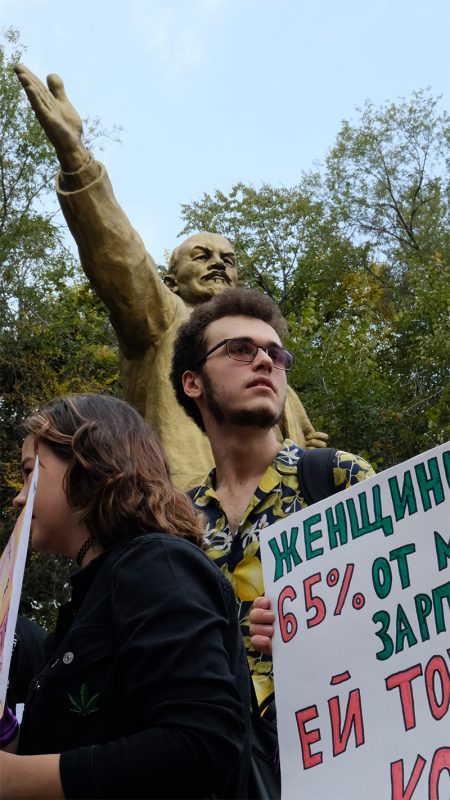
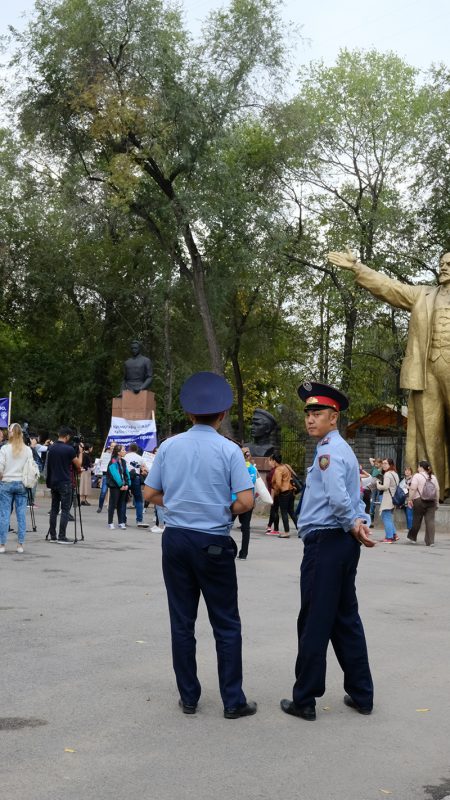
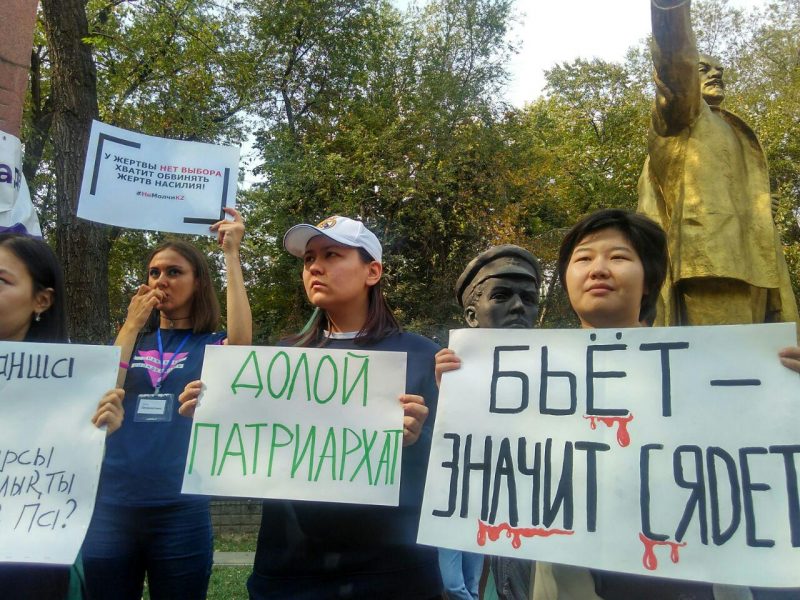
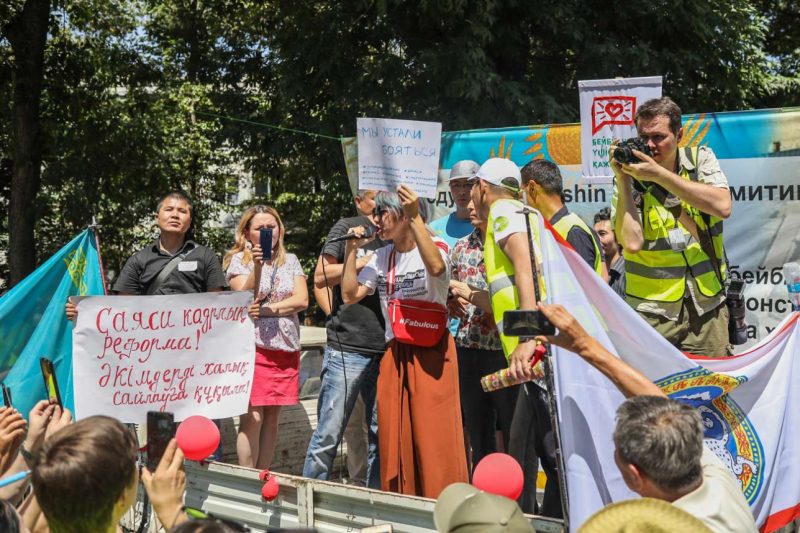
The use of ‘sanctioned’ and ‘protest’ in one context could be absurd if it is not normal. Article 20.1. of the Constitution of the Republic of Kazakhstan states that “Freedom of speech and creative activities shall be guaranteed. Censorship shall be prohibited.” However, the Law of the Republic of Kazakhstan N 2126 circumstances that “any form of protest, picket, demonstration or march that expresses social, group or individual opinion must get permission from the government 10 days prior of the act if it wants to be legal.” By September 28th, 2019, only 3 protests were legalized and got a status of ‘sanctioned’ in the history of independent Kazakhstan. All of them happening within the last 3 months. With this short essay, I want to put forward the idea that what is claimed as an act of political emancipation, in this case, is its failed rehearsal. I respectively use works of Étienne Balibar and Augusto Boal to address this riddle.

Sanctioned protest for equal rights. Sept 28th, 2019. Almaty, Kazakhstan. Photo by Daniyar Musirov. https://vlast.kz/fotoreportazh/35447-v-almaty-prosel-miting-za-zenskie-prava.html
Sanctioned protest for peaceful protest. June 30th, 2019. Almaty, Kazakhstan. Photo by Almaz Toleke. https://informburo.kz/novosti/sankcionirovannyy-miting-v-podderzhku-mirnyh-sobraniy-prohodit-v-almaty.html

Balibar introduces the history of emancipation as “not so much the history of the demanding of unknown rights as of the real struggle to enjoy rights which have already been declared.” Ironically, the first two sanctioned (after 36 declines) protests were in support of ‘peaceful gatherings’. The demand was to be able to express the protest. In terms of Balibar, it might come under the category of pre-history of emancipation or another restriction of his model. This case further expands the problem of “equal emancipation” as it is the majority of “us” protesting for autonomy from the minority of “them”. Therefore, the autonomy of these protests become bigger than politics because ‘part’ of society “excluded – legally or not – from the universal right to politics” is the whole society. So under limited Balibar’s model, the sanctioned protests failed to be acts of political emancipation.


Sanctioned protest for equal rights. Sept 28th, 2019. Almaty, Kazakhstan. Photo by Damira Mukitanova. https://www.the-village.kz/village/city/picture-story/7645-fotoreportazh

If its not an act itself, then can it be a rehearsal? In terms of Boal’s “theater of the oppressed”, these protests could go into the category of forum theater as the participants “intervene decisively in the dramatic action and change it.” Some people led the action by submitting application for protest and getting it, while others supported by coming to it and being active participants with placards and statements. Still the rehearsal was failed because oppressed people are trying to liberate themselves within the ‘given’ theatre. It is the government that allowed a specific ‘stage’ where spectators could imitate acting. And by specific place, I mean the square behind the cinema theatre Saryarka with a golden monument of Lenin reminding participants how a communistic dream in this country covered years of external colonization and how a democracy is under an internal one now. 

Sanctioned protest for equal rights. Sept 28th, 2019. Almaty, Kazakhstan. Photo by Damira Mukitanova. https://www.the-village.kz/village/city/picture-story/7645-fotoreportazh

Ten Points

  1. Beginning with my first point, I would like to ask the question, how is theater an instrument of colonization? During class, Professor Taylor had made this statement and got me interested in knowing more about it, then I pose this, is theater an instrument of weaponazing spectators and spect actors? It reminds of museums being built in in communities where it will gentrify in the name of “art.”
  2. Performance, as we discussed during class, is a way that follows conventions, that is, it followed rules. Churches, dances, or even a class can be a performance, they have a beginning, a middle, and an end. Performance usually refers to reiterated behaviors, twice behavior, happening more than once. This is something that has been already seen or experienced and performance is “reviving it”
  3. Performance is and Performance As. Ballet is a performance, a theater piece is a performance. A political spectacle as a performance, memorials as performances, classrooms and churches as performances where there is a reiteration or twice the behavior.
  4. As spectators, when we watch a ‘theater piece” we give the protagonists the role, where as the spect actors, we feel empowered to act and change the ending of a scene. Therefore, performances are neither true or false, they are either effective or not effective.
  5. The condition of possibility of politics is the definition to go back to “betweeness” to those who have rights and those who think they have rights but they have been constituted by the “not has”. Its the consternation of the exclusivity of the has. The universality of the emancipation of the model “impossible”. If the world emancipated, we would not have the struggles. For example, being a felon, you are being deprived of rights, who can take away rights? This question is part of the “political spectacle” and a constant struggle. The whole history of emancipation is not so much beyond demanding human rights as of the real struggle to enjoy the rights that have already been declared, theoretically we should be able to enjoy these rights. Who declares these rights? An example is migrants, they do not exist within the realm of rights, and under the United States, they are declared as criminals, its always an open struggle and an open debate. Resistance is a way of becoming contingent, it is opportunistic, you have to find the way to crash and push the limits and pick up on something towards as if it seems it can’t happen where you need to push and make cracks (the role of the spectator changing the scene in a theatrical piece).
  6. During the ancient times in Greece, theater was developed as a healing practice and Artistotle talks about art about what could happen. In the previous readings we talked about how art, as a mode of resistance, mobilizes communities for social justice. Alfredo Jaar is an example of how his master piece of burning the space the community built to bring awareness of “taking space.”
  7. Dialectical Materialism: unearthing societies laws of motion treating social situations as processes, and traces all inconsistencies. The human feelings are in disharmony with themselves, opinions and attitudes.
  8. Alienation effect: A representation that alienates is one which allows us to recognize its subject, but at the same time makes it seem unfamiliar. How does it become a barrier for showcasing empathy? and why, according to Brecht, theater must alienate what is shows if, in essence, theater is a pleasurable experience ?
  9. Without politics there would be no “us vs them” so, there would be no performance with no spectator.
  10. When Boal talks about “rehearsal” I think about the conversation we had in class when politicians are trained in television, because they “repeat” (twice behavior; performance) and show to their audiences (spect actors) what they believe, making spect actors act to their “speeches”

10 Things Echoed

  1. Emancipation: of the spectator, of the oppressed, of the space
  2. Subject: what does being a subject mean and how does object and subject transform into each other?
  3. Spectator/Spec-actor: participating and participation. Who has the right to do and who is passive?
  4. Resistance: from the performers, the spectators, the resources
  5. Opportunity: space/time
  6. Process & Product (rehearsal/performance)
  7. Empathy (civility): are these two ideas connected. Both seem key in “success”.
  8. Identity & Identify: identity is shape by the political and how one identifies
  9. Danger: what is at risk and who is at risk? What is dangerous in political performance?
  10. Politics & politics: the role each plays on the other (body, economic, language on the Political)

The Ten Points

Ten points/ideas/concepts (though they may be reductive) that I see echoed in our readings thus far:

1) Spectators
a. “Spec-Actors” must take more responsibility for their “actions” during a performance and we can see how some of the political theorists demand a higher responsibility from the audience – the ones who believe the “Make belief.” Perhaps there is a way of thinking about responsibility and limitation as terms.
2) Art Activism (Artivism)
a. With limitations, a lot of the (political) art that is presented in Diana Taylor’s book forces the audience to confront their limitations and understand their limitation with performance and political acts. This “Artivism” is just one of the ways that politics and performance are inextricably linked together, and we see examples of that in all of the readings.
b. Also, every artist is responding to his or her political moment. (Almost inevitable.)
3) Transformation
a. The performance can transform an audience, and a political act can transform a nation, the population, supporters, etc. There is an element of transformation rooted in Boal’s work with the spect-actor.
4) Emancipation, or freedom?
a. We’ve read that it is the minoritarian subject’s struggle for emancipation, or the “us vs. them” dichotomy that constitutes politics. The spectators are also encouraged to free themselves from a “passive” state of being within the theater and become more active and involved.
5) Struggle is what makes politics
a. Tension between the actor and the spectator is also what activates political performance. Tension perhaps Is another phrase to kick around.
6) Resistance
a. Tying this again to the inherent struggle for equality that pervades the political theater. This resistance is also held strong in the theater itself – with (for example) the methodologies of Brecht and Boal as acts of resistance.
7) Civility – etiquette?
a. We discussed civility in the context of “knowledge of assumed spaces” and discussed the idea of tying it to political correctness. I am honestly unsure about how to approach civility, but there is definitely a way to discuss civility (and approach it through all of the readings) in the context of “who has the right?”
8) Passion, Empathy, Emotion, Affect
a. Passion makes politics (Mouffe’s assertion) – and art is dangerous because it sways a man’s emotions. Emotions, which could also be considered a form of passion, are powerful. And the art of “passionate speeches” in politics are also powerful. There is lots to unpack in this concept, but I am not sure of which term would be best, if any of them.
9) New possibilities/potentiality
a. There is definitely an echo of “potentiality” in our readings. In discussing transformation and identification within the political spectrum and “potentiality” especially in regards to world-making, within the performance realm. The potentiality within Boal’s Theatre of the Oppressed is endless, for instance.
10) Entertainment?
a. I hesitate with this one, but there is definitely a simple element of “entertainment” that resonates throughout the readings and within the realms of politic and performance. People won’t show up to the theater if they are not entertained. There is also a reason why so many “celebrities” and “reality TV starts” have successfully (relative) entered the political spectrum and stayed. Perhaps this ties into the spectators taking more responsibility for what they are consuming, supporting, and engaging with.

La desnaturalización de la norma

El tema que abordan los tres textos es cómo las artes escénicas, debido a su contacto inmediato con el público a través del cuerpo, deben ejercer esa conexión para desnaturalizar las normas políticas, sociales y de género.
            En el caso de Brecht, su texto propone que la función del teatro es romper el velo de familiaridad del entorno social más inmediato de manera que se genere extrañeza y distancia respecto de él. Boal, por otra parte, reconstruye minuciosamente los componentes de la Poética aristotélica para proponer que la catársis pone al espectador en un rol pasivo, ya que le delega al actor el lugar de pensar y actuar por él (en una suerte de analogía con lo que ocurre en la política representativa entre el/la ciudadano/a que vota y el/la político/a). A partir de una serie de técnicas corporales y ejemplos, el autor contrapone al modelo aristotélico la figura del “spectator” como una manera en la que el actor y el espectador confluirían en una figura que permitiría la emancipación política del cuerpo y de la conciencia.

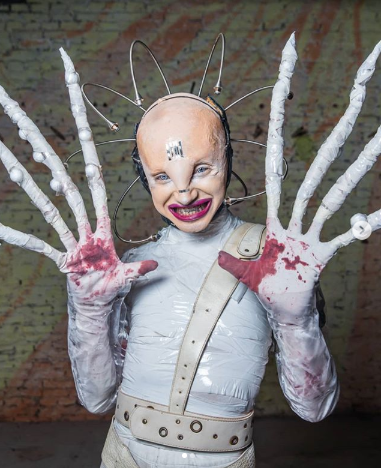
Shiva The Destroyer, perfórmer y drag queen argentinx

            Diana Taylor recoge algunos de los aspectos vertidos por ambos autores para pensar una teoría contemporánea de el/la performance como disciplina artística. Para la autora, es la repetición corporal (en contraposición a la representación teatral) la manera en la que el/la perfórmer crea efectos y afectos. Una de sus más poderosas herramientas es que, como manera de leer normas sociales, potencialmente toda práctica convencionalizada en el cuerpo (de raza, género, de nacionalidad) se vuelve una performance. Así, la norma de la performance es romper, o cuestionar, esas normas naturalizadas, mediante la transmisión de un saber corporal que elimina los límites entre “vida”, “arte”, “espectador”, “artista”, “política” y “estética”.