Disrupting the Network

The readings this week are all about disrupting the network. Problematizing the network. Occupying the network. The Zapatista movement blew a hole in the hegemonic hierarchical capitalistic structure of thought and transaction, making the invisible visible. The movement became a lateral network among the people instead of dangling a leader or figurehead above the crowd. It encouraged new ways of thinking about indigenous rights and responses; the spectacle spread like wildfire and manifested itself in aesthetic practices, artistic practices and new forms of activism. The subversive politics of using indigenous aesthetics and technologies in a “modern” world or distributing those within a modern network is significant. Jill Lane writes, “…the Electronic Disturbance Theater had designed the flight plans for a companion digital Zapatista Air Force: the code for its “Zapatista Tribal Port Scan” (ZTPS) was released for public use on 3 January 200I. With this software, artists and activists could mount their own aerial attack on any web site-the U.S. government, or the Mexican military-sending thousands of messages through the “barbed wire” of ports open to the cyber network.’ The messages sent by the digital activists were drawn from a fragmented, bilingual poem about the Zapatista struggle for peace with dignity in Chiapas” (Lane 130). 

            Not only does the EDT vigorously question the idea of space and embodiment in the cyber network, but this narrative elevates the fragmented, the bilingual, the forgotten (Lane 131). It illuminates the invisible and intangible “space-betweenness” that the protesters – the indigenous population negotiating citizenship and human rights violations – aesthetically and (perhaps) geographically occupy. Even the title, “entre la luz y la sombra” is a call to that in between-ness. The nonviolent nature of the movement also is a direct rejection of violent colonization practices. It furthermore appropriates and subverts “power” in a hierarchical, manipulative sense. By this I mean, the word is the weapon, as the Subcomandante says. There was always the “illusion” of the weapon, but that weapon was the word – it was the will of the people, the movement. The Zapatistas used this illusion, the word ultimately, to manipulate and mobilize the capitalist, neo-liberal hierarchy; I see this as subverting the way “illusion” has been weaponized to marginalize, control, regulate and erase bodies. This movement leaves me with more ideas about the potentiality and futurity of bodies and lives in translation; of the way that activism can employ bilingual narratives and the fragment to mobilize and subvert hierarchies. 
Digital Resistance

This week’s readings made me reflect a lot about different strategies of resistance and the smaller actions that can serve to intervene upon what often seem to be impossibly complex and oppressive systems of power. I was struck by the account of the “geographies of power” and the concept of disturbance spaces featured in Jill Lane and Ricardo Dominguez’s essay “Digital Zapatistas”. They discuss the Critical Art Ensemble’s reversal of “the familiar Deluzian figuration which sees the nomad as the site of the Other” and its insistence that “it is now power which is nomadic, rendering our social condition ‘liquesce’” (134). Certainly nomadic power would demand different strategies than those familiar images of past Revolutions. The symbolic figure of Subcomandante Marcos, “dead, not dead, not not dead” (Taylor), as well as the stories of Mayan technologies and the action of “bombarding” military bases with paper planes give resistance and revolution a new poetic logic.  

The lineage of hacktivist interventions, and its inspiration on Zapatista strategies, seems like an important point of reflection in this contemporary moment. Thinking of the recent shutdown by the Iranian state of all internet connectivity, it is impossible to discount the significant force of traditional (relatively) immobile state power despite networked frameworks and transnational model of the internet. The readings on the Zapatistas this week seem like a great place to start (and, in some cases, continue) to think through how to challenge the particular kind of power which brutally governs today.

Mask Off

Throughout the pages of “The Human Condition,” Hannah Arendt contends that denying the individual access to the realm of politics is to deny him or her their most fundamental right; the right for promise; for an utterance to actualize within space and time, transpiring as action; what I could further clarify as the right to see your own results, uncut.

Our readings this week speak on the necessary formation of the collective under this constant threat of the biopolitical, their appetite for power and control situating the political realm on its own, untouchable plane; unreachable overhead and yet still capable of causing destruction on the ground. Enter stage left, the Zapatistas and the Electronic Disturbance Theatre (EDT), led by Subcomandante Marcos and Ricardo Dominguez, respectively. 

These urgent collective formations fixate their leaders as “drag-kings,” noted by Diana Taylor, or a performative measure that symbolizes both an insurgent masculinity as well as a reprieve from the identity conventions that serve to further dehumanize these groups which endeavor to depict the nakedness of Emperor.

“The intentional fiction of masculinity (the hero and the voice of rebellion) based on performatic techniques. A revolutionary symbol without face or ego, made up of words and collective dreams.[His queer/ trans act] de-privatizes the face, the name, in order to transform the body of the multitude into the collective agent of revolution” (Preciado).

Creating these collective movements depends on a figure in which his or her people can see their own transformative powers. In this way, the leader begs to be dwarfed by the  idea, his body becoming as big as the assembly that exists in the many temporalities that modernity has shepherded. It is this building upwards, to the side, reaching down, and scooping up, that erects the 99% against the powerful few, for a single man can be easy to destroy, but his ideas can continue to thrive.

In “Digital Zapatista,” Jill Lane begins at our fingertips, with the world-making capabilities of cyberspace recontextualizing how we think of political legitimacy, making way for a novel, digital Zapatista whose “ virtual protests most often reveal the ways in which cyberspace itself is occupied and organized as a commercial and private, rather than public space to be protected with the full force of the law, or of the military” (127). 

What the Internet does for the Zapatistas and the EDT (and potentially any other form of social insurgency) is constructing a new public sphere described by Lane as a “runway for the staging of more productive ‘lines of flight’ for those struggling for social change” (131). We can easily compare this to airplanes taking flight towards unheard destinations, or we can view it even more succinctly as a utopian performance, a fashioning of disturbance. 

A modern fashioning of disturbance appears wherever the virtual and embodied blur and combine. This form of resistance comes in the form of a semantic disordering of established modes of living, in an attempt to “making visible the underlying and hidden relations of power on which the smooth operation of government repression depends” (Lane, 136). The political performance Dominguez and Marcos personify this “contention from the margins” (Dominguez) showing to the sidelined minoritarian and/or indigenous person that Limbo can be a state of mind, an abdication to Doom can be a signature silhouette worth dismantling, and fashioning one’s self towards Emancipation can be spectacle, even when banished to the periphery of Power.

Such theatrics require the refiguring of traditional resources, props, or fabulations, in order to reproduce, rehearse, and practice their world-shattering perspectives. In this way, the gestural use of the ski mask by the Zapatistas makes their presence legible to the greater public while anonymizing their personhood, as Marcos himself states, “the mask reveals” (Marcos). 

Into modernity, the EDT and digital Zapatista map an “alternate form of embodiment against exploitative ‘weightlessness’,” or the dogged prescriptions of Power that restrain a working class from the editors table, a sphere of political actualization that in its essence denies these individuals their right to rights. Instead, Marcos and Dominguez implore those compelled to life on the cutting room floor, to pick up the pieces of their intolerable production, and transform them into an act worth witnessing.

The new central figure of Argentine right wing politics: the troll

The readings of this week analyze the shift of political culture, identities and practices with the rise of digital technology. In “Trump from Reality TV to Twitter, or the Selfie-Determination of Nations”, Brian T. Edwards underlines how Trump adopted reality television and Twitter formats to create the appearance that he addresses his base directly, with a performance rhetorically and aesthetically far more appealing to contemporary audience/population that the one utilized by traditional politics. In that sense, Mark Poster coins the term “netizen” to think a new kind of political identity that shares allegiance to the nation with allegiance to the net as identical political and social practices. On the other hand, Paul Starr summarizes the concept “surveillance capitalism” as a technique implemented by governments and corporations to harvest personal data in digital media in order to produce behavioral modification.

These ideas can shed light to a way of influence public opinion that became the principal strategy of right wing governments in Argentina, namely, the use of  microtargeting, trolls and viralization of fake news to impact voting behavior. In the case of Macri in Argentina, this technique consisted in the secret hiring of Cambridge Analytica to microtarget fake news to voters, and then to massively viralize hashtags about this fake news with trolls.

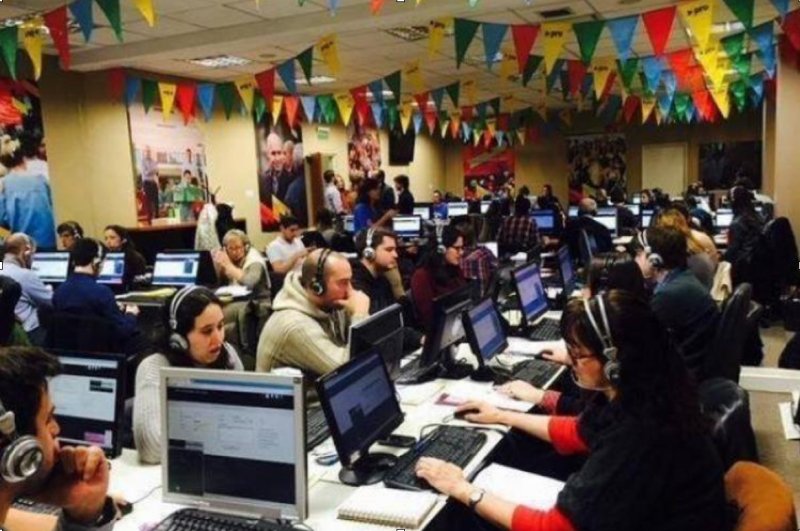
In the photo we can see the Trolls Center of the Pro government, whose existence started to be suspected when thousands of tweets of users with names uncommon in Argentina and with a “google translate” writing style shared the hashtags that supported Mauricio Macri.

Although after the voting it was revealed that most of the news that this trolls shared were fake, the immediate effect that they had was decisive to decide the presidential result. In that way, the troll became the most prominent figure in Argentine politics during the last years, shifting the traditional importance of social movements, as the impact of digital media and the incalculable effects of viralization far way exceeded the possible impact of popular corporeal manifestations.

A digital shift

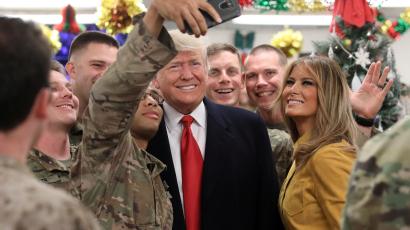
Navy Seal takes photo with Trump during site visit

The articles this week focus on the changing landscape of political spectacle from analog to digital. As technology and the internet continues to develop methods of sharing information has changed what we think of as a nation state. Poster explains, the conditions of a globalized internet has made citizenship obsolete because the internet is a borderless place (72). Universality then becomes inherent in what we would consider citizenship or netizenship as individuals navigate political relations on a decentralized internet. As the Recombinant Theatre and Digital Resistance article explains, digital culture has been reworked as a “invasion of mass media that functions as a reproduction and distribution network for the ideology of capital” (151). In comparing analog to the digital, Critical Arts Ensemble explains, the analogic model created a sense of assuredness about the order of the world whereas the digital model has created a fragmented understanding of phenomena which has disrupted everyday communication to embrace a technology based worldview (152).

This technological shift can be seen in the way Donald Trump has run his reality television show and presidency. As the internet and social media has taken over and the chase for online “friends” becomes a political act, Trump’s style of entertainment and administration American has transformed popular culture and US politics (Edwards, 27). Edwards explains, whereas as previous politicians maintained the analogic, Trump’s rhetoric emerges through the digital, communicating style through reality television and online tweets. Steaming from The Apprentice boardroom we see how the entertainment of “You’re Fired!” has shifted its aim from celebrities to political cabinet members (33); moreover, the benefit for Trump (and perhaps a pitfall for the American people) is that incorporating social media views and likes reduces any engagement of civic matters down to a popularity contest. 

Edwards, B. (2019). Trump from reality tv to twitter; or the Selfie-Determination of nations, Project Muse. 74 (3): 25–45.

Poster, M. (2006). Information Please: Culture and Politics in the Age of Digital Machines. Duke University Press.

“Recombinant Theatre and Digital Resistance.” (2000). Critical Art Ensemble.  44 (4): 151–66.

Rebel Yell

“What I call the selfie-determination of nations is a digitally mediated, imagined community in which individual citizens, bots, and trolls exist side by side. It is at times difficult to know who is real and who is a digital creation” (Edwards 39).

I was shocked, though I shouldn’t have been, to learn that a large amount of Trump’s twitter followers are paid bots. They aren’t real. Or are they? The running theme in all of this week’s readings was survival. The afterlife of a political figure, movement and collective have been radically transformed in the digital age. “But still, he lives on – sur-vives – as a hashtag (#maga)” (Edwards 31). The digital platform comes in all shapes and sizes, but space itself is intangible. The survival is in spite of, or perhaps even due to, the lack of form and tangibility in the sphere of appearance, which is also akin to the lack of form required in wild, passionate political responses. If “passion is the stuff for politics” as we discussed early on with Mouffe, then the digital age’s passionate afterlife, also extending to the form-less and perhaps “strategy”-less insurgencies discussed in the article, “Insurgencies don’t have a plan – they are the plan: Political performatives and vanishing mediators,” are working off of this intangible space of potentiality, harnessing and using emotional response from the larger people as their fuel. My question is: even as marketing analytics and surveys skyrocket, the question for me remains – who is going to be touched, affected, etc. by this afterlife? Who is affected by this survival in the digital age? Rather, is anyone’s opinion actually changed? If we know – or are to assume – that facts don’t change people’s minds, then can the rebel yell of “enough!” be the thing that sways?

Celebrity, Capital, & Communication

A popular quote from Trump’s hit reality TV show, The Apprentice. He was known as a successful businessman who taught others how to be leaders and make millions of dollars. What American wouldn’t look up to this white capitalist?

When thinking about political figures, or rather actors, it isn’t often the case that celebrity would come into play in regards to credibility. With the current US president Donald Trump, being a rich capitalist celebrity is his only credibility. In Trump from Reality TV to Twitter, the article focuses on how information and fact is now circulated due to a change of power. Having a reality tv star as president of the US has placed enormous value on social media and the dramatic. The information, or the “text”, is consumed through Trump’s main platform, Twitter, or circulated through fake news on Facebook, or debated on TV. The question is, what has caused us to teeter away from data and professionalism–“the analog.” It isn’t the president to blame entirely, but perhaps the digital era and pleasure his audience seeks from media and the many forms and genres it comes in.

What should the purpose of the internet be, especially for the political? Mark Poster in Information Please argues that the purpose of the internet has been primary for the development and sustainability of global economies. The internet has elicited international consumerism by the form of accessible communication. However, the internet should be used for more than the benefit of the economy but for global communication and engagement. Poster also asks us to rethink the term citizen and “the machine heterogenesis” of the human which I am not quite sure what he is referring to.

There is no arguing that technology and media platforms have a huge role in politics at this time. We see that in the above examples, especially in regards to Trump. Paul Starr in his Foreign Affairs article “Big Tech and the Business of Surveillance” points out that the power technology holds in politics and society will only cause more opposition towards technology. Many blame these platforms for what content and conversations are produced from them. Starr writes, “Nationalism is on the march today, and the technology industry is in its path: countries that want to chart their own destiny will not continue to allow U.S. companies to control their platforms for communication and politics.” When we talk about chart, we can literally think about marking on the internet in which things become materialized. But what is Starr referring to when he is discussing the liberation from the US and its use of technology?

Light From a Dead Star

What it takes to make a successful reality television star isn’t too disparate from what it now takes to make a political actor. 

I write this fully cognizant of the swath of “stars” in the reality television galaxy, from the Lotharios on The Bachelor (Since 2002) to the Alphas on Survivor (Since 2000) to the All-American Sweethearts on American Idol (Since 2002) to the so-real-you-could-reach-out-and-touch-em’ passersby on The Real World (Since 1992) to the Vulgarian Elites of the Real Housewives (Since  2006)…

There is a universe out there, where these stars have emitted a spectacular performance of reality, inevitably skewed by medium, that has bathed society in beaming rays of soft power for such a prolonged duration, that its illuminance has become blinding.

To make a competent reality television star is to make a modernized amalgamation, much like Dr. Frankenstein’s monster, only much more cognizant of all the experiments and performances of starpower that came before, terrorizing our collective imagination. 

Now, don’t look under the bed, look all around you- a digitized archive in the sky containing the vastness of these many performative actions to starpower, sanctions of identity, reiterations, and affirmations of consequence, that, like the greatest Slasher villain or Horror movie fiend, is out of sight, but always on your mind, and potentially, dangerously accessible, simply in saying their name three times whilst staring into a mirror, or perhaps when you’ve closed your eyes and fallen asleep…

The Internet has become a ladder up (or down) towards the world of the intolerable, where our dreams seek materialization through an immersion within the intensity of digital time, bending space around it, Social Media spreading across its surface like constellations, creating the emergent potential for community, as the individual exists in the “solitary glow of handheld devices” (37 Edwards). 

The format for reality television and Internet consumption makes it truly difficult for their stars to burn out, with cross promotion and spin offs of spin offs into web series preserving their ray of light for a potentially unlimited period of time. And why exactly should we rid ourselves of them? Don’t forget- these are real people on the air, in our screens. Mr. Rogers was bound to be cancelled sooner or later, but why would we ever cancel someone (or something) like a Donald Trump?

Our reading this week, identify this collapse between entertainment and news, under threats of insurgency, and an appeal to a new kind of citizenship, indebted to an appeal to passion, a subsequent masquerade of information, and the birth of society as super-spectacle, where the line between hard and soft power, celebrity and charlatan, have blurred.

Mark Poster gives us a method for operating in this new domain and it relates squarely with Performance Studies. In “Information Please,” he contends that Western concepts and political principles cannot form the rights of man and citizen in this increasingly globalized condition. Operating in this domain not only ignores the World Wide Web of universality facilitated by the Internet, but also the humanizing force of technology on our natural plane of existence. This helps to develop my initial observation: What it takes to make the perfect reality television star and/or political actor is actually a bid towards man and machine hybridity.  

“In short, we may build new political structures outside the nation-state only in collaboration with machines. The new community will not be a replica of the agora but will be mediated by information machines. What is required therefore is a doctrine of the rights of the human-machine interface” (72, Poster)

If we watch Trump’s performance in this realm of human robots (or maybe living dead), we bare witness to a political insurgency that exposes the outmodedness in our perceived notion of power in real-time, streaming now, in turn, “changing people’s frames of reference by offering windows of possibility, allowing for the viral opportunity to “feel the exhilaration of making a difference by the mere fact of being together” (Arditi). And like any noteworthy performance, these coups last far beyond their initial spark and are innately devised to do so. 

Described by Benjamin Arditi in “Insurgencies don’t have a plan…,” these insurgencies are “animated by the belief that present-day conditions harm equality, freedom, social justice, and so on that they can make a difference by acting to make another, more equal and just world emerge from this one…organizing the future was not their top priority because they were already making a difference by merely demonstrating, occupying, and generally defying the order of things.” 

Trump and his cohort strive to disturb the present as if in rehearsal for the future, a transmission that relies on the collapse of news and entertainment, the notion of a media, detached and untrustworthy, and an abdication towards Doom that inverts our man-made absurdities, exposing the underlying fragility of a cultural hegemony built on the dread and disillusion of its subjects. 

Digital Possibilities and Pitfalls

Paul Starr’s review of Shoshana Zuboff’s book The Age of Surveillance Capitalism, he mentions the possibility of a “for-profit-city.” Here, the city is run by a subsidiary of Google’s parent company, and the citizens are relentlessly monitored with the eventual goal to “obviously over time track them through things like beacons and location services as well as their browsing activity” (Emphasis mine). Yet, Starr reiterates that Zuboff uses this example not to display totalitarianism, which implies violence into conformity, but to highlight “instrumentalism.” This instrumentalism is an outgrowth of Brian Edwards’ world that we are living in now: “That Twitter would become the preferred venue for someone in the position of the most powerful individual in the world will be after all important. That the selfie is a globally ubiquitous form of representation is crucial.”

While Starr via Zuboff and Edwards warn us of the dangers of the digital, Poster and the Critical Art Ensemble give us ways to wield the power of these tools. Poster engages with the Netizen, a citizen of the web that emerges when both human and citizenship rights fail us. Poster stresses the possibilities of the internet’s non-analog methods where “vast stores of information” become accessible and editable “in digital form, may also be altered in its reception and retransmitted” (78). Therefore, plagiarism and repetition become standard but also, as Poster highlights, a political one. Critical Arts Ensemble gives us a glimpse into recombinant theater through the use of information and communication technology (ICT). Their piece Flesh Machine as described integrates ICT and biotechnology. They emphasize their performance as not just theater but as an “information organizer.” I caution both writers to lean too far into the digital, the consistent production of information with seemingly no end. CAE even emphasizes that they were teaching computer literacy in their presentations, and that “computer literacy translates perfectly into bioliteracy since it is just another form of informatics/cybernetics” (164). As we learn to think more like computers, perhaps the question should be asked as to whether computers are the right method by which to process information. In other words, computers work in aggregates and data processing but rarely ask us to sit with the information in a personal way. Who do we stand to lose in these aggregates, and historically who have been left out or cut out of these systems? What happens if we refocus our politics from profit to thoughtful production? If we think of all systems from cybernetics to human relations as political, I urge a reintegration of care and thought in the production.

Elements of Recombination

In a previous post, I wondered how we could approach Azoulay’s civil contract of photography through the digital era. After reading this week’s texts, perhaps Poster’s in particular, I realize that the question can and should be rethought on the basis that citizenship can no longer be formulated within the confines of the nation-state due to the deterritorializing force of globalization, and the contingent nature of the digital landscape. Poster questions the situatedness of the concept of “citizenship” in today’s world (both as conceptualized alongside the nation-state, and the claim of universality present in Balibar, even as it moves beyond the nation-state paradigm), aligning himself with critical discourse that “locates an antagonism between globalization and citizenship,” that “globalizing processes strips the citizen of power,” erasing borders and “rendering problematic the figure of the citizen as a member of a limited national community” (71). Critical here is also his observation that Western concepts and political principles “may not provide an adequate basis of critique in our current, increasingly global, condition” (72). Poster sees, here, a potential for a new form of power and association (71).

After all, the breakdown of borders does not only have to do with physical territory, but also with the previous separation of political activity from arenas such as consumption, either of media or not. Edwards’ article on Trump and the “Selfie-Determination of Nations” makes it abundantly clear, through the example of the Trump presidency, that pop culture is now a hallmark of American politics. Edwards proposes that digital technologies have created the “selfie” social form, a “digitally mediated, imagined community in which individual citizens, bots, and trolls exist side by side” (39). Edwards highlights the role of circulation, specifically the circulation of information, in this process, and how Trump has capitalized on it in the creation of his audience. The texts this week in general share a preoccupation for form, following the impulse in social theory to examine the often obscured construction of modern social practices. Drawing upon Dilip Gaonkar and Elizabeth Povinelli’s privileging of form to content, Edwards argues for a focus on “what it is about the Trumpian Tweet itself––or the reality television format––that propels his message across the circulatory matrix…to understand how the form intersects with the rise of a new relationship of individuals to politics in the digital age” (30, emphasis mine). Like last week’s readings that pointed to the failure of merely attacking the content of Trump’s speech as lies, Edwards urges us to analyze how Trump strategizes circulation in order to understand the mechanisms driving his “success,” such as direct contact with his audience, or the calling into being of social groups based on social capital, competition, and temporary alliances (38). Edwards rightly observes that in the political transformation of the age of Trump, there is a “battle over the media themselves” (40). I would like to add that this does not just materialize upon the grounds of Trump’s denunciation of “fake news,” but also pertains to other shadowed and global players such as Russia and their influence on the U.S. elections, which predominantly played out in the digital sphere. Indeed, it is interesting to consider, within the intersections of globalization, capitalism, and imperialism, a “war of images that isn’t visible.”

Poster asks if in the contemporary situation, the media has the ability to create new subjects. These important questions are raised:

Can the new media promote the construction of new political forms not tied to historical, territorial powers?

What are the characteristics of new media that promote new political relations and new political subjects?

How can these be furthered or enhanced by political action?

(Poster 78).

Poster’s concept of the “netizen” is based upon the web’s decentralizing features that can escape the control of the nation-state due to its deterritorializing and contingent, unpredictable nature, one based on open exchange: “any point may establish exchanges with any other point or points” (78), although here it is important to note that in certain countries this “free exchange” is heavily policed and censored. However, I did find Poster’s examples of how media can supersede existing political structures (women mingling with men freely in chat rooms in the Arabic world, gay individuals socializing and organizing on the Internet in Singapore) to be compelling (82).

The Critical Art Ensemble’s piece on recombinant theatre gives us some other apertures to answering the questions posed by Poster. I found the idea of recombination as cosmology interesting: “a new way of understanding, ordering, valuing, and performing in the world” (151). The Ensemble discusses its view on street theatre as performances that “invent ephemeral, autonomous situations from which temporary public relationships emerge whereby the participants can engage in critical dialogue on a given issue” (157); again, there is an emphasis on the contingent nature of these gatherings as ephemeral, autonomous, and temporary, and the creation of a “loose-knit ephemeral public” (159). The conventions of recombinant theatre, based upon “participation, process, pedagogy, and experimentation” (158) and eliminating privileged positions such as that of the director, have to do with horizontalization, what CAE proposes as a digital move because the analogic is grounded in “one voice [that] speaks for the ‘betterment’ of all” (158). Interesting is how CAE suggests that strategies and tactics “will not come from the university or cultural industry centers; rather, it will emerge from the minor sectors and nomadic vectors” (157). As Deleuze and Guattari have noted, the planetary machine is paradoxical (mutational) in that it is precisely that which creates micro-assemblages; “Following André Gorz’s formula, the only remaining element of work left under world capitalism is the molecular, or molecularized, individual…a macropolitics of society by and for a micropolitics of insecurity” (215-6). Here, we may also consider how Trump has developed an anti-globalization rhetoric as a tempering of this insecurity.

Like Poster, the Ensemble locates the radical nature of its model within its potentiality and the creation of new possibilities within the mutational possibilities of today, although here there is a more concrete practice of the work, which occurs around the axis of invention and unpredictability. While failure can be a real result, so can “the possibility of an emergent discourse of liberation” (159), as seen in such interventions as The International Campaign for Free Alcohol and Tobacco for the Unemployed (1998), which materialized the possibility of open exchange in a space reserved exclusively for consumption (159). Globalization also figures as a problematic in this text, as the Ensemble acknowledges that due to it, “a new theatre that bursts the boundaries of the theatre of everyday life” has been created (161). From here, CAE suggests the use of technology, the “emerging theatre of information” (161), as a tool, an “information organizer” (163). Perhaps Poster enters here when he suggests that even the borders between the natural and science and technology have dissolved: “The conditions of globalization are not only capitalism and imperialism: they include the coupling of human and machine” (72). In arguing for the building of a new political structure outside the nation-state, Poster posits that this will only be possible through the “coupling of human and machine…the new ‘community’…will be mediated by information machines” (72). Similarly, I think the observation from CAE that information and communication technology (ICT) will mediate but is “not going to provide community, democracy, expanded consciousness, or interactive theatre” (163) is a smart demarcation; too often the discourse on technology and its “progressive” potential endows it with a utopian promise. Technology can act as a facilitator, such as in the case of Flesh Machine (1997), but we still need to put the responsibility for the work and process, thinking and doing, on ourselves.

ACTUATION – IMPROVISATION

Not only are “prediction products” what “Zuboff sees as the true basis of the surveillance industry”, “which anticipate what users will do now, soon, and later”, but our behaviors are being shaped by technology firms, for us (Netizens or by media newly constructed subjects) to become even more predictable. (https://www.foreignaffairs.com/reviews/review-essay/2019-10-10/new-masters-universe) How do these predicted and even created actions connect to the “digito- analogic hybrid forms” and processes of today? (Critical Art Ensemble, Recombinant Theatre and the Digital Resistance, MIT Press 2016, p.153) I got to the point of asking: What is improvisation today within the time of technology and how are we being choreographed? Fred Moten says that music is the improvisation of organization. We can consider improvisation as the nexus of the digital (order from order) and the analog (chaos from order, order from chaos). Inventing the term “Monk’s Law” Fred Moten asks: “Is genious that which gives or that which breaks the rule?” and answers it by saying that giving and breaking are bound up with one another. (So maybe rather a Musizen than a Musician- considering the contingent element of improvisation – as an “encounter between a statement and situations or movements“). The “mode of deterritorialization” and “the unknown outcome” of the experimental Recombinant theatre carries the unpredictability within order as improvisation, and can therefore be put in conversation with Mark Poster’s Internet “containing the potential of new practices”, that “de- and reterritorialzes exchanges” and is interdisciplinary: “any point may establish exchanges with any other point or points, a configuration that makes the Internet very difficult, if not impossible, to control by the nation-state.” (p. 78/79 Mark Poster Information Please) Brian T.Edwards in his article Trump from Reality TV to Twitter, or the Selfie Determination of Nations, quoting Bill Pruitt talking about Trump on p.26: “You never knew what was going to happen exactly. It was like the greatest, grandest improvised theater with all the stakes woven into it.” I see Trump’s constant unpredictability as an important part and tactic of his political spectacle of power.

How do multiple fleshless bodies improvise with each other? It is true that “Social Media creates communities (…)” (p.38, Brian T. Edwards) and that “the internet contains the potential of new practices” (p.78 Mark Poster). Nevertheless, I believe that as artists, we share a common interest on understanding performing arts as a way to create places for gathering. “(…) the body is still the key building block of theatre” (p.163, CAE) and virtual communities through virtual theatre create a disembodiment that will prevent important and necessary social gatherings of flesh and bodies, of spec-actors from the contingent qualities of improvising together in the digital age- FLESHNETS.

Entretenimiento político

Con el ingreso de las plataformas digitales al escenario político, las lecturas de esta semana nos invitan a pensar la influencia que tienen estos espacios en línea, para el desenvolvimiento y desarrollo de la política, en donde parece haber un hilo común para trazar en las lecturas: la fusión en el consumo del entretenimiento y la política. Lo que antes parecía dos mundos separados, en los últimos años con la llegada de las redes sociales y una figura como la de Donald Trump, esto cambió.

Así lo plantea Mark Poster: “As consumption has become political, so politics has become a mode of consumption (…) The primary means by which citizens obtain information about candidates is the television set, bringing politics to individuals in the same way they experience entertainment.” (73). O pensando en Trump y su relación con Twitter, Brian T. Edwards: “Donald Trump transformed himself from reality show, real estate developer, business man, into someone who understood the political theater of the office of the presidency.” (36). “What Donald Trump instinctively knew during the presidential campaign of 2015 and 2016 was that the space between news and entertainment had collapsed.” (40) Esta superposición entre política y entretenimiento es la que nos permite pensar en que evidentemente sí existe un valor determinante de estas plataformas online para configurar el campo político actual.

Me interesa destacar la mención de Brian T. Edwards “the political theater of the office of the presidency” para relacionarlo con el trabajo que leímos Recombinant Theatre and Digital Resistance. Ambos trabajos piensan en las nuevas tecnologías de la información en relación a la creación de una comunidad virtual, un espectador, real o no: “The second front is virtual theatre proper, which tends to manifest in one of two ways. The first manifestation is the virtual community” (…) In other words, those involved in the virtual theatre are nothing more than neutralized subjects incapable of disrupting the matrix of authority and thus establishing an autonomous subjectivity” (162), por su parte T. Edwards: “Social media creates communities of followers who exist in the solitary glow of handheld devices, a million fingers scrolling news feeds (…) What I call the selfie-determination of nations is a digitally mediated, imagined community in which individual citizens, bots, and trolls exist side by side. It is at times difficult to know who is real and who is a digital creation.” (39). Hay entonces otro actor en este panorama digital-político que se configura y que vale la pena preguntarse cuál es realmente su accionar y su influencia como ciudadano.

Pensando en el modo en que se organizan las campañas políticas actuales, y volviendo a Poster: “Candidates in election campaigns increasingly rely on media to reach their constituents. Political advertisements are the chief means of conducting campaigns” (73), se me hizo inevitable pensar en el reciente interrogatorio de Alexandria Ocasio-Cortez a Zuckerberg: “You announced recently that the official policy of Facebook now allows politicians to pay to spread disinformation in 2020 elections and in the future. So I just want to know how far I can push this in the next year?”

Performing the Digital

Through capitalist models and overly produced material from the analog to the digital, this essay discussed the influence of mass media, reproduction, and a power structure, on page 152, Critical Art Ensemble says “In three sentences Lautreamont summed-up the methods and means of digital aesthetics as a process of copying a process that offers dominant culture minimal material for recuperation by recycling the same images, actions, and sounds into radical discourse.” This explains how powerful and practical the “digital” is. Critical Art Ensemble points out another definition affirming “From the smallest details to the first principle of the digital paradigm, it acts in a manner contrary to the analogic by insisting that orders comes from order (pg 153).” To my understanding, if we are talking as a performative spectacle or art, this order is already produced from a pre existing model. The essay thus imply a connection or a line between author and audience and, if we are talking in terms of performance, the digital theater cannot rely on one individual or a single creator. Critical Art Ensemble then, decentralizes authorship moving “theater” from the stage and onto the streets. They affirm that if there were to not be an “action” or a script there will be no performance. Critical Art Ensemble provides a an example with a work titles “The International Campaign for Free Alcohol and Tobacco for the Unemployed,” in which such “performance encouraged folks to act the message this performance showed, on page 159, “CAE carried out a guerilla performance in Sheffield, UK… in the hope of revealing some of the hidden structures of domination in everyday life. CAE chose a harmless action that took place in a location where the typical activities of the local population would not be disturbed.” Becoming a stage for spectators rather then spect-actors. Similarly, in the text of Brian Edwards, he argues that the digital age, entertainment, and other sources of media have given a raise to populism in the global sense. He focuses on how Donald Trump propelled this seismic symptom that altered entertainment, technology, art, politics and the media. Being trained in television, his rhetoric spread across what it is popular culture and the Untied States politics, where, without the use of the script, his political stand became entertainment and rupturing the “American Century”, on page 32, Edwards says “Twitter itself, and its logic of digital circulation—that which propels a message along a circulatory pathway—operate within the period after the American century. What the “American century” means in this context is what I have called elsewhere a Lucean logic of broadcasting (“After the American Century.”)

Digital technologies, news and politics

Dos factores relacionados entre sí han afectado el concepto de ciudadanía, y su correlativo ejercicio de la política, de manera más o menos reciente: la globalización y las tecnologías de la información, empezando por la televisión y expandiéndose a las redes sociales.  La idea de nación, el marco en el cual la ciudadanía se materializa, ha cambiado radicalmente, El artículo de Poster propone un recuento histórico de este proceso y comparte el análisis que Balibar hace al respecto. Con la nación en proceso de disolución ante el fenómeno de la globalización y la emergencia del mundo virtual, al que se trasladan gran parte de las discusiones que antes tenían como lugar ideal los escenarios físicos usados para los ejercicios democráticos, la plaza pública específicamente, la noción de ciudadanía cambia.  De esta manera, al lado del ciudadano emparentado al concepto de nación hoy tenemos al Netizen, el sujeto político del ciberespacio “In contrast to de citizen of the nation, the name often given to the political subject constituted in ciberspace is “netizen”. Netizen may only be a partial term, because no one lives in the Net permanently, at least not yet” (Poster 78). Si bien el autor nos recuerda que el espacio virtual no es un lugar en el que se pueda permanecer eternamente, lo que sucede allí tiene impactos en los ejercicios democráticos tradicionalmente corporizados, especialmente, en procesos de votación en distintos niveles.  

La relación entre la política y las tecnologías digitales es explorada también en el artículo de Edwards, quien estudia el caso de Trump a través de los usos de la televisión y Twitter.  Para Edwards “There is an intimate relationship between the rise of digital technologies and the social formations that organize us, that is, how we relate to each other. The correlation between the history of technology and society itself has long been central to politics (28). La televisión y las redes sociales han contribuido a esta nueva comprensión de la política, acercándola cada vez más a las formas de entretenimiento masivo de la cultura pop estadounidense mediante un cambio en la circulación de la información y por tanto las noticias y en una interacción entre comunidades que crean esporádicamente en torno a intereses específicos.  Este límite difuso entre el entretenimiento y noticias, según Edwards, fue lo que Trump aprovechó en su campaña para llegar a la presidencia de los Estados Unidos y es a partir de esa organización social – digital que ha gobernado (40).     

Esta forma de hacer política que alcanzó su climax con Trump, tal vez porque él mismo ya había sido un personaje del espectáculo en su reality show “The Apprentice”, ha sido adaptada a escenarios políticos en otros países, en Colombia, un evidente uso de las redes sociales, incluyendo “fake news” e información ambigua y tendenciosa, ha venido en aumento (esto me hace pensar en la lectura de la semana pasada sobre el imperio de las creencias por encima de los hechos y en cómo esta emocionalidad es utilizada en política para inducir a los ciudadanos a votar con base en creencias o manipulación de sus temores, por encima de un ejercicio argumentativo basado en información más o menos comprobable), pero tal vez sus efectos más importantes y adversos se hicieron evidentes en la campaña por el No, en el marco de la votación del plebiscito para refrendar los acuerdos de paz entre el gobierno y la guerrilla de las FARC en 2016, en el que se distribuyó deliberadamente información falsa por parte de los grupos opositores, hecho que después fue admitido por el director de la campaña quien dijo que el objetivo de poner en circulación esa información era “que la gente saliera a votar verraca”, en otras palabras, que la ciudadanía tome decisiones políticas con base en información errada.

https://www.larepublica.co/ocio/entrevista-de-la-campana-del-no-del-diario-la-republica-gano-distincion-del-cpb-2470111
Tomada de la página de la cadena de noticias Caracol https://caracol.com.co/emisora/2016/09/04/medellin/1472999862_149849.html

Political Spectacles in the Digital Age

Three articles focus on the shifting of political spectacles from different facets: the evolution of theatre of being in the digital age; the specactors transformed from citizen to netizen; the new digital forms reform the political spectacles in the States.

CAT discusses their theatre form called the recombinant theatre and gives a closer look at the theatre in a chronological sense. The value of analogic and the digital, since the day digital appears, have been trading off with each other.In the analogic era, people have a sense of certainty about cosmo till it comes to digital era, for each principle analogic holds dear, the digital model proposes its opposite. (CAT,152)At the beginning of this coexistence, The anachronistic economy of artisans reproduces itself as a luxury economy(CAT, 153): As digital is a test of equivalence, its process offers an ongoing flow of sameness, of order from order(CAT, 154), the high end of value is still found in the analogic because digital reproduction is lack of Aura (Walter Benjamin). Along with the discovery of DNA, the digital age developed into another level: since the origin of life is not analogic (order from chaos )but digital ( order from order)( CAT,155), both analogic and digital have the same value in the regime of art. When it comes to the age of Modern art, where the value is defined by context. The counterfeit was no longer the counterfeit if it met the expectation of sameness. (CAT,156)

       Today as the segments of knowledge go deeper, it opens up possibilities for the theatre of everyday life. As the old form of the theatre of everyday life become the perfect representation of gender hierarchy found in ordinary social space, the usefulness of everyday life is waning. But the development of Theatre of information seems promising because of its intense level of technological mediation, the audience is a step down from actually attending the event. Comparing to the Virtual theatre where we find the feedback loops between electronic and the organic, it seems to have deepened the pedagogical dimension of resistant theatrical practice. (CAT, 165)

On the other hand, the definition of citizen changed a lot in the digital age. Balibar claims that man points to the same referents as citizens, the two are one. He does not agree that there is a duality of individual and the person engaged in political affairs. According to Balibar Man has to emerge in the political issue and become a citizen in the meantime. (Poster, 70)In Poster’s opinion, we also have to find a way to turn the defensive place for being a citizen into an offensive one in a digital age the most important thing is to take into account the intervention of machines to switch the Doctrine of human (Baudrillard) to the doctrine of human-machine. For instance, the digital age politics has become consumption,( like what is elaborated in Trump’s case) citizenship is a blend of autonomous individual of modernity with the postmodern neotraditionalist of identity politics, it becomes even more complicated in the borderless world of the internet.( Poster, 75) According to Poster, citizen evolve to netizen. This claim resonates with what is mentioned in the article of CAT: regarding the new potential of practice of the internet, and the transformation of the citizen, the theatre of becoming is for sure in its new stage of the process.

But Poster also reminds us that internet, not as a utopian realm but has its hierarchy and control, manipulation and risks. We have to analyze how political representation is reproduced and its repercussions on national sovereignty. (Poster ,84)

An impact on multiple aspects of globalization, including transnational flows of capital and people, which in turn led to the proliferation of new forms of communication and the ways in which culture circulated through the world, from satellite television to digital piracy(Edwards, 28) As Friend requests and followers are a perverse new form of social capital, as expressions like the selfie is “a new phatic agent in the energy flows between bodily movements, sociable interactions, and media technologies that have become fundamental to our everyday, routine experience of digital activities” (Edwards, 39 ), Trump’s twitter is par excellent an example of how the circulation of social media become the self-determined political spectacle for authorities, and how this has managed and regulating American citizens’ relationship to the world outside the united states.

Poster, M. 2006. Information Please: Culture and Politics in the Age of Digital Machines. Duke University Press.

Edwards, Brian T. 2019. “Or the Selfie-Determination” 74 (3): 25–45.

Ensemble, Critical Art. 2000. “Recombinant Theatre and Digital Resistance.” TDR/The Drama Review 44 (4): 151–66.

Which server contains you?

Credit: https://www.flickr.com/photos/ibm_media


Look at the picture carefully. Trump has just made a new post on Twitter and got thousands of angry replies. The data about it is now being processed by one of the servers you see. As long as the machine is safe the evidence of political battles, poor Friday choices and cat videos will be available to any user of cyberspace at any time for better or for worse. Poster believes that “new media offer possibilities for the construction of planetary political subjects, netizens who will be multiple, dispersed, and virtual, nodes of a network of collective intelligence.” I would argue that this idea is still idealistic in its willingness to create collectivity through digital space even though he mentioned that he is not suggesting “a utopian realm of equality and freedom.” Undoubtedly, cyberspace creates expansive communities within it but just as it happens in “analog” life people’s views are framed through their sources of information. And the abundance of sources online is controlled by the political power like Trump administration and its continuous supply of digital content that tries to blurry “the boundary between news and entertainment” even further. Edwards does not try to attribute potential collective intelligence to online users as he doubts their existence in the first place. In what he calls “the selfie-determination of nations” it is hard to recognize not only real information but a real person. His infostructure is “a digitally mediated, imagined community in which individual citizens, bots, and trolls exist side by side.” It means the digital identity is created not only around those living in the real world. Some of Internet subjects without bodies might even have more persuasive digital traces of existence than real people who do not use a mobile device. Does it mean that it is a time when the analog or the real version has to stand “the test of equivalence” to the digital one? Well, as long as the servers are on, we will keep persuading machines that we are humans every time checking “I’m not a robot” box. Even if netizenship gets created, it will arise a new question of who will be governing the cyber state.

Digital logic and new ways of information circulation

In Poster’s discussion of citizens, digital media and globalization, he proposes that the primal citizenship is deprived of its power since the world of Internet is technically borderless (though I still feel that language is still serving as the final frontier and border, where the sense of belonging and unity as mobilized bodies is still retained), and a new citizenship is  being forged by the advent of Internet — the netizenship. It’s partial, temporary, but crucial to the globalized sociopolitical environment. It is “more practically dispersed across the globe… inherently bidirectional and ungovernable by existing political structures” (Poster, 84) , and is capable of organizing social  orders and generating movements in a much more participatory way.

It is clear that digital technology is changing the society by altering the ways of thinking. It has created a new digital logic, which is quite different from the previous analogic one. It does not create order from chaotic, but generates from the existing order to order. The uniqueness of humane is not that important anymore, which reminds me of Walter Benjamin’s idea of the lost “aurora” in arts. Digital era is the era of replication. Therefore what contributes to the value of art is no longer the authenticity, but the reframing it does through copying. Through the process of making art and letting people interact, or even purchase and possess art pieces themselves, the normally unseen hierarchy framing is revealed. People start to notice the Pierre Bourdieu’s term of “field”, or  the constitution, which essentially makes art legit. The same things happen within recombinant theatre, where “participation in the theatre of everyday life can make the transparent codes of gender separation/hierarchy opaque and impossible to miss. Once these codes are perceived, a critical understanding quickly follows through dialogue” (CA Ensemble, 160) .

Internet has also changed our ways of consuming information as well as the transnational circulation of messages. In Edwards’s writing, the one man’s narrative created by Trump through Reality TV shows and Twitter is not only about its content, but also about its ways of presentation and circulation. Political tweets are now part of the American popular culture, and Internet, along with interactive social media, have greatly empowered its potency of transnational circulation. Such popular culture used to serve as soft power, probably with ideology implied and coated with entertainment, while now the line between soft power and hard power is continuously blurred (Edwards, 40). Therefore, when interacting with digitalized internet space and information, the political intention is projected to us more strongly than ever.

Digital Spectactors

This week’s readings focus on the notion of the digital and the potentialities and pitfalls that they produce for political action and spectatorship at the dawn of the new millennium.

The Collective Arts Ensemble recognizes the digital’s revolutionary paradigm shift and how entire cosmologies shifted and modified our understanding knowledge and history and the nature of existence itself. The digital is especially influential in our way of consuming commodities, in that consumers now want products that are the same as everybody else’s but still unique and personalizable, juxtaposing digital practicality (replication) to analog aesthetics (artisanship). In an era of increased worker alienation through neoliberal hyperspecialization, recombinant theater—which include happenings and street theater practices—serve as bridges between the digital and the analog, bringing in alienated populations to the spectacle of the theater of everyday life, spurring spectators into critical assessment of social relationships.

In “Citizens, Digital Media, and Globalization”, Poster posits that social media and the digital age are reconfiguring our understanding and our practice of politics: “The conditions of globalization and networked media present a new register in which the human is recast and along with it the citizen” (70). There are ways of accessing a specific, normative type of citizenship through consumption, to buy green or rainbow, for example—citizenship becomes an extension of consumption” (73)—and in this sociopolitical climate, politics becomes a mode of consumption. Poster highlights the need for a planetary (as opposed to universal) democratic movement that takes into consideration the new ways of embodying citizenship in the digital age, including the intromission of machines and the ubiquity of consumption as an inescapable process.

In “The Politics of Passion”, while framing the differences between performatives and animatives, Taylor foregrounds the importance of the body that assembles and becomes one in a crowd for the mobilization of affects that produce mass mobilizations. In light of the digital, Taylor underscores the importance and the influence of physical space for the channeling of political affects, in the creation of the space of appearance in the front lines: “By  gathering  together,  those  in  opposition  identify  themselves to  themselves.  By being  there,  they  prove  that  people  can  become  active  participants;  protest  can happen;  resistance  is  not  only  possible  but  it  is  being  enacted”. Echoing Butler and the power of bodies assembled, huge swaths of bodies in protest invoke a more solid form of political identification and representation, an embodied democracy, more so than in traditional political performatives like elections which can be so easily robbed. In brief, Taylor purports that, even in the eve of the digital, we must not forget the body, because in this age, spectators “are simultaneously political agents, the objects of politics, and performers for other spectators watching events from a different vantage point”—like those watching protests from their phones and computer screens maybe thousands of miles away.

This changing notion of spectatorship is echoed in Arditi’s conceptions of insurgencies in contemporary massive demonstrations. First he highlights the political importance of insurgencies despite the misconception that they are less organized or doomed to failure because contemporary examples do not propose a specific political plan: by not prescribing themselves, the spectacle can be the end in itself, and does not close off its meanings or exclude populations like any other political goal: the ends of insurgencies remain open. Arditi also notes an interesting change in our conception of the spectator in the context of insurgencies: users of social media amplify insurgencies, “giving rise to a spactactor”, a subject who participates in the inauguration of a new space with every like and share. They act to multiply the space of resistance in ways different than simply spectators documenting: they are also holding the state accountable for misdeeds and join in the joy or dread of open rebellion.

These conceptions of the world of politics in the digital age coalesce in the figure of Donald Trump, which Edwards breaks down in “Trump from Reality TV to Twitter, or the Selfie-Determination of Nations”. By highlighting how our state political systems are facilitated (if not predetermined) by the technological advancements of the time (think printing press), Edwards suggests that the digital communication age, coupled with the ease of access of platforms like Twitter, are conducive towards figures like Trump—whose rhetoric reaches his base with ferocious speed. Similarly, Trump transforms the stage of American politics by incorporating the logics of mass media entertainment and reality television—pushing for ratings, reviews, roaring applause—as a real-time measure of his labor as POTUS. The digital age defines and facilitates new ways of forming social alliances and the individual’s place and response to them: by extrapolating the image of the reality TV show contestant, the WINNER, to social media, every existing user would be motivated to accrue the highest approval ratings quantifiably (through likes or reblogs, much like votes on reality competition shows). Therefore, thanks to the advent of the digital, politics in the US swerves more towards the idea of celebrity, of popularity, of approval ratings and consumption, rather historically predetermined notions of the political and of democratic participation.

I agree with Poster in that the Net does provide new ways of forming political alliances (like hashtags and crowdfunding), but what is meant to be put to test is the potential of these new configurations to subsume and substitute traditional forms of cohesive political practices. I would say that Trump’s ability to transform politics to reality TV, that is, consumerist entertainment, uses the Net to promote backwards, neoliberal, stagnant political spectacles that only reifies old political bonds and configurations.