“‘Marcos’ final speech is a puzzle: ‘he who has never lived does not die’ undoes ‘he who does not exist and never existed.’ Dead, not dead, not not dead. But how, he asks, ‘do you kill what was never alive?’ How, in other words, can you kill the Marcos meme? You can’t” (Taylor). In THE DEATH OF A POLITICAL “I:” THE SUBCOMANDANTE IS DEAD, LONG LIVE THE SUBCOMANDANTE!, there is a conversation of reincarnation of figures and what people/bodies can see but furthermore represent, especially in regards to zapatisma.
The quote above is similar to Dolores “Lolita” Lebrón manifesto. “Yo no vine a matar. Yo vine a morir.” Her autonomy exists in her ability to claim death, to exist through the lens of death, because she is not in control of liveness, hers and definitely not others. The colonized female embracing death as a practice of agency is radical, but also all that is left for her to claim. The life of the body is given to the colonizer, but death is given to the colonized. This is similar to the final speech of Marco. One is immortal because life is never granted to those who are seen “dead” by a society, those who are in control of their own death but not their own existence/life.
This quote from Our Word is Our Weapon stood out to me in regards to what being a woman and being a zapatista is. “She. Has no military rank, no uniform, no weapon. Only she knows she is a Zapatista. Much like the Zapatistas, she has no face or name. She struggles for democracy, liberty, and justice, just like the Zapatistas…she is a part of the amorphous yet solid part of society that says, day after day, ‘Enough is enough!'”(De Leon 38). A woman of color is a metaphysical dilemma that is fighting between life and death, existence and visibility, agency and identity. The Zapatista is no longer a name carried by man, but an ideology that has been long before carried by women of color.
“here we are, the dead of all times, dying once again, but now in order to live.”
From a very brief essay written in January of 1994– an essay which may also be read as a sort of memorandum or a preface towards a manifesto that would be unfold in the writings collected in Our Word Is Our Weapon– Subcomandante Insurgente Marcos of the revolutionary Zapatistas group explicated the dire conditions of life of indigenous people in southeast Mexico. Marcos talks of 150,000 dead indigenous persons; dead from curable diseases. He talks of government at every level leaving indigenous persons out of all consideration of solutions, until elections roll around. He tells us that charity resolves nothing but for the moment, and when those moments have come and gone, death again visits the homes of the indigenous. In this brief essay, Marcos wrote clearly the resolve he and the Zapatistas had come to: no longer would they look to the government; now, they look to their ancestors.
This resolve the Zapatistas had reached would focus on one profound effect, which would come to make this revolutionary movement recognized across borders and oceans, fashioning for itself a network of international solidarity, with their word as their weapon. Their resolve was distilled into this aim: “…so that our people awaken from this dream of deceit that hold us hostage.” For this, Marcos states “We are ready to die…”
This post could go in a number of directions, but I’m very interested in this particular essay, so I’m choosing to focus on it and its relation to other essays we’ve read. For instance, I’m interested in what it means to look at extremely precarious (even torturous) conditions of life and fight against it by reorienting the process and performance of one’s death? What would Boal think of this theater of the oppressed? Would he have been able to see this readiness to die as antithetical to liberation, or would he have seen it as a decision to celebrate the lives of ancestors who had sustained something worth dying for under several hundred years of murderous oppression? How does this readiness to die change how we think about Balibar’s three concepts of politics? Does this fit neatly into emancipation, transformation or civility? Do these concepts rest on an assumption of the preservation of an individual’s life over the life of a people? Does Butler’s performative theory of assembly account for actors with this resolve? Are they spect-actors or something more?
The Zapatistas understood “percepticide,” “the body of the condemned,” “intolerable images”; and they understood it in a way that I think makes us confront some of the discussions we have had before regarding the agentic capacity of a spect-actor and the limits of political engagement. As Diana Taylor says in her essay titled “The Politics of Passion”: “…it seems political decisions in the past decade have been increasingly forged through affective and embodied struggle.” This is a question of the “role of physical bodies in movements” that tremendously complicates how we think of our (dis)identifications with political structures and movements. It is a profound decentering of subjecthood, a death of a political “I” (Taylor), in which one’s orientation towards a different future does not include oneself in its eventual concretion. It is interesting to think now how we must adopt such a visionary practice if we are to save our planet. I don’t know what such a politics on such a scale looks like, but I think it’s something we have to think about.
The readings for this week center the Zapatista movement in México as a postmodern revolution that used different spaces as the cyberspace as a way to expand their presence descentering it from a single figure and leader, reproduce their ideas and to make it more accessible while reimagining the idea of presence.
Taylor, explains the complicated performance and important gesture of the “death” of Subcomandante Marcos. She explains the idea that, in spite of the attention that the movement caused, the government still “couldn’t see us” (the indigenous people) while they got a lot of attention from the media. This is very telling of the mechanisms of media that might highlight rebellions and their mestizo leaders, but still invisibilize indigenous people. Yet, the figure of comandante Marcos as a “drag-king” (Paul Preciado) that utilizes the mask to “transform the body of the multitude into the collective agent of revolution” is highlighted as a death that did not kill the ideas of the movement. As his figure disappeared, the movement became more centered in collective struggle, rather than in the image of just one leader. Yet, Taylor also looks at the important aspect of the circulation of the image of Marcos, as “his performance was that he was able to personify the thoughts and priorities of a movement far older and greater than he was.” In the interview to Domínguez they present us the idea of using the media as a space for bridging the most marginal with the spaces and systems of new forms of power.
Lane and Domínguez analyzes the use of digital media as a space for public protest that was also a form to “register a huge, collective, politicized presence in digital space.” (130) Through the analysis of the Electronic Disturbance Theater the authors explain the relation between performance and embodiment in the cyberspace as the Digital Zapatismo used “disturbance spaces” resignifying what we have been discussed as the space of appearance.
Zapatistas, a revolutionary group, is one of the most influential social movements that can also be considered “postmodern.” It is a postmodern movement “because they had somehow accomplished, by ripping into the electronic fabric, this possibility of expanding a network and manifesting a network without having access to a network” Taylor says on pg 3 in the interview. Known for their unconventional methods and use of the internet, the Zapatistas brought attention to indigeneity through performances, the use of masks, and the referencing of other social justice leaders. The use of space and possibilities given by cyberspace allowed Zapatistas to combine political protest with conceptual art as an act of social revolution. With the support of Electronic Disturbance Theater, cyberspace became a port of entry that turned the internet into a map and a pocket of resistance. “EDT illuminates a new set of possibilities for understanding the relation between performance, embodiment, and spatial practice in cyberspace,” Lane affirms on pg 131 that EDT is now allowing us to understand the notion of embodiment through specific possibilities that constitute presence in digital space as both collective and politicized. Through paper planes, Zapatistas used a form o poetics, a discursive missile to attack social domination as a protest of the occupation of indigenous land. I find the work of the Zapatistas within the cyberspace to be metaphorical, the use of the word “frontier,” for example, “laws of access and rights of passage.” Going back to the notion of embodiment, it is interesting to note how the Zapatistas are still present through their actions and performances in cyberspace without the physical body being present. EDT questions this relationship of speciality and embodiment, is intriguing to know that the physical human body is a vehicle for performance art. But we see Zapatistas being present in this disturbance without their flesh being present. It is hard to ignore the lack of a body in the cyber performance, but this asks us to question the extent of the physical body and embodiment. Artist or hacktivist have engaged with cyberspace in a manner o that could not be achieved in the physical reality or polyspatial embodiments,” Lane says on page 131. The theatricality and use of the mask by Subcomandante Marcos touches on the collective, anonymity, and performance. “Marcos, like the mask, was a colorful ruse, a hologram born of the uprising that reflected the aspirations of those who longed to challenge the regimes of domination” Taylor says on pg 3. I think the use of the mask is a symbol or a metaphor that calls out this censorship in the internet, where this so called space is supposed to be public, it is still controlled and those who have a voice can still be silenced and oppressed. In relation to the readings and the “global grassroots support network” as well as facebooks ads, if you always have an audience listening, are you always — even unintentionally performing? And has Wikileaks now turned, in a way, as the new form of innovation of protest that causes social and governmental disturbances in and out of cyberspace?
The Zapatistas have a
unique way of organizing people, and also narrating the leadership inside the
organization.
The dialogue between Taylor and Dominguez provides a prehistory of the leadership before Marcos. In the last CAE article we read, they describe the digitalization as everywhere on the earth (CAE,151) and they believe that this ubiquitous digitalization influences the theatre of being a lot. But the bodily movement of Zapatistas reverses the situation by their intergalactic mode of action, which builds up bridging between those who are most marginal outside the system and those systems that seemed to be the site of new power. As they are doing civil disobedience from a community without access to any of the infrastructures, it shows the possibility of expanding a network and manifesting a network without having access to a network. They developed the anonymity essence of the digital disturbance in a new way.
The
CTA calls their action poems because of its aesthetic values and the narrative
they have in their manifestos. Dominguez even uses the word aurora to
describe the uniqueness of this aesthetic movement appearing in certain space
and time and claims that it could be translated into the emergent qualities of
tactical media. It reminds me of Dreamers’ actions, alsoArendt’s
argument on the web of human relations in the plural. (Arendt,181)As Dominguez
puts it, this movement could be an anti-anti-utopian as it is still developing.
When taking a closer
look at those selected writings of Marco period, we can find why it is anti-anti, rather than utopian itself. They see the
battle for minds as more significant than the fight for the territory Postmodern
insurrectionists, that is why Marco is Subcomandante -the real comandante of
the Zapatistas is the people, he is merely a voice for their will: it has no
central head or decision-maker; it has no central command or hierarchies.
“We are the network, all of us who resist.”( Marco,159) The writing
matches with the leadership style, it is both observative and humorous: he says
that Neo-liberal politics of market economics and free trade condemns a third
of the world’s people to abject poverty and the new world war is actually a world
of money versus humanity, “ like weeds in the road- silenced, faceless,
nameless”(Marco,142)( reminds me of the narratives in Open vein of Latin
American, things have never changed over the past hundred years), and
articles like Tales of the lime with an identity crisis,( Marco,431) The
schizophrenic pig (Marco,428) have a witty voice of storytelling in it. Although
the stories are from Latin America, the theme is universal. It inspires people
from different worlds, as indigenous activities, it also influenced the
electronic disturbance theatre by setting a good example of bodily movement. (Taylor
and Dominguez)”We propose that we make use of all possible and impossible
media in order to consult with the greatest number of human beings on the five
continents”.( Marco 160)
Taylor’s article witnesses the disappearance of Marco. By combing the history the same naming in the history of Latin America.: Traditional heroic figures, Che, and other revolutionary characters, and Marco, she narrates the development and the growth of transformative leadership: “Marcos” signaled the powerful potential of indeterminacy—the capacity for invention and reinvention, the willing into being, into the light of a power that was always there, potent, but in the shadows. According to her, Marco is like a ” Drag king made up with collective dreams”. The various shifts had tilted the center of the movement in different directions. As Marco claims, the Younger generation is going to take the leadership into more horizontal leadership strategies. Comparing to the fandom of revolutionary leaders ( Mao and other politicians ), Marcos’s existence and disappearance is a political utopian. In this way, it won’t be too intimidating when he said he who has never lived does not die.
Ensemble, Critical Art.
2000. “Recombinant Theatre and Digital Resistance.” TDR/The Drama Review 44
(4): 151–66.
Marcos, S. 2002. Our Word
Is Our Weapon: Selected Writings. Seven Stories Press.
Arendt, Hannah. 1998. The Human Condition. Edited by Margaret Canovan. Chicago: The University of Chicago Press.
Dancing with the
Zapatistas. (2019). Dancing with the Zapatistas: The Death of a
Political “I:” the Subcomandante is Dead, Long Live the
Subcomandante!. [online] Available at:
http://scalar.usc.edu/anvc/dancing-with-the-zapatistas/marcos-declares-himself-dead?path=path-1
[Accessed 23 Nov. 2019].
Dancing with the
Zapatistas. (2019). Dancing with the Zapatistas: Ricardo Dominguez:
Interview about the Zapatista Movement. [online] Available at:
http://scalar.usc.edu/anvc/dancing-with-the-zapatistas/ricardo-dominguez-interview-about-the-zapatista-movement
[Accessed 23 Nov. 2019].
From reality TV to social media, the boundary between entertainment and news become more and more blur and almost collapse. Edwards thinks, to understand the phenomenon, we need to investigate the role of media played for Trump—”What complicates the distinction between reality TV and Twitter is that some of the same audience carries over from one to the other. The massive presence of bots in the audience of Twitter is new, and the means of engagement with the president’s utterances are quite different for users of the social network than for consumers of television broadcasts…But to get to Twitter, or rather to arrive at the place where his use of Twitter would be so effective, Trump had to play part in a transformation of television itself”. (Edwards, P32) Additionally, Edwards states the relationship between culture and politics shifts into a soft power formation. In the age of Trump, American popular culture altered the politics in America: “The transformation was not produced only by Trump himself, although he has had an outsized role in altering the manner by which US culture circulates globally. Nevertheless, the effects on politics (both domestic and international) are more important than the causes. The global circulation of Donald Trump’s rhetoric and persona beginning with the 2015 campaign ruptured a crucial divide between popular culture and political discourse, and under Trump, the US political system itself has become a form of global entertainment”. (Edwards, P 27)
In
the new relationship between digital media and society, technology itself
becomes the centre of politics in some way. The example of Trump`s tweet
illustrates how his performance style solidifies his audience by direct
contacting and thus challenged the traditional mainstream media. Edwards says:
“The decade since then has generated social formations that intersect and
interact with digital technology so closely that it is often difficult to name
where one begins and the other ends. Of course, historical perspectives on a
moment while it is still taking place are both difficult and urgent. It is not
incidental that we have seen the expression of revolutionary impulses around
the world, which, whether they have been successful or not, are in some way
built on people finding a voice that they did not have before, and now think
they have”. (Edwards, P29)
Similarly,
Poster brings up the idea that how digital media technology contributes to the
social reality construction—He questioned in the information era, Western
political ideology such as the liberal and humanist are seriously questioned.
The subject of citizenship and previous social relations are overturned by the
new technology. –” The architecture of the internet, by contrast, is that
of a decentralized web. Any point may establish exchanges with any other point
or points, a configuration that makes it very difficult if not impossible to
control by the nation-state. ..In all of these ways, the internet contains the
potential of new practices. The process of realizing this potential is, it must
be emphasized, a political one”.
Poster
discuss the new relationship between people and society by the redefining the
notion of human and citizen in the information era. By drawing the postmodern
theory, Poster argues that new media may contribute to decentralization, brings
interaction to people, and may not leads to new imperialisms. Poster was critiquing
Hardt and Negri`s theory: “The internet holds the prospect of serving to
introduce post-national political forms because of its internal architecture,
its new register of time and space, its new relation of human to machine, of
body to mind, its new imaginary, and its new articulation of culture and reality.
Despite what may appear in the media of newsprint and television as a
celebration of the internet’s harmony with the institutions of the nation-state
and the globalizing economy, new media offer possibilities for the construction
of planetary political subjects, netizens who will be multiple, dispersed and
virtual, nodes of a network of collective intelligence. (Poster, P84)
The national identity has been challenged by
globalization. Poster says: “In the present context, one must tread lightly and
carefully in any critique of the limitations of these bulwarks of human
freedom. Yet circumstances today present an extraordinary case of transcultural
and transnational mixing.” Also, Poster brings up the notion of netizen to
demonstrate how identity crosses the countries: “In contrast to the citizen of
the nation, the name often given to the political subject constituted in
cyberspace is “netizen.” …Yet the netizen might be the formative
figure in a new kind of political relation, one that shares allegiance to the
nation with allegiance to the net and to the planetary political spaces it
inaugurates. Certain structural features of the internet encourage, promote or
at least allow exchanges across national borders”.
While
Poster discusses about how digital performed in the politics, Critical Art
Ensemble (CAE) analyse the new paradigm of digitality by investigating culture
vectors, such as digital economy, digital arts, information theatre—”the
formation of digital theatre (in the broadest sense of this term) is a struggle
over the micro-sociology of the performative matrix of everyday life” . (CAE,
P151) “Over the past century, a long-standing tradition of digital cultural
resistance has emerged that has used recombinant methods in the various forms
of combines, sampling, pangender performance, bricolage, detournement,
readymades, appropriation, plagiarism, theatre of everyday life,
constellations, and so on”. (CAE, P151)—CAE talked about how digital resistance
challenged tradition social specialization division and art form, to lead a
call for interdisciplinary collaboration.
Digitality
creates hybrid analogic forms of aesthetics: “however, in the aesthetic realm
of the commodity, the appearance of difference is more desirable. Today auto
manufacturers offer a digital infrastructure with an analogic
superstructure…To this day, digital aesthetics is still on the economic
margins. While it is dominant in appearance in the form of the mass media-now
literally the domain of the digital-the high end of value is still found in the
analogic “ (CAE, P154) The notion of Plagiarism seems become a form of cultural
production. When aiming to the expectation of sameness, counterfeit is no
longer simply counterfeit. One good example of digital arts may be Duchamp:
“With his readymade series, Duchamp struck a mighty blow against the value
system of the analogic. Duchamp took manufactured objects, signed and dated
them, and placed them in a high culture context. Duchamp’s argument was that
any given object has no essential value and that the semiotic network in which
an object is placed defines its meaning, and hence, its value.’ (CAE, P155)
Also,
by mentioning recombinant theatre and information theatre, CAE argues the
authority can be distributed through bodies and reshaping the subjectivity:
“Gilles Deleuze and Felix Guattari have persuasively argued in A Thousand
Plateaus that the matrix of authority is centered on the body…In other words,
those involved in the virtual theatre are nothing more than neutralized
subjects incapable of disrupting the matrix of authority and thus establishing
an autonomous subjectivity”. (CAE, P162)
Reference:
Brian T. Edwards, “Trump from Reality TV to Twitter, or the
Selfie-Determination of Nations”
Mark Poster, “Citizens, Digital Media, and Globalization”
Critical Art Ensemble, “Recombinant Theatre and Digital Resistance”
Los materiales de esta semana sirven para mostrar de qué manera las propuestas teóricas de El Príncipe de Maquiavelo siguen más vigentes que nunca en el ágora político contemporáneo. En primer lugar, en lo que a la espectacularidad de la política concierne, Maquiavelo es insistente en resaltar que “no es preciso que un príncipe posea todas las virtudes citadas, pero es indispensable que aparente poseerlas”. La idea de la política como una apariencia, en el sentido de un aparecer mediático que se planea como una ficción pero que se escenifica como una verdad, es también lo que subraya Richard Schechner cuando propone que los políticos hacen creer y creencia (make belie(f)(ve)) a partir de la repetición performática de una escena y un discurso “more artificial than a halloween movie”. Pongo por ejemplo los actos de campaña del actual presidente de Argentina hasta diciembre, Mauricio Macri, quien construyó una estética de la política como una fiesta con música y baile. Opuesto al tono más discursivo y serio de Cristina Fernández de Kirchner, que una porción de la sociedad despreciaba debido en parte a la invectiva mediática contra ella, Macri propuso la política como un escenario no-discursivo de festejo, a partir de un slógan publicitario irrealizable en la práctica, en gran medida porque sería imposible demostrarlo empíricamente: “unir a los argentinos”. Acaso el video sea un buen ejemplo de cómo políticos ponen en escena algo que saben que es una ficción pero que lo constituyen como creencia a partir de la repetición performática.
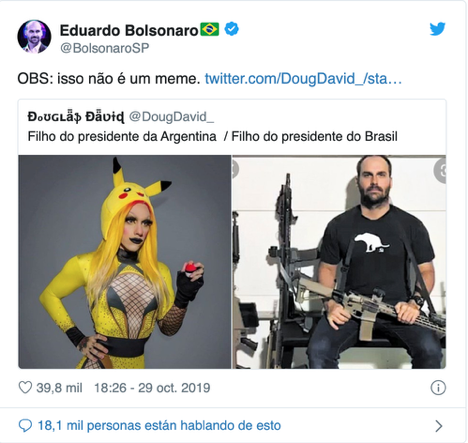
Por otro lado, Maquiavelo en el capítulo XXI afirma que el Príncipe debe hacer o aparentar grandes hazañas para ser estimado, como Fernando de Aragón, quien “hizo la guerra cuando estaba en paz”, idea que se conecta con la afirmación de Charles M. Blow de que cuando el líder alcanza el “folk hero status” cualquier acción mediática en apariencia aberrante para el sentido común de una sociedad en otro contexto sólo ayuda a aumentar su leyenda. Esto lo podemos observar en el meme que compartió el clan Bolsonaro comparando al hijo de Jair Bolsonaro con el del presidente recientemente electo de Argentina, que practica cosplay. Una imagen teñida de homofobia, transfobia y machismo y que en cualquier otro momento hubiera sido unánimemente repudiada por la prensa y la diplomacia de Argentina y Brasil, para los seguidores de Bolsonaro, que festejan sus “hazañas mediáticas”, ayuda a contribuir con su admiración al personaje performático de macho militarizado.
Considering the readings of this week, I would like to continue with my thoughts and ideas of the last post. What does it do to us, spectators, and to victims themselves of them being “incapable of returning the gaze“? (Rancière, “The Emancipated Spectator” p.96) Rancière describes it as one of the reasons for why and how horror through images is being banalized- not due to the amount of images- it is the lack of the victim looking at us; objectified bodies without names. I deeply appreciate the way that Ariella Azoulay writes in “The Civil Contract of Photography” about the different gazes and expressions of the photographed in the daguerreotypes. ” These photographed people address someone who is not present, an addressee who opens up the space in which they are placed, who undoes – albeit very slightly – its oppressive limits. Though they know nothing of the category of a universal addressee, their gaze is addressed to someone like her whose existence they assume when they address their gaze to her, revealing something of their feelings toward their enslavers.” (p.173) Their gaze has power as it goes beyond the very moment of being “violently fixed”; this gaze goes out of the image, and therefore out of time. Does the claimed truth carry true affect? The spectator does not know if the gaze of the ones becoming stationary through photography has been choreographed or decided by the photographer/ director, therefore she needs to look with a “gothic lens” at the ones who became “gothic subjects”. (gothic lens / gothic subject are concepts by Bonnie Honig, included by Christina Beltrán in her text “Undocumented, Unafraid, and Unapologetic”.)
El tema en común que comparten las lecturas de esta semana es la relación
entre política, discurso e imagen, y de qué manera irrumpen en la arena pública los
efectos políticos de lo visible. En The civil contact of photography, Ariella Azoulay
postula que en la producción de la imagen fotográfica hay un exceso de sentidos
inmanejables por quien fotografía y que pueden ser definidos por la noción de “acción”
teorizada por Hannah Arendt, en tanto la foto produce efectos irreversibles e
indestructibles. Para la autora, el acto fotográfico carece de autor individual ya que
múltiples actores participan de su producción, difusión y recepción, y, en ese sentido,
involucrarse como espectador/a de ese acto implica una especie de contrato en el que
este/a accede a una “ciudadanía de la fotografía”.
En “Undocumented, unafraid and apologetic” Cristina Beltrán analiza el
activismo virtual de nuevas comunidades de jóvenes indocumentadxs, y cómo esos
espacios, en tanto proponen nuevas visualizaciones de lo político, posibilitan la
emergencia de disidencias. Por otro lado, Beltrán muestra también cómo esas
visualizaciones, cuando pierden su caracter disruptivo, pueden ser asimiladas por
discursos de derecha, como los manifestantes que, aunque reivindicando identidades
migrantes, enarbolan opiniones nacionalistas y pro ejército.
En “The intolerable image”, Rancière se pregunta qué vuelve intolerable una
imagen y causa indignación de un estado social de cosas, en tanto es uno de los
efectos políticos más eficaces del arte. Para Rancière este efecto no es nada más que
visual, sino que entraña una cierta conexión entre lo visible y lo decible. De acuerdo al
autor, en la época contemporánea, en la que hay una superproducción de imágenes,
aquello que anestesia los efectos políticos de lo visual es que el sistema oficial de
comunicación restringe la posibilidad de que esas imágenes sean interpretadas y por
tanto se vuelvan móviles de acción. Por eso, Rancière considera que el poder político
de las imágenes se encuentra en su capacidad de perturbar la conexión hegemónica
entre lo visual y lo verbal, proponiendo nuevas configuraciones de lo que puede ser
visto, dicho, pensado, y por ende nuevos
Living in a time when the production, distribution, and consumption of images happens at an extremely fast and constant rate, reflecting upon the ontological nature of an image, and the contemporary ways images can and should be used for political change is of utter importance. A crucial point that the authors of this week’s readings touch upon is the responsibility we have as spectators of an image. This very Brechtian calling, invites us to understand that the translation of the image from it’s two-dimensional realm unto the realm of knowledge depends upon what Rancère understands as a Dispositif of visibility–the understanding an image as an element within a network of conceptions of realities, perceptions, symbols, meanings, and other data: “An image never stands alone. It belongs to a system of visibility that governs the status of the bodies represented and the kind of attention they merit. The issue is knowing the kind of attention prompted by some particular system (Rancière, 93).” Reading Azoulay alongside Rancière, the reader, and also the spectator of photography, is prompted to re-think of their own role in the creation of meaning and knowledge by understanding this role within a body-politic. Thus, the spectator is positioned as a citizen, a political subject that must act and think responsibly. Personally, this understanding of political responsibility via our relationship to an image is perhaps the most urgent subject touched upon the authors. Particularly as we live in a time when our connection and understanding of the world is mediated by images. Thinking not only of revolutions, and reconstructed monuments (Protests in Chile, the defaced Ángel de la Independencia in Mexico City), but also of how contemporary atrocities and violent social injustice such as police brutality against black citizens gets recorded, and shared with such ease that one must always question our role as mediators, as spectators, as consumers, and distributors of such images. “Becoming a citizen means replacing these impartial positions with a position that is partial to the civil contract of photography, a contract without which modern citizenship is invalid, insofar as it is the contract that made the conquest of the world as picture possible (Azoulay, 157).”
Last but not least, Beltrán touches upon a very specific example of how citizenship and political belonging is reconfigured not only via images, but via the platforms that today are responsible for holding and sharing various forms of media. Via social media interactions and cyber-testimonios DREAMers have re-arranged and “queered” immigration politics by claiming their right to visibility. Refusing secrecy, and challenging surveillance, DREAMErs are organizing, questioning, and archiving their existence in a way that for me, is the perfect embodiment of Azoulay’s citizen of photography: “The act of prolonged observation by the observer as spectator has the power to turn a still photograph into a theater stage upon which what has been frozen in the photograph comes to life.”
In “Stereotypes of Persecution,” René Girard analyzes the mobilization of hatred in collective persecutions (mob formation) during times of crisis, what he delineates for his study as “acts of violence…that are legal in form but stimulated by the extremes of public opinion” (12). In giving one example of crisis, Girard includes an extract of Portuguese monk Fco de Santa Maria’s writing, from which I’d like to locate a few key terms that characterize a spectacularization of crisis as well as apply to the texts this week more generally.
The first is confusion; “Everything is reduced to extreme confusion” (13). The second, pity; “No pity is shown to friends since every sign of pity is dangerous” (13) (I’d like to extrapolate to distance and empathy here as well; “All the laws of love and nature are drowned” (13)). Here specifically, I am interested in how crisis propels egocentrism at the same time that it precludes empathy: in its stead, there are processes of othering. And the third, blindness; “Men…act like desperate blindmen, who encounter fear and contradictions at every step” (13). These terms are not distinct but interrelated; for example, within confusion is also the element of distraction that leads to blindness and the location of blame within targeted populations (the notion of scapegoats); “[Men] are disconcerted by the immensity of the disaster but never look into the natural causes” (14).
Taylor takes up this point of “never looking” concretely in her chapter “Percepticide.” In examining the Argentine population’s reaction to spectacles of power during The Dirty War, Taylor argues that people were “forced to focus on the given-to-be-seen and ignore the atrocities given-to-be-invisible” (119), that is to say, vision and visibility operated within certain frames dictated by the State, destroying kinship bonds by forcing people to look away from the atrocities committed and rendering the population blind (122-3). However, Taylor also distinguishes percepticide as “self-blinding,” that is, individuals chose not to look out of fear, colluding as spectators who disavowed their spectatorship. It is interesting to note that within the context of crisis, a communal identity was shaped, but one that positioned the “us” vs. the “them.” I’d like to briefly linger on positionality because it is from there that the logic for political action, whether moblike or resistant in nature, often derives. Girard writes that in choosing the persecuted, “the persecutors always convince themselves that a small number of people, or even a single individual…is extremely harmful to the whole of society” (15). The formation of the mob is interpellative for Girard –”The crowd’s act of becoming a crowd is the same as the obscure call to assemble or mobilize, in other words to become a mob” (16)– he shows how hatred can also mobilize a call to assembly. Here, the “othering” of the victimized is rationalized along infectious lines because to the mob, the preservation of society itself is at risk. Taylor’s analysis of photographs during the Malvinas/Falkland Islands war illuminates how the construction of an “us” during wartime is also performed in the name of national unity; “Spectators are encouraged to enter into the narrative…in the staging of a singular ‘body'” (121).
Taylor’s analysis of Griselda Gambaro’s Information for Foreigners is fascinating in working through how the playwright stages the techniques of “blinding” and the perception of this process together. One of the central aspects seems to be how Gambaro forces the spectators to see, and towards the recognition of their complicity in what is seen, eliminating the possibility of deniability. In the play, the “audience is being invited to transgress, to see that which should never be seen” (126), namely, staged scenes of torture and terror in practice. Gambaro’s work also invites the audience beyond the theatrical frame (that also operates along Taylor’s visual frame of the given-to-be-seen and given-to-be-invisible) to the offstage: our Brecht reading on alienation effects came in handy here, and Taylor notes that Gambaro doesn’t allow for close identification in the play (130). At the same time, The Guide in Information acts as a figure of authority, censoring what the viewers can see, demonstrating how sight is imbricated in relations of power. An important contribution of Taylor’s text is not only how it brings forward the audience’s role in systems of terror (129), but also how it explicates the population’s role as audience in State spectacles of violence meant to “prove to the population at large that the regime has the power to control it” (130).
The photos in Taylor’s text that depict military violence in broad daylight seem to challenge Foucault’s argument for the disappearance of punishment as a spectacle. However, Foucault is working specifically within the context of penal law; it is worth noting that public State repression is often justified as extrajudicial during “states of emergency” (Chile immediately comes to mind), although some have argued that we now live in a permanent state of exception along Agambenian lines. Foucault also argues that the body mediates power relations and a system of subjection (here there is an intersection with Taylor’s text); “the body becomes a useful force only if it is both a productive body and a subjected body” (26). What is critical for me in Foucault’s text is how punishment is disappearing from visibility –it becomes the “most hidden part of the penal process” and leaves “everyday perception and enters that of abstract consciousness” (9)– under the guise of a State handling of justice in respectable terms by not explicitly and publicly targeting the body, a transformation that resembles a distraction; “justice no longer takes public responsibility for the violence that is bound up with its practice” (9). Foucault argues that this distraction is achieved through distancing (that is becoming increasingly inverse to recognition and responsibility through this week’s texts): autonomous sectors carry out the penalty for example, “bureaucratic concealment” is at work (10). In the age of mass incarceration and migrant detention centers, we should not be fooled that this distribution of visibility and concealment of bodily harm means that justice is operating upon the premise of universal rights.
According to Foucault,
as the sovereignty power of making die shifts into biopower ((Foucault 2003, 255), The cruel
punishment acts against the human body have become a discipline. Biopower
enacts through technologies of power to humanize the penal system and the
knowledge of man: i.e. the stereotypical persecution is the consequence of
these techniques. (Girard,17) These stereotypies work in the logic of racism:
by creating caesuras within a
population”, a confrontational relationship is built up between “us” and “them.
(Foucault 2003, 255)
In
meanwhile, as the system of punishment are to be situated in a certain
“political economy” of the body… it is always the body that is at the
issue.”(Foucault, 23)The
authority uses terror to subject the body and make invisible space in public
life. People become percepticide and fail to recognize certain aspects of the
society and the self, as their psychological ability to humanely response to
the reality is killed by horror.In Taylor’s article, she mentioned how Population is manipulated to see and not to see,
and how Propaganda acts on the population level, and build up an ideology, a
collective imaginary(Taylor, 122) by The mutuality and the reciprocity of the
look, the recognition between “ us and them” happens. The case study about the
Argentinian artist Gambora’s work the information for foreigners is used
to explain how percepticide could be used for specactors to see, to admit and
finally, to act. A theatrical presentation of terror could be the Caution for
us not to think of nonvisible spaces as nonspaces. (Taylor, 131) Through the
illusionist quality, theatre can be a space for people to transform.
Taylor, D. 1997. Disappearing Acts: Spectacles of Gender and Nationalism in Argentina’s “Dirty War.” Disappearing Acts: Spectacles of Gender and Nationalism in Argentina’s “Dirty War.” Duke University Press.
Girard, R, and Y Freccero. 1989. The Scapegoat.
Johns Hopkins University Press.
Foucault, M, A Sheridan, and A M S Smith. 1995. Discipline
and Punish: The Birth of the Prison. Peregrine Books. Vintage Books.
Foucault, M. 2003. “Society Must Be Defended”: Lectures
at the Collège de France, 1975-1976. Jeff Borrow List. Allen Lane.
“In my grandparents’ time, in my mom’s time, Spanish was looked down upon. You were punished in school if you spoke Spanish. You were not allowed to speak it. People, I think, internalized this oppression about it, and basically wanted their kids to first be able to speak English. And I think that in my family, like a lot of other families, that the residue of that, the impact of that is that there are many folks whose Spanish is not that great.” – Julián Castro
Performance, once people get in the door (or in the space), can be a tool for mass communication and education, however, I think of political spectacle as one that performs to distract, instead of performing to inform. For a political spectacle that engages the spectator, there must be a sense, or an “appearance,” of truth and narrative.
The words I am left with that create political spectacle are: narrative, truth, transformation, participation, and struggle.
Texas, as an aesthetic, is nothing but a spectacle. The hair is bigger, the plates are bigger, the hats are bigger, the mouths are bigger, the arenas are bigger – and the politics are no different. The large and lavish American Airlines Center recently held a political rally for Donald Trump, and it was definitively, “marked by enthusiasm,” according to Fox News.
This political (and Fascist) campaign, in particular, is fueled by an antagonistic (or agonistic), us versus them concept, and the tension inherent in this binary is echoed throughout many of our readings as constituting the “stuff” of politics. For instance, Chantal Mouffe takes the idea of a binary, of an “us/them” dichotomy in politics and moves it toward a productive view of the conflict. “My claim is that it is impossible to understand democratic politics without acknowledging ‘passions’ as the driving force in the political field” (Mouffe 6). Her view is that politics should provide the “arena” for a productive and passionate conflict, which in itself constitutes politics. In this model, it seems that the people become the subject(s) on which politics operate; politics and the political spectacle specifically operates and impose itself on the people.
However, if we are to look at politics within the performative framework, and move toward viewing performance as an ontology, the political subject, the spectator (spect-actor), is demanded to take more of a responsibility in their participation. One is not simply mean to sit back and enjoy (or not), be entertained (or not), and quietly pass the time during a performance. If theatre scholars such as Augusto Boal and Berlot Brecht are encouraging their audiences to be a more active participant in the theatre, this translates to those “subjects” in the political arena to take a similarly active role in their participation, or to take active responsibility for their complacency.
The subject – the subjected, the object, the subjugated – presupposed as either an us or a them, is usually placed somewhere on the dichotomous hierarchy of agency within the political arena. The minoritarian subject in particular is free to actively disidentify with their placement on this hierarchy, as we will discuss later with minoritarian political figures in the spotlight. Looking at the American Airlines Center specifically, that space makes itself accessible only to a small portion of the population. Not everyone has the “right” to appear in this space.
Texas is known for its vast and diverse geography (or, perhaps, not known), and population. The “space of appearance,” as discussed in Judith Butler’s Notes on a Performative Theory of Assembly, is no different. Butler asks: “Which humans are eligible for recognition within the sphere of appearance, and which are not? What racist norms, for instance, operate to distinguish among those who can be recognized as human and those who cannot? – questions made all the more relevant when historically entrenched forms of racism rely on bestial constructions of blackness” (Butler 36). The sphere of appearance performed at the American Airlines Center on Thursday, October 17th is, perhaps, a direct contrast to the sphere performed at many of the Democratic National Debates held thus far this election season – primarily due to the choices of two Texas senators.
Beto O’Rourke and Julián Castro (though I could also include Cory Booker and Pete Butteigeige in this discussion, I am choosing not to), two politicians from Texas on the campaign trail toward the presidency, have both diversified the sphere of appearance through their use of code-switching from English to Spanish during debates.
I have approached code-switching in my previous work as a dramaturgical and literary exercise; it happens in the moment of choque, or when one is not quite able to grasp what comes next in the source language. That tension produces the code-switch. It also appears in, though is not exclusive to social situations, when expressing and negotiating power dynamics, sexual dynamics, and workplace politics. Though it is not exclusive to switching between linguistic codes, I am focusing on this instance of linguistic code-switching.
The code-switching performed by O’Rourke and Castro actively invites non-English speakers (yet active voters) into the typically Western hegemonic political sphere of “whiteness.” Though this is not the lavish spectacle of the American Airlines Center, it is still is a form of political spectacle. This active code-switching inherently implies a narrative, there is a “truth” expressed in it, and there is an element of transformation. I believe this is more of a long game, as the spectacle itself continues after the code-switching has taken place. As translation is an inherently political act, this code-switching is also politically driven and begins to negotiate the politics of “appearance” within the code-switching subject in the afterlife of the debate.
We see this afterlife negotiated in the perception of O’Rourke and Castro, respectively. One article from USA today reads:
“Some social media users criticized the candidates for attempting to appeal to Latino voters by speaking in Spanish — or “Hispandering,” a term used to describe a politician trying to pander to the Hispanic community. Others, such as those who watched the debate on the Spanish-language broadcast network Telemundo, appreciated that the candidates were trying to connect with them on that level.” O’Rourke, defined in many articles as a fluent Spanish speaker, is overall praised for his code-switching, especially in the face of his whiteness.
Julián Castro however has faced harsh criticism for not being “fluent” in Spanish. The term “monoglot” is referenced almost as a derogatory term when referring to Castro. The critique of Castro’s monolingualism, especially when placed next to the reaction of O’Rourke, is rooted in the problematic pressure placed on the minoritarian subject to be “true” and “authentic”; it emphasizes the Jose Muñoz’s burden of liveness for the minoritarian subject in the political field. Castro is still demanded to perform as a “Latino,” though the linguistic code of Spanish is only one small part of that multi-faceted identity. An example of arguments supporting Castro’s monolingualism, positing it as inherently American, appears in a Washington Post article online, reading: “Because, while bilingualism is for many Latinos a treasured aspect of maintaining community in the United States, Castro’s monoglot experience is just as authentic — and even more uniquely American….Castro revealed more about his family’s history with Spanish. “In my grandparents’ time, in my mom’s time, Spanish was looked down upon,” he said. “You were punished in school if you spoke Spanish. You were not allowed to speak it.” He said many Latinos have “internalized this oppression” and desired their children to only speak English.”
For the final project, I am interested in excavating this phenomenon of code-switching in the political arena, yet expanding the sphere of observation to a larger understanding of code-switching which is not limited to linguistic codes. I see one of the core elements of political spectacle as living in the narrative of the political performance, of the appearance of “truth,” which makes the spectator “believe.” I am curious about code-switching in the way that it can (or not) mobilize bodies, create affect, and where it is placed within the political spectrum.
As a last note, (and though it lands us in New Mexico instead of Texas) the ad for “Valeria Plame for Congress” is a strong example of narrative, truth, transformation, participation and struggle. (For me, it also has a Texan aesthetic.) I would argue employs a type of rhetorical and visual code-switching throughout in an effort to engage the spectator. It is also quite entertaining.
While last week we focused on political theories in the abstract, the writings this week had to do with conceptions of politics within and through performance. I was drawn to Boal’s work in breaking down the numbing of contemporary audiences through Aristotelian structures of “coercion” which built upon Brecht’s disavowal of the entertainment of theatre. Through these structures, performance is a practice, rehearsal, or training ground for the “real” political sphere, a place where we are able to think critically about and try-out new strategies of disrupting economic realities and distributions. However, for both, the performance while it is political is not necessarily politics. In the Taylor text, we are introduced to a more nuanced definition of performance where art provides “a means of intervention into the political (which she cannot control) by using her body, her imagination, her training, self-discipline,” (116) and that “large or small, visible or invisible, performances create change” (10). Here, the performance is more than a practice round for the political sphere, it is the sphere in its ability to change and transform people. These works continue to make me think about the power of performance and the affect it creates, and how these tools are used in the political. When we break down the barrier and view politics and performance as the same thing, how does this help us reflect on and and analyze transformational claims (perhaps, “truths”?) being formed in either methods?
The works of Taylor, Brecht, and Boal converge in their insistence of performance as a tool (or to echo Boal a ‘weapon’) in which knowledge production can be used to destabilize ruling powers and facilitate political transformation. Crucial to this process is the idea of alienation which both Brecht and Boal insist upon in their texts. Brecht insists upon a degree of artifice which is so clear to the audience that it allows reflection and avoids the passiveness the hyper-real theatre expects from their viewers. It seems that in order for the performance to affect the audience (or spect-actor) in a way that encourages them to critically question what they are experiencing, the performance theatrical tools must highlight artifice “…for character and all must not grow on the audience so much as strike it (Brecht, 197).” While in Brecht’s writing this process of disensuss, criticism, and alteration happens during a theatrical performance, and reverberates after the staging is over, in Boal we see tools that prepare the participants to act in staged and non-staged social situations. Boal, in the same way Brecht insists upon artifice, makes a case against empathy: a case against relinquishing power. In both of these theatre theorists, as well as in Taylor, we see an insistence on a mode of performance which trusts that all bodies present have an ability and possibility for action. These authors and their reflections on political performance invite, incite, and insist upon the potentiality of political action. They remind us that “disbelief can move mountains (Brecht, 189)”.
In The Theatre of the Oppressed by Augusto Boal, the argument that is presented is that theater within itself is innately political, while showing that Aristotelian theatre adhere to an oppressive state. Therefore, the author reviews the history of theatre through the works of Aristotle, Machiavelli, Hegel and Brecht. With the old historical connections to theater the author then presents and forms a new idea of theater that breaks down the boundaries set by the old system between the performers and the spectators. In chapter one the author presents Aristotle’s philosophy while defining tragedy in the Aristotelian epistemology as a coercive system that has the viewer in conformity and not allowing room for a rebellion. He also states that the character in this philosophy has certain traits that the audience sympathizes with, which allows the audience to suppress this as the spectator. Boal moves on in the 4th chapter to reviewing his work in Peru. Through a literacy program by presenting ways in which people can become an active participant in theater rather than just being a mere spectator, who is inactive. In the program participants uses different theater related exercises to talk about their lives and confronting different issues. Therefore, the audience can actively determine the outcome of each action. On the other hand, in Performance by Diana Taylor, she explores the different dynamics of performance, while exploring the social, economic, political and sexual aspect of each performance to highlight and confronting social issues. Taylor focuses on performance but specifically performance art and reassuring readers that performance is not solely based on an imitative aspect, rather it includes change, critical context and creativity. Overall highlighting performance as a tool to do something even when it seems as if there is not much that is being done. Finally, Bertolt Bercht in Brecht on Theatre: The Development of and Aesthetic, the author discusses the development of his own theatrical aesthetic, by showing how theater can serve as a too that can trigger a social change in society, to be quite honest, I was not sure how to interpret the notes in his writings, they were at times contradictory.
El tema que abordan los tres textos es cómo las artes escénicas, debido a su contacto inmediato con el público a través del cuerpo, deben ejercer esa conexión para desnaturalizar las normas políticas, sociales y de género. En el caso de Brecht, su texto propone que la función del teatro es romper el velo de familiaridad del entorno social más inmediato de manera que se genere extrañeza y distancia respecto de él. Boal, por otra parte, reconstruye minuciosamente los componentes de la Poética aristotélica para proponer que la catársis pone al espectador en un rol pasivo, ya que le delega al actor el lugar de pensar y actuar por él (en una suerte de analogía con lo que ocurre en la política representativa entre el/la ciudadano/a que vota y el/la político/a). A partir de una serie de técnicas corporales y ejemplos, el autor contrapone al modelo aristotélico la figura del “spectator” como una manera en la que el actor y el espectador confluirían en una figura que permitiría la emancipación política del cuerpo y de la conciencia.
Shiva The Destroyer, perfórmer y drag queen argentinx
Diana Taylor recoge algunos de los aspectos vertidos por ambos autores para pensar una teoría contemporánea de el/la performance como disciplina artística. Para la autora, es la repetición corporal (en contraposición a la representación teatral) la manera en la que el/la perfórmer crea efectos y afectos. Una de sus más poderosas herramientas es que, como manera de leer normas sociales, potencialmente toda práctica convencionalizada en el cuerpo (de raza, género, de nacionalidad) se vuelve una performance. Así, la norma de la performance es romper, o cuestionar, esas normas naturalizadas, mediante la transmisión de un saber corporal que elimina los límites entre “vida”, “arte”, “espectador”, “artista”, “política” y “estética”.
In his work The Politics of Aesthetics, Ranciéré turns to Aristotle’s view of the political being as, “a speaking thing” (12). Highlighting, artisans, or the poor, do not have the privilege of overseeing a community because their work will always take priority. This marks a clear distinction between who may partake in political discourse and who may not. However, there is a disjunction between speaking things and the privilege of speaking. Balibar illuminates, citizenship can not be solely based on verbal capacity as speech is both a power relation and a skill (4). If political representation relies on the ability and privilege to speak for oneself, then there will always be subjects who go unheard. As such, communities who are governed by those that have particular functions of speech must be cautious of the “good orator”. Sophists, those who excel in and take advantage of the art of persuasive speaking, have the ability to misuse their abilities to manipulate the public. Taking from Balibar, every individual combines several identities to make one (28). If this is the case, then we must question whether the active political being inherently takes advantage of their speaking skills to serve one or more of their various identities, rather than the whole community.
Enquanto lia os textos foi impossível não pensar sobre a atual situação política do Brasil. A ideia de antagonismo de Chantal Mouffe parece muita adequada para analisar o retorno do autoritarismo no país. O antagonismo destrutivo, ou seja, radicalização da divisão entre nós e eles, a tentativa de aniquilação de tudo que é identificado por “eles” (ou por “nós”) como sendo ligado a “nós” (ou “eles”), a identificação do “outro” como inimigo, o não reconhecimento da pluralidade e a não lealdade aos princípios democráticos definem perfeitamente o que acontece atualmente no Brasil. A visão de Mouffoe sobre a importância das práticas artísticas e culturais na resistência contra hegemônica e a ideia de partilha do sensível de Rancière me levou a pensar sobre as instâncias que são os principais alvos de ataques do governo atual. A educação e a arte, assim como os seus agentes, suas instituições, seus temas, seus conteúdos e seus símbolos, vêm sofrendo constantes ataques no Brasil desde 2016. A noção de partilha do sensível como “o sistema de evidências sensíveis” que revela que pode e quem não pode tomar parte, quem pode e quem não pode participar, me lembra a ideia defendida por Jorge Larrosa da escola como “tempo livre”, ou seja, como um tempo/espaço no qual todos podem participar. O ataque a escola e a universidade pública no Brasil, assim como aos artistas, as obras e instituições de arte, tem claramente o objetivo de aniquilar os espaços da participação democrática, espaços onde a crítica e a prática do agonismo ainda parecem possíveis. Os textos me instigaram a pensar também nas formas de resistência contra o autoritarismo que surgem no âmbito educacional e artístico no Brasil contemporâneo.
[en ESPAÑOL] Chantal Mouffe provee un esquema simple pero abarcador sobre sus usos de los conceptos políticos que informan sus tesis. Es crítica férrea de la política (neo)liberal contemporánea que, en sus mecanismos profundos, pone la democracia en jaque al proponer un consenso objetivo ilusorio que elimina la posibilidad de un ejercicio libre de la democracia propiamente dicho en un contexto pluralista globalizado. Al tomar una postura agonística—que reconoce un oponente político como adversario y no enemigo, que presupone un respeto mutuo en una competencia por los afectos de una mayoría del electorado—reconoce que la política democrática es una confrontación directa entre proyectos hegemónicos sin la posibilidad de una reconciliación final. En su capítulo “Agonistic Politics and Artistic Practices”, desmorona la dicotomía entre la política y el arte y presenta el quehacer artístico como un lugar de intervención, de resistencia y, sobretodo, de crítica capaz de retar el imaginario social necesario para la reproducción capitalista. Lo interesante del asunto es que el neoliberalismo es tan abarcador que también tiene la capacidad de destruirse a sí mismo: en ese afán racionalista-universalista-occidenal, las naciones-estados hipercaptalistas y hegemónicas protegen los derechos de libre expresión que posibilitan, en primera instancia, la concepción, creación y difusión de prácticas artísticas subversivas. Por tanto, el neoliberalismo ahora tendría que crear consensos ilusoriamente mayoritarios que creen oposición frente a la resistencia a la vez que defiende su derecho a resistir. Entonces, ¿cómo es que el Estado resiste la resistencia? Varios ejemplos puertorriqueños me brincan en la memoria: vayas de metal para contener las marchas multitudinarias, como las reces; apagar los micrófonos de los contrincantes en los hemiciclos senatoriales; liberar gases lacrimógenos a las once de la noche, luego de varias horas de protesta, por parte de los policías frente a la casa de gobierno en San Juan. Pero hay práticas artísticas que no se callan, que prefieren alborotar incluso en medio de las protestas, y menciono un ball queer (al estilo de Paris is Burning o de la serie Pose) que se realizó a plena luz de día en la Plaza de Armas en el centro del Viejo San Juan durante las protestas en contra del gobernador este verano pasado. Las cuerpas queer intervinieron en las protestas y aportaron sus voces y sus cacerolas a las manifestaciones, impusieron su estética y voluntad queer a las masas reclamando su derecho a la libre expresión, exigiendo el fin a toda violencia heteropatriarcal y capitalista, especialmente la del gobernador. Escogieron un espacio público y frecuentado que, según el lente agonístico, no fue para alcanzar un consenso, sino para sublimar sus preocupaciones democráticas e interceder en pos de las víctimas más marginadas del gobierno actual.
[in ENGLISH:] Chantal Mouffe is a determined critic of contemporary (neo)liberal policies that, in their deep mechanisms, threatens democracy by proposing an objective and illusory majority, which in turn eliminates the possibility of a proper free and fair democracy within the context of a pluralistic globalization. By taking an agonistic stance—which recognizes a political opponent as an adversary and not an enemy, which presupposes a mutual respect un a competition for the affection of an electoral majority—Mouffe recognizes that democratic politics is a direct confrontation between hegemonic projects without the possibility of final reconciliation. In “Agonistic Politics and Artistic Practices”, she discards any easy dichotomy between art and politics and presents artistic creations as a place of intervention, resistance, and, above all else, criticism capable of challenging the social imaginary necessary for capitalist (re)production. What is interesting is that neoliberalism is so encompassing that it also even has the capacity to self-destruct: in its rationalist-universalist-Western zeal, hegemonic hypercapitalist nation-states protect freedom of speech rights which make possible, in any case, the conception, creation, and diffusion of subversive artistic practices. Neoliberalism will now need to create an illusory consensual majority which creates an opposition to the resistance while at the same time defending their right to resist. Therefore, how does the State resist resistance? Various examples from Puerto Rico jump to memory: metal hurdle fences to contain multitudinous marches, as if cattle; turning off opponents’ and dissenters’ microphones in Senatorial hearings; releasing tear gas at eleven at night, after hours of protests, by the police in front of the governor’s mansion in San Juan. Yet there still are artistic practices that refuse to be silenced, which prefer disrupting even during the protests, and I mention a queer ball (to the tune of Paris Is Burning or the series Pose) held in broad daylight in the Plaza de Armas in the heart of Old San Juan during the protests against the governor this past summer. Queer bodies intervened during the protests and contributed their voices and their pans to bang with, imposed their queer aesthetic and will on the masses reclaiming their right to free expression, demanding an end to all heteropatriarcal and capitalist violence, especially the governor’s. They chose a frequented public space which, from an agonistic lens, not to reach a consensus, but to sublimate their democratic concerns and intercede in the name of the most marginalized by the current government.
The readings this week, to be quite frank, were a struggle. However, after much metaphorical weed-whacking, it is clear that one of the ways in which these three theorists interact with one another is on the basis of equality and emancipation. Ranciére states that, “Politics exists when the figure of a specific subject is constituted, a supernumerary subject in relation to the calculated number of groups, places, and functions in a society” (51). The unrecognized party – the minoritarian subject, in this case – struggling for equal recognition is what constitutes politics. Balibar supplements an understanding of this struggle for emancipation with, “The autonomy of politics…is not conceivable without the autonomy of its subject, and this in turn is nothing other than the fact, for the people, that it ‘makes’ itself, at the same time as the individuals who constitute the people confer basic rights upon one another mutually” (4). In this sense, the political again is only “made” within the body of the subject; it is made within the struggle of the subject’s body for equal recognition and emancipation, of which can only be gained through an outside source. Meanwhile, Mouffe, (in my view) takes the idea of a binary, of an “us/them” dichotomy in politics and puts it in the framework of the positive. “My claim is that it is impossible to understand democratic politics without acknowledging ‘passions’ as the driving force in the political field” (Mouffe 6). She moves toward a productive view of conflict. Or rather, moves toward a view in which politics should provide the “arena” for a productive and passionate conflict, which in itself constitutes politics. There is an undeniable exploration of the ‘dominant’ power bloc and hegemonic ideologies within these texts, and I am left with questions of embodiment, of power, of the visual representation of the struggle for equality, and of political aesthetic in performance.
A ‘surface’ is not simply a geometric composition of lines. It is a certain distribution of the sensible
Jacques Rancière
That statement and Rancière’s further critique of Plato’s mute function of writing and painting reminded me of the use of placards in pickets and marches. Placard – a two-dimensional surface which combines both visual and textual aesthetics – is associated with an expression of political position in democratic society. Placards in single pickets (as group protests are prohibited) got viral in Kazakhstan this summer. Statements did not involve a direct opposition message, but were quotes from constitution or phrases as “you cannot run away from truth”. However, placards became politically significant in my country because each act led to a police detention. Those detentions brought up a hypothesis that a placard as a surface is considered political. The prove didn’t make wait for it: public appearance with an empty white placard immediately attracted attention of police. Therefore, placard might be a mute or whatever dimensional sign but it can carry a sensible political aesthetic.
A fundamental yet complicated question lingers in my head while reading: what is the premise to follow or assumption that we are making when we talk about politics?Where does political right comes from, or how it is constituted remains inexplicit to me. However, it is crucial as it determines the perspective from which we interpret politics as a part of human society as well as humanity.
It is indicated that “autonomy becomes a politics when it turns out that part of society (and hence of humanity) is excluded-legally or not-from the universal right to politics” (Balibar, 6), which seems to suggest that political rights only come into being with its opposite counterpart of oppression begins and politics only a form of establishment created by human but not humanity. Similarly, Mouffe used terms of “hegemonic nature of every kind of social order and envisaging society” to characterize politics (Mouffe, 2). If that is true, then the relationship between “natural right” (such as liberty, equality) and “political (or probably legal) right” becomes truly paradoxical. As natural right should be universal and independent from all different traditions, cultures, legal systems and governments, the formation of politics- although in the name of emancipation- to some extent violates the nature of human rights itself.
In literary theory, especial in the academia world of China, we talked a lot about how to distinguish “the art for the people” and “L’ art pour L’art“. In Rancière’s universe, none of these definitions make sense, because art is no longer about consensus or for certain purpose(14), it is autonomy. It is mind-blowing because my expectation for art was only what Rancière would call as the representative regime of art.(43)
His critics about Madame Bovary is inspiring. As we usually think Emma’s story as an ethical story, Rancière thinks Emma was trying to bring art into life, (but the rising of bourgeois and capitalism would not allow this, so she must be killed, as Rancière claims in another essay) and his idea of aesthetic of daily life merges in that part.(55 )
Chantal Mouffe is more radical, sometimes even speaks from an opposite standpoint of the other two. By putting the mode of production into question, she challenges the possibility of building up the ensemble. In Mouffe’s idea, not even Marx’s definition of class is applicable, Identity is more solid in describing the ineffable changes of modern or postmodern life. She also thinks distinguishing political and non-political art is not necessary,because it is to symbolize social relations. (91)
Etienne Balibar holds an opinion in between, he reclaims the difference between “politics” and “political”, the autonomy of politics and the politics of emancipation seams testified for the artistic concept of Rancière.(2)
This week’s authors share a common political vocabulary and offer a particularly critical lens for thinking about questions of democracy, although not necessarily agreeing on the purposes and strategies of political action. For Mouffe (2013), “What liberal democratic politics requires is that the others are not seen as enemies to be destroyed, but as adversaries whose ideas might be fought, (…) but whose right to defend those ideas is not to be questioned.” (07)
Dissent, in Mouffe’s agonistic political landscape, is “always present” (09) in the need for “consensus” (08), as a constitutive character of social division and as “a confrontation with no possibility of final reconciliation” (17). Jacques Rancière, on the other hand, stresses the importance of disagreement as a perception that “simultaneously discloses the existence of something in common and the delimitations that define the respective parts and positions within it” (12). Rancière calls this apportionment the “distribution of the sensible”. And different from Mouffe’s agonistic theory that presupposes an equal political ground among peers in equal conditions of appearance, the distribution of the sensible “reveals who can have a share in what is common to the community” (12), “it defines what is visible or not in a common space, endowed with a common language” (13), and “is a delimitation of spaces and times, of the visible and the invisible, of speech and noise, that simultaneously determines the place and stakes of politics as a form of experience” (13). The “stakes of politics” is precisely what is put into the debate in Étienne Balibar’s text, where the author questions the limits of that which is politically recognizable, relating this intelligibility to pre-existing structures of power that determinate the inside and outside spaces of our political life.
As Balibar points out, it
is not enough to recognize the plural, striated and hegemonic sphere of
politics. One must take into account the different conditions of appearance for
each individual to take space within “the political”. Mouffe’s agonist vision
fails to encompass the actual consequences each “outsider” is exposed
to in order to take a stand against hegemonic structures of power. To put it
simply, Mouffe interpretation “sublimates” the real, material risks
involved in the struggle against dominant consensus and hegemonic political
violence.
I do not think that one can envisage the nature of the agonistic struggle simply in terms of an ongoing contestation over issues or identities. One also needs to grasp the crucial role of hegemonic articulations and the necessity not only of challenging what exists but also of constructing new articulations and new institutions.
(Mouffe 11)
For me, this quote from Mouffe’s text summarizes her argument for the transformative potential, and need, of the political. Mouffe locates the potentiality for the establishment of counter-hegemonies in the hegemonic structure itself, which is always subject to “undecidability” and “contingency.” The political, then, should work to “disarticulate it in an effort to install another form of hegemony” (2). Thus, political action does not end at deconstruction, but requires the proposal of other possibilities; new “modes of visibility” to follow Rancière. I found Mouffe’s argument against consensus especially pertinent to the political situation of the Democratic Party today, which is often described as having arrived at an impasse, visualizing the “safe route” as a path to electoral victory (a strategy that is not necessarily successful, as we have seen); one only needs to recall Presidential candidate Elizabeth Warren’s words in July’s debate when she questioned of her fellow candidates, “Why run for President just to talk about what we really can’t do and shouldn’t fight for?”
Regarding art’s role in the political, firstly, I agreed with Mouffe’s argument for activism to take on public spaces and institutions because they are “always striated and hegemonically structured” (91); I am reminded of Ngũgĩ wa Thiong’o’s’ “Enactments of Power,” in which the Kenyan National Theater becomes a site of struggle as well as a performance space that is “never empty,” but rather a “complex interplay of the entire field of internal and external relations…in the context of time and history” (14). I also liked Mouffe’s transition from examining the “transformation of the work process” (87), new forms of production, to her argument that critical artistic practice takes as its terrain of contestation the “agonistic production of new subjectivities” (90)– Balibar enters here in his observation that politics is “change within change, or the differentiation of change” (12).
If art is able to touch us on an affective level, its power “to make us see things in a different way” (Mouffe 97), here I connect Mouffe’s agonistic politics with Rancière’s aesthetic regime of art, which operates upon a disturbance of the sensible (63). Mouffe’s argument that “every order is predicated on the exclusion of other possibilities” (2) dialogues well with Rancière’s focus on visibility and how art can expand the field of intelligibility. For example, Rancière, citing Flaubert among others, expounds literature’s place in dismantling the representative regime’s hierarchical vision. By horizontalizing both meaning-making by leaving interpretations open, and creating new modes of visibility of who is able to be seen, literature engages in a politics that is not defined by the notion of equivalence present in the “universal exchangeability of commodities” (55); its political potential rather lies in the destabilizing of existing hierarchies of language.