This week’s readings create their own self-fulfilling world, or at least the efforts and possibility of such creation within Zapatistas. It is about a fight for human right pursued by indigenous people, and also led (at least ideally) by them. Marcos, as the subcomandante of the revolution, had become the most iconic figure in the fight through time. However, this is not a traditional story about the becoming of a legendary political leader and the “glorious fruit” he and his followers bring about. It is a narrative of the making and disappearance of a single leader, as he ultimately dissolves into people.
In Marcos’ book, it is obvious that he pours his efforts into the pursuit for human rights in a rather universal context, starting from Mexico but trying to out to all population living under the same precarity as the consequences of neoliberalism, of which he regards as the forth World War. It seems that a unity of people without oppressing hierarchy is the destination of the campaign, therefore the unique organization of Zapatistas is of great significance. By stating that “it is our conviction and our practice that in order to rebel and to struggle, neither leaders nor bosses nor messiahs nor saviors are necessary. To struggle, one only needs a sense of shame, a bit of dignity, and a lot of organization” (Marcos, Between Light and Shadow), Marcos unfolds a blue print where the majority of people would not be sacrificed to suffice what the power and mighty minority demand. The only way to truly accomplish this goal and secure its sustainability would be “death” of a leader, who might one day become a dominant ruler is not carefully watched. Marcos constantly attempts to remind people of such a destination by calling out to them “in the name of the children, elders, men and women, all of them indigenous”, emphasizing that “we” “want you to know we recognize your greatness as indigenous peoples and human beings, and we want you to receive this salute sent, through my hands, from all the indigenous rebels of the Zapatista National Liberation Army.s” (Marcos, 224). In these persuasive writings, Marcos is a hologram with a leader’s persona, a figure constructed only to be destroyed one day, ideally a media from people, through people to people, and for people.
In the Death of a Political ‘I’, Taylor traces the reasons behind the political performance of Marcos’ farewell to the audience, in comparison with some other political figures. Through years of struggle, Marcos has already become a cultural phenomenon, known as meme. It appears to be a mortal person, whereas in fact its spirit is imprinted in a zeitgeist, tied to modernity, human rights and community, therefore “the man who was Marcos may die, but “Marcos” will live as long as he fulfills a symbolic function (Taylor). The liveness of “Marcos” is replicated, distributed and reside in all people that hold the same belief, it has no irreplaceable flesh, and thus it can be evergreen and immortal.
In Poster’s discussion of citizens, digital media and globalization, he proposes that the primal citizenship is deprived of its power since the world of Internet is technically borderless (though I still feel that language is still serving as the final frontier and border, where the sense of belonging and unity as mobilized bodies is still retained), and a new citizenship is being forged by the advent of Internet — the netizenship. It’s partial, temporary, but crucial to the globalized sociopolitical environment. It is “more practically dispersed across the globe… inherently bidirectional and ungovernable by existing political structures” (Poster, 84) , and is capable of organizing social orders and generating movements in a much more participatory way.
It is clear that digital technology is changing the society by altering the ways of thinking. It has created a new digital logic, which is quite different from the previous analogic one. It does not create order from chaotic, but generates from the existing order to order. The uniqueness of humane is not that important anymore, which reminds me of Walter Benjamin’s idea of the lost “aurora” in arts. Digital era is the era of replication. Therefore what contributes to the value of art is no longer the authenticity, but the reframing it does through copying. Through the process of making art and letting people interact, or even purchase and possess art pieces themselves, the normally unseen hierarchy framing is revealed. People start to notice the Pierre Bourdieu’s term of “field”, or the constitution, which essentially makes art legit. The same things happen within recombinant theatre, where “participation in the theatre of everyday life can make the transparent codes of gender separation/hierarchy opaque and impossible to miss. Once these codes are perceived, a critical understanding quickly follows through dialogue” (CA Ensemble, 160) .
Internet has also changed our ways of consuming information as well as the transnational circulation of messages. In Edwards’s writing, the one man’s narrative created by Trump through Reality TV shows and Twitter is not only about its content, but also about its ways of presentation and circulation. Political tweets are now part of the American popular culture, and Internet, along with interactive social media, have greatly empowered its potency of transnational circulation. Such popular culture used to serve as soft power, probably with ideology implied and coated with entertainment, while now the line between soft power and hard power is continuously blurred (Edwards, 40). Therefore, when interacting with digitalized internet space and information, the political intention is projected to us more strongly than ever.
Machiavelli’s Prince writes about political philosophy as well as the ruling strategies it generates. It would be fair to say that some of his philosophy is dark and manipulative, but at the same time surprisingly “practical” or “truthful” when compared to the political reality – even though it’s six centuries later today. When he talks about how the way things ought to be is never the way things really are, and those who incline to the former would always see to his downfall, it reminds of the immoral tricks behind political campaign, with the ultimate goal of winning. When he talks about how people should either be well treated or crushed without any opportunity of revenge, the brutality within dictatorship that happened in history would come to mind. With the Republic Machiavelli painted bear in mind, it would be an alarming journey to go through the three other materials.
Schechner distinguishes make belief from make believe by pointing out the substratum that make belief can lead people into a firm prejudice that they would celebrate, advocate, or even willingly die for. These believes are not always moral and justice. On the contrary, they often are radical, contradictory and sometimes horrible. But once they align with certain mindsets, passions and demands, they become dangerously empowered, almost poisonous.
On the other hand, Kolbert’s article explains how people are bound to their own prejudice and thus overlook most evidences that suggest otherwise. It is probably the mindset passed on by evolution through a collaborative life style and has not yet been modified in time by modern social environment. This is why proper education of criticality is of great significance, which could help us tell the truth from the fake. Unfortunately, such education still might no escape the trap of “myside bias”, as human society is never about rationality and solid science. The advancement of science itself is fueled by curiosity (and probably a wish to conquer), which is, in other words, passion.
The theory and the research both help explaining how Trump emerges as a folk hero, who break the norms and moral standards but still get praised and supported. Folk hero is the natural rule breaker fighting for a greater good, where his behaviors become demonstration of might, and might becomes right, the most forceful power.
Citizenry and citizenship in the era of new medias, especially imaging medias, is a thread that weaves all three readings this week together. Starting with Beltrán, it is clearly proposed that medias have been serving as mobilizing forces in order to create participatory politics modes for a long time. When conventional media such as prints, flyers, news and verbals are still dominate, it was common for undocumented to blend themselves in the crowd. Through public spaces, the undocumented enact with a larger group, while at the same time find themselves disguise and protection of some extent. However, the advent of Internet and social media no doubt took things a step forward, it helped creating an alternative queer public sphere that is highly interactive, collective and peer based, allowing the voice of the undocumented to travel far beyond the geographic or physical boundaries and transform into a real difference. They “reject secrecy in favor of claiming membership through a more aggressive politics of visibility and protest” (Beltrán, 87) that include a vast variety of social issues, with the action known as “coming out”.
This voluntary exposure of one self indicate the bold efforts to become civically legible and politically speakable (Beltrán, 89), which lead to the discussion of image and spectatorship centered in Rancière and Azoulay’s discussions. Azoulay argues that photography has provided a new logic of performance and a new method of action, of which there is never a true stopping point. Photography create a contract that binds all three parties – the objectives of the photo, photographer and spectators – into a citizenry, where the seen as well as the “unseen” deliver and generate. The interpretation does not end by the moment of capture, but gets prolonged and repeated with differences. Therefore, spectatorship should not be passive as it has been defined anymore. Spectators surely participate, and it’s their participation made the whole new citizenry a possible and accessible sphere for the unseen to be revealed, for the silenced to speak, and for actions to be encouraged. In such way, the power of a general visibility (including the seemingly missing or invisible) is highlighted within the world making of images.
This is also the reason why the intolerability of images becomes of great importance. As Rancière explains, for a certain awareness or identification to be triggered by images, for example the guilty of being part of imperialism, one has to already know what guilty is and what should be ashamed of. “For the image to convince, the spectator must already be convinced” (85) of certain premise, which largely rely on common knowledge, one’s morality and political perspective, which comes from socialization. Then Rancière poses the question of whether the images should be abolished as they do not always convey the truth as they are meant to, with the ideal answer of “what we need is images of actions, images of the true reality or images that can immediately be inverted into their true reality” (Rancière, 87). Images never stop as they are, be them still or moving ones. In the era of highly mediated images, the truth may not be presentable, but it is the framing that actually leads what is presented forward into actions, and it is the actions made that truly matters.
1. Beltrán, Cristina. “Undocumented, Unafraid and Unapologetic.” In From Voice to Influence, edited by Danielle Allen and Jennifer S. Light. Chicago and London: University of Chicago Press, 2015.
2. Azoulay, Ariella. “The Spectator Is Called to Take Part.” In The Civil Contract of Photography. New York: Zone Books, 2008.
3. Rancière, Jacques. “The Intolerable Image.” In The Emancipated Spectator. London, New York: Verso, 2009.
How persecution and violence came into being in human society, how does it work against human bodies, and what are the possibilities of resistance, consist of the main themes of this week’s reading. Foucault’s Discipline and Punish provides a historical, thorough analysis of how bodies became the target, the object, of painful torment, as well as how such torment became the apparatus of executing power, whether it is the sovereignty power of making die and letting live, or the biopower of making live and letting die. Making flesh suffer–especially in a way that is of humiliation and alienation–against its initial willing, shows absolute domination over “others”. Therefore there is not only the visible method of persecution, which is violence, but also a hidden logic of racialization–the creating of “us” against “them”.
Girard pointed out this dangerous yet constant phenomenon, or even the need of division within human society as the root of stereotypes of persecution. According to Girard, there are always the same key elements that motivate persecution. First is the eclipse of culture that causes social crisis, which makes people “blame either society as a whole… or other people who seem particularly harmful for easily identifiable reasons” (Girard, 14). It is almost alarming to realize such vicious instinct of looking for scapegoat to take the blame, ruling out the “abnormal”, in order to somehow ease the pain of life, or simply the feeling of being disconcerted. Then there comes an absurd move towards scientific reasons, such as poisoning, creating a myth that overlooks the personal insignificance and believes in the great danger small group can pose to a vast society.
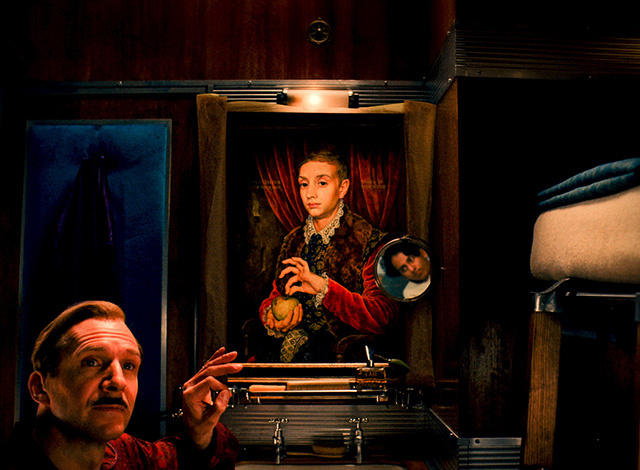
The “us and them” discussion continues in Percepticide while Taylor focuses on the what it means of seeing and being seen. The strong temptation people feel to see is due to the voyeuristic pleasure, which is largely a sexual desire in its own form, and can be manipulated by either letting see or leaving an absence in theatre, with a precondition of distancing. However, once such scopic pleasure is smushed, as in Gambaro’s work, seeing gains an enormous power and it transmits within the crowd, bouncing back and force, connecting everyone as a whole so there is no escape for only one side. Victims are seen closely but can also “returns our look” (Taylor, 135). This duality of mutual visibility reminds me of the very classical scene in Wes Anderson’s The Grand Budapest Hotel (2014), where the M. Gustave, Zero and the Boy with apple in the picture all stares at each other, while at the same time drawing the audience in despite the existence of a screen. It in a way represents the complex relationship between persecuted Jews, the silenced people of kinship (maybe as potential allies of persecutors) , mirroring the tragedy of history as a warning of today, of what tragedy might happen when people turn away from the fact and refuse to see.
The Grand Budapest Hotel 2014
Foucault, Michel. Discipline and Punish: The Birth of the Prison. Second. New York: Random House.Inc, 1995.
Taylor, Diana. “Percepticide.” In Disappearing Acts: Spectacles of Gender and Nationalism in Argentina’s “Dirty War,” 119–281. Durham: Duke University Press, 1997.
Girard, René. “Stereotypes of Persecution.” In The Scapegoat, 12–23. Baltimore, Maryland: The John Hopkins University Press, 1986.
Dragonfly Eyes Trailer, Presented by Xu Bing’s Studio
In the year of 2017, a contemporary art piece called Dragonfly Eyes made its debut and led to heated discussion. Dragonfly Eyes isan eighty-minute indie film created by a New York City based Chinese artist Xu Bing and his team. Xu Bing has worked decades with visual art and installations and had developed a rather intriguing approach towards symbols and representations, while this is the first time that he ever makes an attempt to involve human beings and real bodies in his artistic work. The film focuses on the tragic life story of a woman who lived a marginal life. She endured great precarity, from poverty, betrayal of love, to sexual harassment, body shaming and sexism. After several plastic surgeries, she ended up being a cyber star selling her sexuality. However, things went downhill quickly and the story ends where she vanishes suddenly, leaving no trace at all.
Although this is a film, I still consider it a performance — mediated performance might be more precise — due to its content of bodily actions and nature of liveness. Xu Bing’s studio made a straight forward statement at the very beginning of the video, clarifying that “this is a film without actors or camera crews. All the visual materials has been taken from public surveillance videos” (Dragonfly Eyes trailer, 2017). Statistic shows that up until the year of 2017, over 17 million surveillance cameras have been installed and actively working throughout China, and the number may accelerate to 45 million by 2020, making China the country with the highest density of CCTV and least privacy. Xu Bing’s team had no professional photographer but the whole country’s cameras working 24-7 for them. This is a unique film where all 11000 hours long footages come from “live records” of daily human performance captured by CCTV. It is also made through an utterly reversed filmmaking process, as the team first collected the footages of surveillance security cameras all over China, examined closely and categorized them, then developed a script based on what they have seen. Finally the selected recordings were edited into a narrative and also fictional film tinged with absurdity.
Dragonfly Eyes is neither a conventional film made for movie theatres, nor a film that can be approved by Chinese National Radio and Television Administration under current censorship because of its graphic representation of sensitive subjects. However, Xu Bing chose to add a logo of dragon on a grass green background to the beginning himself, which is the symbol that would be given to all films if they are approved by Chinese government for public release. This is a clear irony of censorship with in a cultural context, but it also refers to political civility in universality. Censorship in a way is enforced to make sure that all conversations happen in the social political environment subject to what is considered correct by the established dominion or authority. The surveillance cameras are installed initially to serve a similar purpose, to secure the dominance of a governing system and a common (or greater) good. However, its appliance are not always upright. It is disturbing to see them turning into apparatus of violence that constantly intrude privacy of people, recording images of nudity and intimacy.
In the book 1984, George Orwell warned about the terrifying violence censorship can cause. He depict a world of worst scenario, where every single person’s behaviors are kept under Surveillance “for the benefit of the country”. People spy on other’s daily performance, pry into their privacy, and turn those misbehaved in. There is a clear and absolute subject when it comes to censorship and surveillance, excluding enemies as well as the disqualified. This is an action bonded by so called civility, the hegemonic social settings that limits and rules the public, bonding citizens to its strict contract under penalty. Its initial intention is to sustain the very condition of democratic politics for mutual respect and thus equal conversation. But with time it associates with identification, advocating “an identity totally exclusive of any other, one which imperiously commands its self-realization through the elimination of any trace of otherness in the ‘we’ and in the ‘self’” . Thus civility is turned into a a filter on the path to political privilege. This is also why as soon as these images and videos are taken outside the context, people are instantly aware of its absurdity. All images seem inappropriate and become real matters of delicacy. Looking closer, a power transfer would emerge, as the power hold by authorities took a unwitting but also problematic shift into the hands of artist, leaving behind the question whether it is legit for art to go far beyond the its artistic realm and mold the truth or reality as it wishes. The both political and ethnic question of how shall art interfere the world and people’s life needs to be deliberated. When an artist take advantage of private/personal actions to pose against the authorities, he might also be using his privileges to deprive the inherent power of people. This is probably where identification comes in a draw its line.
Whether a political art work is intruding inherent right of people partially depends on where identification is oriented. Identification possess the power to alienate or align, and it projects through performance through the relationship between actors and spectators. Editing raw materials excerpted from documentary videos into a narrative film is an act that alters the idea of contemporary performance and spectatorship. Boal believed that spectatorship restrict people in a passive position that is at a higher risk to be oppressed. He proposed the idea of spect-actor in stead of spectator to encourage participation from the context of performance to daily political scenes. While Xu Bing took a step further, turning every single person into a complex combination of both actor and spectator. Consciously or not, our bodies are conducting actions throughout life. People live as live performances. On the flip side, people also live as spectators all the time. As Taylor inferred, “the debates about what can and cannot be known through vision, and how spectators evaluate what they experience, continue into the present and are now further complicated by the prevalence of mediated spectacles and interactive digital technologies” (Taylor, 75). Bodies are manipulated into spectacles that appeal to the public eyes and minds, and because of its kinship with feelings and emotions, opinions opposed to truth can be projected and inserted all the way through, making the identification dangerously political.
With the advent of Dragonfly Eyes, the power retained within seeing has never been so amplified. “Dangerous seeing, seeing that which was not meant to be seen, puts people at risk in a society that polices the look. The mutuality and reciprocity of the look, which allows people to connect with others, gives way to unauthorized seeing” . Similar things happened during our workshop of Boal’s Theatre of the Oppressed, where several actors chose to gain more power by positioning themselves in certain distance, as witnesses or commenters. When surveillance cameras are installed across the country, or even all over the world, the slightest trivia can be exposed to certain eyes — eyes of the authorities. Then the inevitable but problematic question of who is allowed to see and who should be seen follows. The ability to see empowers the spect-actors by creating a distance while at the same time offering them the opportunity to deliberate, report, discuss and comment, or even interpret or distort the fact as they wish. It then leads to an ethical aspect of truth and lie.
While Xu Bing took a step further, turning every single person into a complex combination of both actor and spectator. Consciously or not, our bodies are conducting actions throughout life. People live as live performances. On the flip side, people also live as spectators all the time. The power retained within seeing has never been so amplified. “Dangerous seeing, seeing that which was not meant to be seen, puts people at risk in a society that polices the look. The mutuality and reciprocity of the look, which allows people to connect with others, gives way to unauthorized seeing” . Similar things happened during our workshop of Boal’s Theatre of the Oppressed, where several actors chose to gain more power by positioning themselves in certain distance, as witnesses or commenters. When surveillance cameras are installed across the country, or even all over the world, the slightest trivia can be exposed to certain eyes — eyes of the authorities. Xu Bing was the first to try and break down that one-way round routine. His work activated the power of seeing the unseen through a peeking hole that he created. Therefore, empowered and affected by the bodily storytelling, audience naturally align with him. Then the newly born spect-actors would have the opportunity (or capability) to further deliberate, report, discuss and comment, or even interpret the fact as they wish, as in a spiral circle.
Bibliography:
Balibar, Étienne. 2002. Politics and the Other Scene. New York: Verso.
Taylor, Diana. 2016. Performance. North Carolina: Duke University Press.
Boal, Augusto. 2006. The Aesthetics of the Oppressed. Florence: Routledge.
Speech and action and their relationship to power in appearance is discussed in both Arendt and Butler’s writings. Action is clearly a core concept to Arendt as she states straight forward, “A life without speech and without action, on the other hand—and this is the only way of life that in earnest has renounced all appearance and all vanity in the biblical sense of the word—is literally dead to the world; it has ceased to be a human life because it is no longer lived among men”. She also firmly believes that action is not efficient unless it is accompanied by speech, as language confirms that equality and distinction constitute human plurality.
Arendt goes on to elaborate on the relationship web of human society, and pointed to power and space of appearance, where she thinks power is power and it can only be generated through the public space and relationship established among people, as in this way the potentialities of action are consistent to retain power . Therefore social movements or resistance that express popular will are the very practice of power.
On the other hand, Notes Toward a Performative Theory of Assembly introduced its theory through popular will and mass social campaigns but leads to a different direction. It feels strange to me at the beginning that the performativity of bodies has to be proven under the premise that language can be performative, as the sequence shall be reversed in nature.
Butler pays great concern to the “precarity” experienced by minority (a relatively minority, not only defined by gender and sexuality but also anyone excluded and made “dispensable” by certain democratic system). She resists Arendt’s idea to some extent as the power in performativity is not unidirectional by stating “… performativity does not just characterize what we do, but how discourse and institutional power affect us, constraining and moving us in relation to what we come to call our “own” action.”
1. Make believe and make belief. “make believe” is pretending the unreal to be real consciously and it happens so often in performance, especially in theatre that we tend to forget its existence. But isn’t that how “make belief” happens? When things start to feel spontaneous and then snick into our subconsciousness. It is a level higher above and much more powerful, touching upon people’s passion and irrationality.
2. The making of they and us. By which I mean spectator-ship and retro spectator-ship, particularly in the contemporary theatre and other performance fields.
3. Identification. This is something implied by Brecht when he talks about the roles actors should play in theatre. I also want to expand its context to find out how we identify with one another and how we revel against others. In other words, how is ally and enemy formed with intention.
4. Truth and representation (and fiction). It is of common knowledge that theatre is not a copy of reality. Aristotle states that it should be the recreation of the creative principles in nature and help nature to right its wrongs. Therefore, it should contribute to something true although itself is fictional. I wonder does truth matter or even matter as the core value in performance? If so, then how far can representation go without running into distortion?
5. Entertainment and Education. I do agree that theatre should be joyful, it should reach out with emotion and speak to the souls, make them akin. However, it then inevitably becomes educational. And that is exactly what Brecht did with his own theatre work. Theatre is used to achieve sublimation, to inspire greater admiration or awe and to make a difference, which I find fascinating and hope to explore more. Also, which is the true core and which is the tool, or candy coat? That is also something worths thinking.
6. Empathy. It is called the dangerous thing by Boal, as it’s manipulative, encouraging people to give up part of their emotion to another being and enable that person to lead or even act on behalf of themselves. He cast it away because of its potential power, very much likely as what Plato did with art. I have always understood empathy as one of the greatest gift in human, and I wonder if it is a merit of humanity, or a instinct all mammals have (According to Taylor). Moreover, is empathy only about emotion and sensory feelings, or it’s bonded with the most instinctive and trust worthy judgement that involves ration, which happens so fast that we barely realize.
7. Emancipation, freedom and equality. The question of nature right versus legal right still haunts me from the first day. Emancipation refers to some people being deprived of their natural right (freedom and equality) and become the object to be freed, which infer to different class structures. Schiller even states that art should be used to educate and make people more qualified to their right of freedom. However, as nature right, it should not be earned but given by birth, and having to earn it already indicate an established solid structure of politics that is somehow paradoxical and against its original motto.
8. Alienation. Something seems a method in theatre but a core reflecting the social and political construction in fact.
9. Civility. A complicated concept, especially when associated with political correctness. It helps build a bridge for all political discussions, but also create complexity through regulations, sometimes even covers up the most pressing issues.
10. Activism. It concerns “doing” in transformation on a large scale and requires the cluster to turn passion into strategy, which then ideally involves ration.
Reading through this week’s materials is quite a wonderful adventurous journey. Brecht on Theatre, Theatre of the Oppressed and Performance all touched upon what should theatre (performance) do as well as its capability of affecting human society, especially in the modern age of science. The approaches and the focuses, however, did vary.
Brecht began with questioning the essence of theatre, and following the footsteps of Aristotle, he concluded that it is a representation of men’s life together in human society, and it should be of sheer entertainment, a “purification which is performed not only in a pleasurable way, but precisely for the purpose of pleasure”. However, it does not mean that theatre brings nothing but laughter to the world. It’s aesthetic meaning truly lies in its unique way of creating alienation and how it reflects on people’s inner feelings and makes a difference, as “the pleasure felt… must be converted into the higher pleasure felt when the rules emerging from this life in society are treated as imperfect and provisional”. In fact, such conclusion leads back to the first chapter in Theatre of the Oppressed, where Boal traces back to the very origin of poetry, theatre and tragedy and lands on Aristotle’s theory of art as recreation. According to Aristotle, art is the recreation of all creating principles of nature, and it even goes beyond into self perfection in order to correct where nature has failed. Based on this statement, Aristotle also developed the idea of “the sovereign art”, which is the rules above all kinds-Politics. “Nothing is alien to politics, because nothing is alien to the superior art that rules the relations among men”, therefore every art is associated to the vast horizon of politics, and bringing its education within each performance.
Performance acknowledged the fundamental theory of theatre as art, yet explored performance as well as its interaction with politics from a broader perspective, which is relatively new but also universal. As an extension of Aristotle’s “imitation”, the crucial term “doing” is brought into sight in supplement, strengthening the value of acting, repeating with difference, and transmitting memory, knowledge, cultural identities, etc. With such strong social element and bond, performance spontaneous but also legitimately enters the field of politics and activism, where its core of entertainment becomes the best strategy and method.
A fundamental yet complicated question lingers in my head while reading: what is the premise to follow or assumption that we are making when we talk about politics?Where does political right comes from, or how it is constituted remains inexplicit to me. However, it is crucial as it determines the perspective from which we interpret politics as a part of human society as well as humanity.
It is indicated that “autonomy becomes a politics when it turns out that part of society (and hence of humanity) is excluded-legally or not-from the universal right to politics” (Balibar, 6), which seems to suggest that political rights only come into being with its opposite counterpart of oppression begins and politics only a form of establishment created by human but not humanity. Similarly, Mouffe used terms of “hegemonic nature of every kind of social order and envisaging society” to characterize politics (Mouffe, 2). If that is true, then the relationship between “natural right” (such as liberty, equality) and “political (or probably legal) right” becomes truly paradoxical. As natural right should be universal and independent from all different traditions, cultures, legal systems and governments, the formation of politics- although in the name of emancipation- to some extent violates the nature of human rights itself.