The “life” and “death” of Marcos- Zapatista movement as a political practice

The Zapatistas have a unique way of organizing people, and also narrating the leadership inside the organization.

The dialogue between Taylor and Dominguez provides a prehistory of the leadership before Marcos. In the last CAE article we read, they describe the digitalization as everywhere on the earth (CAE,151) and they believe that this ubiquitous digitalization influences the theatre of being a lot. But the bodily movement of Zapatistas reverses the situation by their intergalactic mode of action, which builds up bridging between those who are most marginal outside the system and those systems that seemed to be the site of new power. As they are doing civil disobedience from a community without access to any of the infrastructures, it shows the possibility of expanding a network and manifesting a network without having access to a network. They developed the anonymity essence of the digital disturbance in a new way.

The CTA calls their action poems because of its aesthetic values and the narrative they have in their manifestos. Dominguez even uses the word aurora to describe the uniqueness of this aesthetic movement appearing in certain space and time and claims that it could be translated into the emergent qualities of tactical media. It reminds me of Dreamers’ actions, also Arendt’s argument on the web of human relations in the plural. (Arendt,181)As Dominguez puts it, this movement could be an anti-anti-utopian as it is still developing.

When taking a closer look at those selected writings of Marco period, we can find why it is anti-anti, rather than utopian itself. They see the battle for minds as more significant than the fight for the territory Postmodern insurrectionists, that is why Marco is Subcomandante -the real comandante of the Zapatistas is the people, he is merely a voice for their will: it has no central head or decision-maker; it has no central command or hierarchies. “We are the network, all of us who resist.”( Marco,159) The writing matches with the leadership style, it is both observative and humorous: he says that Neo-liberal politics of market economics and free trade condemns a third of the world’s people to abject poverty and the new world war is actually a world of money versus humanity, “ like weeds in the road- silenced, faceless, nameless”(Marco,142)( reminds me of the narratives in Open vein of Latin American, things have never changed over the past hundred years), and articles like Tales of the lime with an identity crisis,( Marco,431) The schizophrenic pig (Marco,428) have a witty voice of storytelling in it. Although the stories are from Latin America, the theme is universal. It inspires people from different worlds, as indigenous activities, it also influenced the electronic disturbance theatre by setting a good example of bodily movement. (Taylor and Dominguez)”We propose that we make use of all possible and impossible media in order to consult with the greatest number of human beings on the five continents”.( Marco 160)

Taylor’s article witnesses the disappearance of Marco. By combing the history the same naming in the history of Latin America.: Traditional heroic figures, Che, and other revolutionary characters, and Marco, she narrates the development and the growth of transformative leadership: “Marcos” signaled the powerful potential of indeterminacy—the capacity for invention and reinvention, the willing into being, into the light of a power that was always there, potent, but in the shadows. According to her, Marco is like a ” Drag king made up with collective dreams”. The various shifts had tilted the center of the movement in different directions. As Marco claims, the Younger generation is going to take the leadership into more horizontal leadership strategies. Comparing to the fandom of revolutionary leaders ( Mao and other politicians ), Marcos’s existence and disappearance is a political utopian. In this way, it won’t be too intimidating when he said he who has never lived does not die.

Ensemble, Critical Art. 2000. “Recombinant Theatre and Digital Resistance.” TDR/The Drama Review 44 (4): 151–66.

Marcos, S. 2002. Our Word Is Our Weapon: Selected Writings. Seven Stories Press.

Arendt, Hannah. 1998. The Human Condition. Edited by Margaret Canovan. Chicago: The University of Chicago Press.

Dancing with the Zapatistas. (2019). Dancing with the Zapatistas: The Death of a Political “I:” the Subcomandante is Dead, Long Live the Subcomandante!. [online] Available at: http://scalar.usc.edu/anvc/dancing-with-the-zapatistas/marcos-declares-himself-dead?path=path-1 [Accessed 23 Nov. 2019].

Dancing with the Zapatistas. (2019). Dancing with the Zapatistas: Ricardo Dominguez: Interview about the Zapatista Movement. [online] Available at: http://scalar.usc.edu/anvc/dancing-with-the-zapatistas/ricardo-dominguez-interview-about-the-zapatista-movement [Accessed 23 Nov. 2019].
Political Spectacles in the Digital Age

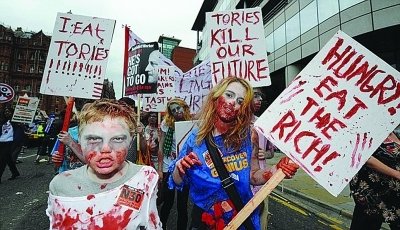
Three articles focus on the shifting of political spectacles from different facets: the evolution of theatre of being in the digital age; the specactors transformed from citizen to netizen; the new digital forms reform the political spectacles in the States.

CAT discusses their theatre form called the recombinant theatre and gives a closer look at the theatre in a chronological sense. The value of analogic and the digital, since the day digital appears, have been trading off with each other.In the analogic era, people have a sense of certainty about cosmo till it comes to digital era, for each principle analogic holds dear, the digital model proposes its opposite. (CAT,152)At the beginning of this coexistence, The anachronistic economy of artisans reproduces itself as a luxury economy(CAT, 153): As digital is a test of equivalence, its process offers an ongoing flow of sameness, of order from order(CAT, 154), the high end of value is still found in the analogic because digital reproduction is lack of Aura (Walter Benjamin). Along with the discovery of DNA, the digital age developed into another level: since the origin of life is not analogic (order from chaos )but digital ( order from order)( CAT,155), both analogic and digital have the same value in the regime of art. When it comes to the age of Modern art, where the value is defined by context. The counterfeit was no longer the counterfeit if it met the expectation of sameness. (CAT,156)

       Today as the segments of knowledge go deeper, it opens up possibilities for the theatre of everyday life. As the old form of the theatre of everyday life become the perfect representation of gender hierarchy found in ordinary social space, the usefulness of everyday life is waning. But the development of Theatre of information seems promising because of its intense level of technological mediation, the audience is a step down from actually attending the event. Comparing to the Virtual theatre where we find the feedback loops between electronic and the organic, it seems to have deepened the pedagogical dimension of resistant theatrical practice. (CAT, 165)

On the other hand, the definition of citizen changed a lot in the digital age. Balibar claims that man points to the same referents as citizens, the two are one. He does not agree that there is a duality of individual and the person engaged in political affairs. According to Balibar Man has to emerge in the political issue and become a citizen in the meantime. (Poster, 70)In Poster’s opinion, we also have to find a way to turn the defensive place for being a citizen into an offensive one in a digital age the most important thing is to take into account the intervention of machines to switch the Doctrine of human (Baudrillard) to the doctrine of human-machine. For instance, the digital age politics has become consumption,( like what is elaborated in Trump’s case) citizenship is a blend of autonomous individual of modernity with the postmodern neotraditionalist of identity politics, it becomes even more complicated in the borderless world of the internet.( Poster, 75) According to Poster, citizen evolve to netizen. This claim resonates with what is mentioned in the article of CAT: regarding the new potential of practice of the internet, and the transformation of the citizen, the theatre of becoming is for sure in its new stage of the process.

But Poster also reminds us that internet, not as a utopian realm but has its hierarchy and control, manipulation and risks. We have to analyze how political representation is reproduced and its repercussions on national sovereignty. (Poster ,84)

An impact on multiple aspects of globalization, including transnational flows of capital and people, which in turn led to the proliferation of new forms of communication and the ways in which culture circulated through the world, from satellite television to digital piracy(Edwards, 28) As Friend requests and followers are a perverse new form of social capital, as expressions like the selfie is “a new phatic agent in the energy flows between bodily movements, sociable interactions, and media technologies that have become fundamental to our everyday, routine experience of digital activities” (Edwards, 39 ), Trump’s twitter is par excellent an example of how the circulation of social media become the self-determined political spectacle for authorities, and how this has managed and regulating American citizens’ relationship to the world outside the united states.

Poster, M. 2006. Information Please: Culture and Politics in the Age of Digital Machines. Duke University Press.

Edwards, Brian T. 2019. “Or the Selfie-Determination” 74 (3): 25–45.

Ensemble, Critical Art. 2000. “Recombinant Theatre and Digital Resistance.” TDR/The Drama Review 44 (4): 151–66.

Why folk heroes are on the rise?

Schechner claims that Make believe is when you know what you perform does not exist in reality and Make belief means making people believe, making a certain reality by, i.e., a religious activity. In real life, Politicians use the fluidity between these two methods to form people’s prejudice against something. In my opinion, the biggest difference between the two is whether the audience participates in the performance, that is, whether they are specactors: i.e. in political spectacles, if the voter is convinced by the authorities make belief, they vote for the politicians,  Machiavelli is the first one who make the process of Make belief clear in the political field: in his opinion, education in those past centuries has only given citizens idleness and weakness, which makes them lack of decency, And they don’t have the love of freedom as they were republicans, so the politicians are allowed not to be good ( in the Christianity sense) anymore.

Kolbert explains the citizens’unreasonable response to political fiction from the perspective of cognitive behavior studies. She thinks Sociality is the key to the question because human beings rely on cooperation and highly depend on others’ expertise. As a result, there is no sharp boundaries between one person’s idea and knowledge and those of other members of the group. Once formed, a certain impression is remarkably perseverant, even when their beliefs has been refuted, people fail to make an appropriate revision in those beliefs. Because people have “confirmation bias” in collaborative works in cognitive mode and Myside bias in personal cognitions. In Kolbert’s words: the Environment changed too quickly for the natural selection to catch up so it is easier for people in the society to be trapped in fake news and crazy politician fandoms.


The other article explains why the specactors are still actively involved while it is obviously fraudulent. For supporters, what they never condone in their personal lives, they relish in the folk hero. For political figures like Trump, sexism、 lying、 corruption only adds to his legend. Blow’s article starts with a case study about fandom and tells us the real reason behind these paradoxes: He cited the example of Monkey King who is a hero but also a misbehaving child who only needs a firm hand and a sense of purpose to come good, and tries to explain the supporters intention behind their ridiculous behaviors.

Machiavelli, The Prince
Richard Schechner, “Make Believe and Make Belief” (https://www.youtube.com/watch?v=YG6fMnH17GU)
Elizabeth Kolbert, “Why Facts Don’t Change Our Minds” (https://www.newyorker.com/magazine/2017/02/27/why-facts-dont-change-our-minds)
Charles Blow, “Trumpism Extols it’s Folk Hero,” NYT, 4/8/19, (https://www.nytimes.com/2019/04/07/opinion/donald-trump-trumpism.html)

A New century Image-making

According to Azoulay, as soon as photography became a tool available to the masses, a new form of civil relations was enacted that was not mediated by sovereign power (Azoulay, 134) and as the visual creation can be converted into the conceptual, into knowledge, exposes the instrumental approach to photography that characterizes various fields of legal, political, or moral discourse that constantly make use of photography. Photography is thus perceived as a transparent means of achieving the same general, universal goals. Yet the image maintains a direct connection with the depicted object because it was written by the object’s own reflected light, by its aura. The secularization of photography, therefore, was accompanied by the creation of its transcendent standing.(Azoulay, 149)

In Rancière’s words, an image never stands alone. It belongs to a system of visibility that governs the status of the bodies represented and the kind of attention they merit. (99) What is called an image is an element in a system that created a certain sense of reality, a certain common sense. ( Azoulay, 102)

Rancière also maintains that the image is not the duplicate of a thing, it is a complex set of relations between the visible and the invisible, the visible and the speech, the said and the unsaid. It is not a mere reproduction of what is out there in front of the photographer, It is always an alteration that occurs in a chain of images which it alters it in turn. ( Rancière, 93-94) His opinion resonances in Azoulay’s criticize of Roland Barthes about the horror image: Azoulay believes that the Barthes’s unsatisfied feeling in front of a horror picture is based a conventional way of looking/ seeing, instead of blaming on the picture itself, Azoulay suggest the spectator take action to capture thing visualized by photographer intentionally and unintentionally. 

Azoulay’s opinion also echoes in Rancière’s argument about the intolerable image: there would no longer be an intolerable reality in which the image could counter-pose to the prestige of appearances, but only a single flood of images, a single regime of universal exhibition. The assertion of the authority of the voice thus emerges as the real content of the critique that took us from what is intolerable in the image to the intolerability of the image. ( Rancière, 89) Action is presented as the only answer to the evil of the image and the guilt of the spectator.

In Beltrán’s case studies, the youth activists in the DREAMER community take action through establishing new relations between words and visible forms, speech and writing, a here and an elsewhere, a then and a now. ( Rancière, 100)By starting or joining a political group on a social network site,” noncitizens”engaging in political activity and take action.

Azoulay, A. 2008. The Civil Contract of Photography. Zone Books. Zone Books.

Cristina Beltrán  2015. From Voice to Influence: Understanding Citizenship in a Digital Age. Edi. Allen, D, and J S Light. University of Chicago Press.

Rancière, J. 2014. The Emancipated Spectator. Verso Books.

Persecution and percepticide

According to Foucault, as the sovereignty power of making die shifts into biopower ((Foucault 2003, 255), The cruel punishment acts against the human body have become a discipline. Biopower enacts through technologies of power to humanize the penal system and the knowledge of man: i.e. the stereotypical persecution is the consequence of these techniques. (Girard,17) These stereotypies work in the logic of racism: by creating caesuras within a population”, a confrontational relationship is built up between “us” and “them. (Foucault 2003, 255)

In meanwhile, as the system of punishment are to be situated in a certain “political economy” of the body… it is always the body that is at the issue.”(Foucault, 23)The authority uses terror to subject the body and make invisible space in public life. People become percepticide and fail to recognize certain aspects of the society and the self, as their psychological ability to humanely response to the reality is killed by horror.In Taylor’s article, she mentioned how Population is manipulated to see and not to see, and how Propaganda acts on the population level, and build up an ideology, a collective imaginary(Taylor, 122) by The mutuality and the reciprocity of the look, the recognition between “ us and them” happens. The case study about the Argentinian artist Gambora’s work the information for foreigners is used to explain how percepticide could be used for specactors to see, to admit and finally, to act. A theatrical presentation of terror could be the Caution for us not to think of nonvisible spaces as nonspaces. (Taylor, 131) Through the illusionist quality, theatre can be a space for people to transform.

Taylor, D. 1997. Disappearing Acts: Spectacles of Gender and Nationalism in Argentina’s “Dirty War.” Disappearing Acts: Spectacles of Gender and Nationalism in Argentina’s “Dirty War.” Duke University Press.

Girard, R, and Y Freccero. 1989. The Scapegoat. Johns Hopkins University Press.

Foucault, M, A Sheridan, and A M S Smith. 1995. Discipline and Punish: The Birth of the Prison. Peregrine Books. Vintage Books.

Foucault, M. 2003. “Society Must Be Defended”: Lectures at the Collège de France, 1975-1976. Jeff Borrow List. Allen Lane.

Art and labor: a case study


Keywords: Fiction; Reiteration; Action

Actors in the factory:

In his video installation Disguise[i] (Yang,2015), Chinese artist Yang Zhenzhong scans the faces of 50 workers with 3D technology and asks the workers to wear masks while working. In the video, each worker still has his/her own face, but their expressions freeze as they are working on the assembly line as usual. Facial expression is the main method for human beings to disclose their feelings and desire, either on stage or in daily life. As the faces are hidden behind the masks, the working bodies of those workers are signified.

The artist also uses a high-speed camera to enhance the theatrical sense of this video by presenting these workers’ daily life in slow motion. This technique adds a dignified and solemn attitude to the labors as if they were actors with Noh masks. Furthermore, the live sound has also been distorted into the effect of echo in the nightmare because of the speed change. The solid perception of the labor scene, combined with these simple artistic treatments, presents a limited absurdity and strangeness, therefore an uncanny sensation. This also constitutes the tone of many of Yang’s works: both witty and humorous which shows a streetwise of contemporary art.

I find this work interesting because it is ambiguous in the ways how it can be interpreted: On the one hand, the application of masks has made the workers more thinglike, as Merleau-Ponty calls “objet historique”,[ii](Pietz, 14)On the other hand, the mask they have is individualized, because each of them has a mask with his/her own characteristics, and they act in passive yet active ways like they do in real life.

The paradox lies behind these two interpretations are obvious: The labors in the production mode are oblivious and are considered to be subversive bodies, they are silent and have been hidden behind certain masks like in this video. In meanwhile, as China steps into late capitalism, the mobilization of labor -like other advanced capitalist countries-has made the labor process more performative.[iii](Mouffe,86) Contemporary production has made productive labor in its totality similar to performing artists like is shown in the video.

It is hard to tell if the masks of these workers are a satire on the alienation of laborers by capitalist machines, or a reminder of workers as performers.

Who is watching?

It is worth mentioning that Yang’s sponsor is an art fund of an international enterprise, which produces kitchen utensils, and Yang’s project is completed under the support of this Italian company, furthermore, the video is taped in the Chinese factory of this company. The exhibition of Yang’s Disguise is divided into three parts: the 3D mask exhibition; a 30-minute video; and a photo exhibition about the production process of the video, which all belong to this art fund, and stored in three different galleries in Shanghai and Italy. After the 30-minute video is completed, the artwork was sent to the company’s exhibition hall in Italy and was to be exhibited with the products produced by these workers to advertise for the company. As it was strongly opposed by the artist, the art fund agreed to package the product with plastic wraps, “camouflage “it into a static sculpture to match the exhibition of the video.

What happened in this exhibition venue can be viewed as the reiteration of “Disguise”: The products are concealed in a deliberately wrapped way to highlight the scene of the workers working on line, which is a dramatic perversion of daily life. In advanced capitalism, the products are everywhere, while the workers who made them are oblivious. Arendt makes distinctions between work, labor, and action, and believes that homo faber is the only kind of laborer who can take action and get power through laboring because they communicate with each other through their labor,[iv](Arendt, 208) in other circumstances, the labors in the society are merely making a living because they are far away from what they are fabricating. In the exhibition process of Disguise, the artist makes this absurdity more obvious by juxtaposing the products and the workers in the same space.

The actions of the workers, even though represented through the media, have also occupied this joint venue through this exhibition, therefore, make their appearance in the social space, which has been neglecting them purposefully. And this kind of appearance has not been less powerful because of the mediation. Judith Butler believes that when the body enters a certain place, even if there is no violent resistance, the appearance itself is an action.[v](Butler,74-75) From this point of view, whether the viewer is a retailer preparing to buy Italian kitchen utensils or an audience who is ready to enjoy the high art, Yang has helped the workers to take action and complete a certain degree of presence. Nevertheless, like many of Yang’s works, a relaxed subversion and a tease of the public seem to strengthen the performance of these producers and in turn their resistance.

Labors in performance

When putting the artwork into the context of his career, we will find that Yang’s works have similar deep thoughts about people or laborers in plural forms. The Story of Spring[vi] is an early work of Yang’s made in 2003. He divides Deng Xiaoping’s southern tour speech[vii] into countless pieces, and asks each of the people who worked in Shenzhen Siemens AG at that time to speak out one word, and in turn, reconstitutes the speech through the editing. The reinterpretation of the speech is also a reinterpretation of political performance. Unlike the empty propaganda of the politician, the laborers change the political gene of speech in the form of individuals; by reiterating the performer from singular to plural, they make a solid action, without being silenced. When putting these two art pieces together, the development of China’s economy in the past two decades is clear: labor-intensive production mode remains the same but as the capitalist form continues to develop, the totality of workers has changed dramatically.

From the semi-underground state to the display of works in dozens of countries, Yang has been using labor to make his art for decades. A Chinese critic Lu Mingjun calls Yang’s works ” illusions of revolution”[viii] because Yang seems to avoid weighty expressions by being playful. To some extent, Yang’s artworks are political and revolutionary because politics and performance are connected after all. By forming “fictions”, politics and performance produce symbols to rearrange what is seen and said, between what is done and what can be done.[ix](Rancière,35-36) Performance and politics are both iteration and repetition of certain modes[x](Schechner,33) and performance can also be a kind of preparation for politics[xi].( Taylor, 3) (Boal, 20)

 Although being witty and sometimes cynical, Yang’s works should be considered as political spectacle for sure.

Political spectacle recommendation:Exam and other video installations which appear at Yang’s personal exhibition called Still life and Scenery provoked Hutong Rectification in Beijing, which makes another perfect example of Yang’s artworks as political spectacles.[xii]


[i] Yang zhenzhong.com. Disguise. last modified in May 2015

[ii] Pietz, William. 1985. The Problem of the Fetish, I. Res: Anthropology and Aesthetics 9 (2): 5–17.

[iii] Chantal Mouffe. 2013. Agonistics: Thinking the World Politically. London: Verso.

[iv] Arendt, Hannah. 1998. The Human Condition. Edited by Margaret Canovan. Chicago: The University of Chicago Press.

[v] Butler, Judith. 2018. Notes Toward a Performative Theory of Assembly.Santiago: Pléyade.

[vi] Yang zhenzhong.com. The story of spring. last modified in March 2008http://www.yangzhenzhong.com/?p=250&lang=zh-cn

[vii] Dengxiaoping’s speech in his southern tour is a milestone for China’s economic reform and opening, Shenzhen is the harbor of economic reform.

[viii]artron.net. Panorama: Vision – the politics of theater and surveillance

 last modified on September 2018 https://news.artron.net/20180904/n1021426.html

[ix] Rancière, Jacque. 2004. The Politics of Aesthetics. Gariel Roc. New York.

[x] Schechner, Richard. 1985. Between theatre and anthropology. University of Pennsylvania Press Philadelphia. 

[xi] Taylor, Diana. 2003. The archive and the repertoire: Performing cultural memory in the Americas. Duke University Press Durham, NC.

On another level, performance also constitutes the methodological lens that enables scholars to analyze events as performance. Civic obedience, resistance, citizenship, gender, ethnicity, and sexual identity, for example, are rehearsed and performed daily in the public sphere. (p. 3)

Boal, Augusto. 1998. Legislative theatre.  A. Jackson, Trans. London: Routledge .

Our mandate’s project is to bring into the centre of political action—the centre of decisions—by making theatre as politics rather than merely making political theatre. In the latter case, the theatre makes comments on politics; in the former, the theatre is, in itself, one of the ways in which political activity can be conducted. (p. 20)

[xii] Panorama: Vision – the politics of theater and surveillance

Yang zhenzhong.com. Exam. last modified in August 2012 http://www.yangzhenzhong.com/?p=2237&lang=zh-cn

Action: from Arendt to Butler

Through the distinction between labor, work, and action, Arendt highlights the non-utilitarian nature of action, and even calls action the real nascent of a man(Arendt, 177); Butler re-examines the gender performativity theory, in closely observing the activities of the minority groups, she partially opposes, and partially develops Arendt’s theory of action through philosophical deduction.

The biggest difference between the two theorists is that Arendt starts from the tradition binary opponents of words and deeds, and opposes the overrated importance of thinking in ancient philosophy; while Butler’s argument derives from her theory of gender studies, which emphasizes the embodiment of action.

In developing her argument, Butler also used Chantal Mouffe’s antagonism approach of democracy, introducing the concept of “recognition”, which explores the definition of “the people”, and also puts the “precarity” of action into the light. (Butler, 36) Through a Derridian argument, Butler comes up with her definition of human and life and frames the embodiment of humans in relation into “network” in a biological sense, which echoes Arendt’s concept of “net”.(Butler, 43) Butler claims that the human body is the junction of the public and private sphere. As the ontology of action, the body also determines that the action cannot be absolutely public, as Arendt has distinguished. (Butler, 43)

From the perspective of gender assignment, Butler maintains that even if people do not actively choose, as long as the body goes to the street, this is already performative, and it is, therefore, an action. The deduction broadens the view of freedom comparing to Arendt’s. (Butler, 58)
The two theorists’ points of view have a lot in common, i.e. they both explore the concept of action from the plural aspect. Although she pushes some points to extremes, it is clear that many of Butler’s views are echoes of Arendt’s point of view, for example, Butler’s precarity is the transformation of uncertainty in antagonistic pluralism.

But several questions haunt me while reading these two theorists, especially about Arendt’s:

i.e. 1, According to her, when actions are purposeful, they are bad actions. Isn’t it a purposeful gathering to gain freedom?(Power corrupts indeed when the weak band together in order to ruin the strong, but not before. Arendt, 203)

2, Is she against Machiavellianism? Is the valorization of forgiveness the reason why she was interpreted as a Nazi sympathizer?

Ten keywords

10 keywords I found can be divided into two categories, the first five are the characteristics of political spectacles, which explain “what” is political spectacles; the rest five focus on “how” to do political spectacles.

1, “us and them”

Art is political. Like in politics, to let art happen, there has to be an “us and them”,the power of “us” is predicated on the exclusion of the “them”.

2, “plural”

Political action is always plural, there is an anticipation for the control of adversity. Performance is by nature plural because it cannot happen without audiences.

3, “civility”

 The idealism of hatred is the seeds of fascism, and the solution is to create a place for politics/performance, adding adversaries, not enemies. The political field has a nature of antagonism, so the notion of civility is to moderate the adversaries in this field.

4, “identity”

 Identity is fluid and it is possible that everyone had multiple identities at different points in life. To become an anti-fascist, one has to become minoritarian.

5, “empathy”

Empathy is what Boal opposes in his writing, also consents the idea of Boal, Taylor thinks we should not equal empathy to illusion, but to take it as an essential way of approaching communication between performers and audiences.

6, “mimesis”

Aristotle’s interpretation of mimesis is representational, as the participatory politics is in contrast with representational politics, We have to get away with mimesis, and find an art/performance to do things that are not already done.

7, “alienation“

According to a more literary translation from its German origin, “alienation” means anti-illusionistic, the illusion Brecht aims at confronting is not only in theatrical terms but also the representative regime of art itself. Because Brecht thinks the representative art is something which confirms the existed social setting.

8, “animation/passion”

Political activities are for people with passions, so are performances. Based on her interpretation of empathy, Taylor developed the idea of “animation”, which is the core value of the performance and can be generated from both the audiences and the performers.

9. “Spect-actor”

Boal argues the fourth wall has not been torn down by Brecht because spectators are still on their seats. The spect-actor should get involved in the theatrical work by going on stage and does the symbolic trespass.

10, “feeling/affect”

Brecht claims that to realize the epistemological function of theatre in a scientific age, the “old affect “should be replaced by “alienation”, but in Taylor’s opinion, all kind of feelings provoked by performance is possible.

Evolution of the audience

Occupy Wall Street

” We know that barbarians have their art. Let us create another.

(Brecht, 31)

If viewed in chronological order, the concept of the audience has been greatly developed in the arguments of the three theorists. The context and framework of the three authors are not the same:Brecht used the dilemma of reinterpretation of classic in modern theater as the foothold of his discussion. He argues that “We and our forbears have a different relationship to what is been shown .”(187)

Boal puts theatre works into the frame of social development. Taylor casts into light the performance activities from the 1960s and keeps social movements in her spectrum of research.

Brecht advocated the separation of roles and actors which sets the audience free from empathy effects and makes a transformation from the “old-affects” to Alienation possible ( 192 ).

“The audience must become the character.”

(Boal, xxi)

Boal combed the ancient theater’s Geneology and thought that the purpose of the traditional theater was to emphasize a determined social and ethos. At the same time, he thinks that Brecht’s work to break the fourth wall was not completed (xx). The invasion as symbolic trespass, audiences must be actively involved as “spec-actors”, so that the fourth wall can be broken through. (xxi)

“Performances often challenge the limits of the artists. But they also challenge those of the viewers.”

( Taylor, 72)

With the embodiment and the socialization of performance, the relationship between performance and the audience has become more complicated. Through the premise of “seeing is doing”/” viewing is an action” (82), Taylor differents the audience in these contemporary performances. The audience becomes plural in her discussion as performance is collaborative work in a social movement aspect. “The performance itself asks audiences to do something, even that something is to do nothing.” (86) She proposed that “affect” and “E-motion” as vital for the animation of the performer and audience, which opposes Brecht‘s attitude toward “old affect”.

The common characteristics of the three theorists are to recognize the epistemology value of performance/theatre, to reveal the power of art as political intervention. By putting the hierarchy essence of“catharsis” and “empathy” into question, the relationship between the performance and the audience is re-examined, the possibility of the citizen as the audience evoluted.

To be political or not

In literary theory, especial in the academia world of China, we talked a lot about how to distinguish “the art for the people” and “L’ art pour L’art“. In Rancière’s universe, none of these definitions make sense, because art is no longer about consensus or for certain purpose(14), it is autonomy. It is mind-blowing because my expectation for art was only what Rancière would call as the representative regime of art.(43)

His critics about Madame Bovary is inspiring. As we usually think Emma’s story as an ethical story, Rancière thinks Emma was trying to bring art into life, (but the rising of bourgeois and capitalism would not allow this, so she must be killed, as Rancière claims in another essay) and his idea of aesthetic of daily life merges in that part.(55 )

Chantal Mouffe is more radical, sometimes even speaks from an opposite standpoint of the other two. By putting the mode of production into question, she challenges the possibility of building up the ensemble. In Mouffe’s idea, not even Marx’s definition of class is applicable, Identity is more solid in describing the ineffable changes of modern or postmodern life. She also thinks distinguishing political and non-political art is not necessary,because it is to symbolize social relations. (91)

Etienne Balibar holds an opinion in between, he reclaims the difference between “politics” and “political”, the autonomy of politics and the politics of emancipation seams testified for the artistic concept of Rancière.(2)