Brian Edward’s “Trump from Reality TV to Twitter, or the Selfie-Determination of Nations” argues, “we are witnessing a shift in a sustaining if fraught relationship between culture and politics, between what has been called soft power and hard power” (28). Edwards points out that “the history of technology and society itself has long been central to politics” (idem), from the Industrial Revolution to the popularization of the printed press. For the author, digital technologies relationship to new social forms is directly implicated to both the rise of global populisms and what he calls “the selfie-determination of nations”.
The selfie-determination of nations
refers to “a digitally mediated, imagined community in which individual
citizens, bots, and trolls exist side by side. [And] It is at times difficult
to know who is real and who is a digital creation (39). Although a bit
simplistic, Edward’s argument is a pungent one. The author recognizes the
impact of globalized economies in the way we communicate but it fails to extend
his analysis outside US-politics. The rise of global populism is rendered as an
American “cultural export”, without any thought given on how American neoliberalism
is slowly turning into a neofascist wave around the globe, a transformation led
by economic insecurity and cultural scapegoating.
Following Edward’s “exportation” argument, Jair Bolsonaro, “the trump of the tropics” as he has been called by US-media, is certainly following Donald Trump’s media strategy, with a more explicitly fascist approach. Like Trump, he uses twitter to communicate with his followers, where he is always in control of the narrative. Manipulation by bots and trolls organized action is becoming ever more common, actually interfering on how people perceive politics, and posing a dangerous threat to democracies all around.
To Machiavelli, the state is an amoral entity, a force without no inherent purpose, and whose direction is always imposed by the ruler. Different from Aristotle, whose beliefs led him to think about the education of the citizens as a means to maintain the spirit of the polity, Machiavelli regarded the citizens as inert beings, completely divorcing the politics of the State from the ethics of the people. If the State is no longer an instrument for achieving the good life, then what is the State for? Even though Machiavelli had the Monarchy in mind when he wrote The Prince, the question that arises after reading his book is possible the same question that has being raised by several anti-government movements today, in our democratic world.
The bitter conclusion that the state, the nation-state as well as any other, is not an inherently beneficent entity, but a dynamic, expansive and aggressive force with no ethical principle, also calls into question the belief of the state as the guardian of the sovereign rights of its people. Nowhere in The prince is there any limitations placed upon the power of the state, no regard for human rights or equity. The core of the state, according to Machiavelli, is power. However, persuasion is much needed for a ruler, and Machiavelli attributes this not to learned or earned authority, but to the appearance of strength, rendering power visible to the subjects. The appearance of strength should not only be the main concern for the prince, as it also should be his political strategy. Appearance, Machiavelli suggests, trumps reality.
As Machiavelli explains “love is helped by a chain of obligation which, men being selfish, is broken whenever it serves their purpose; but fear is maintained by a dread of punishment which never fails” (69). The proposition that the power of the prince is maximized through fear rather than love highlights the importance of affection in the political process, since fear, for Machiavelli, can be generated, as opposed to love which is guarded by Machiavelli as an internal feeling. According to the author, fear ultimately results in more control, maximizing the power of the prince. No wonder why his work was so important to fascists rulers around the world, from Stalin to Mussolini…
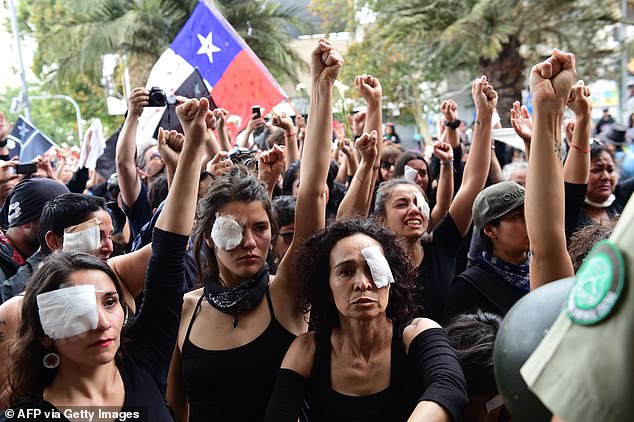
This is the second time that the work of Alfredo Jaar is addressed in one of our readings. And right in a moment when Chile, his home country, is staging a complex political spectacle: on one side, more than one million of people are taking the streets to protest against inequality, on the other side, President Sebastian Pinera’s violent repression of the protests, using the military apparatus to contain the civil unrest by shooting protesters in the eye. How we choose to frame these events, or how they appear to us in the media are part of, as Jacques Rancière suggests, a “sensible system” (100) that operates “from the kind of consumption of the image that makes images out of atrocity without inducing a political response”. For Rancière, what makes an image intolerable is also a recognition of humanity. He writes:
“If
horror is banalized, it is not because we see too many images of it. We do not
see too many suffering bodies on the screen. But we do see too many nameless bodies,
too many bodies incapable of returning the gaze that we direct at them, too
many bodies that are an object of speech without themselves having a chance to
speak. The system of information does not operate through an excess of images,
but by selecting the speaking and seasoning beings who are capable of
‘deciphering’ the flow of information about anonymous multitudes” (96)
Analyzing Jaar’s installation “The eyes of Gutete Emerita”, Rancière calls attention to the inversion of the gaze, from the horrible events carried out by the Hutu militias, armed and trained by Rwanda military, to the forced witnessing of the eyes upon these horrendous acts. For Rancière, “The true witness is one who does not want to witness” (91). Jaar’s work then overturns “the dominant logic that makes the visual the lot of multitudes and the verbal the privilege of the few” (97). The spectator first has to read about Emerita’s experience of the Rwanda genocide and only after this “knowledge” can they have access to Emerita’s concentrated stare, “in whose eyes we can detect the horror they have seen” (93).
jaar-12x
Opposed to the “spectacle of horror”, Gutete
Emerita’s framed gaze “disrupts the counting of the individual and the
multiple.” (99) Rwanda genocide is turned from a massacre of “nameless
beings without an individual history” to a sensible experience that
redistributes the visible. As Rancière proposes: “The
images of art do not supply weapons for battles. They help sketch new
configurations of what can be seen, what can be said and what can be thought
and, consequently, a new landscape of the possible. But they do so on condition
that their meaning or effect is not anticipated” (103)
Against the terrifying normalization of mass productions, Jaar’s intervention speaks directly to the problem of human disposability in a way that disrupts aesthetic regimes of mediated suffering. Through that disruption, the artist renders visible the fundamental categories of the political that makes necessary the reflection upon the intolerable reality.
Michel Foucault’s “Discipline and Punishment” traces a “genealogy of the present scientifico-legal complex from which the power to punish derives its bases” (23) “against the background of a history of bodies” (25). According to the author, the function of the penal system is to maintain social order and to reinforce “sovereign power”, by preserving the pre-existing power structure. More importantly, as Foucault notes, in the penal and juridical system, “the body is invested with relations of power and domination” and inserted in a system of subjection, where “the body becomes a useful force only if it is both a productive body and a subjected body” (26). That is why “the sentence that condemned or acquits is not simply a judgment of guilt, a legal decision that lays down punishment; it bears within it an assessment of normality and a technical prescription for a possible normalization.” As René Girad also notes, the “difference that exists outside the system is terrifying because it reveals the truth of the system, its relativity, its fragility, and its mortality” (Girad 21).
If “torture is a technique” (Foucault 33), its objective is to exert the “sovereign power” by means of revealing the “truth” (Foucault 44) of the crime and the criminal – the abnormality of it -, as well as “the operation of power” (Foucault 55) that established this dissymmetry of forces and its mechanisms – “its visible manifestations” (Foucault 57).
As a “political ritual”, the public execution sought to “recharge” (Foucault 57) the “sovereign power”. The spectacle surrounding it had the effect of educating the people on the consequences of disturbing the social order and defying the “sovereign power”; that is the consequence of acting abnormally. This was possible because the people were to “take part in it” (Foucault 58) both as spectators and witnesses of this power, dismantling any possible trace of solidarity with those who had been condemned, for “[I]t is not enough for the social bond to be loosened; it must be totally destroyed” (Girard 15).
The political problem posed by solidarity was that it led to the intervention of the people in the spectacle of the executions, questioning the “right to punish” attributed to the “sovereign power”: If the execution “spectacle” was poorly performed, it carried with it the danger of turning into a “carnival” (Foucault 61), where roles were flipped, and so was power – authorities were mocked while criminals were transformed into heroes.
The threat posed by “solidarity” is then neutralized in the modern penal system, where visibility turns into secrecy. Diana Taylor addresses this operation of power in her analyze of Griselda Gambaro’s play Information for Foreigners, where the theatrical representation of Argentina’s violent politics is made visible. By staging this visibility in a “theatre” setting, Gambaro’s confronts the spectator’s position as a passive bystander, also calling into question the lack of solidarity in the face of political repression. Gambaro not only de-normalizes the spectator passivity but by “showing” what was intended to be “invisible” to the public, she also exposes the “percepticide” (Taylor 123) that prevents kinship to take form as a political affect.
In the performance entitled after the homonymous work of Brazilian fiction writer Conceição Evaristo (in: Olhos D’água, 2014) and intentionally misspelled as “A gente combinamos de não morrer” (“We agreed not to die”), transgender Brazilian artist Jota Mombaça (Monstra Errática) carefully manufactures handmade knives with precarious materials such as branches, shards of glass and red string. With the performance’s title, also inscribed on the artist’s forearm, Mombaça proposes a form of “pact of surviving”, articulating through afro-diasporic lenses issues of violence and resilience among non-normative and non-white bodies. The performance ends with the artist surrounded by a variety of newly crafted objects that resemble, at the same time, both weapons and tools (see Fig. 1). Mombaça wields each one of them and points to the spectators, staring firmly and forward, ready for the attack to come, but also, and strategically, in position to counter-attack (see Fig. 2). Vulnerability here becomes a twofold position: a set of knowledge gained through shared experiences and a form of power that guides a practice of survival.
Figure 1: Branches, shards of glass and red string give shape to a precarious form of weapon-tool. Jota Mombaça (Monstra Errática). “A gente combinamos de não morrer”. Performed at Goethe Institute in Salvador, Bahia, 2018. Source: Taylla de Paula.Figure 2: Jota Mombaça (Monstra Errática). “A gente combinamos de não morrer”. Performed at Goethe Institute in Salvador, Bahia, 2018. Source: Taylla de Paula
“A gente combinamos de não
morrer” intersects matters of race and sexuality in a combined manner in order
to create a network (“A gente” / “us”) brought together by the precariousness
of life and the possible responses it may invoke in the context of political
cultures in post-colonial worlds; where norms, social and political
organizations have developed in contexts of power that maximize precariousness
for some and minimize it for others. In the post-colonial world, the one that
Mombaça claims not to exist[i], “death has become the
most profitable business in existence”[ii], and “life” can only be
ethically articulated in the plural tense. Through an alliance, Mombaça’s pact
of survival establishes a nonidentitarian and transnational lineage, where the
historic memory of the minoritarian becomings surfaces as strategies of
resistance and social transformation in the context of a “death-world”[iii].
Similarly, the political
practices that take shape inside contemporary feminist movements in Latin America,
such as the “Ni una menos” and “Vivas Nos Queremos”
movements, confront the necropolitics that systematically murders trans
and cis women, and that excludes them from the
opportunities of life. These movements mobilize alliances through the
performative exercise of rights, demanding “the right to have rights”[iv],
to follow Hanna Arendt’s axiom. And even though there performativity surfaces
in a linguistic manner – “Ni una menos”, “Vivas Nos Queremos” –, it gains
visibility, hence political intelligibility, through corporal movements, acts
of resistance and the creation of improvised and ephemeral assemblies.
I’m especially interested in how these feminist alliances are taking shape within the expansion of what Sayak Valencia calls the “necro-liberalism”, in a moment when far-right politicians are surging to power around Latin America based on platforms of ethno-economic nationalism, Christianity, and patriarchal family values. More specifically, in the case of Brazil, this call for alliance takes place in face of the recent elect government of Jair Bolsonaro. Bolsonaro’s rhetoric is not strange to what Valencia identifies as the “hetero-necro-patriarchy”[v] and its reliance on the neocolonial governance, “where death is a kind of civilizing technology that persists until today and connects the current context with colonial intermittency”[vi]. Through the suppression of certain people produced as disposable or unwanted, the neocolonial governance also radically denies their “right to appear” (Butler 2015). Violence and death become common elements, where necropolitics create the state of emergency in which trans women, cisgender women, and other minoritarian becomings have to survive.
In order to counterpose the neocolonial governance of contemporary far-right governments, Valencia proses the incorporation of transgender discourse into feminism as an epistemological tool, generating strategies of common resistance between cis and trans women that refuse altogether the biological model of womanhood, while also potentially creating bridges in communities highly exposed to social and state necropolitics, “in spaces where vulnerability and damage to the bodies of women and nonbinary people and injustice are the norm”[vii].
This perspective calls into question the idea of demanding rights as separate and exclusive claims to separate identitarian groups, divorced from the violent web of relationships that concede or cease these rights in the first place. As Butler explains: “Even as located beings, we are always elsewhere, constituted in a sociality that exceeds us. This establishes our exposure and our precarity, the ways in which we depend on political and social institutions to persist”[viii]. However, transfeminist alliances like the one proposed by Mombaça’s performance are not necessarily directed towards “political and social institutions” represented by the power of the State. Rather, it’s a gesture that, from the start, recognizes the State apparatus’s participation in the differential allocation of vulnerability, and therefore, it is not an ally. The objective of Mombaça’s pact is first and foremost to enhance the potentiality of survival for those who are considered unintelligible[ix], for those whose vulnerabilities are maximized by the action or absence of the State. Ultimately, it is a critical form of alliance, one that proposes a participatory and interchangeable practice of resistance in the present and not the claim of a right.
Keywords for the final project: Alliance; Transfeminism; Space of Appearance; Resistance
Political Spectacle: In 2019, traditional samba school Mangueira won the Rio Sambadrome competition parade with a show that paid tribute to Rio councilwoman Marielle Franco, who was assassinated the year before. The lyrics talked about the unsung Brazilian heroes, many of them indigenous, black or females, such as Franco. The parade’s last image is of a Brazilian flag in the samba school’s official colors (green and pink). Instead of the traditional national motto “Ordem e Progresso” (“Order and Progress”) , the flag had a curved band inscribed with the phrase “Indians, blacks, and poors” —> https://youtu.be/scKZBmi3-F0?t=3071
[i] In another performance entitled “The Colonial Wound Still Hurts” (Venice, 2015), Mombaça writes on top of a map with the artist’s own blood: “The colonial wound still hurts. The post-colonial world doesn’t exist”. Not only the phrase is inscribed with the red liquid, but also the national borders of territories such as the US, Europe, Russia, Israel, Brazil, India, China and South Africa are highlighted with blood. As it asserts itself as a bodily fluid with the potentiality for tainting everything it touches as it spreads around the geographically constructed body of the world, blurring and redefining its borders, Mombaça’s bloody inscription emphasizes the correlations between territorial conquest and violation (both corporal and geographically), challenging the euro-centered cartographic representation of the world through its modes of visibility. Mombaça’s intervention operates in order to redefine this visibility, for there can be no postcolonial world while the colonial bodies still bleed.
[ix] See Butler, Judith. “Política de gênero e direito de aparecer”. In:
Corpos em aliança e a política das ruas: notas para uma teoria performativa
de Assembleia. Translated by Fernanda Siqueira Miguens. Rio de Janeiro:
Civilização Brasileira, 2018, p. 57.
In our social lives, to be visible, to be intelligible is to exist. As Judith Butler (2015) points out, for those who are considered unintelligible, for those whose vulnerabilities are maximized by the action or absence of the State, the struggle to forge alliances must be fundamental for establishing a plural and performative intelligible proposition. A proposition capable of producing a “rift within the sphere of appearance” (Butler 2015: 50), exposing the contradictions already present at the core of the claim for a “universal” right to appear and exist in public. This right, Butler states after Hanna Arendt, is undermined by different forms of power that act as to qualify who can and who can not appear in public. These structures of power can only be questioned by a critical alliance that seeks not to guarantee for themselves the right to appear in the public sphere but to overcome altogether the differential allocation of vulnerability through its modes of visibility, and therefore, its political intelligibility.
Thinking about the networks of solidarity mobilized by contemporary transfeminist movements, where the main slogans in circulation center around the demand to not be killed, it’s possible to say that these movements rely on the performative exercise of rights, demanding “the right to have rights”, to follow Arendt’s axiom. And even though this performativity surfaces in a linguistic manner – “Ni una menos”, “Marielle Presente!”, “Vivas Nos Queremos” –, it gains intelligibility, hence visibility, through corporal movements, acts of resistance and the creation of improvised and ephemeral assemblies. Their appearance within the public sphere is an act that exposes the inefficiency of a right (the right to live and not be injured or murdered by another) in order to reclaim that same right.
The imagination and political practices that take shape inside these social movements confront the necropolitics that systematically murders trans and cis women, and that excludes them from the opportunities of life. As Butler notes: “we are already within the political when we think about transience and mortality. (…) a commitment to equality and justice would entail addressing at every institutional level the differential exposure to death and dying that currently characterizes the lives of subjugated peoples and the precarious, often as the result of systematic racism or forms of calculated abandonment” (2015: 48).
Key-words, concepts and questions for our final project:
1) Democracy: What are the limits of representative democracy? 2) Dissent: Should all art be responsible for creating dissent? 3) Hegemony: can representative democracy exist without hegemony? 4) The political X Politics 5) Is performance always political? Is politics always a performance? 6) How current political actors have mobilized performances from the past in their public appearances? What has been “hunting” current political affairs? 7) Bodily participation X Non-bodily participation in the political debate: This comes to mind in relation to Balibar’s text (on page 17 he mentions “the bodily disposition of individuals”). The differences between “bodily participation” and “non-bodily participation” in a moment when political campaigns focus so much on our digital interactions, bring to the fore the importance of non-bodily participatory politics. 8) “Resistance is always opportunistic”. How contemporary social movements can be thought in relation to this axiom? 9) Does contemporary art still have the potential for “turning society upside down” (Brecht 185)? 10) If spectators are “taught to refrain from intervening or resisting the hegemonic vision of persuasive drama” (Taylor 77), what happens when the political debate is staged to look like a spectacle?
Looking back at last week’s readings in light of Boal, Brecht and Taylor’s text for this week, is possible to draw a line of thought connecting political participation and spectatorial participation. The question would then be: Does contemporary art still have the potential for “turning society upside down” (Brecht 185) and redistributing the sensible? If spectators are “taught to refrain from intervening or resisting the hegemonic vision of persuasive drama” (Taylor 77), what happens when the situation staged demands for the active participation of its spectators? Brecht’s Marxist theater is one that invites the spectator to participate in a critical way – more intellectual than sensorial, also resisting the “alienation effect” – where “the rules emerging from this life in society are treated as imperfect and provisional” (Brecht 205), “impermanent” (Brecht 190) and where all “actions [are] performed as experiments” (Brecht 195).
Augusto Boal’s Theatre of the Oppressed follows similar guidelines, believing that “todo teatro é necessariamente político” (Boal 13), for all human activity is – potentially – political. However, while Brecht’s dialetical approach is based on the role of the actors as responsible to employ and encourage “thoughts and feelings which help transform the field [of human relations] itself” (Brecht 190), Boal invests the spectators with the power to transform the “scene”, and to interfere actively and critically – thus the use of the term “spect-actors” – in order to change what was previously staged. It is important to note that both texts were written during oppressive historical circumstances, Brecht in response to the European fascisms of the 1930s and ’40s; and Boal in the context of the Brazilian military dictatorship (1964-1985). Arguably, harsh political circumstances call for new artistic interventions, expanding the horizon of the visible, audible and sayable, the distribution of the sensible.
To finish, I would like to highlight the pedagogical strategy in this week’s books. The three of them seem to have not the expert, but the common folk in mind, making their points (and political views) clear and accessible, as well as practical, in the sense that they can be performed and acted out in the real world, and not only as theory.
This week’s authors share a common political vocabulary and offer a particularly critical lens for thinking about questions of democracy, although not necessarily agreeing on the purposes and strategies of political action. For Mouffe (2013), “What liberal democratic politics requires is that the others are not seen as enemies to be destroyed, but as adversaries whose ideas might be fought, (…) but whose right to defend those ideas is not to be questioned.” (07)
Dissent, in Mouffe’s agonistic political landscape, is “always present” (09) in the need for “consensus” (08), as a constitutive character of social division and as “a confrontation with no possibility of final reconciliation” (17). Jacques Rancière, on the other hand, stresses the importance of disagreement as a perception that “simultaneously discloses the existence of something in common and the delimitations that define the respective parts and positions within it” (12). Rancière calls this apportionment the “distribution of the sensible”. And different from Mouffe’s agonistic theory that presupposes an equal political ground among peers in equal conditions of appearance, the distribution of the sensible “reveals who can have a share in what is common to the community” (12), “it defines what is visible or not in a common space, endowed with a common language” (13), and “is a delimitation of spaces and times, of the visible and the invisible, of speech and noise, that simultaneously determines the place and stakes of politics as a form of experience” (13). The “stakes of politics” is precisely what is put into the debate in Étienne Balibar’s text, where the author questions the limits of that which is politically recognizable, relating this intelligibility to pre-existing structures of power that determinate the inside and outside spaces of our political life.
As Balibar points out, it
is not enough to recognize the plural, striated and hegemonic sphere of
politics. One must take into account the different conditions of appearance for
each individual to take space within “the political”. Mouffe’s agonist vision
fails to encompass the actual consequences each “outsider” is exposed
to in order to take a stand against hegemonic structures of power. To put it
simply, Mouffe interpretation “sublimates” the real, material risks
involved in the struggle against dominant consensus and hegemonic political
violence.