His final words (“Between Light and Shadow”) Subcomandante Insurgente Marcos begins with: “Good evening, afternoon, or morning, whichever it may be in your geography, time, and way of being. Good very early morning.” I see this approach to time and space as crucial for the digital Zapatista. In their article “Digital Zapatistas” Jill Lane and Ricardo Dominguez ask:“Can a collective social body materialize – make itself felt, register its effects – in electronic space? ” (p.131) I would like to add the component of time to this question. Through the constant repetition of utterances such as “once there was a time when time wasn’t measured” and “at that time, time didn’t exist” in “Our Word Is Our Weapon” by Subcomandante Insurgente Marcos, I am again reminded of the hegemony of constructed (metric) time. “(…) constituting presence in digital space that is both collective and politicized (…)” and out of time; timeless. “You can kill individuals, Marcos recognizes in his final speech, but you can’t kill an idea.” The embodied idea can float in cyberspace and cybertime, landscapes without beginning or end, background or foreground. Since there is no pulse or meter you can dance to the silence inside you, like the gods, and therefore listen and dance through the others; through the we. (Our word is our weapon)
I dance we.
We dance we.
Author Archives: naimamazic
ACTUATION – IMPROVISATION
Not only are “prediction products” what “Zuboff sees as the true basis of the surveillance industry”, “which anticipate what users will do now, soon, and later”, but our behaviors are being shaped by technology firms, for us (Netizens or by media newly constructed subjects) to become even more predictable. (https://www.foreignaffairs.com/reviews/review-essay/2019-10-10/new-masters-universe) How do these predicted and even created actions connect to the “digito- analogic hybrid forms” and processes of today? (Critical Art Ensemble, Recombinant Theatre and the Digital Resistance, MIT Press 2016, p.153) I got to the point of asking: What is improvisation today within the time of technology and how are we being choreographed? Fred Moten says that music is the improvisation of organization. We can consider improvisation as the nexus of the digital (order from order) and the analog (chaos from order, order from chaos). Inventing the term “Monk’s Law” Fred Moten asks: “Is genious that which gives or that which breaks the rule?” and answers it by saying that giving and breaking are bound up with one another. (So maybe rather a Musizen than a Musician- considering the contingent element of improvisation – as an “encounter between a statement and situations or movements“). The “mode of deterritorialization” and “the unknown outcome” of the experimental Recombinant theatre carries the unpredictability within order as improvisation, and can therefore be put in conversation with Mark Poster’s Internet “containing the potential of new practices”, that “de- and reterritorialzes exchanges” and is interdisciplinary: “any point may establish exchanges with any other point or points, a configuration that makes the Internet very difficult, if not impossible, to control by the nation-state.” (p. 78/79 Mark Poster Information Please) Brian T.Edwards in his article Trump from Reality TV to Twitter, or the Selfie Determination of Nations, quoting Bill Pruitt talking about Trump on p.26: “You never knew what was going to happen exactly. It was like the greatest, grandest improvised theater with all the stakes woven into it.” I see Trump’s constant unpredictability as an important part and tactic of his political spectacle of power.
How do multiple fleshless bodies improvise with each other? It is true that “Social Media creates communities (…)” (p.38, Brian T. Edwards) and that “the internet contains the potential of new practices” (p.78 Mark Poster). Nevertheless, I believe that as artists, we share a common interest on understanding performing arts as a way to create places for gathering. “(…) the body is still the key building block of theatre” (p.163, CAE) and virtual communities through virtual theatre create a disembodiment that will prevent important and necessary social gatherings of flesh and bodies, of spec-actors from the contingent qualities of improvising together in the digital age- FLESHNETS.
How does one fight a fiction, a fantasy?
A political
spectacle is based on making Belief through make believe (inspired by Richard
Schechner, “Make Believe and Make Belief”). There is a clear guideline given to that in The
Prince by Niccolò Machiavelli. “How a prince must act to win honour”
is the title of chapter 21, in which Machiavelli writes: “(…) a
prince must endavour to win the reputation of being a great man of outstanding
ability.” The crucially concluding question that Charles M. Blow poses
in his New York Times article Trumpism exolts its folk hero is the
following: “How does one fight a fiction, a fantasy?“. This
question overwhelms me. I cannot think of possible answers. Fiction mixed with the
important tool of the sovereign -unpredictability-, our fighting seems to become
futile. Machiavelli, p.81: “I hold strongly to this: that it is better to be impetuous than
circumspect; because fortune is a woman and if she is to be submissive it is
necessary to beat and coerce her.“ Elizabeth Kolbert, the New Yorker-
“Why Facts Don’t Change Our
Minds”, explains what became known as confirmation bias: “(…) the
tendency people have to embrace information that supports their beliefs and
reject information that contradicts them”
and includes Jack Gorman and Sara Gorman: “(…)cite research
suggesting that people experience genuine pleasure—a rush of dopamine—when
processing information that supports their beliefs.” We constantly
create fantasies. We are making ourselves believe and are made to Belief. A fantasy. How can WE fight the arrival
point of creation of fictions? (if “we can
hardly tell where our own understanding ends and others’ begins”? Sloman and Fernbach in Elizabeth Kolbert, the New Yorker-
“Why Facts Don’t Change Our
Minds”)
gaze out of time
Considering the readings of this week, I would like to continue with my thoughts and ideas of the last post. What does it do to us, spectators, and to victims themselves of them being “incapable of returning the gaze“? (Rancière, “The Emancipated Spectator” p.96)
Rancière describes it as one of the reasons for why and how horror through images is being banalized- not due to the amount of images- it is the lack of the victim looking at us; objectified bodies without names.
I deeply appreciate the way that Ariella Azoulay writes in “The Civil Contract of Photography” about the different gazes and expressions of the photographed in the daguerreotypes. ” These photographed people address someone who is not present, an addressee who opens up the space in which they are placed, who undoes – albeit very slightly – its oppressive limits. Though they know nothing of the category of a universal addressee, their gaze is addressed to someone like her whose existence they assume when they address their gaze to her, revealing something of their feelings toward their enslavers.” (p.173)
Their gaze has power as it goes beyond the very moment of being “violently fixed”; this gaze goes out of the image, and therefore out of time. Does the claimed truth carry true affect?
The spectator does not know if the gaze of the ones becoming stationary through photography has been choreographed or decided by the photographer/ director, therefore she needs to look with a “gothic lens” at the ones who became “gothic subjects”.
(gothic lens / gothic subject are concepts by Bonnie Honig, included by Christina Beltrán in her text “Undocumented, Unafraid, and Unapologetic”.)
diagonal looks
I wanted to see how the readings of this week address the gaze of the victim and wondered- Does the victim ever get to look back? This question became important to me, as in my own research I am interested in the representation of femininity (through the figure of the Madonna specifically in the middle-age, and beginning of renaissance), especially in how male painters saw the ideal of a woman and represented it. I am therefore focusing on their bodies that are curved, twisted, forming diagonals. Their eyes are diagonal- down, in a form of submission, or on the contrary up to the sky begging for guidance. But almost never frontal- directly looking at us.
In her text Percepticide, Diana Taylor writes on page 128: “Sight is gendered or, perhaps more accurately, visual access is gendered. As in rituals, only the initiates have the right to see the hidden source of power. And in the all-male theatre of the Argentine horror show, women are not the see-ers but the objects to be seen.” On page 120 you see the Photo by Jorge Aguirre where an image of “a beautiful model” is to be seen- the model not looking directly at us, but down, into the emptiness. “The beautiful model is the object of the girl’s look, but of course she doesn’t return the look.” (p.121)
When wondering why the play of Griselda Gambaro, Information for Foreigners is so threatening, even though no actual violence is being shown, Taylor writes: “(…)because the victim looks back at us, returns and challenges our gaze-just as the victims who were abducted, yelling and screaming, during the Dirty War. ” (p.133) (…) We are in the same room. This naked body does not, as in cinema, exist in the realm of the imaginary, pure celluloid; it is materially present. The victim returns our look.” (p.135) As a spectator, it is definitely easier to distance oneself through the lack of being directly looked at.
Foucault mentions that during the spectacle of the scaffold, the head of the assasin will be covered with a black veil and quotes De Molène on page 13/14: “(…) the condemned man was no longer to be seen. Only the reading of the sentence on the scaffold announced the crime and that crime must be faceless. (The more monstrous a criminal was, the more he must be deprived of light: he must not see, or be seen.“
The eyes of women in most painting and photographs are shown, the difference is that they are never allowed a powerful frontal look and posture (linking desire to a visual lack?) This lets the spectator not only own them (as John Berger in Ways of Seeing mentions the Spectator-Owner), but I almost dare to see it as a torture- the fact that the victim is not allowed to look at us.
Polymeters
Look harder and longer. This simultaneity, up to a certain point, is only apparent: a surface, a spectacle. Go deeper, dig beneath the surface, listen attentively instead of simply looking, of reflecting the effects of a mirror. You thus perceive that each plant, each tree, has its rhythm, made up of several: the trees, the flowers, the seeds and fruits, each have their time. […] In place of a collection of fixed things, you will follow each being, each body, as having its own time above the whole. Each one therefore having its place, its rhythm, with its recent past, a foreseeable and a distant future.
Henri Lefebvre, Rhythmanalysis, 41
I am interested in escaping anticipation and control (of individual reactions) of political strategies, by finding ways of becoming less predictable. “There is an inextricable link between power and rhythm. What power imposes in the first place is a rhythm (rhythm of everything – life, time, thought, discourse)”, Roland Barthes wrote. I am suggesting to rather consider the link between power and meter and to look at how meter emerged as a transversal concept across the arts, poetics, philosophy, and social science. For me, the meter subjugates, not rhythm, and I see the notion of polymeters and polyrhythms as a way to abolish the hegemony of meter that is imposed upon us as constraint and for becoming more unpredictable through that. It is important to first shortly explain the three basic modes of temporal organization in music – pulse, meter and rhythm and I mostly refer here to the important book The rhythmic structure of music by Cooper. Pulse is one of a series of regularly recurring, precisely equivalent stimuli. Like the ticks of a metronome or a watch, pulses mark off equal unites in the temporal continuum. Meter is the measurement of the number of pulses between regularly recurring accents. Within meter pulses become beats; accented beats are strong, unaccented beats are weak. Rhythm is the way in which one or more unaccented beats are grouped in relation to an accented one. In most compositions, we find a hierarchy of metric organization and some rhythmic groupings are more difficult to realize within a given meter. Aspects of temporal organization which measure are metric. And Foucault writes: “The mechanisms introduced by biopolitics include forecasts, statistical estimates and overall measures.” Crucial is, that pulse is necessary for the existence of meter, bur rhythm can exist without meter! Rhythm is independent of meter and theoretically even of pulse, it can happen in any type of metric organization. Henri Meschonnic proposes to get back to the ancient meaning of rhythm: Rhutmos (rhéin to flow and –(th)mόs a way, a manner) is the pattern of a fluid element (a letter, a peplos, a mood), an improvised, changeable form.
Bojana Cvejic wrote a summary of our thoughts and discussions we had in her course at P.A.R.T.S., where I mentioned my ideas for the first time: “When rhythm is wrested from the established notion of measure in music, a perplexing diversity of terms, instruments and practices unfolds, situating it between a manner of flowing (ruthmos) and an order of movement, proportioned figure (metron), in “the gray gap between black beats” (Nabokov).” The consolidation of the bar line and therefore the introduction of the hegemonic meter seems to have become a part of music only during the 17th century. (Simultaneously with the emergence of capitalism especially in Holland and England?) For example, also the blues used to be an open form with the duration needed for the story a musician was about to tell and did not necessarily have the now common 12 bars. Composer Girard Grisey worked on the relationship between change, predictability, order and disorder. “One can also imagine an oscillating rhythm in which the meter itself would fluctuate constantly.” Link to Tempus ex Machina by Girard Grisey Grisey denies the periodic considered as an ideal point of reference, the basis of a hierarchy which is for him linked to “maximum predictability” and order. He refers to Abraham Moles that says “the notion of rhythm is linked to that of expectation (1966)” and I personally think that the fulfillment of the expectation is linked to metric control and metronomic pulse. (notes from a class with Bojana Cvejic). “Sunny Murray and Albert Ayler did not merely break through bar lines, they abolished them altogether.”, John Litweiler. I had to think of Free Jazz and Swing while working on this paper. As written in the chapter 6 Innards of Time of the book “Flow, gesture, and spaces in free jazz : towards a theory of collaboration”: “The swing is one of those subcutaneous rebellions against the tyranny of the bar line.” To swing means to fluctuate between 2 and 3, to be in 2 and 3 at the same time. Breaking down all rhythmic elements into ‘twos and threes’ (8th notes, 16th notes and triplets) has its roots in nearly all folkloric traditions from Gnawa music of North Africa through the Balkan to Colombian Bata. Drummer Milford Graves: “(…) but if you’re counting like a metronome and everything is like Bamp, Bamp, Bamp just like the second hand, that is extremely dangerous. That means your body is not responding. It must respond. You cannot walk across the street in military march, you know on the beat per second on a major highway where traffic is coming. (…) your tempo is going to change. That’s what the body expects. (…)“. I need to explain, that polymetrics, as I am using the term in this paper, allow not only for different simultaneous rhythms but for the possibility of shifting and changing time and restraints. I am not suggesting to get rid of meters as it is important for the possibility of communal organization and collectivity, but of its hegemony. We do not need one meter that keeps a measured amount of beats controlled, but to share a pulse that allows for interdependency through the possible plurality of polyrhythmic shared within polymetric space and time.* To this thought I want to add beautiful quotation of Osip Mandelstam (“Government and Rhythm” 1920): “Solidarity and rhythm are the quantity and quality of social energy. Only the collective can have rhythm. (…) Rhythm demands a synthesis, a synthesis of the spirit and the body, a synthesis of work and play.(…)” I wonder- how do we free ourselves from the prison of meter opposed on us in order to be more easily controlled through the therefore established possibility of expectancy? What would it mean to live in a polymetric society? On a society based on polymetrics and the resulting less predictable poly-dictability? How would it influence the power of dictator’s unpredictable acts upon us? Would it? “The dictator must never be predictable“, Sue Prideaux in Dictators: the great performers. We still are. But we can start forgiving.
I want to end this paper with another quotation of the book “Flow, gesture, and spaces in free jazz : towards a theory of collaboration” of page 52. Guerino B.Mazzola and Moreno Andreatta conclude the first part of chapter 6 with the following: “So the new thing about time was that it made the move from facticity to the level of making: time became a thing to be construed from scratch. No more tyrannic clocks, no more eternal lines, no lines at all. We make time, we are the new hands, and the clock, and the gestures, which mold time. Not surprisingly, such expressive making also changed the time’s stature: physics’ anorexic timeline was transmuted into a voluminous body of time as shaped by the powerful hands of working musicians.“
“These intimate and predatory forms of exploitation are introducing calculation through rhythms into new arenas of every day life. The question is therefore how to bridge—analytically and politically—the relationship between newer and older(re)configurations of rhythm, power, and everyday life.” Intersectional rhythmanalysis: Power, rhythm, and everyday life by Emily Reid-Musson.
*I very clearly make a differentiation between polymeters and polyrhythms, which in music is not always the case, and not in this way as I am doing it for this paper.
Swinging Max Roach
2 and 3 at the same time- swinging La Réunion!!
https://www.youtube.com/watch?v=DOm3lqhvvRI
Archie Shepp – Free jazz
Ari Hoenig- Polymetrics / Polyrhythms
Conlon Nancarrow born in the US, lived most of his life in Mexico. He is one of the most important composers of our time and forerunner of contemporary music, but somehow strangely unknown. He mostly composed music for player piano. “One reason for working with the player piano was my interest in temporally dissonant relationships. Temporal dissonance is as hard to define as tonal dissonance.”
Rhythm Study No. 1 (1951) is a polyrhythmic composition with over 200 changes of meter. https://www.youtube.com/watch?v=1mKfQYzfduY
3 keywords and 2 videos
Recent examples of Austrian politics
https://www.youtube.com/watch?v=2Yhq6P7Glhg
https://www.youtube.com/watch?v=Qp1XODO1Wtg
3 Keywords: Unpredictability, Claiming empathy and giving care (emotional identification), clear narrative (aesthetics)
polyrhythmic politics
It was fascinating for me this week, to read Judith Butler and Hannah Arendt next to each other; to see the relations, shared – and differently developed ideas. I am interested in how the two authors bring time and rhythm into play. On p.75 Judith Butler poses the question: “How do we understand this acting together that opens up time and space outside and against the established architecture and temporality of the regime? (….)”
“This time of the interval is one in which the assembled bodies articulate a new time and space for the popular will (…) as an alliance of distinct and adjacent bodies whose action and whose inaction demand a different future.” What exactly is this new time, this opposing temporality that Butler is talking about?
Hannah Arendt (p.214): “Where the biological rhythm of labor unites the group of laborers to the point that each may feel that he is no longer an individual but actually one with all others, (…) this eases labor’s toil and trouble in much the same way as marching together ceases the effort of walking for each soldier.”
I think the established architecture of the regime could be seen as the notion of “meter” in music. Also Hannah Arendt might actually be talking about the facism of meter and not rhythm. The meter that is imposed on the biological rhyhtms (plural) of labour and frames the pulse. Judith Butler is talking about the interval, Hannah Arendt about the “Erscheinungsraum- the space of appearance (Nabokov about the grey gap between black beats). Maybe we do not need one meter that keeps a measured amount of beats controlled, but to share a pulse that allows for interdependency through the possible plurality of polyrhythmic shared space and time.
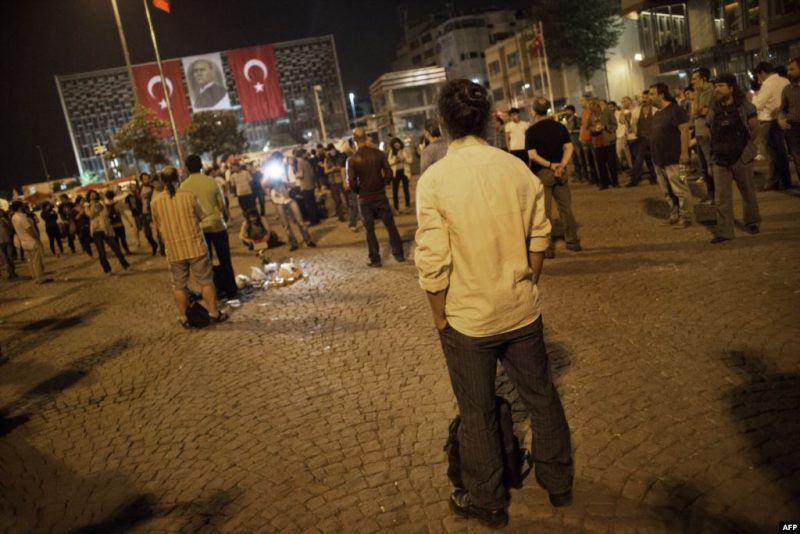
Maybe as for many others this week, the dancer and performance artist Erdem Gündüz was constantly in my mind while reading, mostly because of the exactly this “new” time and space he created, this unpredictable, out of meter temporality through the standing man. ( We met him just shortly after the protest when were in Istanbul with the conservatory for dance). I wanted to share these videos, even though unfortunately I could not find such good material online
https://www.youtube.com/watch?v=cNONsBm-bv0
https://www.youtube.com/watch?v=dO8hkU4uK2g
Connections
unpredictabile / unfamiliar On page 17 Balibar brings about a very important concept for me, that political strategies are finding schema for the anticipation and control of individual reactions. Therefore, they become predictable and controllable. I wonder, how can we find ways of inserting unpredictability, of becoming and being unpredictable? Brecht is talking about alienating the familiar. Resistance is a way of becoming contingent, of being a subject to chance. Jaar having the built paper Konsthall be burnt down the next day, a good example, I find.
empathy / identification A political performance intends to have as many people as possible identify with it. When Boal talks about the danger of empathy, he might have been talking about the danger of identification that is being misused. Nevertheless, we need empathy as a shared emotion. When Mouffe talks about Jaar she says how new forms of subjectivity and new modes of identification can be constructed through the aesthetic means of art.
interdisciplinary / hegemony Brecht implies the importance of the independence of different art forms when uniting them (e.g. music not only as background, ornament,…). I had to think of relating this to artivism, explained by Mouffe, that as she writes “can be seen as counter-hegemonic moves against the capitalist appropiation of aestethetics”, by establishing a new hegemony. I think that the giving the same power to each art form in an interdisciplinary approach (does not have to be a collective one) leads to a different hegemony.
becoming Boal says that theatre is change, it is becoming and not being. (Also considering the efficacy of transformation taking place before spectators eyes.) Balibar writes that “in a becoming one is detorrialized”, talking about the minoritarian as a becoming or process- “all becoming is a becoming- minoritarian.” Do we, in order to be anti- facist, have to become minoritarian?
emotions Brecht emphasizes strongly the importance of emotions of pure knowledge and not emotions out of ignorance. Because it is also the emotions evoked through knowledge that are making transformations possible. Mouffe also mentions that it is through the affect the intellect can be reached-“the effect of our aesthetic experience should be to move us “through our senses and through our reason”.
passive / active Mouffe writes that also cultural producers, not only consumers, we all have been transformed into passive functions of the capitalist system. Boal and Brecht focus attention on the importance of the character’s free spirit and his mobility within the form, as well as the action driven spectator, spec-actor. Belonging by doing not through falling. I like that Diana Taylor opens the notion of “scenario”, which see says can function as the framework within which thinking takes place. I like that Diana Taylor opens the notion of “scenario”, which see says can function as the framework within which thinking takes place.
rhythm Brecht differentiates between climatic rhythm or linear narrative rhythm. Again, in relation to Balibar’s predictable individual, we could maybe think of rhythmic structures, such as polyrhythmical or polymetrical that could break expectations (such as a regular pulse is creating) and have contingency arise from other forms of rhythm. Scenarios could be considered as meters that create spaces for polyrhythms.
commun-ator
Something that I was looking for during the readings of this week, but which I was not able to answer, is: Who are the spectators Brecht, Boal and Diana Taylor talk about and also, how do they benefit from participation? Theatre is a communal experience so the question is also what kind of community it creates- who is in and who is out? In a way, the audience is rehearsing something by being an active spectator. They are not only experiencing the unfamiliar but doing the unfamiliar. And I like this idea. doing becomes a form of belonging. (Diana Taylor) When Diana Taylor talks about Regina José Galindo, she writes: “She (Galindo) has no illusions that she can change the political situation, but she does everything in her power to make the situation known in the most forceful way possible.” Performance is creating possibilities for learning and for knowledge. And then as Boal writes about Brecht, he mentions, that the emotions evoked through knowledge are making transformations possible, not the emotions out of ignorance. So, the possible dialectic transformation of society. Diana Taylor: “Performance is a doing to, a thing done to and with the spectator.” These are not new questions and or ideas, but maybe instead of wanting to reach most people possible to be spectators of a performance, we have to concentrate more radically on deciding who is the spectator community. Whom do we want and need to be present (not, who happens to be present). With whom is this Performance being done today and with whom tomorrow?