This week’s
readings made me reflect a lot about different strategies of resistance and the
smaller actions that can serve to intervene upon what often seem to be
impossibly complex and oppressive systems of power. I was struck by the account
of the “geographies of power” and the concept of disturbance spaces featured in
Jill Lane and Ricardo Dominguez’s essay “Digital Zapatistas”. They discuss the
Critical Art Ensemble’s reversal of “the familiar Deluzian figuration which
sees the nomad as the site of the Other” and its insistence that “it is now
power which is nomadic, rendering our social condition ‘liquesce’” (134).
Certainly nomadic power would demand different strategies than those familiar
images of past Revolutions. The symbolic figure of Subcomandante Marcos, “dead,
not dead, not not dead” (Taylor), as well as the stories of Mayan technologies
and the action of “bombarding” military bases with paper planes give resistance
and revolution a new poetic logic.
The lineage of
hacktivist interventions, and its inspiration on Zapatista strategies, seems
like an important point of reflection in this contemporary moment. Thinking of
the recent shutdown by the Iranian state of all internet connectivity, it is
impossible to discount the significant force of traditional (relatively)
immobile state power despite networked frameworks and transnational model of
the internet. The readings on the Zapatistas this week seem like a great place
to start (and, in some cases, continue) to think through how to challenge the
particular kind of power which brutally governs today.
In their article
“Recombinant Theatre and Digital Resistance”, the Critical Art Ensemble argue
for an expanded consideration of digitality, beyond its associations with the
fields of information and communication technology. The piece presents a broad
range of examples that show the ways in which the digital (as opposed to the
analogue) manifests as an ideological formation in post-Enlightenment society.
It describes the changes in the industrial revolution, the increasing
alienation of people from their labor, as an example of digital formations. The
scientific development of DNA as a way of understanding biology is also used as
an example of a shift towards digital thinking, towards thinking in terms of discrete
units as opposed to continuous beings.
This discussion
of the discrete units that make up the digital paradigm is expanded by the
concept of networks, the new structured relationships between these units. Both
Edwards and Poster discuss the implications of these global networks to our
understanding of sovereignty. In his chapter titled “Citizens, Digital Media
and Globalization”, Mark Poster develops the concept of the “netizen” as a new
category for advocating rights in an era of digital communication. Along
similar lines, Brian Edwards discusses the “selfie-determination of nations” to
consider the blurred national boundaries in the circulation of content online.
I was particularly struck by the discussion, in both of these texts, of the
implications of a media sphere that combines entertainment and politics,
developing similar registers for their consumption. The overlapping functions
of these media might help us think through the ways political spectacles mimic
other kinds of spectacles and produce similar kinds of spectatorship practices.
Machiavelli’s The
Prince develops an account of the way power is acquired and retained.
Through a careful examination of distinct historical cases, the book presents
key tactics for leaders to manage populations and keep control. In particular,
Machiavelli focuses on Principalities, sovereign states run by monarchs, as opposed
to Republics. Even though this form of government is now relatively rare, it is
almost impossible not to think of the contemporary cases that continue to
reflect these dynamics today.
In Chapter 3, titled “On Mixed Princedoms”, Machiavelli discusses
the significant difference between the conquest by States “of the same Province
and tongue as the people of these dominions” and the conquering of areas by
more foreign States. He argues that it is easy to retain dominion over
populations that share the same language and customs, while it is much more
difficult to dominate culturally distinct populations. The continuity in the
cultural life of those conquered means that people may “live peaceably with one
another” still. This recognition of the need for cultural considerations in
governance might help us understand the rise of anti-immigrant discourses
within Western democratic states and the right-wing anxiety that surrounds
migration discourse. The threat to the dominance of particular cultural
practices is given significant political force.
I was also struck by the significance that Machiavelli
assigns to affect in monarchic governance. He discusses the “love” that
subjects must feel for their ruler – a love that should not be distributed
among a multitude of nobles but that should instead be concentrated in the
singular figure of the Prince. “Hate” is also theorized as a powerful force
that threatens the rule of a monarch. I wonder how these emotions are
reorganized in a democratic model – do modern institutions and procedures for
governance redistribute (or diffuse) affect? How can these observations be
applied to contemporary cases of populism?
In her essay “Undocumented, Unafraid, and Unapologetic”, Cristina Beltrán discusses the strategies of visibility deployed by DREAMers in their claims to political recognition. In particular, she considers the appropriation of “coming out” as a strategy originated during the gay rights movement to present the “opening up of new possibilities to imagine political membership and political claim making”, what she calls the “queering of the politics of immigrations” (88). Throughout the text, digital platforms are highlighted for their potential to produce new (and more democratic) spaces of appearance for undocumented people. Transcripts of cyber-testimonios, videos of undocumented youth declaring their legal status and claiming their right to be in the United States, clearly articulate the potential of these new of resistance to the dominant discourses which surround immigration today.
The two other readings for this week can provide valuable insight for the interpretation of the case of cyber-testimonios. In The Civil Contract of Photography, Azoulay develops a new account of citizenship based on the practices of looking associated with photography following the “conquest of the world as picture” (137). This form of citizenship is distinct as it is mapped onto models the deterritorialized spectatorship, where the witnesses of injustice might be located in distant places and yet remain accountable for this differential governance and responsible for restorative action towards the photographed subjects. In“The Intolerable Image”, Jacques Rancière seeks to collapse the distinction between the testimony and the image. In response to the critique of the circulation of photographs taken in gas chambers during the Holocaust, Rancière asks “What distinguishes the virtue of testimony from the indignity of proof?” He argues that the tensions between “having to” speak and being unable to is only possible to capture in photographs, in the expressions of those sharing their testimony.
The cyber-testimonio
of Georgina Perez can be read through both Rancière and Azoulay’s accounts of
citizenship and spectatorship. Georgina’s tearful expression of love, respect
and gratitude for her mother directly confronts and dismisses the impulse
within political discourse to criminalize the parents of DREAMers while emphasizing
the innocence of their kids. The words in her testimony and the emotion we can
perceive in her face during the video both clearly convey the personal depth
and significance of the politics of immigration. In making herself visible, Georgina
is also claiming the kind of citizenship of photography that Azoulay proposes.
She is introducing herself as a political actor within an alternative space of
appearance, and making us (as
spectators) responsible for the differential ways in which we are governed
based on formal “citizenship” status. She finally asks us “Are you going to be
on our side?” (92). As witnesses to her testimony, we have to be.
In her account of the distinction between public and
private, Hannah Arendt claims that “the experience of great bodily pain is at
the same time the most private and least communicable of all” (50). For her,
the site of the body is firmly situated within the private as its experiences
cannot be transferred or shared. Pain, in particular, prevents the victim for
speaking or acting, removing an individual’s potential from participating in
the public realm. The readings assigned for this week develop a very different
account of pain and torture. Both Foucault and Taylor consider the nuanced ways
in which violence, pain and visibility can interact to sustain political
regimes and to produce a particular sense of terror or control among its
subjects.
In her chapter “Percepticide”, Diana Taylor advances the
idea that torture carries a distinct intention, not merely for the victim, but
for the spectator. While Taylor makes reference to make performances, plays and
images throughout, the text is primarily structured around an analysis of
Griselda Gambaro’s 1973 play Information
for Foreigners. This allows for the author to draw parallels between
theatre’s conventions and its demand of the gaze with the particular ways in
which terror and torture operated in Argentina in the 1970s. The way the
audience followed the guide through graphic and violent performances in Gambaro’s
play is also the complicit way in which the Argentinian people lived through a
regime of terror. In the same way as the victim of torture is rendered
powerless, so is the spectator. In Discipline
and Punish, Michel Foucault sets up the body as a concrete site for the
exertion of power. For him, the body is “directly involved in the political
field; power relations have an intimate hold upon it; they invest it, mark it,
train it, torture it, force it to carry out tasks, to perform ceremonies, to
emit signs” (25). Foucault develops a genealogy of practices of punishment to
ultimately present the mechanics of power as operating within a ‘political
economy’ or ‘political technology’ of the body.
Despite dealing with similar themes, the two texts diverge
in several significant ways. I am interested in particular in the ways in which
they might account for a critical position or some kind of resistance to the exertion
of power through direct corporal violence. While Foucault’s account seems to
exclude any exteriority to the discursive constructions of the body through
punishment, by centering her analysis on the analysis of a particular theatre
piece, Taylor might point us towards a potential site of critique and struggle.
Although these two texts
operate very differently, I was struck by the account of invisibility and
secrecy that each presents as a necessary complement to the hypervisible
spectacles of violence. The parallel between the terror of a violent regime (especially
one characterized by regular disappearances) and theatre is also significant in
this respect. Taylor tells us that “dealing in disappearance and making the
visible invisible are also profoundly theatrical. Only in the theatre can the
audience believe that those who walk offstage have vanished into limbo” (132).
Foucault, on the other hand, discusses the ways in which the criminal procedures
in much of Europe were completely secret up until the moment of sentencing. Neither
the accused nor the public had access to the identity of the accuser, to the
evidence presented, or to other information which might point to the legitimacy
of the case. Both Taylor and Foucault are accounting for the role of what is
not known, the opaque processes that rule violence, as key ways of exerting
power and developing an environment of terror.
René Girard’s “Stereotypes of Persecution” develops a
slightly separate account of the ways in which extreme and visible violence
becomes legitimized socially in times of crisis. This text particularly seeks to
identify the key elements that consistently leads to the persecution of
particular groups. His account of the patterns of collective violence is striking
because of its lack of differentiation between those enactments that are widely
considered to be broadly emancipatory (like the French Revolution) from those
associated with tyranny and genocide. Given our previous class conversations on
the power of assembly and the mobilization of individuals in the context of
resistance, I was struck by Girard’s account of assembled masses as “mobs”. Is
there some substantive difference between a group collectively claiming rights
against power and a mob mobilizing against a scapegoated group? Can we account
for the mechanics of political persecution (and, in the case of our project,
the mechanics of political spectacle) without distinguishing between cases of
resistance and those of authority? Just some questions to keep in mind as we
move forward in our project together.
In The Distribution of the Sensible, Rancière claims that “politics revolves around what is seen and what can be said about it, around who has the ability to see and the talent to speak, around the properties of spaces and the possibilities of time” (Rancière 2004, 13). It is through a metaphor of visibility, what is “seen”, that he defines the realm of the political. In Notes towards a Performative Theory of Assembly, Butler considers and extends Arendt’s idea of the space/field of appearance as the political realm where humans recognize one another as such and take action. She significantly emphasizes the fact that not all human subjects are equally recognizable and, hence, the differential conditions of appearance which govern the political. For both theorists, the space of appearance or the realm of the political is exclusive (for Ranciére because of the particular demands on the working class and for Butler given the historical systems of colonial and patriarchal power that govern it) but their aspirations are ultimately oriented towards their expansion not their dissolution.
The benefits of
visibility, of recognition, of representation can easily be taken for granted.
Social justice discourses regularly deploy these terms as a way to expand the
“protection” of the State (i.e. the legal system) or to alter the political
sphere through the introduction of new actors. Many of the established discourses
and conventional practices of resistance within neoliberal democracies today
rely on the visible intervention onto “public space”. While theorists consider
the significance of a space of appearance and recognition, activists
consistently rely on protests, occupations, strikes, boycotts, or other interventions
on public space to act and intervene on unjust social/legal formations. The
current dynamics surrounding migration, particularly the precarious conditions
faced by undocumented immigrants in the US, however, might force us towards
alternative theorizations of the visible and its politics.
The legal charging
document that initiates the removal proceedings against undocumented immigrants
in the United States is called a “Notice to Appear” (NTA). The document
specifies one of three reasons for the initiation of deportation proceedings:
being an “arriving alien” stopped at a port of entry, an immigrant already in
the US who has not been formally admitted or an immigrant who was formally
admitted but is now deemed deportable. Receiving an NTA means that one must
appear at Immigration Court on the date specified, it represents the enactment
of “due process” where migrants have the right to have their cases heard before
a decision is made. This appearance, or making visible, of the undocumented migrant
before the legal system might be considered an instance of recognition (or
misrecognition) within the public sphere. It can be considered in terms of
potential for action or an otherwise political encounter, but would those
migrants not be better served by a claim to the right not to appear? While being undocumented clearly represents a
precarious existence, isn’t it so partly because of the persistent threat of
exposure, the threat of being forced to “appear”?
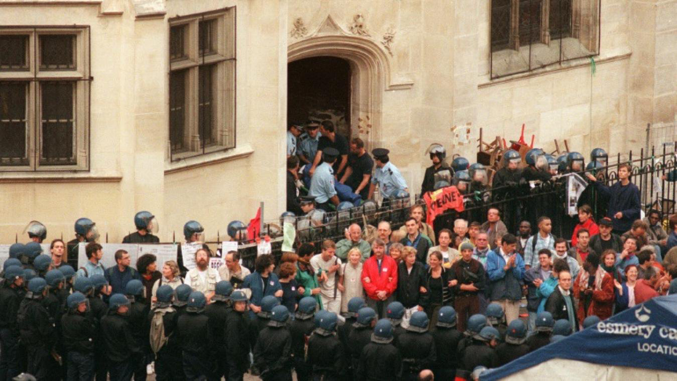
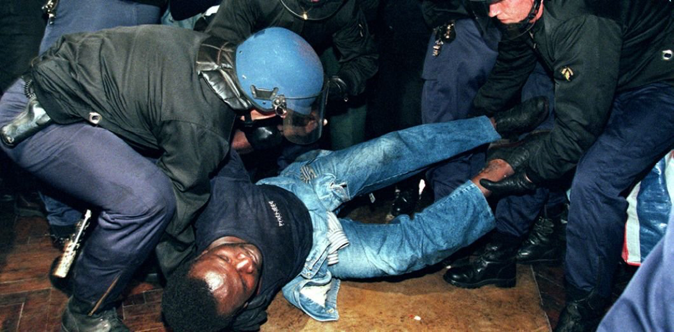
In March 1997, Balibar delivered a speech in solidarity with the Sans-Papiers of Saint-Bernard, a group of around 300 African migrants who in June 1996 occupied the Saint-Bernard Church in Paris to demand legal residency. He begins by saying that the French are “greatly indebted to the ‘sans-papiers’ who, refusing the ‘clandestineness’ ascribed to them, have forcefully posed the question of the right to stay”. Through the organization of the movement and their appearance within the political sphere, the sans-papiers were able to make the claim to the right to legal residency as well as the right to have rights. Balibar further emphasizes that this is revealing of the nature of democracy as “an institution of collective debate, whose conditions are never imposed from above” where “people must always conquer the right to speak, their visibility and credibility, running the risk of repression.” The risk of repression, however, proved to be a significant one given the turn of events for the sans-papier movement and the occupation of the church. Towards the end of August 1996, the French police brutally evicted the sans-papiers from the church. Many of them were subsequently deported from France.
August 23, 1996 – The sans-papiers are forcibly evicted
What, then, does visibility actually do?
These examples do
not seek to discount the political potential of resistance based on visibility.
They do, however, raise questions about the necessity for alternative
conceptualizations of resistance through “clandestineness”, deliberate invisibility
or a rejection of appearance. Considering the contemporary conditions of state (and
corporate) surveillance, as well as the history of policing which defines their
logic, how can we consider the limits of visibility as emancipatory? How can
visibility itself produce precarity? Can performances of resistance be
fragmented? Can they resist their own impulse to monopolize the gaze?
While I question
Balibar’s premise of an absolute democratic benefit to visibility (Were the
sans-papiers not already forced into a
kind of new legal visibility by the enactment of Pasqua
laws in 1993?), his speech further gives us a foundation for alternatively
conceptualizing resistance. From these events, Balibar theorizes the concept of
citizenship, not as an institution or as a status, but rather as “collective
practice”. This concept is also briefly pointed to in his essay Three Concepts of Politics in an account
of the concept of equal liberty:
[Rights] cannot be granted, they have to be won, and they can only be won collectively. It is of their essence to be rights individuals confer upon each other, guarantee to one another…There is autonomy of politics only to the extent that subjects are the source of ultimate reference of emancipation for each other. (Balibar 2002, 4)
I am interested particularly in the latter part of this claim – the recognition of rights between individuals. Subjects as the reference of emancipation for each other. Rather than performing resistance through action in public space, through protests or strikes which reinforce the State as the entity capable of granting or recognizing rights, how can we resist differential governance by protecting, shielding or hiding our neighbours from the threat of visibility, of a necessarily exclusive (legal) public sphere? How do we reimagine solidarity so that precarity is not further reproduced and intensified towards those most vulnerable? What tactics of resistance should we adopt to face a State which demands formal appearance and visibility?
Balibar, Etienne. 2002. “Three Concepts of Politics: Emancipation, Transformation, Civility” In Politics and the Other Scene, 1-39. London: Verso Books.
Butler, Judith.2018. Notes Towards a Performative Theory of Assembly. Boston: Harvard University Press.
Rancière, Jacques. 2004. The Politics of Aesthetics: The Distribution of the Sensible. New York: Continuum.
Hannah Arendt’s
concept of action (as related to the human condition of plurality) delineates a
particular space for the enactment of politics. According to Arendt, it is
through action and speech that humans distinguish themselves from each other
and disclose their agency. It is in this sense that speech and action are
revelatory and inherently reliant on the condition of human “togetherness”. Action
is described as a beginning, an act that initially discloses its agent. Although
this “beginning” is an enactment of agency, its consequences are beyond the
subject’s control – they are distinctly boundless and unpredictable. Arendt
says that “action has no end” (233), and we can only resort to the faculties of
promise (a kind of contract) and forgiveness to gain some semblance of sovereignty
over the events set in motion through action. It is in the “space of appearance”
(the space for action, as opposed to those for fabrication or labor) that politics
emerges – from the spaces in-between actors and out of their respective
actions. It is then in the (willful) misinterpretation of this space, the
alternative association of the political with the realm of fabrication (associated
with control and molding), that Arendt situates the emergence of fascist and
otherwise oppressive regimes.
The opening chapters of Judith Butler’s Notes towards a Performative Theory of Assembly already establish the book’s direct engagement with Hannah Arendt’s conceptualization of action, speech and the space of appearance. While these concepts are developed and discussed throughout, Butler also presents a critique of the Arendtian conception of public space and distances herself from what she regards as a masculinist ordering of particular human activities. For Butler, Arendt’s reliance on the distinction between the public and the private “leaves the sphere of politics to men and reproductive labor to women” (75) and restricts the potential political considerations that may surround labor of keeping oneself alive. Arendt’s distinction between action and speech is also questioned in Butler’s text through the ideas of “speech acts” and the performative. Despite these points of divergence and Butler’s more persistent emphasis on the particular conditions that allow for spaces of appearance, Arendt’s elaborate conceptualization of action and her particular account of the relationship between politics and power remain central to Butler’s conceptualization of assembly and resistance.
Reflecting
on the readings from the past two weeks, a couple of connections are beginning
to emerge which can be related to the concept of political spectacle. I’m including
and discussing five potential points for further discussion here:
1. Visibility and Public Space
“The distribution of the sensible reveals who can have a share in what is common to the community based on what they do and on the time and space in which this activity is performed. Having a particular ‘occupation’ thereby determines the ability or inability to take charge of what is common to the community; it defines what is visible or not in a common space, endowed with a common language, etc.” (12)
In Politics of Aesthetics, Rancière discusses the distribution of the sensible through the metaphor (or perhaps the literal state) of visibility. The visible then refers to those activities which can intervene politically in virtue of participating or being enacted in a common or public space. Through his account of the aesthetic regime of art, he situates a particular kind of artistic intervention that can transcend the barriers of an occupations (it’s possible restriction of access to the common space) and act politically. This seems to resonate with many elements of performance and theatre which are highlighted in the readings of the second week. For Boal and especially for Brecht, theatre should work to intervene in the particular distributions of the sensible that can prevent many from acting in public space. The concepts of visibility, public space and occupations can then be important ones to consider moving forward in our collective project.
2. Affect
Much of our discussion last week centered on the potential as well as the limitations of empathy as articulated by Boal, Brecht and Taylor. The question of empathy opens up the affective dimension implied in the experience of spectatorship as well as the experience of political action.
Catharsis serves an important role in Aristotelian theatre as a form of purification. Despite Boal’s critique of Aristotelian theater, the critique is based on the form’s effectiveness in producing emotional responses not its failure. For Balibar, hatred is a significant element for fascist identification and for the process of exclusion. For each of these thinkers, the affective is indeed effective (though perhaps negatively so). The question is, then, how can affect be mobilized or reimagined within a framework of resistance such that it produces a material or structural defiance to systems of power.
3. Identification
Balibar’s account of a politics of civility has been helpful in allowing me to think through a differentiation between empathy and identification. For him, “identity is the product of an invariably uneven, unfinished process, of hazardous constructions requiring greater or lesser symbolic guarantees. Identification is received from others and continues to always depend on them” (28). Although identity can be perceived to be something personal or internal, Balibar points us to its inherently social and (hence?) political nature. The movement between identification and disidentification becomes central to his conceptualization of civility. He emphasizes the violence implied in this process, calling it a “disincorporation” or a “dismemberment” (32). The constant potential for change in this processes of disidentification-identification are reminiscent of Butler’s account of performativity (as presented in Diana Taylor’s book) – which emphasizes the recurrent enactment of particular normative behaviours as the basis for gender difference. How can these two texts help us think about the rhythms of identification and the external sources which influence them? How does political spectacle intervene in this process?
4. Agency and Spectatorship
“Performance asks the spectator to do something, even if that something is doing nothing.” (Taylor, 86)
The passivity of
spectators in traditional theatre (the adherence to particular conventions implied)
and Boal’s theorization of the “spect-actor” point us towards different kinds
of spectatorship, which differently theorize the agency of spectators in interpreting
and intervening on a particular action. What are the dynamics of
majority/minority implied in spectatorship and how do those construct power (as
well as affect)?
5. Potential
If performance
need not be true or false, real or pretend, how do we contend with it within
the contemporary “distribution of the sensible”? How is “potential” a political
force? How can it enact resistance?
The three
readings for this week each outline alternative potentials (and now actualized
roles) for theatre and performance within contemporary divisions of labor and structures
of power. Bertolt Brecht and Augusto
Boal each begin with a critique of traditional or Aristotelian theatre, accounting
differently for the entanglement of these practices with political interests. Boal
interprets Aristotle’s definition of tragedy as a tool for political
repression. He says that the catharsis elicited from the spectator in theatre
represents “the purgation of all anti-social elements” (47) and provokes a
realignment with the ‘moral’ expectations of the State. Brecht similarly
critiques the passivity of spectators in traditional theatre: “Seeing and
hearing are activities, and can be pleasant ones, but these people seem
relieved of activity and like men to whom something is being done” (187). While
Boal reimagines theatre’s revolutionary potential by proposing the roles of the
“joker” and the “spect-actor”, Brecht instead suggests that theatre and its
actors should create a sense of alienation rather than identification from the
audience (“I must not simply set myself in his place, but must set myself
facing him, to represent us all. That is why the theatre must alienate what it
shows” (193)).
The Transborder Immigrant Tool, Electronic Disturbance Theatre 2.0/b.a.n.g lab (2007)
I was most struck by the recurrent critique of empathy present throughout the readings. In Performance, Diana Taylor asks “does the performance event have to have happened?” (66) She follows this question with a description of the Transborder Immigrant Tool (TBT) which, despite never fulfilling its intended function, produced political consequences because of its potential and its intentions. The work is significantly not reclaimed because of the empathic outcomes for those who did “experience” it, but for its role in disturbing political discourse. Still, this example of performance could be critiqued from Brecht’s perspective as it is not exactly set “at the disposal of those who live hard and produce much” (Brecht, 186). Taylor is, then, expanding the possibilities for political engagements within performance. She later says “Performance is not judged in terms of true/false; being/pretending. Instead, the affective is the effective.” To what extent does this challenge/extend the positions of Boal and Brecht in their articulations of the political potential of theatre? Is this affective mobilization related to empathy or does it produce some more profound/radical political transformation?
Finally, does
the establishment of conventional practices of resistance and the
categorization of performance within the realm of “art” limit its transformative
political potential? Can these practices of political theatre and performance still
be said to participate in Rancière’s “aesthetic regime” of art (if I understand
the concept properly)?