The readings this week are all about disrupting the network. Problematizing the network. Occupying the network. The Zapatista movement blew a hole in the hegemonic hierarchical capitalistic structure of thought and transaction, making the invisible visible. The movement became a lateral network among the people instead of dangling a leader or figurehead above the crowd. It encouraged new ways of thinking about indigenous rights and responses; the spectacle spread like wildfire and manifested itself in aesthetic practices, artistic practices and new forms of activism. The subversive politics of using indigenous aesthetics and technologies in a “modern” world or distributing those within a modern network is significant. Jill Lane writes, “…the Electronic Disturbance Theater had designed the flight plans for a companion digital Zapatista Air Force: the code for its “Zapatista Tribal Port Scan” (ZTPS) was released for public use on 3 January 200I. With this software, artists and activists could mount their own aerial attack on any web site-the U.S. government, or the Mexican military-sending thousands of messages through the “barbed wire” of ports open to the cyber network.’ The messages sent by the digital activists were drawn from a fragmented, bilingual poem about the Zapatista struggle for peace with dignity in Chiapas” (Lane 130).
Not only does the EDT vigorously question the idea of space and embodiment in the cyber network, but this narrative elevates the fragmented, the bilingual, the forgotten (Lane 131). It illuminates the invisible and intangible “space-betweenness” that the protesters – the indigenous population negotiating citizenship and human rights violations – aesthetically and (perhaps) geographically occupy. Even the title, “entre la luz y la sombra” is a call to that in between-ness. The nonviolent nature of the movement also is a direct rejection of violent colonization practices. It furthermore appropriates and subverts “power” in a hierarchical, manipulative sense. By this I mean, the word is the weapon, as the Subcomandante says. There was always the “illusion” of the weapon, but that weapon was the word – it was the will of the people, the movement. The Zapatistas used this illusion, the word ultimately, to manipulate and mobilize the capitalist, neo-liberal hierarchy; I see this as subverting the way “illusion” has been weaponized to marginalize, control, regulate and erase bodies. This movement leaves me with more ideas about the potentiality and futurity of bodies and lives in translation; of the way that activism can employ bilingual narratives and the fragment to mobilize and subvert hierarchies.
“What I call the selfie-determination of nations is a digitally mediated, imagined community in which individual citizens, bots, and trolls exist side by side. It is at times difficult to know who is real and who is a digital creation” (Edwards 39).
I was shocked, though I shouldn’t have been, to learn that a large amount of Trump’s twitter followers are paid bots. They aren’t real. Or are they? The running theme in all of this week’s readings was survival. The afterlife of a political figure, movement and collective have been radically transformed in the digital age. “But still, he lives on – sur-vives – as a hashtag (#maga)” (Edwards 31). The digital platform comes in all shapes and sizes, but space itself is intangible. The survival is in spite of, or perhaps even due to, the lack of form and tangibility in the sphere of appearance, which is also akin to the lack of form required in wild, passionate political responses. If “passion is the stuff for politics” as we discussed early on with Mouffe, then the digital age’s passionate afterlife, also extending to the form-less and perhaps “strategy”-less insurgencies discussed in the article, “Insurgencies don’t have a plan – they are the plan: Political performatives and vanishing mediators,” are working off of this intangible space of potentiality, harnessing and using emotional response from the larger people as their fuel. My question is: even as marketing analytics and surveys skyrocket, the question for me remains – who is going to be touched, affected, etc. by this afterlife? Who is affected by this survival in the digital age? Rather, is anyone’s opinion actually changed? If we know – or are to assume – that facts don’t change people’s minds, then can the rebel yell of “enough!” be the thing that sways?
CBC News: The National U.S. President Donald Trump remains popular among supporters despite the possibility he could be the first president to seek re-election with impeachment on his resume.
The readings and video this week definitely struck a chord with the importance of narrative in political spectacle and even in the ascension of the political sphere. Machiavelli’s analysis The Prince, on how one is to ascend to power and subsequently keep power, resonates strongly today in our political arena, and illuminates just how long these questions have been circulating in society. For instance, Chapter XVII in the book, “Concerning Cruelty and Clemency, and whether it is better to be Loved than Feared,” has been a resounding refrain throughout dramatic depictions of political arenas (and throughout historical arenas, though I personal was not in the room for those discussions.) In television shows such as “Game of Thrones,” “House of Cards,” and so many others (better than these two), I am confronted with the themes, the questions of: “Is it better to rule out of love or fear?”, “Do I want to be respected or feared?” Is there a difference?
The importance of narrative is inextricably linked to all of the points in Machiavelli’s analysis. The power of narrative can lead folks to their slaughter, as is demonstrated in Chapter VIII on “wickedness,” serve as a tool for mitigation, and if powerful enough, we are faced with the reality that it is often powerful than fact, especially today. Richard Schechner defines Make Belief as, “when these kind of [make-believe] actions create a substratum of belief, reinforce a substratum of belief even as they create it, that people are willing to die for.”
Let’s take Trump. Trump is someone I believe people, his supporters and opposers alike, would die for if given the opportunity. The article “Trumpism Extols Its Folk Hero,” Charles Blow states, “I believe that, like Edwards, Trump ascended to folk hero status among the people who like him, and so his lying, corruption, sexism and grift not only do no damage, they add to his legend….The folk hero, whether real or imaginary, often fights the establishment, often in devious, destructive and even deadly ways, and those outside that establishment cheer as the folk hero brings the beast to its knees.” Trump as ascended to this folk hero status by spinning his narrative in the way that makes him nearly immune to “fact-checking” or any sort of logical opposition. Blow ends the article by asking, “How does one fight fiction, a fantasy?” How do you fact-check a fantasy?
Elizabeth Kolbert’s New Yorker article, “Why Facts Don’t Change Our Minds,” is a smart investigation into the “collective consciousness,” and examines scientific studies which prove that we – as a society, as a collective – don’t think alone. We do not understand how everything works in this world, and usually that is acceptable, except when it comes to making political decisions. Her reference to the Gormans was most interesting with, “The Gormans, too, argue that ways of thinking that now seem self-destructive must at some point have been adaptive. And they, too, dedicate many pages to confirmation bias, which, they claim, has a physiological component. They cite research suggesting that people experience genuine pleasure—a rush of dopamine—when processing information that supports their beliefs. “It feels good to ‘stick to our guns’ even if we are wrong,” they observe.” Politics are so hairy, so exhausting, so toxic and depressing, that using a scientific entry point to examine this phenomenon is quite helpful.
I don’t believe that Trump is “making believe.” I don’t even think he believes he is lying. Trump is deep in the throes of “make belief,” and even if he is fully conscious (partially conscious, perhaps) of when he is administering false information, he is now at a place where he is occupying the space between – or above – any kind of measurable moral hierarchy; he may actually believe completely the “facts” he communicates, which in turn facilitates the “make-belief” affect in his supporters, solidifying his role as the “folk hero” for the conservative and “down-trodden,” and makes him impervious to the real facts which could, in another arena, another time, wipe him out in one stroke.
Larissa Martinez, the valedictorian at McKinney Boyd High School, kept her background a secret until she took the stage at graduation June 3. (Video: McKinney ISD)
Cristina Beltrán positions the subject of citizenship as the central object of study in “Undocumented, Unafraid, and Unapologetic.” She argues that “social media’s interactive and peer-based features allow DREAMers to circumvent traditional political elites and mainstream immigrant rights organizations” in the way that they approach activism and political engagement (Beltrán 81). This is a “queer” version of democracy (81). “Drawing on the precedent of the gay rights movement, DREAMers have queered the politics of migration by seeking transformation of existing social structures rather than merely accommodation within them” (Beltrán 98). While the performative use of social media and video circulation here is not for entertainment purposes, for me this echoes Jose Muñoz’s “burden of liveness,” in that these minoritarian subjects actively and publicly disidentify with their “ascribed status” in an effort to affect change and create a new space within the democratic system. This type of spectacle asserts a new truth within the political arena; it functions as a new ontology of the way to understand citizenship.
Ranciére’s “The Intolerable Image” examines the patterns in political art surrounding the production, reproduction and circulation of the intolerable image. He states, “The shift from the intolerable in the image to the intolerability of the image has found itself at the heart of the tensions affecting political art” (Ranciére 84). The critique here revolves around the spectator and their involvement with the photograph; he references Guy Debord in the examination of the spectacle and reality. “The spectacle, he [Debord] said, is the inversion of life” (Ranciére 85). The two-fold nature of looking at political images solidifies our complicity in the “reality” of the photographed subject or system. “Thus, we need images of action, images of the true reality or images that can immediately be inverted into their true reality, in order to show us that the mere fact of being a spectator, the mere fact of viewing images, is a bad thing” (87).
DREAMers, through the way they problematize the hegemonic idea of citizenship and who is allowed to appear and participate within the political sphere, uphold Ariella Azoulay’s theory of universal citizenry within the realm of photography as discussed in the third chapter “The Spectator is Called to take Part” of The Civil Contract of Photography. In their acts of “coming out,” publicly online, the videos force everyone to take responsibility for their spectatorship. Everyone is a spectator. Everyone shares the responsibility. Furthermore, it is through the act of photography – in this case, videos posted on social media – that they enact and establish their citizenship. Simply by participating within the political sphere they enact their citizenship. However, Azoulay also states, “The various practices in which photographs are used tend to relate the photograph less and less to a framework of political relations in which one becomes a citizen and more often to a distributive system of finished products” (143-144). Is the emphasis on photography as a political act then placed firmly in the circulation of that photograph?
“Becoming a citizen of the citizenry of photography means rehabilitating the relation between the photo and the photography, between the printed image and the photographic event – that is, the event that took place in front of the camera, constituted by the meeting of photographer and the photographed object that leaves traces on a visual support” (Azoulay 157). However, like the DREAMers’, what if the act of photography is exacted on the self? What does it mean to make yourself the subject through the distribution of photography and film in the digital age? If the event that takes place in front of the camera and the meeting of the photographer and the photographed is all wrapped up into one – does this change or trouble the plurality of action? Furthermore, how is this spectacle the inversion of reality? In viewing these spectacles, how are we to negotiate the space between Ranciére’s concept of “proof” and “testimony” as it relates to the reality produced (reproduced) in these videos?
Michele Foucault was well on his way to the formation of his theory of biopower in the historical layout of public execution in Discipline and Punish. His move from execution as a public spectacle to, “punishment, then will tend to become the most hidden part of the penal process,” is reflected in his theory of biopower much later as the shift from the almighty monarchical sovereign to the nation-state sovereign (Foucault, 9). From this we can draw that the state’s power, as it relates to punishment, is much more limitless; before, when the sovereign could “let live and make die,” the power ended when the sovereign made die, however the state shifts to a “make live and let die” power dynamic that extends the state’s power to have a psychological hold over the public in a regulatory fashion through the “invisibility” of punishment. It is still happening; we just don’t see it. Or rather, we now choose not to see it.
Diana Taylor states (within the context of Argentina) in Percepticide that “Signs indicated what the population was to see and not to see,” creating a clear delineation between the public and private sphere, and that which is private is also incredibly dangerous and violent (Taylor, 119). “Spectacles of violence rendered the population silent, deaf, and blind…To see without being able to do disempowers absolutely. But seeing without the possibility of admitting that one is seeing further turns the violence on oneself. Percepticide blinds, maims, kills through the senses” (Taylor 123-124). The public exaction of biopower from the days of old enacts a sort of transference to become an invisible and powerful monster, exacting itself now on the population where “if you see something, say something,” is a trap. If we say something, it becomes real. And if it becomes real, we will have to continue to do something about it.
I believe that Percepticide manifests itself differently depending on the particular political arena. Perhaps this idea of “not seeing,” can be looked at in a perspective way through Rene Girard’s concept of the scapegoat mechanism. Girard looks at persecutions which are, “acts of violence, such as witch-hunts, that are legal in form but simulated by the extremes of public opinion” (Girard 12). He traces the genealogy of the scapegoat through the context of religion and animals – using the example of the sacrifice. Sacrificial “victims” – which, in this framework are not necessarily victims – are meant to end the cycle of violence in a crisis. They are sacrificed without the fear of reciprocity. This particular intensity of public opinion to create the scapegoat which ends in collective forms of violence is contingent upon the similarly violent delineation between public and private spheres through the enaction of biopower, of seeing and not-seeing, and through the (hidden) spectacle of the state. In this case – I’m left with the question of narrative and language. If punishment is “hidden,” if the power of the state is left to live on through the invisible threat of punishment and torture, if the sacrificial scapegoat must be created to avoid further crisis – what type of narrative is required to sustain this? And, is there a narrative – is there language – sufficient enough to undo this mechanism once it is mobilized?
“In my grandparents’ time, in my mom’s time, Spanish was looked down upon. You were punished in school if you spoke Spanish. You were not allowed to speak it. People, I think, internalized this oppression about it, and basically wanted their kids to first be able to speak English. And I think that in my family, like a lot of other families, that the residue of that, the impact of that is that there are many folks whose Spanish is not that great.” – Julián Castro
Performance, once people get in the door (or in the space), can be a tool for mass communication and education, however, I think of political spectacle as one that performs to distract, instead of performing to inform. For a political spectacle that engages the spectator, there must be a sense, or an “appearance,” of truth and narrative.
The words I am left with that create political spectacle are: narrative, truth, transformation, participation, and struggle.
Texas, as an aesthetic, is nothing but a spectacle. The hair is bigger, the plates are bigger, the hats are bigger, the mouths are bigger, the arenas are bigger – and the politics are no different. The large and lavish American Airlines Center recently held a political rally for Donald Trump, and it was definitively, “marked by enthusiasm,” according to Fox News.
This political (and Fascist) campaign, in particular, is fueled by an antagonistic (or agonistic), us versus them concept, and the tension inherent in this binary is echoed throughout many of our readings as constituting the “stuff” of politics. For instance, Chantal Mouffe takes the idea of a binary, of an “us/them” dichotomy in politics and moves it toward a productive view of the conflict. “My claim is that it is impossible to understand democratic politics without acknowledging ‘passions’ as the driving force in the political field” (Mouffe 6). Her view is that politics should provide the “arena” for a productive and passionate conflict, which in itself constitutes politics. In this model, it seems that the people become the subject(s) on which politics operate; politics and the political spectacle specifically operates and impose itself on the people.
However, if we are to look at politics within the performative framework, and move toward viewing performance as an ontology, the political subject, the spectator (spect-actor), is demanded to take more of a responsibility in their participation. One is not simply mean to sit back and enjoy (or not), be entertained (or not), and quietly pass the time during a performance. If theatre scholars such as Augusto Boal and Berlot Brecht are encouraging their audiences to be a more active participant in the theatre, this translates to those “subjects” in the political arena to take a similarly active role in their participation, or to take active responsibility for their complacency.
The subject – the subjected, the object, the subjugated – presupposed as either an us or a them, is usually placed somewhere on the dichotomous hierarchy of agency within the political arena. The minoritarian subject in particular is free to actively disidentify with their placement on this hierarchy, as we will discuss later with minoritarian political figures in the spotlight. Looking at the American Airlines Center specifically, that space makes itself accessible only to a small portion of the population. Not everyone has the “right” to appear in this space.
Texas is known for its vast and diverse geography (or, perhaps, not known), and population. The “space of appearance,” as discussed in Judith Butler’s Notes on a Performative Theory of Assembly, is no different. Butler asks: “Which humans are eligible for recognition within the sphere of appearance, and which are not? What racist norms, for instance, operate to distinguish among those who can be recognized as human and those who cannot? – questions made all the more relevant when historically entrenched forms of racism rely on bestial constructions of blackness” (Butler 36). The sphere of appearance performed at the American Airlines Center on Thursday, October 17th is, perhaps, a direct contrast to the sphere performed at many of the Democratic National Debates held thus far this election season – primarily due to the choices of two Texas senators.
Beto O’Rourke and Julián Castro (though I could also include Cory Booker and Pete Butteigeige in this discussion, I am choosing not to), two politicians from Texas on the campaign trail toward the presidency, have both diversified the sphere of appearance through their use of code-switching from English to Spanish during debates.
I have approached code-switching in my previous work as a dramaturgical and literary exercise; it happens in the moment of choque, or when one is not quite able to grasp what comes next in the source language. That tension produces the code-switch. It also appears in, though is not exclusive to social situations, when expressing and negotiating power dynamics, sexual dynamics, and workplace politics. Though it is not exclusive to switching between linguistic codes, I am focusing on this instance of linguistic code-switching.
The code-switching performed by O’Rourke and Castro actively invites non-English speakers (yet active voters) into the typically Western hegemonic political sphere of “whiteness.” Though this is not the lavish spectacle of the American Airlines Center, it is still is a form of political spectacle. This active code-switching inherently implies a narrative, there is a “truth” expressed in it, and there is an element of transformation. I believe this is more of a long game, as the spectacle itself continues after the code-switching has taken place. As translation is an inherently political act, this code-switching is also politically driven and begins to negotiate the politics of “appearance” within the code-switching subject in the afterlife of the debate.
We see this afterlife negotiated in the perception of O’Rourke and Castro, respectively. One article from USA today reads:
“Some social media users criticized the candidates for attempting to appeal to Latino voters by speaking in Spanish — or “Hispandering,” a term used to describe a politician trying to pander to the Hispanic community. Others, such as those who watched the debate on the Spanish-language broadcast network Telemundo, appreciated that the candidates were trying to connect with them on that level.” O’Rourke, defined in many articles as a fluent Spanish speaker, is overall praised for his code-switching, especially in the face of his whiteness.
Julián Castro however has faced harsh criticism for not being “fluent” in Spanish. The term “monoglot” is referenced almost as a derogatory term when referring to Castro. The critique of Castro’s monolingualism, especially when placed next to the reaction of O’Rourke, is rooted in the problematic pressure placed on the minoritarian subject to be “true” and “authentic”; it emphasizes the Jose Muñoz’s burden of liveness for the minoritarian subject in the political field. Castro is still demanded to perform as a “Latino,” though the linguistic code of Spanish is only one small part of that multi-faceted identity. An example of arguments supporting Castro’s monolingualism, positing it as inherently American, appears in a Washington Post article online, reading: “Because, while bilingualism is for many Latinos a treasured aspect of maintaining community in the United States, Castro’s monoglot experience is just as authentic — and even more uniquely American….Castro revealed more about his family’s history with Spanish. “In my grandparents’ time, in my mom’s time, Spanish was looked down upon,” he said. “You were punished in school if you spoke Spanish. You were not allowed to speak it.” He said many Latinos have “internalized this oppression” and desired their children to only speak English.”
For the final project, I am interested in excavating this phenomenon of code-switching in the political arena, yet expanding the sphere of observation to a larger understanding of code-switching which is not limited to linguistic codes. I see one of the core elements of political spectacle as living in the narrative of the political performance, of the appearance of “truth,” which makes the spectator “believe.” I am curious about code-switching in the way that it can (or not) mobilize bodies, create affect, and where it is placed within the political spectrum.
As a last note, (and though it lands us in New Mexico instead of Texas) the ad for “Valeria Plame for Congress” is a strong example of narrative, truth, transformation, participation and struggle. (For me, it also has a Texan aesthetic.) I would argue employs a type of rhetorical and visual code-switching throughout in an effort to engage the spectator. It is also quite entertaining.
The readings this week – it was as if I did not completely understand Hanna Arendt’s piece until Judith Butler came into the picture. The interaction between these two texts is much more interesting than either of them alone, in my humble opinion. The greatest takeaway from the readings was tackling questions on the body, the (act?) of speaking, and agency. Hanna Arendt clearly delimitates between acting and speaking, making the “act” a concerted action, or an action that represents the beginning of something – perhaps a revolution. She attributes this as well to speaking, “If action as beginning corresponds to the fact of birth, then speech corresponds to the fact of distinctness and is the actualization of the human condition of plurality, that is, of living as a distinct and unique human being among equals” (Arendt 178). Arendt inextricably links speaking and action, as both of them, in her view, are required to answer the question [from every newcomer], “Who are you?” (178). It translates to identity. It communicates identity.
Arendt continues to nail down this point with, “In acting and speaking, men show who they are, reveal actively their unique personal identities and thus make their appearance in the human world, while their physical identities appear without any activity of their own in the unique shape of the body and sound of the voice” (179). There is an element here where Arendt marries speech and action, or that action is a condition of speech, or vice versa, that also represents the plurality of the human condition, that acting and speaking bring people together and, for lack of a better term, is the stuff of revolution.
I think immediately of the trans actress MJ Rodriguez, who stated recently in an interview, “Simply being trans is activism.” Simply, her physical condition and attributes, not her actions nor speech, but simply that “physical identity” Arendt refers to – that is now activism, which does require a form of action. Judith Butler delves into her Arendtian critique on this issue in chapter 1 of Notes Toward a Performative Theory of Assembly. She problematizes the Arendtian view of “action” and “speech” particularly, and actually references trans politics:
“As we know, not everyone can take for granted the power to walk on the street or into a bar without harassment. To walk on the street alone without police harassment is precisely not to walk with the company of others and whatever nonpolice forms of protection that supplies. And yet, when a transgendered person walks on the street in Ankara or into McDonald’s in Baltimore, there is a question of whether that right can be exercised by the individual alone….To walk is to say that this is a public space in which transgendered people walk, that this is a public space where people with various forms of clothing, no matter how they are gendered or what religion they signify, are free to move without threat of violence. To be a participant in politics, to become part of concerted and collective action, one needs not only to make the claim for equality (equal rights, equal treatment), but to act and petition within the terms of equality, as an actor on equal standing with others” (Butler 53-54).
MJ Rodriguez could walk through the grocery store, and it would be seen as inherent activism; it could be seen as action, as the concerted act at being treated or seen as equal. This is the greatest divergence between the two texts; however, it is understandable as each was writing from her own specific political moment. It leaves me with questions of affect – what is the most effective form of action? Does it involve speech? The element of performativity is not contingent upon speech, as we have seen. How can we trace, measure or answer these questions of embodiment and action through the history of “performative assemblies?”
Ten points/ideas/concepts (though they may be reductive) that I see echoed in our readings thus far:
1) Spectators
a. “Spec-Actors” must take more responsibility for their “actions” during a performance and we can see how some of the political theorists demand a higher responsibility from the audience – the ones who believe the “Make belief.” Perhaps there is a way of thinking about responsibility and limitation as terms.
2) Art Activism (Artivism)
a. With limitations, a lot of the (political) art that is presented in Diana Taylor’s book forces the audience to confront their limitations and understand their limitation with performance and political acts. This “Artivism” is just one of the ways that politics and performance are inextricably linked together, and we see examples of that in all of the readings.
b. Also, every artist is responding to his or her political moment. (Almost inevitable.)
3) Transformation
a. The performance can transform an audience, and a political act can transform a nation, the population, supporters, etc. There is an element of transformation rooted in Boal’s work with the spect-actor.
4) Emancipation, or freedom?
a. We’ve read that it is the minoritarian subject’s struggle for emancipation, or the “us vs. them” dichotomy that constitutes politics. The spectators are also encouraged to free themselves from a “passive” state of being within the theater and become more active and involved.
5) Struggle is what makes politics
a. Tension between the actor and the spectator is also what activates political performance. Tension perhaps Is another phrase to kick around.
6) Resistance
a. Tying this again to the inherent struggle for equality that pervades the political theater. This resistance is also held strong in the theater itself – with (for example) the methodologies of Brecht and Boal as acts of resistance.
7) Civility – etiquette?
a. We discussed civility in the context of “knowledge of assumed spaces” and discussed the idea of tying it to political correctness. I am honestly unsure about how to approach civility, but there is definitely a way to discuss civility (and approach it through all of the readings) in the context of “who has the right?”
8) Passion, Empathy, Emotion, Affect
a. Passion makes politics (Mouffe’s assertion) – and art is dangerous because it sways a man’s emotions. Emotions, which could also be considered a form of passion, are powerful. And the art of “passionate speeches” in politics are also powerful. There is lots to unpack in this concept, but I am not sure of which term would be best, if any of them.
9) New possibilities/potentiality
a. There is definitely an echo of “potentiality” in our readings. In discussing transformation and identification within the political spectrum and “potentiality” especially in regards to world-making, within the performance realm. The potentiality within Boal’s Theatre of the Oppressed is endless, for instance.
10) Entertainment?
a. I hesitate with this one, but there is definitely a simple element of “entertainment” that resonates throughout the readings and within the realms of politic and performance. People won’t show up to the theater if they are not entertained. There is also a reason why so many “celebrities” and “reality TV starts” have successfully (relative) entered the political spectrum and stayed. Perhaps this ties into the spectators taking more responsibility for what they are consuming, supporting, and engaging with.
But this makes it simpler for the theatre to edge as close as possible to the apparatus of education and mass communication. -Berlot Brecht
The three readings this week – Boal, Brecht and Taylor – highlight the intentional engagement of the social, particularly with the minoritarian subject. The result of this social engagement solidifies the ways in which we are often unable to understand politics without performance, and vice versa.
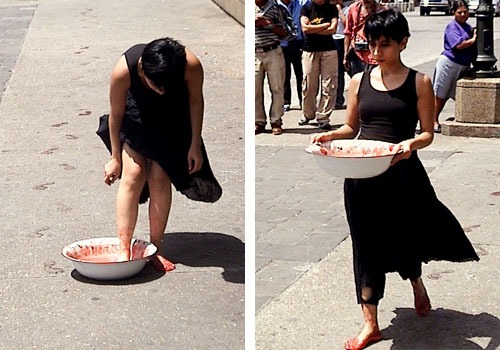
Quien puede Borrar las huellas Regina José Galindo
“A Regina Galindo lunch break.” – Diana Taylor, Performance
Boal argues that Aristotelian theatre, which was inherently designed intimidate the audience and eliminate “bad” or illegal tendencies in the audience, “is not the only form of theater” (Boal xiv). His chapter, “Poetics of the Oppressed,” dives heavily into examples of “theatrical” exercises which engaged (in this case) the minoritarian subject in a process of creation and narrative, and by doing so he subverts Aristotle’s Poetics to liberate the oppressed and disrupt the hegemonic ideologies of theatrical form. This engagement in the social is mapped out visually and performatively in Taylor’s book Performance. The concrete examples of performance, accompanied by striking visuals, inextricably linked the political and the performance, the performer and the spectator, and more often than not, the performer transformed the spectator into the “spec-actor” by encouraging (and often forcing) the public to engage in the performance and take responsibility for their action (or reaction). Brecht (who’s rhetoric I struggled the most with this week), in reference to representation on the stage, states that, “All that mattered was the illusion of compelling momentum in the story told…Even today we are happy to overlook such inaccuracies if we can…grasp the immense or splendid feelings of the principal characters of these stories” (Brecht 182). He is relying on the engagement of the social to further our understanding of performance as a tool within a (potential) political arena. Taylor supplements this with a more concrete example, “Political advisers know that performance as STYLE (rather than ACCOMPLISHMENT) generally wins elections. Advisers ask whether a performance is effective or memorable, not whether it corresponds to verifiable facts” (Taylor 90). Taylor’s book is a performance within itself, often directing and diverting the readers’ attention to certain words or passages through spacing, style, and size of the text and visuals. These readings leave me with questions of the power of disbelief, how to make someone believe, the power of transformation, and how important it is to engage the social – to engage the often considered, “subject” – as a necessary method to disrupt hegemonic forms and ideologies in performance.
The readings this week, to be quite frank, were a struggle. However, after much metaphorical weed-whacking, it is clear that one of the ways in which these three theorists interact with one another is on the basis of equality and emancipation. Ranciére states that, “Politics exists when the figure of a specific subject is constituted, a supernumerary subject in relation to the calculated number of groups, places, and functions in a society” (51). The unrecognized party – the minoritarian subject, in this case – struggling for equal recognition is what constitutes politics. Balibar supplements an understanding of this struggle for emancipation with, “The autonomy of politics…is not conceivable without the autonomy of its subject, and this in turn is nothing other than the fact, for the people, that it ‘makes’ itself, at the same time as the individuals who constitute the people confer basic rights upon one another mutually” (4). In this sense, the political again is only “made” within the body of the subject; it is made within the struggle of the subject’s body for equal recognition and emancipation, of which can only be gained through an outside source. Meanwhile, Mouffe, (in my view) takes the idea of a binary, of an “us/them” dichotomy in politics and puts it in the framework of the positive. “My claim is that it is impossible to understand democratic politics without acknowledging ‘passions’ as the driving force in the political field” (Mouffe 6). She moves toward a productive view of conflict. Or rather, moves toward a view in which politics should provide the “arena” for a productive and passionate conflict, which in itself constitutes politics. There is an undeniable exploration of the ‘dominant’ power bloc and hegemonic ideologies within these texts, and I am left with questions of embodiment, of power, of the visual representation of the struggle for equality, and of political aesthetic in performance.