“here we are, the dead of all times, dying once again, but now in order to live.”
From a very brief essay written in January of 1994– an essay which may also be read as a sort of memorandum or a preface towards a manifesto that would be unfold in the writings collected in Our Word Is Our Weapon– Subcomandante Insurgente Marcos of the revolutionary Zapatistas group explicated the dire conditions of life of indigenous people in southeast Mexico. Marcos talks of 150,000 dead indigenous persons; dead from curable diseases. He talks of government at every level leaving indigenous persons out of all consideration of solutions, until elections roll around. He tells us that charity resolves nothing but for the moment, and when those moments have come and gone, death again visits the homes of the indigenous. In this brief essay, Marcos wrote clearly the resolve he and the Zapatistas had come to: no longer would they look to the government; now, they look to their ancestors.
This resolve the Zapatistas had reached would focus on one profound effect, which would come to make this revolutionary movement recognized across borders and oceans, fashioning for itself a network of international solidarity, with their word as their weapon. Their resolve was distilled into this aim: “…so that our people awaken from this dream of deceit that hold us hostage.” For this, Marcos states “We are ready to die…”
This post could go in a number of directions, but I’m very interested in this particular essay, so I’m choosing to focus on it and its relation to other essays we’ve read. For instance, I’m interested in what it means to look at extremely precarious (even torturous) conditions of life and fight against it by reorienting the process and performance of one’s death? What would Boal think of this theater of the oppressed? Would he have been able to see this readiness to die as antithetical to liberation, or would he have seen it as a decision to celebrate the lives of ancestors who had sustained something worth dying for under several hundred years of murderous oppression? How does this readiness to die change how we think about Balibar’s three concepts of politics? Does this fit neatly into emancipation, transformation or civility? Do these concepts rest on an assumption of the preservation of an individual’s life over the life of a people? Does Butler’s performative theory of assembly account for actors with this resolve? Are they spect-actors or something more?
The Zapatistas understood “percepticide,” “the body of the condemned,” “intolerable images”; and they understood it in a way that I think makes us confront some of the discussions we have had before regarding the agentic capacity of a spect-actor and the limits of political engagement. As Diana Taylor says in her essay titled “The Politics of Passion”: “…it seems political decisions in the past decade have been increasingly forged through affective and embodied struggle.” This is a question of the “role of physical bodies in movements” that tremendously complicates how we think of our (dis)identifications with political structures and movements. It is a profound decentering of subjecthood, a death of a political “I” (Taylor), in which one’s orientation towards a different future does not include oneself in its eventual concretion. It is interesting to think now how we must adopt such a visionary practice if we are to save our planet. I don’t know what such a politics on such a scale looks like, but I think it’s something we have to think about.
The digital is no longer a pervasive part of our
reality; no longer a frightening specter looming behind screens, trapped. Indeed,
it is our reality; or, as Mark Hansen argues in his book Bodies in Code,
our reality is now best thought of as “mixed reality.” As with mixtures of
other types, the ingredients—the digital and the “real”—lose what clear
separation or distinction they appeared to have before: they are blended to
make something new.
Analyses of our mixed reality often find the most fertile
soil for investigation in social media. Along these lines, social media, such
as Twitter and Instagram, are most fruitfully approached not as isolatable or
individuated bodies, but as networks in which a vast array of lifeforms and
systems are deeply entangled: not just ‘the human’ and ‘the digital’ but a
multiplicity of communities, ecosystems, belief systems, and so on and so
forth. An analysis that exemplifies such an approach is found in Brian T.
Edwards’ essay “Trump from Reality TV to Twitter, or the Selfie-Determination
of Nations.” Here, Edwards demonstrates the entanglement between newly emerging
technologies and the emergence of new social forms. Edwards shows us the mechanics
of the movement of Trump’s boardroom from his reality TV show The Apprentice
to the cabinet room and how this movement was facilitated through his social
media campaign: “the simulacrum board room of The Apprentice anticipates
the transformation of the White House Cabinet Room at the televised live
sessions in the early months of 2018.” Social media were the means through which
Trump’s campaign propagated the image of himself as a successful business
tycoon, allowing him not only to move out of financial distress but to
constitute a public for himself, providing analyses such as Edwards’ with a demonstration
of the image economies and ‘common sense’ formations articulated by Ariella
Azoulay and Jacques Ranciére.
As we begin to understand the mechanics—the logics of
circulation, as Edwards would call it—of our mixed realities, we also begin to understand
the instability of the concept of ‘citizen’ which we have long taken as
political bedrock. Mark Poster, in the chapter titled “Citizens, Digital Media,
and Globalization” from his book Information Please: Culture and Politics in
the Age of Digital Machines problematizes the term ‘citizen’ in four ways:
first, the principles of the term derive from the West, and the West is
responsible for an imperialist and capitalist form of globalization; second,
the principles (of natural rights), rooted in the Enlightenment, require one to
extract oneself from the social in order to proclaim the universal as natural;
third, the conditions of globalization are not only capitalism and imperialism,
but also the coupling of human and machine, and we therefore may build new
political structures outside of the nation-state only in collaboration with
machines; fourth, linked with machines in a global network, the citizen has
become something else. Poster proposes instead that we speak of netizens:
the citizen of mixed reality.
This movement from citizen to netizen would certainly constitute
the type of movement towards digital logics called for by the Critical Arts
Ensemble (CAE). In their essay “Recombinant Theatre and Digital Resistance,”
this type of movement is described as a surrendering of the values and
certainties of analogic cosmology. Digital logics, according to the CAE, are
those that offer an ongoing flow of sameness: order from order. Alongside analog
logics, the CAE speaks of ‘hybridization’ in the Western style of marketing. This
hybridization is an articulation of mixed reality applied specifically to
marketing strategies, which, as we’ve seen, are invested not only in what we’ve
traditionally thought of as ‘products’ of consumption, but also in people—in
Presidents. Thus, the concept of hybridization is of crucial importance to our
current understandings of political spectacle, and the CAE defines it by explain
that “on the one hand, the consumer wants the assurance of reliability provided
by digital replication, and on the other hand, desires to own a unique
constellation of characteristics to signify he/r individuality.” I want to
conclude with a couple questions with regard to what this concept of
hybridization may imply about current social logics and organization in light of
these essays, and to offer a possible problematic at work here in order to see
where we might build on these analyses.
In our mixed realities, these hybridized Western marketing
strategies are seemingly ubiquitous. I am interested in the implications of the
definition of the ‘digital logics’ at work here—that is, the assurance of
reliability provided by digital replication. Recalling George H. Bush’s
invocation of Clint Eastwood’s “Make my day” line in his 1988 presidential
debate with Michael Dukakis (examined in Edwards’ essay), we ask how this invocation
carried with it a summoning of racist logics of Eastwood’s film. This “make my
day” line can be seen as one such “assurance of reliability provided by digital
replication,” as it signifies a carrying over of racist logics without needing
to explicitly lay them out. Digital logics, then, cannot just be thought of as
being confined to digital coding of 0’s and 1’s, but is also coded into
the languages we are speaking in our conversations every day. Therefore, coding
is not only about digital replication—a form of replication that is treated in
these essays as recently emergent—but the replication of logics that have been
in operation for centuries. Can we, then, approach ‘coding’ as a means of
anticipating social organizations and ‘mobilizations’ of affects in marketing (/presidential)
campaigns? If so, then I think it is important to problematize the ‘netizen’
invested in these campaigns. The netizen, though it offers a means of understanding
mixed reality, forgets the social foundation of the Internet
(which, I believe, is also the social foundation of mixed reality more generally):
it is about networks, not individuals. The netizen thus seems to carry with it
the Enlightenment illusion of individuality—that compulsion to “extract oneself
from the social order to proclaim the universal as natural.” I think that this
concept may reinscribe this Enlightenment (i.e., Western) tradition that has
given ‘individuality’ and ‘body’ to persons so selectively throughout our
history if we are not careful to avoid such pitfalls. Thus, we ask: Where might
explorations of hybridization and mixed reality lead us if we let go of this individual?
“The photo… is the outcome of focus, excision and framing. Yet the image retains a direct connection with the depicted object, because it was written by the object’s own reflected light, by its aura” (Azoulay, 149).
Ariella Azoulay’s theorizing of the “horror photo,” which, in the work of Jacques Rancière, is called “the intolerable image,” is caught up in an institutional complex–of “structures, mechanisms, and positions”–that is prepared to manage it at any time and place. The “horror photo” must be more shocking every time we see it, if we are to be reconciled with death, so as not to be insensitive to it (155). This line of thinking is positioned as a point of departure for Azoulay, who, in her book chapter “The Spectator Is Called to Take Part,” orients her theory of the civil contract of photography towards the act of prolonged observation, telling us that this act by “the observer as spectator” has the power to “turn a still photo into a theater stage upon which what has been frozen comes to life” (159). Thus, following her statement quoted at this essay’s opening, we see that it is not always only the photo that is the outcome of “focus, excision and framing,” but also the “coming to life” of that which “has been frozen.” It is interesting to interpret these two outcomes as ‘photos’ and ‘figures’ (respectively), performing in various unpredictable ways, resting on the hinge of the image–that is, the futurism of the ‘world picture’, which was “photography’s vision from the very beginning” (Azoulay, 138).
According to Azoulay, the object of photography, present in the world of experience, “imprints an image on the emulsion that… always contains an element that exceeds the world of experience, thus exceeding interference” (149). I think what Azoulay is getting at here is of tremendous gravity: it is both similar and different that the transcendent experience sought after in Kant’s aesthetics, and that aesthetic experience sought after by Barthes. Here is where we begin to understand her theory of the civil contract of photography as a theory of image economy: a circulation of meaning, affect, figuration, coalescing time and time again in unpredictable ways in multitudes of performative contexts, exceeding the world of experience, bringing life to the frozen, turning observers to spectators. Her theory is of excess, surplus production, even while protecting the negative (death; dead object, addressee). It is deterritorialization: “the photo acts, thus making others act…oriented toward the future” (129).
Thus, the connection between the “horror photo” and the “horror figure” are clear. But what do some of these “horror figures” look like? Christina Beltrán, in her essay “Undocumented, Unafraid, and Unapologetic,” provides us with an account of the figure of “the foreigner” as the “truest citizen,” noting the harm this has done in public discourse as well as in its manifestations in immigration policy: “… the very attributions used to make immigrants attractive (they work hard; they value family and tradition) can easily become the same qualities that make them threatening (they take our jobs; their patriarchal and homophobic traditions threaten our capacity for progress). Rendering immigrants as forever foreign, the logic of xenophilia feeds into the xenophobia that pro-immigrant advocates are trying to overcome” (86). I am recalling here Balibar’s statement in his essay “Politics and the Other Scene” that all protest can turn into legitimation (Balibar, 7). This goes both ways and in various other unpredictable directions too though, as we return our thoughts to Azoulay’s assertion that “photography functions on a horizontal plane”: it is a tool of the masses (134, 138).
I am interested in what this all means when the “emulsion” upon which the “object of photography…imprints an image” (Azoulay, 149) is the body; when the body is also the “horror figure,” formed through an image economy of “horror photos.” In the surplus production of the image, how are bodies transformed? How do ‘we’ participate directly in image economies in ways that meaningfully address and radically transform scenes and spacetimes of horror without reinscribing or reifying it? As Jacques Rancière tells us in his book chapter “The Intolerable Image” that “there are images in language as well. They consist in all those figures that replace one expression by another, in order to make us experience the sensible texture of an event better than the ‘proper’ words would” (94). Rancière’s attention to the experience of the sensible texture of an event certainly rooted in his theory of the ‘distribution of the sensible’, but I think there is much more here. I’ll say first that my interest in the “horror figure” as it develops through economies of “horror photos” (both discursive and photographic images) stem from an interest in the genre studies that have been done within Black studies, trans studies, disability studies, and queer theory that have provided close readings and rich accounts of figures attached to bodies. For example, discourses around social death and the figuration of the living dead, the zombie; or, the trans body as a body always in transition, neither here nor there, real nor fake, like a ghost. In connecting Azoulay, Beltràn and Rancière to these discussions, I think the turning of the observer to spectator blossoms into a yet deeper investment in transforming the very process of figuration that turns a still photo into a theater stage, that brings to life that which has been frozen.
“The treatment of the intolerable is thus a matter of dispotif of visibility. What is called an image is an element in a system that creates a certain sense of reality, a certain common sense. A ‘common sense’ is, in the first instance, a community of sensible data: things whose visibility is supposed to be sharable to all, modes of perception of these things, and the equally sharable meanings that are conferred on them. Next, it is the form of being together that binds individuals or groups on the basis of this initial community between words and things. The system of information is a ‘common sense’ of this kind: a spatiotemporal system in which words and visible forms are assembled into shared data, shared ways of perceiving, being affected and imparting meaning. The point is not to counterpose reality to its appearances. It is to construct different realities, different forms of common sense–that is to say, different spatiotemporal systems, different communities of words and things, forms and meanings” (Rancière, 102). *For an example of this in action, see the queering of immigration politics in the cyber-testemonios of undocumented, unafraid, and unapologetic youth on social media (Beltràn).
In his chapter “Stereotypes of Persecution” in The Scapegoat, Rene Girard discusses a form of targeting or, further, mobilization of the affects; specifically, the mechanism of the accusation and the interaction between representation and acts of persecution. Focusing on a process of creating uniformity through negative reciprocity, especially in time of crisis (which is spoken of in this essay along similar lines of Habermas’ “legitimation crisis”), Girard details the movement from the identification of a particular group or individual as a threat, based on appearance, to the stereotypical accusation which circulates through crowds, in the form of “They are going to harm our society!”. Girard’s concern is to show that the pattern of collective violence crosses cultures and that its broad contours are easily defines; his shows this through an enumeration of the qualities that tend to polarize violent crowds against those who possess them.
Michel Foucault, in his investigation of torture as a mechanism of punishment in Discipline and Punish, expounds upon this interaction between stereotypical accusation (representation) and acts of punishment (persecution). Foucault positions the body in direct involvement with the political field: power relations have an immediate hold upon it; they invest it, mark it, train it, torture it, force it to carryout tasks, to perform ceremonies, to emit signs. In line with Girard, Foucault sees the body (although Girard speaks not so much of ‘the body’) as bound up, in accordance with complex reciprocal relations (where Girard focuses exclusively on negative reciprocation). Foucault extends this idea of the body–the ‘body-politic’–to the mechanisms of interrogative torture, where the body constitutes the point of application of the punishment and the locus of extortion of the truth.
In his genealogy of the penal spectacle, Foucault demonstrates the movement from the theatrical public execution to the tendency of punishment to become the most hidden part of the penal process. A few consequences of this movement are that it leaves the domain of the “more or less everyday perception and enters that of abstract consciousness; its effectiveness is seen as resulting from its inevitability, not from its visible intensity; it is the certainty of being punished and not the horrifying spectacle of public punishment that must discourage crime.
Diana Taylor, in her essay titled “Percepticide,” extends some aspects of Foucault’s arguments and challenges others. Like Foucault, Taylor also regards punishment as a political tactic, a complex social function. She agrees with Foucault that everyday perception enters abstract conscious, but challenges it by positioning this ‘percepticide’ as existing also as a survival strategy. She agrees effectiveness is connected to perceived inevitability, but challenges Foucault’s assertion that this perceived inevitability is not always lacking in visual intensity, positing instead that the theatrical visual demonstration of power (public arrests rather than public executions) give weight and force to that invisible penal process which dances around our anxious imaginations. Further, it is this argument of Taylor’s that gives added support to Foucault’s argument that it is the certainty of being punished and not the spectacle that must discourage crime. Though this seems hard to fully grasp, I think what is being argued is that, in the theater of penality, it is not that the public spectacle of execution has been removed from the plot, but that the public spectacle has been demoted to the role of support for the new mechanism of punishment: that which is invisible. Are we more afraid of a terror we can’t see or a terror we can see?
Working from Jacques Rancière’s description of what constitutes politics proper, Étienne Balibar, in his book Politics and the Other Scene, argues that there is a paradox inherent in the predication of politics on “the part of no part.” The part of no part can neither be a subject in nor of politics; therefore, the part of no parts, the ‘have-nots’, existence, which is the condition of the possibility of politics, is at the same time the condition of its impossibility. Using Rancière’s formulation as a point of departure, Balibar advances three theses: all identity is fundamentally transindividual (it is a bond validated among individual imaginations); rather than identities, we should speak of identifications (no identity is ‘once and for all’); every identity is ambiguous (no individual has a singular identity). Interpreting the title of Balibar’s essay along these lines, I believe that what Balibar was getting at was a formulation of ‘politics’ and the ‘other scene’ as mutually constitutive and codependently materializing economies: the ‘other scene’ is distinctly named apart from ‘politics’ and simultaneously its conditions of emergence. They are not isolated events, strung together by narrative threads, one acting and the other reacting: endlessly. They are circulations of energies, coalescences and dissipations, cool fogs and hot, dense balls of gas. We cannot mean politics without also meaning performance; we cannot mean appearance without also meaning disappearance—what we have, then, is surplus rather than positive and negative; duality rather than binary.
My reference to ‘duality’ is based on the quantum-mechanical property of being regardable as both a wave and a particle. There is much more we can do with more recent quantum theory concepts, but this early-discovered property made a significant impact on the field of physics, and I think it can have similar effects on understandings of politics and performance in discussions of the digital (and the posthuman in general, but that’s for another essay). Using ‘duality’ as an anti-binary framework, it is interesting to discuss politics and performance as two different measurements of the circulation of power, of the economy of affects and the sensory, of the coalescence and dissipation of bodies oriented towards desires.
Jacques Rancière, in his book titled Politics of Aesthetics, introduces us to his concept of ‘the distribution of the sensible’: the system of divisions and that define, among other things, what is visible and audible within a particular aesthetico-political regime. For Rancière, the essence of politics consists in the distribution of the sensible, asserting that these aesthetic regimes are simultaneously theoretical discourses—that is, sensible reconfigurations of the facts they are arguing about. The distribution of the sensible is one interesting articulation of the energy circulations and materializations of politics and performance, which demonstrates the systematic definition of divisions and boundaries, rather than its predication on ever-fixed divisions and boundaries. The essence of politics (performance) is, then, perception, which we feel as excitations of senses and affects—not isolatable phenomena, but economies, series of practices (Balibar here, again). To move against a distributive understanding of performance (politics) is to contribute to the maintenance of what Diana Taylor calls ‘percepticide’: The American Way.
Chantal Mouffe, in her book titled Agonistics: Thinking about the World Politically, refers to ‘politics’ as the ensemble of practices, discourses and institutions that seeks to establish a certain order and to organize human coexistence in conditions which are always potentially conflicting—there is a reduction of passions and a distillation of identities. It is not, for Mouffe, the prime task of democratic politics to eliminate passions or to relegate them to the private sphere in order to establish a rational consensus in the public sphere. Rather, it is to sublimate those passions by mobilizing them towards democratic designs, by creating collective forms of identification around democratic objectives. The celebration of politics of disturbance, according to Mouffe, ignores the “other side of the struggle” (another scene; and, another duality). What Mouffe wants to get across, then, is that to predicate an articulation of politics (performance) on disappearance, absence, nothingness; or, to conjecture that politics and performance (often assumed to be a regime vs. a resistance), appearance and disappearance, power and powerlessness, operate as binaries is to “eliminate the passions,” to define borders between bodies, ignoring any leakage, any transference, any bleeding. Those passions, rather, demand our orientation towards them, as an assembly, as a collective body.
In her book, Performance, Diana Taylor argues that “people
absorb behaviors by doing, rehearsing, and performing them” (13). Performances “operate
as vital acts of transfer, transmitting social knowledge, memory, and sense of
identity through reiterated actions” (25). Taylor advocates for what I’ll refer
to as ‘trans-spacetime’ in her engagement with the digital, explaining that “the
digital has become an extension of the human body”: we all have ‘data-bodies’
(108). Taylor concludes that “Experience can no longer be limited to living
bodies understood as pulsing biological organisms. Embodiment, understood as
the politics, awareness, and strategies of living in one’s body, can be
distanced from the physical body” (138).
Working through these theories in constellation, I want to
introduce stimulating concepts from Stephen Hartman’s essay “The Poetic
Timestamp of Digital Erotic Objects.” In this essay, Hartman describes ‘cyberobjects’
and ‘technogenesis’ as constitutive elements (performances) of ‘screen
relations’ in what I’ll name ‘cyberspacetime’. Objects in cyberspacetime are ‘introjected’
by someone—that is, one comes to identify with a cyberobject and takes it into
oneself—and, as groups interact with these cyberobjects, these objects become ‘groupal
objects’. In other words, these cyberobjects become the basis of a ‘technogenesis’:
what Mouffe would see as a mobilization of passions. In the spirit of Butler’s acknowledgement
of vigils as performative assemblies, I want to look at two performative assemblies
in cyberspacetime, which mobilized affects and passions towards a democratic
design (specifically, mutual support and interdependence).
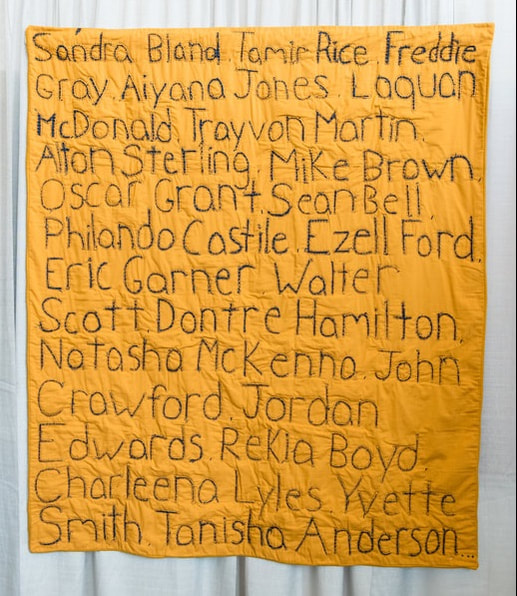
Say Their Names, Sara Trail, 2017.
The SayTheirNames Movement and the MeToo Movement are examples
of performative assembly/collective politics which grew in the soil of cyberspacetime
to spread roots in what I’ll name ‘trans-spacetime’. SayTheirNames was borne
from The Social Justice Sewing Academy, performed in the sewing and
embroidering of a quilt with the names of Black people who have lost their
lives unjustly, often as “invisible victims of police brutality” (artist: Sara
Trail 2017). The idea was inspired by the social media hashtag #sayhername;
likewise, MeToo blossomed from the viral #metoo hashtag which brought a vital
conversation about sexual violence to national attention. In circulations of affective
economies in cyberspacetime, performative assemblies formed which were oriented
towards democratic designs.
In her articulation of this process of orienting our body,
Sara Ahmed comes to define a larger picture of Queer Phenomenology. She tells
us that the queer was always already in the phenomenology; it is a matter of
orienting ourselves towards it. For Fred Moten, the queer in the phenomenology
is the dialect in the dialectic; for Diana Taylor, it is the ‘spect-actor’ in
the spectacle; for Bertolt Brecht, it is the pleasurable and entertaining in
the terrible and never-ending labor which should ensure one’s maintenance. Orienting
towards these things, we create those ‘desire lines’, which Ahmed borrows from
landscape architecture to describe the formation of new norms.
These repeated behaviors, these performances, are found in Hannah Arendt’s theorizing of actions in the ‘space of appearance’ in her book The Human Condition. Judith Butler, in Notes Towards a Performative Theory of Assembly, rethinks ‘action’ as well as the discursive and performative practices shaping subjecthood as spaces of appearance, where assemblies come to materialize both matter and meaning, which are always performative. Butler engages with Arendt’s theory, acknowledging that she shows that “the body or, rather, concerted bodily action—gathering, gesturing, standing still, all of the component parts of ‘assembly’ that are not quickly assimilated to verbal speech—can signify principles of freedom and equality” (48). Both Arendt and Butler use the language of a kind of thermodynamics in describing ‘power’ and ‘popular assemblies’ (respectively), highlighting their understanding of the experimental nature of concerted action as well as their understanding of the role of environment in the process of meaning, mattering, materialization. The environment, the space of appearance, is historicized, and is a coalescence of historicized bodies in concerted, historicized action, predicated on the mobilization of the passions, the orientation towards collective identifications and desires.
The space of appearance is a new spacetime (which is also
cyberspacetime): one that is inherently a trans-spacetime (in the sense of the ‘trans-‘
prefix, meaning ‘across’, ‘beyond’, ‘changing thoroughly’, and also in the
sense of my own personal orientation towards inscribing the trans body with
power). This trans-spacetime is seen in Arendt’s “Irreversibility and the Power
to Forgive” and “Unpredictability and the Power of Promise.” It is also seen in
Balibar’s assertion that all identity is trans-individual, and in Diana Taylor’s
“acts of transfer.” SayTheirNames and MeToo show that the space of appearance
also must acknowledge a cyberspace of appearance with ‘actions’ or ‘performances’
mobilized around cyberobjects. These introjections of cyberobjects by groups is
also performative assembly, orientation of a collective body, mobilization
towards democratic designs. To conclude, I would like to reintroduce ‘duality,’
as my central thesis is that performative assemblies, in our time, are not constituted
separately in the cyberspace of appearance and the space of appearance, but
that these are actually just different measurements of a trans-spacetime, and
are mutually constitutive and deeply entangled: like politics and performance,
like appearance and disappearance, like coalescence and dissipation, like
matter and energy.
Sara Ahmed, “Orientations: Toward a Queer Phenomenology,” in GLQ: a Journal of Lesbian and Gay Studies
Fred Moten, Black and Blur
Diana Taylor, Performance
Diana Taylor, “Acts of Transference” in The Archive and the Repertoire
Etienne Balibar, “Three Concepts of Politics: Emancipation, Transformation, Civility” in Politics and the Other Scene
Jacques Ranciere, The Politics of Aesthetics
Chantal Mouffe, “What Is Agonistic Politics?” and “Agonistic Politics and Artistic Practice” in Agonistics: Thinking the World Politically
Bertolt Brecht, “Short Organum for the Theatre” in Brecht on theatre: The Development of an Aesthetic
Hannah Arendt, “Action” in The Human Condition
Judith Butler, Notes Toward a Performative Theory of Assembly
Action, for Hannah Arendt, which is never possible in isolation, generates the emergence of a neo-nascence, a new birth, for the actor, constituting and composing their subjectivity. It is in these actions, which are always interactions, that the subject emerges, using speech to construct their distinctness as well as their identifications with collectives. Judith Butler, in Notes Towards a Performative Theory of Assembly, rethinks ‘action’ as well as the discursive and performative practices shaping subjecthood as spaces of appearance, where assemblies come to materialize both matter and meaning, and which are always performative. She expands her theorizing of performativity, specifically how it is related to gender, drawing on Arendt, but also pushing back against her, noting that the ‘in-betweeness’ of subjects formulated by Arendt still carries Arendt’s own gender and racial politics, and questioning Arendt’s presupposition that the body does not enter the speech act and that the public and private spheres are always already separated. Despite this, Butler engages with Arendt’s theory, acknowledging that she shows that “the body or, rather, concerted bodily action–gathering, gesturing, standing still, all of the component parts of ‘assembly’ that are not quickly assimilated to verbal speech–can signify principles of freedom and equality” (Butler, 48).
Butler articulates this becoming part of “collective or concerted action” as being synonymous with becoming a participant in politics (maybe we could consider this as one of the points of our main project?). In this ‘becoming’ (Arendt would say ‘birth’), one needs to make a claim for equality as an actor on equal standing with others. This making of a claim is part of the performativity of the assembly, and the root of its power–it is interesting to note that Arendt described ‘power’ and Butler described ‘popular assemblies’ in the language of a kind of thermodynamics or electromagnetism, highlighting their understanding of the experimental nature of concerted action as well as their understanding of the role of environment in the process of meaning, mattering, materialization (see Arendt p. 200 and Butler p. 7). This ‘environment’ was articulated by Arendt and drawn on by Butler as the ‘space of appearance’. For Arendt, to be excluded from the space of appearance was to be denied the right to have rights, and, as Butler tells us, “the people” are not just produced by their vocal claims, but also “by the conditions of possibility of their appearance… and by their actions” (Butler, 19). Butler elaborates this to be true not just of “the people” but of “the person,” positing the entanglement and mutual constitution of these bodies–indeed, Butler goes on to tell us that “the body is less an entity than a living set of relations; the body cannot be fully dissociated from the infrastructural and environmental conditions of its living and acting” (Butler, 65).
The action of the body is always conditioned action (twice behaved behavior!), which marks part of the historical character of the body. The coalescence of historicized bodies into a historically and future transformation–that is, an assembly–is an interesting play with our naturalized invention of time. It seems that in an assembly, where one must make a claim for equality as an actor on equal standing with others, one must also make a claim for a new temporality and spatiality: a spatiality and temporality which, because of its orientation in relation to the naturalized spatiality and temporality, is inherently queer (and I would add also ‘trans-‘ in the sense of the prefix–meaning ‘across’, ‘beyond’, ‘changing thoroughly’–but also in order to inscribe the trans body with power in the ‘space of appearance’). This queer spacetime is seen in Arendt’s “Irreversibility and the Power to Forgive” and “Unpredictability and the Power of Promise” though it is not articulated. As bodies–through identifications and disidentifications, through orientations and disorientations–we are already assemblies, and, as assemblies, we persist. In this way, ‘assemblies’ are flows and coalescences of energy, creating and conditioned by location, historically rooted and oriented toward the future; in this way, assemblies are performative/political.
Politics is a determinate series of practices, just as performance is in its rehearsals and reiterations.
The ‘conditions’ of the political and the ‘roles’ shaped through reiterative performances are both ‘social relations’.
Rancière’s ‘distribution of the sensible’—that is, the system of division and boundaries that define, among other things, what is visible and audible within a particular aesthetic-political regime—is much like the colloquial use of the term ‘performance’.
In the political narrative, the real must be fictionalized in order to be thought: the logic of stories and the ability to act as historical agents goes together. Politics and performance construct ‘fictions’—that is, material rearrangements of signs and images, relationships between what is seen and said, between what is done and what can be done.
A theoretical discourse (political narrative) is always simultaneously an aesthetic form, a sensible reconfiguration of the facts it is arguing about, an identificatory performance.
Art (performance) has been subsumed by the aesthetics of biopolitical capitalism and autonomous production is no longer possible, the production of symbols has become the central goal of capitalism. With the development of immaterial labor in advanced capitalism, the labor process has become performative, and it mobilizes the most universal requisites of the species: perception, language, memory, feelings. Contemporary production is now ‘virtuosic’, and productive labor in its totality appropriates the special characteristics of the performing artist.
The rhapsodist narrates the story of his character by vivid portrayal, always knowing more than it does and treating its ‘now’ and ‘here’ not as pretense made it possible by the rules of the game but as something to be distinguished from yesterday and some other place, so as to make visible the knotting together of the events. This is a way of treating society as if all its actions were performed as experiments—rehearsals.
People absorb behaviors by doing, rehearsing, and performing them. The prime task of democratic politics is not to eliminate passions or to relegate them to the private sphere in order to establish a rational consensus in the public sphere. Rather, it is to sublimate those passions by mobilizing them towards democratic designs, by creating collective forms of identification around democratic objectives—invoking catharsis, like the theater. Performances operate as vital acts of transfer, transmitting social knowledge, memory, and a sense of identity through iterated actions.
Performativity must be understood not as singular or deliberate act, but, rather, as the reiterative or citational practice by which discourse produces the effect it names. Much like the political mobilization of affects to align political actors (spect-actors?) through identifications aligned with democratic objectives.
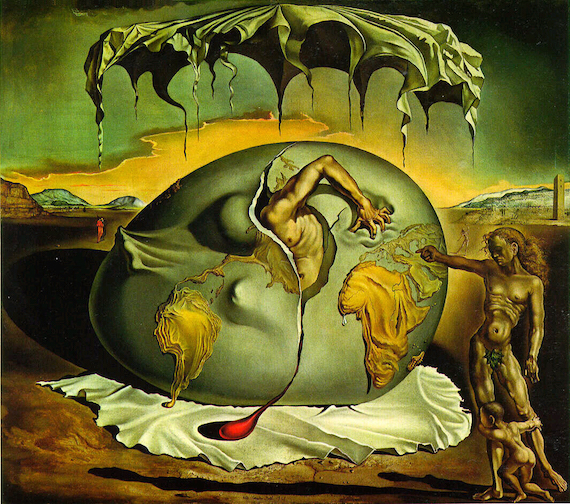
geopoliticus child watching the birth of the new man, salvador dalí, 1943. i just google searched embodiment… it looks like the human is trying to become separated from the world, being birthed from it, cutting the umbilical cord. this separateness is assumed in Brecht and Boal, but in Taylor’s more post-humanist understanding of performance, the ‘human’, the ‘non-human’, and the ‘cyborgian’ appear more interwoven.
Whereas the focus of last week’s readings seemed
to have resided in an articulation of what ‘politics’ is in terms of what it does,
this week’s readings of Brecht, Boal and Taylor aim to articulate what ‘performance’
is in terms of what it does, offering a sort of meta-analysis of the questions
of sameness between these two concepts.
If this is the case, then the main arguments of Brecht,
Boal and Taylor are located in their articulations of how, as Boal puts it, “…
all theatre is necessarily political, because all the activities of man are political,
and theatre is one of them” (ix). Boal describes Brecht’s poetics as “those of
the enlightened vanguard” (155)—his poetics are Marxist, as they assert that
social being determines social thought— ‘man’ is an object of social forces; he
sees the theatre as a place for entertainment, with ‘productivity’ being the
main source of entertainment (186); he wants the theatrical spectacle to be the
beginning of action (106).
Boal, in many ways, picks up where Brecht left
off. He points out that Brecht’s position is clear: the character is not free
to act at all (92) and uses this as a launching pad in a movement that
transforms the spectator into an actor. This movement, accompanied by the
abolition of the private property of the characters, constitutes Boal’s
proposed “poetics of the oppressed” (122).
Taylor moves us forward from this in a tremendous
leap, maintaining the structure of the central theory present in Boal’s poetics—that
“people absorb behaviors by doing, rehearsing, and performing them…”—while incorporating
important questions pertaining to the body from the perspectives of critical
race theory, feminist and queer theory, and post-humanist theory (13). This leads
us to a more nuanced discussion of ‘transforming the spectator to actor’—what Taylor
calls the ‘spect-actors’: people capable of acting and interrupting the
performance or changing their roles they’ve been assigned (80).
Rather than
getting stuck in the tussle between the Hegelian absolute subject and the
Brechtian formulation of the character as the object of economic and social
forces, Taylor marks the body as both the consuming subject and the object of
consumption (97). This understanding of the body, which Taylor takes through
complex rethinkings of experience, ‘scenarios’, and context, enables us to engage
with a politics/performance that is not anti-history, anti-memory, and oriented
towards percepticide, as has been the “American” way (172).
As we have entered a world beyond the limit of structural violence, Balibar wonders whether our politics can be thought of as heteronomy of heteronomy, constituted by the fusion of the problem of violence and the problem of identity. The politics which takes as its object the violence of identities he terms ‘civility’, and he posits three theorems on identity in response: all identity is transindividual; we should speak of identifications rather than identity; and, every identity is ambiguous.
I’m curious about the potential connections to be made between these three theorems relating to identity and the three ways of distributing the sensible as forms of art and forms that inscribe a sense of community—the surface of depicted signs, the split reality of the theater, and the rhythm of a dancing chorus—posited by Rancière. The transindividuality of identity positions it in bonds validated among individual imaginations: is this like a sort of economy of ‘depicted’ (or, ‘embodied’) signs? “The aesthetic regime disrupts the apportionment of spaces in favor of immanence of thought in sensible matter”: as the apportionment of spaces makes “double beings” out of the worker, could ‘identifications’ be a pathway towards a disruption of current modes of doing and making? How is the rhythm of a dancing chorus bolstered by the ambiguity of individual identity? Mouffe posits that artistic and cultural practices can offer spaces of resistance: can the connections between identity and the distribution of the sensible be articulated as agonistic interventions within the context of counter-hegemonic struggle?