The mountain told us to take up arms so we could have a voice. It told us to cover our faces so we would have a face. It told us to forget our names so we can be named. It told us to protect our past we could have a future.
Marco, p. 102
This week’s readings focus on the Zapatista social movements and leaders. Beginning with Our Word is Our Weapon, the work engages us in a compilation of conference speeches, military communiqués, and open letters spliced with poems, short stories, and allegories to provide a human face to what many would consider an evolving “postmodern” movement. Setting a foundation for the grass-roots elements of the revolutionary Zapatista movement, the collection of writings communicates a participatory, arguably non-hierarchical style of politics. Given that there is a constant “we” in the social, Subcomandante Marcos aims to highlight the political space as an ongoing struggle for life outside of death. As such, the Zapatista movement must extend beyond one person. Recognizing this, Taylor (2014) marks the moment when Subcomandante Marcos declares the death of his political persona. While the Subcomandante’s individual inventiveness fulfills a symbolic function, his (re)construction of Subcomandante Insurgente Galeano takes a communal narrative. The reinvented activist explains, the Zapatista movement must always focus on the people, as such his rebirth must be as a collective (Taylor, par. 10).
As the Zapatista movement continues to develop, the dark ski mask that covers the activists face has transformed into the veil of the internet. Lane (2003) highlights one specific instance where the unorthodox methods of the Zapatista Electronic Disturbance Theatre created an “air force” of paper planes to cross digital “barbed wire” in an effort to distribute a poem discussing the struggle for peace in Chiapas, Mexico (p. 130). In an interview with Taylor, Ricardo Dominguez explains digital Zapatismo can be considered postmodern “because they had somehow accomplished, by ripping into the electronic fabric, this possibility of expanding a network and manifesting a network without having access to a network (par. 7). Like Sup. Marcos had previously done, digital Zapatistas reinvent themselves online to embody an appropriate response to injustices and to further expand grass roots globally.
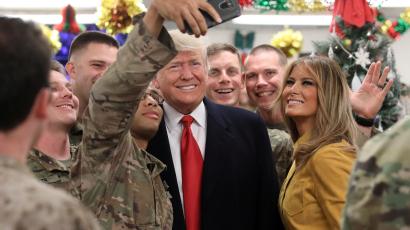
Navy Seal takes photo with Trump during site visit
The articles this week focus on the changing landscape of political spectacle from analog to digital. As technology and the internet continues to develop methods of sharing information has changed what we think of as a nation state. Poster explains, the conditions of a globalized internet has made citizenship obsolete because the internet is a borderless place (72). Universality then becomes inherent in what we would consider citizenship or netizenship as individuals navigate political relations on a decentralized internet. As the Recombinant Theatre and Digital Resistance article explains, digital culture has been reworked as a “invasion of mass media that functions as a reproduction and distribution network for the ideology of capital” (151). In comparing analog to the digital, Critical Arts Ensemble explains, the analogic model created a sense of assuredness about the order of the world whereas the digital model has created a fragmented understanding of phenomena which has disrupted everyday communication to embrace a technology based worldview (152).
This technological shift can be seen in the way Donald Trump has run his reality television show and presidency. As the internet and social media has taken over and the chase for online “friends” becomes a political act, Trump’s style of entertainment and administration American has transformed popular culture and US politics (Edwards, 27). Edwards explains, whereas as previous politicians maintained the analogic, Trump’s rhetoric emerges through the digital, communicating style through reality television and online tweets. Steaming from The Apprentice boardroom we see how the entertainment of “You’re Fired!” has shifted its aim from celebrities to political cabinet members (33); moreover, the benefit for Trump (and perhaps a pitfall for the American people) is that incorporating social media views and likes reduces any engagement of civic matters down to a popularity contest.
Edwards, B. (2019). Trump from reality tv to twitter; or the Selfie-Determination of nations, Project Muse. 74 (3): 25–45.
Poster, M. (2006). Information Please: Culture and Politics in the Age of Digital Machines. Duke University Press.
“Recombinant Theatre and Digital Resistance.” (2000). Critical Art Ensemble. 44 (4): 151–66.
This week’s readings focus on the creation of a political leader. Beginning with The Prince, Machiavelli lays out a blueprint for taking and maintaining power in political regimes. He notes hereditary states and mixed monarchies can be conquered by killing the old monarchies. He further argues, it is necessary to be violent towards self-governed republics because, “it will destroy you, if you don’t destroy it” (p. 19-20). A prince may rise to power by following the examples of previous rulers and by creating a spectacle of power. To win respect, a prince must create the image that he is both a “genuine friend and a genuine enemy” (p. 88). I believe this can be seen in Schechner’s concepts of make believe and make belief. Schechner explains, make believe involves a conscious application of the mask or con game; make belief is when that mask reinforces a strongly held belief that people are willing to act in support of (such as a religious or political belief). Where make believe and make belief overlap is in politics, wherein the politician wears their script as a mask, but asks the spectator to accept the mask as truth.
Kolbert (2017) explains, impressions of truth that fall in line with people’s beliefs are incredibly resistant; even after those impressions have been revealed as false or untrustworthy. They explain, confirmation bias is one entry point to understand why people have a hard time changing their minds/beliefs. Kolbert (2017) finds we hold onto beliefs (even when we could be wrong) because we don’t want to be betrayed by others or simply put, we don’t want to get screwed by those who believe differently than we do. It is for this reason that we must beware the folk hero who often fights the establishment in the name of the people (Blow, 2019). As spectators, we must be critical of those who have used the transcendence of make believe and make belief as a mask for their political advantage.
In June 2018, photographer John Moore captured a photo that unveiled the essence of asylum seeker border crossings. A 2-year-old Honduran girl stands crying in front of a border patrol agent while her mother is face to face with the authority figure. Taken from the child’s point of view, we see the young girl rendered helpless as adults tower over engaged in a legal search of bodies (Garcia-Navarro, 2018). The photos “out” the mother and daughter as asylum seekers in a call for empathy. Similar to the DREAMers in Beltran’s (2015) work, the image works to illuminate “the human face on the complex dynamics of migration as the space of economic arrangements, human desire, and community building” (p.94) After the image went viral the public responded on social media calling the current political administration a shame, people pressures lawmakers to address the separation of families, and most recently the photo won 2019 world press photo of the year (Mark & Ralph, 2019).
While many were aware of current immigration policies, the image forced its spectators to come to terms with the Realities of criminalizing asylum seekers. As Ranciere affirms images have a life of their own; “showing everything that can not be said” (p. 90). In Moore’s image the spectator must cope with harsh reality of families making the trek across the border while the agent captures kin as a part of their job. The photo of the little girl crying makes the spectator wonder, ‘is the situation created at the border just or unjust?’ ‘Will her cries be heard outside this photo or will people continue to look away?’ As Azoulay (2008) highlights, “the spectators work is that of prolonged observation” (p.159). Therefore, it is up to the spectator to do the work of looking and acknowledging the hard truths photos capture.
Garcia-Navarro, L. (2018). ‘It was hard to take this pictures knowing what was coming next’, NPR. Retrieved from https://www.npr.org/sections/pictureshow/2018/06/17/620775153/a-photojournalist-at-the-border
Mark, M., Ralph, P. (2019). A getty photographer tells the story behind heartbreaking photo he took of a migrant girl sobbing while agents questioned her mom at the border, which just won world press photo of the year, Business Insider. Retrieved from https://www.businessinsider.com/photo-migrant-girl-cries-as-border-agents-question-mom-john-moore-2018-6
Foucault’s painting of the modern legal system can be seen in the police murders of unarmed black people. As we see videos of black men being harassed and killed by law enforcement we begin to normalize the spectacle of black death. A new study finds killings are now the leading cause of death for young men, particularly, young black men (Edwards et al., 2019). Though Foucault argued “punishment, then will become the most hidden part of the penal process” (p.9) I would push back and point to these very public (thanks to social media) spectacles of discipline and punishment. We have become the spectators to legal death (or execution) as we see black bodies parish at the hands of police in the name of justice or perhaps the protection of others. Judgement and examination is then had on a very public and legal level. We see police officers and black bodies become adjudicated as we all become spectators to the violence and trials online and in our city streets. Even more, we begin to see how judicial power and punishment affects the officer, the condemned, and the viewing public.
As Taylor notes, “in order to be empowered by seeing, to be able to look back at the monstrous gargoyles without turning into lifeless stones, we must see beyond the theatrical frame and decode the fictions about violence, about torturers, about ourselves as audience” (p.137). To reject the role of the passive spectator, we must look beyond any manipulations of the realities in front of us. The thing about the Black Lives Matter movements and those alike is that they typically bring the police officer under persecution. It makes us (re)consider our relationship to justice and it’s affiliated systems. Instead of bringing the black body to question, the mob turns to look at the enforcer (the police officer) as the cause for violence and injustice. In this case, crowd mobilizes against the toxic officer and against the penal process to fulfill “the dream of purging the community of the impure elements that corrupt it” (Girard, p. 16, 1986).
Edwards, F., Hedwig, L., Esposito, M. (2019). Risk of being killed by police use of force in the United States by age, race–ethnicity, and sex. Proceedings of the National Academy of Sciences of the United States, 116(34). doi: 10.1073/pnas.1821204116
On December 4th, weeks after the 2016 Presidential election, Edgar Madison Welch entered a Washington D.C. pizzeria armed with an AR-15 rifle and fired multiple times (Fisher et al., 2016). After being detained Welch told officers he “read online the restaurant was harboring child sex slaves and that he wanted to see for himself if they were there” adding that he was armed to help rescue them” (Fisher et al., par. 62, 2016). Beginning with a Wikileaks rumor which claimed to publish the content of Hillary Clinton’s emails, users speculated the words “sauce” and “pizza” were codes used in a sex trafficking and pedophilia ring harbored in the pizzeria basement (Groth, 2019). However bizarre, the rumor went from hashtag, to “pizzagate,” to gunshots after the story gained traction online when former national security advisor, Michael Flynn and international news outlets shared the conspiracy online (Robb, 2017; Groth, 2019). Though “pizzagate” is an extreme example, the scandal functions to provide insights on the intricacies of the political narrative. As political strategist James Carville has noted, “a narrative is the key to everything” (Poletta, p.1, 2008). Therefore, it is crucial to understand how complex political processes can be stripped down to stories.
Political narratives organize the story by providing a clear distinction of who is good or bad and/or who just or corrupt (Maclaughlin & Velez, 2019). Take for example,Trump’s 2016 campaign video of “Two America’s” (Dumenco, 2016). In the advertisement, the narrator asks viewers to envision “Hillary Clinton’s America,” a land where crime is rampant and jobs are dwindling. This is shown parallel to “Donald Trump’s America,” where families are secure and business thrives. By creating this binary, the narrative format functions to reinforce worldviews of those who agree with their message. Polletta (2008) explains though individuals typically process messages with intense scrutiny, there is a tendency to immerse oneself in the story. Be it for entertainment or political purposes, people strive to vicariously live out the emotions and events of the character’s experience (Maclaughlin & Velez, 2019). The narrative works to captivate the audience who are encouraged to view themselves as the central character in the story.
Narratives are powerfully transportive forces. Research explains, this transportation is possible because from a young age people learn to rely on imagination to make sense of their social worlds by gathering information and creating representations of their surroundings (Green & Brook, 2000; Maclaughlin & Velez, 2019). Essentially, because humans learn to imagine in the mind, they can picture themselves taking certain actions or views in reality. Hence, when people confront a political narrative they create a “mental model” to understand that narrative world (Maclaughlin & Velez, p.24, 2019). Take for example a presidential race. In this case, a citizen will create a character representation (the candidate), assess their motivations, and create assumptions for how certain actions (voting for someone) can affect their reality and the larger political realm (Maclaughlin & Velez, p.24, 2019). When individuals engage with mediated political narratives, they (re)construct the model provided by the narrative.
One key to the narrative in the current digital age is its ability to spread online (Maclaughlin & Velez, 2019). Much of the narrative’s force is in how it can get someone who agrees with it to act, or in the online case, how it can get someone to “share”. The more a story is disseminated, the more people try to make sense of it in computer mediated and face-to-face communication. Further, the more frequent a message is seen, the more likely someone is to believe the information is true (Pennycook & Rand, 2019). Simply put, people aren’t likely to believe a false narrative because they are particularly gullible, rather it is how often they are inundated with a message and how open minded they are to receiving it. As Groth (2019) highlights, this is especially problematic as “in its most radical form the motivation to act can take the shape of a shooter intruding into the alleged sex traficking headquarters in the basement of the pizzeria with an assault rifle, seeking to directly fight the conspiracy” (p.2).
Liberal and conservative voters are both vulnerable to a good story (Pennycook & Rand, 2019; Harper & Baguley, 2019). Generally, people are more likely to believe narratives they are familiar with (Harper & Baguley, 2019; Polletta, 2008). When individuals are transported into a story they don’t concern themselves with critically evaluating beliefs rather, they are focused on the transportive experience; Instead they ask, “Can I picture myself in this narrative?” (Maclaughlin & Velez, 2019; Polletta, 2008). Liberals and conservatives approach political narratives similarly. Harper and Baguley (2019) find people on both sides of the traditional right-left divide are equally likely to believe political stories that are in line with their current ideologies, and cast aside narratives that are inconsistent with their views. In either case, narcissism plays a pivotal role in whether or not someone will initially choose to believe and be transported into the narratives presented; there is a stronghold on political beliefs (Harper & Baguley, 2019). When someone can envision themselves in a narrative the more successful the story becomes as a strategy for engaging in politics.
As audience members feel like they are directly experiencing an unfolding story that speaks to their ideology, they are prone to welcome and internalize the views of reality offered by the narrative. Rather than engaging in a critical evaluation of information, transported individuals tend to readily adopt the depicted attitudes and experiences as their own (Maclaughlin & Velez, 2019). That is, immersed partisans internalize the story line, characters, and causal relationships as an accurate reflection of their own reality. As the American Presidential race is underway, it is crucial that we (re)examine the stories deeply embedded in US politics. Groth (2019) points out, “great writers don’t write simple stories. They write stories that tap into our expectations and defy them.” (p. 30). This election season, political writers continue to construct narrative models in an attempt to reel in potential voters. While storytelling remains at the helm American politics it is crucial to ask, what would happen if the fights seen in the political arena were based on real action instead of character narratives? What would happen if we refuse to tell stories at all?
Dumenco, S. (2016, August). New Trump TV ad: ‘In Hillary Clinton’s America, hundreds of thousands of jobs disappear. Advertising Age. Retrieved from http://adage.com/article/campaign-trail/trump-tv-ad-clinton-samerica-jobs-disappear/305640/
Fisher, M., Woodrow Cox, J., Hermann, P. (2016). From rumor, to hashtag, to gunfire in DC, Washington Post. Retrieved from https://www.washingtonpost.com/local/pizzagate-from-rumor-to-hashtag-to-gunfire-in-dc/2016/12/06/4c7def50-bbd4-11e6-94ac-3d324840106c_story.html
Green, M. C., Brock, T. C. (2000). The role of transportation in the persuasiveness of public narratives. Journal of Personality and Social Psychology, 79, 701–721. doi:10.1037/0022-3514.79.5.701
Groth, S. (2019). Political Narratives/Narrations of the Political, Narrative Culture. (6)1, 1-18, doi: 128.122.149.96
Harper, C., Baguley, T. (2019). You are fake news: Ideological (A)symmetries in Perceptions of Media Legitimacy. Doi: https://doi.org/10.31234/osf.io/ym6t5
Maclaughlin B., Velez, J.A. (2019) Imagined politics: How different media platforms transport citizens into political narratives. Social Science Computer Review, (37)1, 22-37. Doi: 10.1177/0894439317746327
Pennycook, G., Rand., D. (2019). Who falls for fake news? The roles of bullshit receptivity, overclaiming, familiarity, and analytic thinking. Journal of Personality. 1-64. Doi: 10.1111/jopy12476
Robb, A. (2017). Anatomy of a fake news scandal, Rolling Stone. Retrieved from https://www.rollingstone.com/politics/politics-news/anatomy-of-a-fake-news-scandal-125877/
Action and speech are surrounded by and in constant contact with the web of the acts and words of other men
Arendt (188)
In this week’s readings I came to focus in on the ideas of action and appearance in public. Arednt posits, one of the fundamental characteristics of the human condition is action. For the author, an essential feature of action is freedom and plurality. Arendt does not mean freedom like American apple pie or the ability to make life choices, rather the principal of freedom lies in human ability to begin something new (177-178). Arendt furthers by pairing action with speech and notes, words allow for a type of “second birth”- new beginnings brought out of our own initiatives (176). Plurality then refers to the fact that in order to truly act, it has to be done in the presence of others (188). Just as theater necessitates a spectator, action requires the presence of others. The “space of appearance” therefore becomes a public sphere where “men are together in a manner of speech and action” (199).
Butler takes takes on Arednt by postulating these spaces are built by political action but first she confronts some limitations to Arednt’s analysis. She argues, the philosopher’s perspective is muddied by it’s inherent gender politics. Arendt’s body in public is presumptively male leaving the body in private to be female (75). While Butler recognizes the gender politics was not was at the helm of Arednt’s argument, she highlights, “the sphere of appearance is not that simple, since it seems to arise only on the condition of intersubjective face-off” (76) Butler aims to reimagine the “space of appearance” to consider embodied practices. She highlights, political action is also present in the ways one establishes the body to act between other bodies (a nod to the earlier chapters where she discusses social construction) (77). The coming together in itself is both a political and a bodily enactment.
Whether is be the influence of the performer or the revolutionary action of the spectator authors expand on viewership as functioning under systems and relations of power
Artistic practices have the ability to bring to view unjust political ideologies. Through Taylor’s analysis of various performances we can see how performance functions as a call to attention for the spectator and the politics being critiqued.
Pleasure is the passport. Though many audiences see live performance as a form of entertainment, pleasure often acts as the entry point for critical discourse.
Performance is neither true or false, it is either effective or ineffective. Does the performance make you feel? Does it bring the spectator to act?
Art acts as a representation (i.e. the platonic model). There is the idea of the table; the material, the table itself; the interpretation/representation, the painting of the table.
Theatre does not want distance. It wants to create a actor-spectator relationship. Boal highlights the viewer is capable of responding and interrupting what is on stage. Though Brecht and Boal both agree that “western theatre” requires passivity from the audience.
The requirement of passivity spotlights how theatre can act as colonization.
The body is acts as a site of transfer for knowledge. It is a creative doing which illuminates that which was not seen before.
Boal highlights through his exercises that to control one’s body is to make is capable of being more expressive.
Political art is a confrontation to the hegemonic practices that rule societies.
Struggle often activates performance. Be it through the tension that exists between the proletariat and the bourgeois (or from the spectator and the actor) this struggle pushes individuals to react to what is happening
Art is dangerous. It’s emotional engagement with the spectator can be coercive insofar as it encourages the spectator to take revolutionary action.
Regina José Galindo, No perdemos nada con nacer/We lose nothing by being born
Performance has the power to illicit social change from spectators through its critique of politics and everyday life. In confronting Aristotelian philosophy Boal explains, the coercive system of tragedy which plagues art does not work to engage the audience in revolutionary acts (47). The author laments, though Aristotelian systems of knowing acknowledge what already exists, it works against the spectator in that it only pushes them to conform to society rather than transform it (Boal 47). Instead of looking at theatre as a representations of nature, we must come to acknowledge it as a form of transformation. Boal suggests we make the move towards spect-actors instead of spectators as the former acknowledges the viewers and the performers potential for political and revolutionary action.
Taylor expands by noting viewership can only be understood as “functioning under systems and relations of power” (80). Though performances can often push audiences to uncomfortable and sometimes confusing spaces, it ultimately forces the witness to react and/or respond to what it being shown. Brecht points to the spectator-performer relationship as a mechanism of theatre which allows individuals to breed empathy (183). It is this characteristic that can bring the viewer to reflect on their world and subsequently take part in social change.
In his work The Politics of Aesthetics, Ranciéré turns to Aristotle’s view of the political being as, “a speaking thing” (12). Highlighting, artisans, or the poor, do not have the privilege of overseeing a community because their work will always take priority. This marks a clear distinction between who may partake in political discourse and who may not. However, there is a disjunction between speaking things and the privilege of speaking. Balibar illuminates, citizenship can not be solely based on verbal capacity as speech is both a power relation and a skill (4). If political representation relies on the ability and privilege to speak for oneself, then there will always be subjects who go unheard. As such, communities who are governed by those that have particular functions of speech must be cautious of the “good orator”. Sophists, those who excel in and take advantage of the art of persuasive speaking, have the ability to misuse their abilities to manipulate the public. Taking from Balibar, every individual combines several identities to make one (28). If this is the case, then we must question whether the active political being inherently takes advantage of their speaking skills to serve one or more of their various identities, rather than the whole community.