“She. Has no military rank, no uniform, no weapon. Only she knows she is a Zapatista. Much like the Zapatistas, she has no face or name. She struggles for democracy, liberty, and justice, just like the Zapatistas. She is part of what the EZLN calls “civil society”—a people without a political party, who do not belong to “political society,” made up of leaders of political parties. Rather, she is a part of that amorphous yet solid part of society that says, day after day, “Enough is enough!”
Subcomandante Marcos Twelve Women in the Twelfth Year The Moment of War MARCH 11, 1996
In this passage, dead, not dead, not not dead Subcomandante lays out the aesthetics of a Zapatista woman. Much like the Zapatistas, she is amorphous since he “takes away” all her physical attributes like uniform, weapon, face or name, yet solid as she knows who she is. In fact, only she knows who she is and her knowledge of herself comes from comparison with the Zapatistas like the knowledge of the Zapatistas comes from her understanding of herself. I think this paragraph illustrates the way the Zapatistas get built and aware of themselves and evolve through the members. So, as Subcomandante said he no longer exists when he is not necessary to those who constitute the Zapatistas.
I guess the ability to change a form and a medium is what makes the Zapatistas special and “durational” as Domínguez described them. Taylor said that the decision to “kill” the hologram of “the recognizable leader” in favor of the collective was made within “the undergoing change” in the style of political performance.” But what makes the Zapatistas so sensitive to those changes?
I find the answer in the perception of the Zapatistas time. Subcomandante wrote that when they had “erupted and interrupted in 1994 with blood and fire, it was not the beginning of war for [them] as Zapatistas”: “We had been enduring for centuries.” So there is no starting or ending point: even dead Subcomandante is reborn as a collective. The political spectacle for the group does not follow the linearity of the past, present or future since the concept of time is erased under oppression when they were not present in time. The transition to the cyberspace was easy and natural for the Zapatistas in comparison to inflexible political parties because they didn’t have a presence in the physical space that they could lose. Lane wrote that “for EDT, as for the Zapatistas, cyberspace can be practiced as a new public sphere, a runway for the staging of more productive “lines of fight” for those struggling for social change.” But the communal efficiency of the work done by the Zapatistas cannot be explained only through common struggle. I’m in favor of what Domínguez called “that aura”“that somehow there could be a possibility of interconnecting real bodies embedded outside of the grid as a direct manifestation of the ethics and aesthetics of how networks and tactical media should really respond.” No matter whether we call it hope, aura or belief, it is what outlives sub/comandantes and their memes, creating new forms of collectivity.
Look at the picture carefully. Trump has just made a new post on Twitter and got thousands of angry replies. The data about it is now being processed by one of the servers you see. As long as the machine is safe the evidence of political battles, poor Friday choices and cat videos will be available to any user of cyberspace at any time for better or for worse. Poster believes that “new media offer possibilities for the construction of planetary political subjects, netizens who will be multiple, dispersed, and virtual, nodes of a network of collective intelligence.” I would argue that this idea is still idealistic in its willingness to create collectivity through digital space even though he mentioned that he is not suggesting “a utopian realm of equality and freedom.” Undoubtedly, cyberspace creates expansive communities within it but just as it happens in “analog” life people’s views are framed through their sources of information. And the abundance of sources online is controlled by the political power like Trump administration and its continuous supply of digital content that tries to blurry “the boundary between news and entertainment” even further. Edwards does not try to attribute potential collective intelligence to online users as he doubts their existence in the first place. In what he calls “the selfie-determination of nations” it is hard to recognize not only real information but a real person. His infostructure is “a digitally mediated, imagined community in which individual citizens, bots, and trolls exist side by side.” It means the digital identity is created not only around those living in the real world. Some of Internet subjects without bodies might even have more persuasive digital traces of existence than real people who do not use a mobile device. Does it mean that it is a time when the analog or the real version has to stand “the test of equivalence” to the digital one? Well, as long as the servers are on, we will keep persuading machines that we are humans every time checking “I’m not a robot” box. Even if netizenship gets created, it will arise a new question of who will be governing the cyber state.
Machiavelli’s “Prince” was published in 1532 almost 500 years later Edwards analyzes Trump’s performance as president in a similar manner with a bit of technology. In this short essay, I am not only going to look at the power construction of these two images of a leader (that has been studied extensively), not also the notion of analog and digital when it comes to Trump as a politician.
The massive use of digital space, the adaptation of TV show methodology to politics and constant comparison of Trump to the idea of a president (which is somewhat vague) makes him a great candidate for a classical concept of digital that Critical Art Ensemble brings up. The digital model in an assembly line is a copy of a unique analog that came out of chaos or no specific order before itself, while the digital comes from a known order like contemporary politicians have regulations written before them that they have to follow. However, the digital copy still must “stand the test of equivalence” to the analog, and Trump had to persuade that he is a valid digital president.
Machiavelli said that “the actions of a new prince are watched much more than those of an hereditary one, and when they are recognized as virtuous, they attract men much more and bind them much more to him than ancient blood would do.” In terms of Trump, being a new prince means not being a politician before the election and having every movement and word watched, or being a digital version of a president. According to Edwards, the celebration of Ryan Owens heroic death was considered as the “virtuous” action when “he became President of the United States in that moment” because “Trump brought the logics of the entertainment realm in which he had achieved global recognition” to the space of politics. Thus, “Trump achieved the blurring of the distinction between American popular culture and US foreign policy.”
Edwards underlines that Trump adapted the methods of reality TV shows and shifted the medium in the Capitol chamber from Hollywood cinema of Ronald Reagan to reality television. In this instance, Trump brought to politics methods from dominant culture of his time and “theatre of everyday life” that is the process of copying in digital aesthetics – “a process that offers dominant culture minimal material for recuperation by recycling the same images, actions, and sounds into radical discourse.” The constant repetition of Trump’s methods is a technique of arranging what people can see and, thus, believe. “The people are fickle; it is easy to persuade them about something, but difficult to keep them persuaded.”
The digital expansion of Trump’s politics develops the force in Machiavellian terms as it is not about physical but informational dominance, especially through the internet. Poster thinks that “the internet holds the prospect of introducing postnational political forms because of its internal architecture that is not centered and cannot be controlled.” However, the case of new politics with digital leaders as Trump shows that the internet still operated under the power structures.
“Representation is not the act of producing visible form, but the act of offering an equivalent – something that speech does just as much as photography”. (Rancière 93)
All three authors of this week brought up the idea of what action photography and videography represent and citizenship of their actors. Azoulay starts her chapter by establishing photography as a civil action in Arendt’s term that is irreversible, without “a clearly demarcated beginning and a predictable end”(129), making others act. Both Azoulay and Rancière use examples of photographs of violence and horror as intolerable images to show the act of taking an image by its different participants. For Azoulay in the photo of two armed soldiers behind the dead body of Palestinian, the actors are not only the soldiers, the corpse, their photographer, a photographer that captured the action of taking the image, but also absent Palestinians. They are invisible in the picture, but their presence is embodied in the context where they are not even able to take care of their dead citizens. The unshown is also present in Rancière’s example of Wajcman’s gas chamber witnesses, “in whose eyes we can detect the horror we have seen” (92). Beltran’s actors are invisible and undocumented in real life but appear in social media through images, speeches, and videos, making equivalent queer space of appearance for themselves and all other migrants in a similar situation. In all these cases, participants of the image go beyond what is captured on the picture, including spectators who continue the action of a photo through the feelings it invoked in them. Azoulay states that “although plurality cannot erase structural inequalities and discrepancies between the different protagonists, the space of plurality undermines the apparently stable conditions of domination” (133). DREAM activists prove this idea making their collective appearance visible to the government. While the group fought for American citizenship, Azoulay spoke for citizenship of photography equally sharing the burden of responsibility for images among multiple participants of it. I believe no matter who is seen as a protagonist, author or spectator of an image it is important to keep in mind that everyone encountering carries the obligation to give justice to it.
Job Title: Actor for punishment spectacle. Role of a condemned.
Reports To: The actor will report to the casting director, scriptwriter, director of terror and the audience.
Job Overview: Acting of punishment became easier than ever. Your body will not be torn apart and you will not be executed in front of the audience since “the disappearance of torture as a public spectacle” . “Punishment, if I may so put it, should strike the soul rather than the body”. The spectacle “has shifted to the trial, and to the sentence; the execution itself is like an additional shame that justice is ashamed to impose on the condemned man”. Also, who knows, maybe the audience would intervene and set you free during a public execution. “Confronted with the reality of torture, tendency of audience is to identify with the victim”. We don’t want them to sympathize with you and change the focus of their anger on the executioner. So it is decided. You will play in the penal ritual and get a psychiatric examination. In the prison, you will get up “at the first drum-roll”, work “for nine hours a day throughout the year”, pray for less than an hour a day. Workshops, school, accommodation, and meals are provided.
Responsibilities and Duties: Although you won’t be publicly tortured in a court, you will participate in terror staging of real life. “Theatrical convention allows for splitting of mind from body, enabling the audience to respond either emotionally or intellectually to the action it sees on stage without responding physically”. We will reveal corpses, torture on streets, create own media narratives so that the audience will get blindfolded with their emotions and fear.
However, you must be noted that we have rivals in real theatres who “turn the gaze back onto the blinding apparatus itself”. They invite the audience “to transgress, to see that which should never be seen”. It reminds them that “terror deterritorializes” and they are all foreigners in their houses. But they “are not being victimized”; they “have a capacity for choice and for action”. For you, it means that your acting in terror and court structures must be flowless to make people feel powerless against them.
Qualifications: You will be accepted to the role based on the following stereotypes.
• Stereotype of social crisis, moral causes or natural disaster. 14 “Rather than blame themselves, people inevitably blame either society as a whole which costs them nothing, or other people who seem particularly harmful for easily identifiable reasons.”
• And “thanks to poison, it is possible to be persuaded that a small group, or even a single individual, can harm the whole society without being discovered”. So even you an individual can be blamed for society-wide harm.
• You will get even more chances to be selected is you “belong to a class that is particularly susceptible to persecution rather than because of the crimes you have committed” . You are welcome to be condemned if you are an ethnic and religious minority.
• But mainly you will be judged on whether you are as different as expected and blamed “in the end for not differing at all”.
Case Study of Activism in Kazakhstan in Spring 2019
Preface
7 pm, March 19, 2019. Nursultan Nazarbayev made an urgent announcement on national channel saying that he resigned after 30 years of presidency.At that moment, phone lines and messengers collapsed from people discussing the long-awaited political change in Kazakhstan, sharing hopes and fears about the future. Within the next few days, the government made statements about the status of the first president as a military leader and “the father of the nation”, about K. Tokayev temporally (later officially) taking the place of the second president, about Nazarbayev’s elder daughter becoming the government spokesperson.That news brought the population back to reality where the replacement of roles didn’t change the structure of power.
Stage Directions
Local activists decided to act upon expected presidential elections and influence what Ranciere called “the distribution of the sensible” .“The distribution of the sensible reveals who can have a share in what is common to the community based on what they do and on the time and space in which this activity is performed.” The time choice for the acts was undoubtedly significant, but so were the spaces for expression or, to be precise, their absence. Although “freedom of speech and art is guaranteed, and censorship is prohibited”under the constitution of the Republic of Kazakhstan, “any form of protest, picket, demonstration or march that expresses social, group or individual opinion must get a permission of government 10 days prior of the act if it wants to be legal.” The regulations might remind those of Greek polis for citizens: “before men began to act, a definite space had to be secured and a structure built where all subsequent actions could take place.” However, the modern Kazakhstani limitations do not secure space, hardly ever permitting sanctioned protests. Arendt stated that “to be deprived of it[space] means to be deprived of reality, which, humanly and politically speaking, is the same as appearance.”With their appearance, the activists took back the power to create own reality because, as Butler formed it, plural actions allow to “rethink the space of appearance”. Let’s look at those actions.
Act I
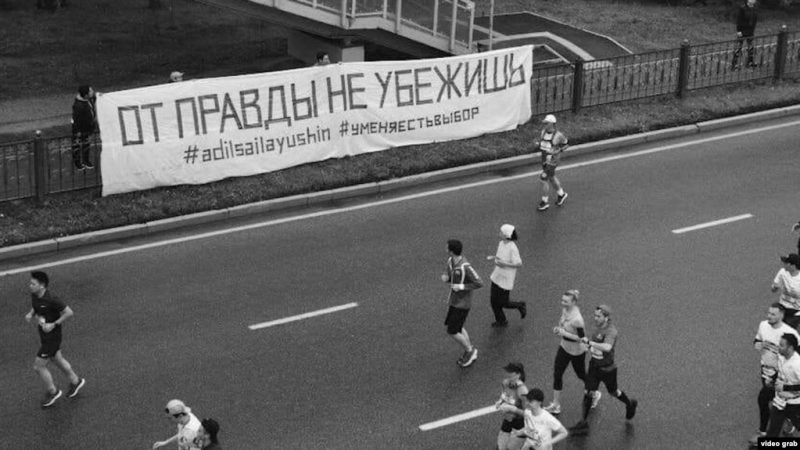
Sign: “You can’t run away from the truth” #AdilSailayUshin (Kazakh: #ForFairElections) #уменяестьвыбор (Russian: #IHaveaChoice). (Photo: Aigul Nurbolatova.)
The first activists in the Spring 2019 banner series got a 15 days’ detention for “carrying out a public action without agreement of permission from the local authorities to express their interests”.Asya Tulesova and Beibarys Tolymbekov’s personal and civil interests were fair elections. They named their act ‘peaceful flash mob’ (the term “flash mob” is not mentioned in the legal restriction). They made a sign “You can’t run away from the truth” with the hashtag “#AdilSailayUshin” (Kazakh: #ForFairElections) and put it along the Almaty marathon on April 21, 2019.Other participants, who weren’t sentenced but fined, captured the moment on cameras. Thanks to them, we can see images of people running along and away from the call for truth.
Discussing the effect of the statement I cannot ignore Austin’s performative utterances because it induced the action claimed with the words.Asya and Beibarys were detained but the case and the photos were all over the internet under #AdilSailayUshin. Within a month, more activists spoke up in ‘the banner manner’, which I will discuss later, resulting in a similar police reaction. Collectively those events got into international press and archived in so much digital and printed evidence that they cannot disappear. Indeed, no one could run away from the truth, that Asya and Beibarys stated: fair elections were wanted in Kazakhstan. Therefore, they made their “happy” performative sentence – the action that was done.
Act II
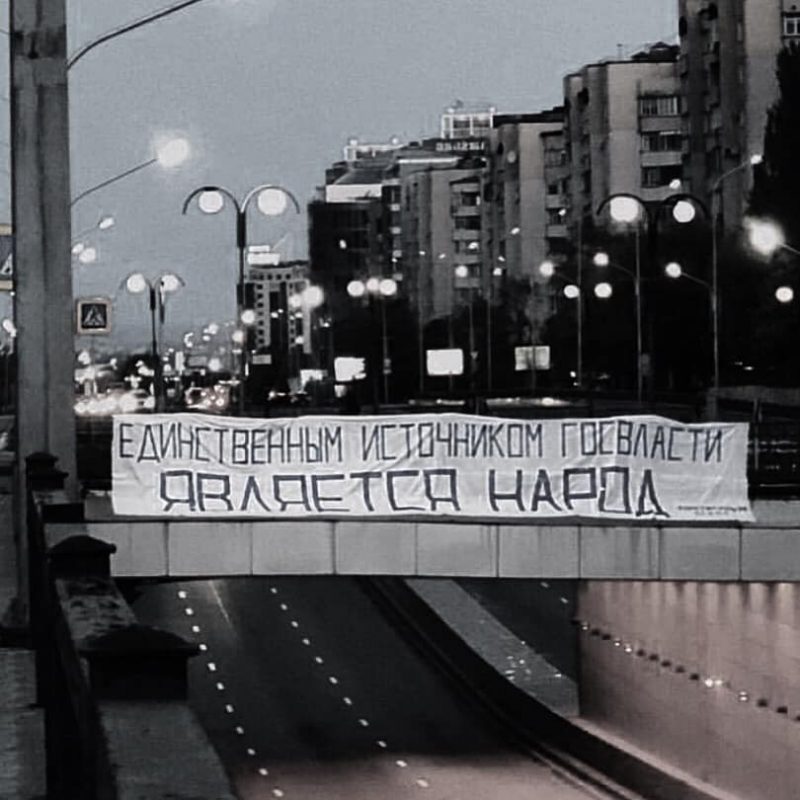
Sign: “The people shall be the only source of governmental power.” (Photo: instagram.com/freekazakhs/)
The same cannot be said about the next act/sign I want to mention (there were other detained activists between two events). On April 29, Roman Zakharov hoisted a sign with a direct quote from the Constitution of Kazakhstan: “The people shall be the only source of governmental power.”His performative utterance was “unhappy” as it did not make the action true.Instead, he was jailed for 5 days for “intentionally littering the city’s public places” (this accusation deserves a whole independent essay).Both banners (by Asya&Beybarys and Roman) oppose the function of writing and painting defined by Plato. For him, “writing and painting were equivalent surfaces of mute signs, deprived of the breath that animates and transports living speech. The mute surface of depicted signs stand in opposition to the act of ‘living’ speech, which is guided by the speaker towards its appropriate addressee.”In the reality of art within legal limitations, signs become vocal and stand ‘instead of’ living speech, which is muted. Ranciere claimed that “politics revolve around what is seen what can be said about it, around who has the ability to see and the talent to speak, around the properties of spaces and the possibilities of time.”The Kazakhstani acts reversed politics towards themselves taking on the visual, vocal, temporal and spatial potential of people that realized them.
Act III
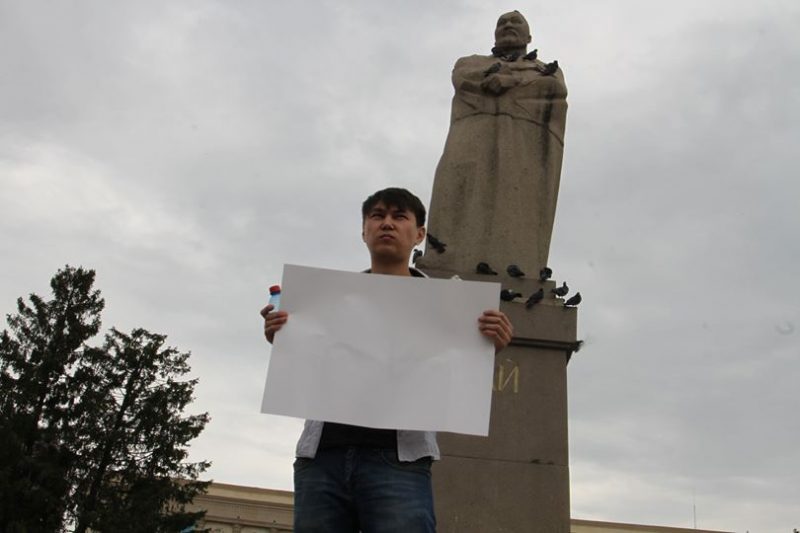
Aslan Sagutdilov holding a blank sign. (Photo: Sagutdilov’s Facebook page.)
I also cannot ignore the pure aesthetics of Kazakhstani activists. “Aesthetics can be understood in a Kantian sense – re-examined perhaps by Foucault – as the system of a priopri forms determining what presents itself to sense experience. It is a delimitation of spaces and times, of the visible and the invisible.” I’ve already discussed space and time in two acts. For visibility and invisibility, I would like to introduce another activist who wanted “to test the limits of his right to peacefully demonstrate” after the previous events. On May 6, Aslan Sagutdinov “stood in a public square holding a blank sign, predicting he would be detained. He was right.”With his act, he pushed the aesthetics of activism and “forms of visibility” even further.He decided “to depict and portray instead of instruct”, his image was blank but understandable for people.What was wanted the whole time were not statements but a right to make them. The blank sign that has a space for expression. This potentiality of space, which was not sanctioned by law, led to the reaction of the police. So the invisible hopes and fears of all participants became visible with the blankness.
I state the police as the participants of the acts because without their reaction there would be no creation of “the space of appearance”. None of those bodies, individuals, could establish that space alone, it happened “only ‘between’ bodies.” Each act led to the reaction of police, attracted supportive bodies to the courts, created virtual bodies discussing the events online. I discussed those acts together because one body “does not act alone when it acts politically”. As Butler stated: “Indeed, the action emerges from the “between”, a spatial figure for a relation that both binds and differentiates.”
Epilogue
The space of appearance that was created over this summer hasn’t been destroyed as Arendt would predict. She said that “unlike the spaces which are the work of our hands”, those created by action “do not survive the actuality of the movement which brought them into being, but disappear not only with the dispersal of men” “but with the disappearance or arrest of the activities themselves.” Kazakhstani activists prove the irrelevance of that limitation. They not only made statements but also fueled collective actions among citizens who gathered for public talks, became observers at the election, three times got a sanctioned physical space for protests and created civil rights organizations. The elections were still highly violated, and people get detained for non-sanctioned protests these days. A preliminary conclusion might not be ‘happy’ but now the potential space of appearance seems real for people as it has been repetitively activated. So words, signs, and blankness create spaces as long as they are created between bodies. “A space of appearance comes into being wherever men are together in the manner of speech and action.”
Key terms: sanctioned, protest, space of appearance, aesthetics, speech
Reading
only one chapter of Arendt’s “The Human Condition” for this week I found it
hard to elaborate on Butler’s extensive discussion and critique of Arendt’s
works, especially since Butler herself underlines how the arguments of the
former transformed through time. The clash of ideas that I feel more comfortable
addressing based on my readings involve the juxtaposition of human plurality
and individualism. Arendt starts her chapter with a statement:
“Human plurality, the basic conditions of both action and speech, has the twofold character of equality and distinction.”
With this sentence, she assumes that action requires a group of people. She later adds that action cannot be performed without speech as it “would not only lose its revelatory character, but, and by the same token, it would lose its subject.” Therefore, in her terms, to act humans must gather together and vocalize their ideas. She excludes bodily aspect of actors as she claims that “physical identities appear without any activity of their own in the unique shape of body and sound of the voice.” On the other hand, Butler proposes her argument of alliance with own self including own body, voice, and existence itself. For her stating the “I” is itself an action as it “refuses to background one minority status or lived site of precarity in favor of any other.” I believe these differences in views of action and actors arise from the context two authors prioritize. Arendt focuses on communal discussions starting from “polis” in Greece, the topic within which her “action” arises is connected to the idea of collective power. She does not erase the inner strength of individuals but says that when it is united into one power it becomes effective. Butler’s “action” comes from gender studies where the primary conflict arises between the social stigmas and individual feelings. Therefore, for her actors, it is important to be able to express themselves on an individual level. The problem I had with Butler’s argumentation is that even though she advocates for the importance of individual experience, she herself falls under overgeneralization and refers to a group of audience by “we” as in this sentence:
“As we know, not everyone can take for granted the power to walk in the street or into a bar without harassment.”
Does that mean
that she calls for support to make her action? Or that the distinction between private
and public is somehow arbitrary?
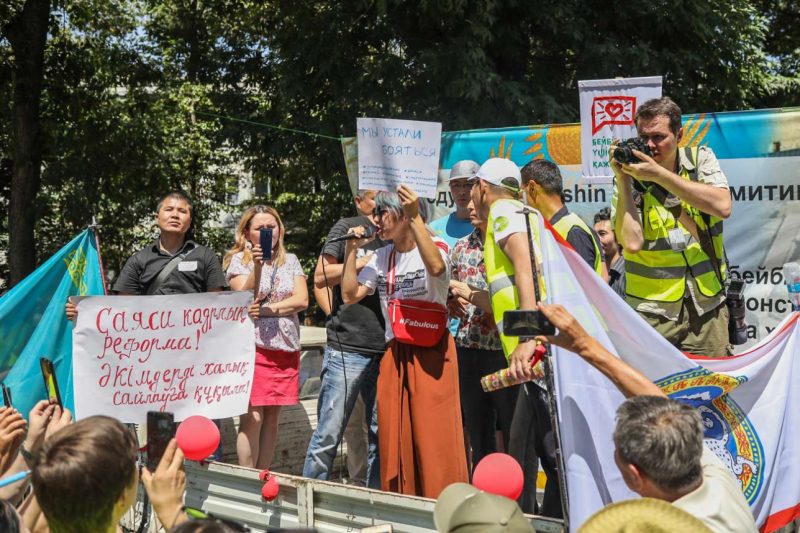
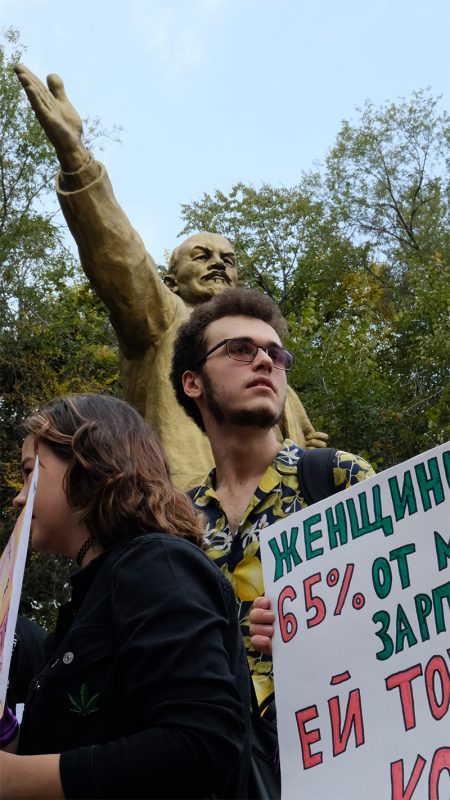
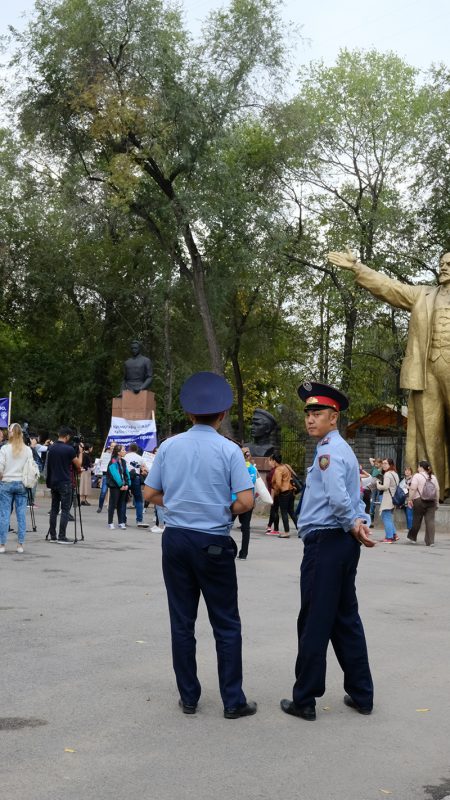
The use of ‘sanctioned’ and ‘protest’ in one context could be absurd if it is not normal. Article 20.1. of the Constitution of the Republic of Kazakhstan states that “Freedom of speech and creative activities shall be guaranteed. Censorship shall be prohibited.” However, the Law of the Republic of Kazakhstan N 2126 circumstances that “any form of protest, picket, demonstration or march that expresses social, group or individual opinion must get permission from the government 10 days prior of the act if it wants to be legal.” By September 28th, 2019, only 3 protests were legalized and got a status of ‘sanctioned’ in the history of independent Kazakhstan. All of them happening within the last 3 months. With this short essay, I want to put forward the idea that what is claimed as an act of political emancipation, in this case, is its failed rehearsal. I respectively use works of Étienne Balibar and Augusto Boal to address this riddle.
Balibar introduces the history of emancipation as “not so much the history of the demanding of unknown rights as of the real struggle to enjoy rights which have already been declared.” Ironically, the first two sanctioned (after 36 declines) protests were in support of ‘peaceful gatherings’. The demand was to be able to express the protest. In terms of Balibar, it might come under the category of pre-history of emancipation or another restriction of his model. This case further expands the problem of “equal emancipation” as it is the majority of “us” protesting for autonomy from the minority of “them”. Therefore, the autonomy of these protests become bigger than politics because ‘part’ of society “excluded – legally or not – from the universal right to politics” is the whole society. So under limited Balibar’s model, the sanctioned protests failed to be acts of political emancipation.
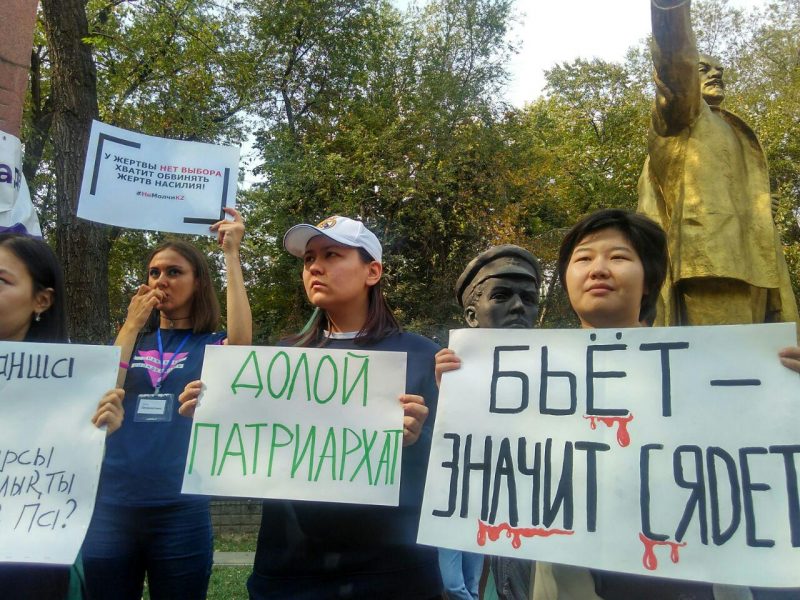
If its not an act itself, then can it be a rehearsal? In terms of Boal’s “theater of the oppressed”, these protests could go into the category of forum theater as the participants “intervene decisively in the dramatic action and change it.” Some people led the action by submitting application for protest and getting it, while others supported by coming to it and being active participants with placards and statements. Still the rehearsal was failed because oppressed people are trying to liberate themselves within the ‘given’ theatre. It is the government that allowed a specific ‘stage’ where spectators could imitate acting. And by specific place, I mean the square behind the cinema theatre Saryarka with a golden monument of Lenin reminding participants how a communistic dream in this country covered years of external colonization and how a democracy is under an internal one now.
Although Brecht, Boal and Taylor are separated by decades of technological and social changes, all of them devote a great part of their work to the phenomenon of spectators. Brecht as a true Marxist was fascinated by scientific era that can educate intellectual proletarian and blames theatre for functioning as an entertainment place raises a “cowed, credulous, hypnotized mass”. In his opinion, theatre should “not only release the feelings, insights and impulses” “but employ and encourage those thoughts and feelings which help transform the field” and society. Brecht suggests changing it to “epic theatre” by “alienation effect” when audience is aware that they are viewing a spectacle by actors with whom they do not empathizes. So he considers the transformation of a spectator as fully dependent on the practice of actors, directors and their practices rather than work with spectators.
Boal claims Brecht’s theatre as following:
“Brecht proposes a poetics in which the spectator delegates power to the character who thus acts in his place but the spectator reserves the right to think for himself, often in opposition to the character”.
Although Boal agrees with Brecht’s critique of Aristotelian “Poetics” and idea of catharsis when “the spectator delegates power to the dramatic character so that the latter may act and think for him” , his theater of oppressed suggests more empowerment of audience when spectators participate in a performance becoming actors themselves. There comes a term spect-actors and a plan of transformation through diverse exercises for audience.
Taylor’s consideration of spect-actors is not limited to theatre, it includes diverse performance forms where spectators get to act on provocative performance even if acting means being silent. In her words, “each performance anticipates its ideal response”. Not performer, actor or director, but a form of performance itself influences the audience and makes it act. Compared to Brecht and Boal, Taylor does not suggest that transformation of spectators should be done through practice with actors or audience but through developing connection between performance and spectator. I guess it works better in the world where stage and reality are not separated anymore. Where a common action can be effectively evoked through an Instagram filter rather than ideological spectacle.
A ‘surface’ is not simply a geometric composition of lines. It is a certain distribution of the sensible
Jacques Rancière
That statement and Rancière’s further critique of Plato’s mute function of writing and painting reminded me of the use of placards in pickets and marches. Placard – a two-dimensional surface which combines both visual and textual aesthetics – is associated with an expression of political position in democratic society. Placards in single pickets (as group protests are prohibited) got viral in Kazakhstan this summer. Statements did not involve a direct opposition message, but were quotes from constitution or phrases as “you cannot run away from truth”. However, placards became politically significant in my country because each act led to a police detention. Those detentions brought up a hypothesis that a placard as a surface is considered political. The prove didn’t make wait for it: public appearance with an empty white placard immediately attracted attention of police. Therefore, placard might be a mute or whatever dimensional sign but it can carry a sensible political aesthetic.