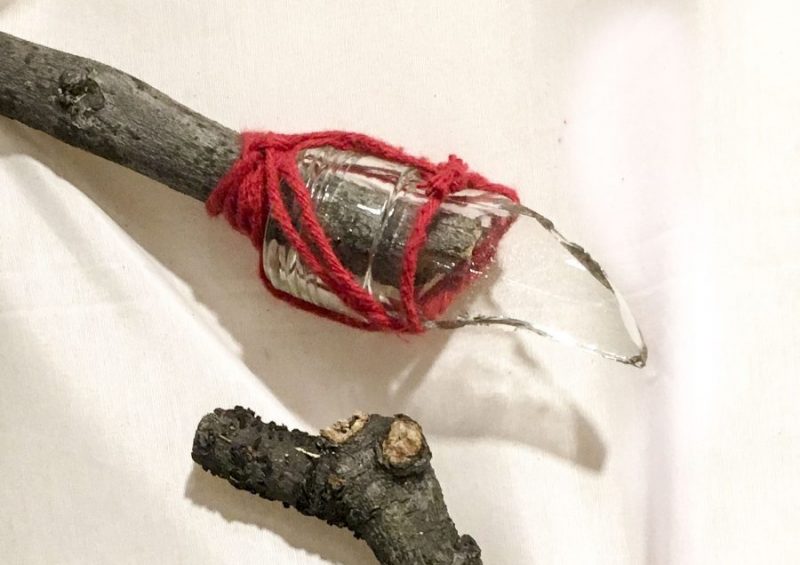
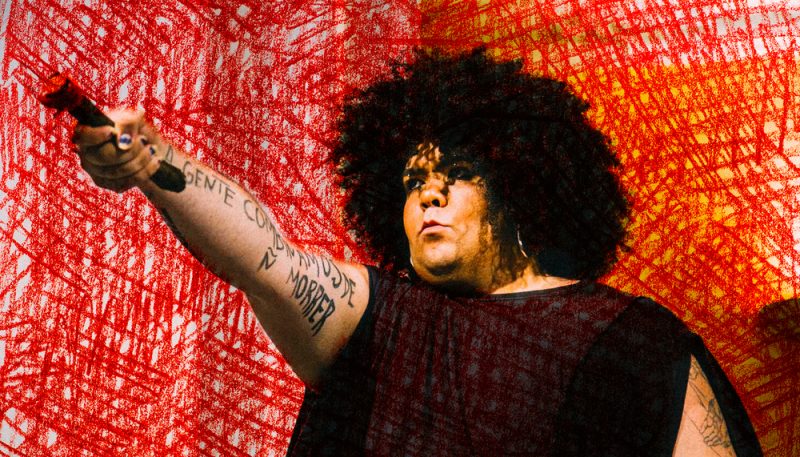
In the performance entitled after the homonymous work of Brazilian fiction writer Conceição Evaristo (in: Olhos D’água, 2014) and intentionally misspelled as “A gente combinamos de não morrer” (“We agreed not to die”), transgender Brazilian artist Jota Mombaça (Monstra Errática) carefully manufactures handmade knives with precarious materials such as branches, shards of glass and red string. With the performance’s title, also inscribed on the artist’s forearm, Mombaça proposes a form of “pact of surviving”, articulating through afro-diasporic lenses issues of violence and resilience among non-normative and non-white bodies. The performance ends with the artist surrounded by a variety of newly crafted objects that resemble, at the same time, both weapons and tools (see Fig. 1). Mombaça wields each one of them and points to the spectators, staring firmly and forward, ready for the attack to come, but also, and strategically, in position to counter-attack (see Fig. 2). Vulnerability here becomes a twofold position: a set of knowledge gained through shared experiences and a form of power that guides a practice of survival.
“A gente combinamos de não morrer” intersects matters of race and sexuality in a combined manner in order to create a network (“A gente” / “us”) brought together by the precariousness of life and the possible responses it may invoke in the context of political cultures in post-colonial worlds; where norms, social and political organizations have developed in contexts of power that maximize precariousness for some and minimize it for others. In the post-colonial world, the one that Mombaça claims not to exist[i], “death has become the most profitable business in existence”[ii], and “life” can only be ethically articulated in the plural tense. Through an alliance, Mombaça’s pact of survival establishes a nonidentitarian and transnational lineage, where the historic memory of the minoritarian becomings surfaces as strategies of resistance and social transformation in the context of a “death-world”[iii].
Similarly, the political practices that take shape inside contemporary feminist movements in Latin America, such as the “Ni una menos” and “Vivas Nos Queremos” movements, confront the necropolitics that systematically murders trans and cis women, and that excludes them from the opportunities of life. These movements mobilize alliances through the performative exercise of rights, demanding “the right to have rights”[iv], to follow Hanna Arendt’s axiom. And even though there performativity surfaces in a linguistic manner – “Ni una menos”, “Vivas Nos Queremos” –, it gains visibility, hence political intelligibility, through corporal movements, acts of resistance and the creation of improvised and ephemeral assemblies.
I’m especially interested in how these feminist alliances are taking shape within the expansion of what Sayak Valencia calls the “necro-liberalism”, in a moment when far-right politicians are surging to power around Latin America based on platforms of ethno-economic nationalism, Christianity, and patriarchal family values. More specifically, in the case of Brazil, this call for alliance takes place in face of the recent elect government of Jair Bolsonaro. Bolsonaro’s rhetoric is not strange to what Valencia identifies as the “hetero-necro-patriarchy”[v] and its reliance on the neocolonial governance, “where death is a kind of civilizing technology that persists until today and connects the current context with colonial intermittency”[vi]. Through the suppression of certain people produced as disposable or unwanted, the neocolonial governance also radically denies their “right to appear” (Butler 2015). Violence and death become common elements, where necropolitics create the state of emergency in which trans women, cisgender women, and other minoritarian becomings have to survive.
In order to counterpose the neocolonial governance of contemporary far-right governments, Valencia proses the incorporation of transgender discourse into feminism as an epistemological tool, generating strategies of common resistance between cis and trans women that refuse altogether the biological model of womanhood, while also potentially creating bridges in communities highly exposed to social and state necropolitics, “in spaces where vulnerability and damage to the bodies of women and nonbinary people and injustice are the norm”[vii].
This perspective calls into question the idea of demanding rights as separate and exclusive claims to separate identitarian groups, divorced from the violent web of relationships that concede or cease these rights in the first place. As Butler explains: “Even as located beings, we are always elsewhere, constituted in a sociality that exceeds us. This establishes our exposure and our precarity, the ways in which we depend on political and social institutions to persist”[viii]. However, transfeminist alliances like the one proposed by Mombaça’s performance are not necessarily directed towards “political and social institutions” represented by the power of the State. Rather, it’s a gesture that, from the start, recognizes the State apparatus’s participation in the differential allocation of vulnerability, and therefore, it is not an ally. The objective of Mombaça’s pact is first and foremost to enhance the potentiality of survival for those who are considered unintelligible[ix], for those whose vulnerabilities are maximized by the action or absence of the State. Ultimately, it is a critical form of alliance, one that proposes a participatory and interchangeable practice of resistance in the present and not the claim of a right.
Keywords for the final project: Alliance; Transfeminism; Space of Appearance; Resistance
Political Spectacle: In 2019, traditional samba school Mangueira won the Rio Sambadrome competition parade with a show that paid tribute to Rio councilwoman Marielle Franco, who was assassinated the year before. The lyrics talked about the unsung Brazilian heroes, many of them indigenous, black or females, such as Franco. The parade’s last image is of a Brazilian flag in the samba school’s official colors (green and pink). Instead of the traditional national motto “Ordem e Progresso” (“Order and Progress”) , the flag had a curved band inscribed with the phrase “Indians, blacks, and poors” —> https://youtu.be/scKZBmi3-F0?t=3071
[i] In another performance entitled “The Colonial Wound Still Hurts” (Venice, 2015), Mombaça writes on top of a map with the artist’s own blood: “The colonial wound still hurts. The post-colonial world doesn’t exist”. Not only the phrase is inscribed with the red liquid, but also the national borders of territories such as the US, Europe, Russia, Israel, Brazil, India, China and South Africa are highlighted with blood. As it asserts itself as a bodily fluid with the potentiality for tainting everything it touches as it spreads around the geographically constructed body of the world, blurring and redefining its borders, Mombaça’s bloody inscription emphasizes the correlations between territorial conquest and violation (both corporal and geographically), challenging the euro-centered cartographic representation of the world through its modes of visibility. Mombaça’s intervention operates in order to redefine this visibility, for there can be no postcolonial world while the colonial bodies still bleed.
[ii] Valencia 2019: 16.
[iii] Mbembe 2003: 40.
[iv] Arendt, Hannah. “O declínio do Estado – Nação e o fim dos direitos do homem”. In: O sistema totalitário. Lisboa: Dom Quixote, 1978. p. 347-374.
[v] Valencia 2019: 183.
[vi] Idem.
[vii] Valencia 2019: 186.
[viii] Butler 2015: 97.
[ix] See Butler, Judith. “Política de gênero e direito de aparecer”. In: Corpos em aliança e a política das ruas: notas para uma teoria performativa de Assembleia. Translated by Fernanda Siqueira Miguens. Rio de Janeiro: Civilização Brasileira, 2018, p. 57.