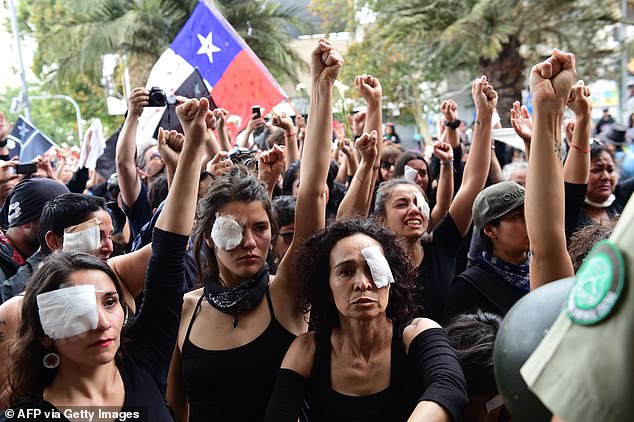
This is the second time that the work of Alfredo Jaar is addressed in one of our readings. And right in a moment when Chile, his home country, is staging a complex political spectacle: on one side, more than one million of people are taking the streets to protest against inequality, on the other side, President Sebastian Pinera’s violent repression of the protests, using the military apparatus to contain the civil unrest by shooting protesters in the eye. How we choose to frame these events, or how they appear to us in the media are part of, as Jacques Rancière suggests, a “sensible system” (100) that operates “from the kind of consumption of the image that makes images out of atrocity without inducing a political response”. For Rancière, what makes an image intolerable is also a recognition of humanity. He writes:
“If horror is banalized, it is not because we see too many images of it. We do not see too many suffering bodies on the screen. But we do see too many nameless bodies, too many bodies incapable of returning the gaze that we direct at them, too many bodies that are an object of speech without themselves having a chance to speak. The system of information does not operate through an excess of images, but by selecting the speaking and seasoning beings who are capable of ‘deciphering’ the flow of information about anonymous multitudes” (96)
Analyzing Jaar’s installation “The eyes of Gutete Emerita”, Rancière calls attention to the inversion of the gaze, from the horrible events carried out by the Hutu militias, armed and trained by Rwanda military, to the forced witnessing of the eyes upon these horrendous acts. For Rancière, “The true witness is one who does not want to witness” (91). Jaar’s work then overturns “the dominant logic that makes the visual the lot of multitudes and the verbal the privilege of the few” (97). The spectator first has to read about Emerita’s experience of the Rwanda genocide and only after this “knowledge” can they have access to Emerita’s concentrated stare, “in whose eyes we can detect the horror they have seen” (93).
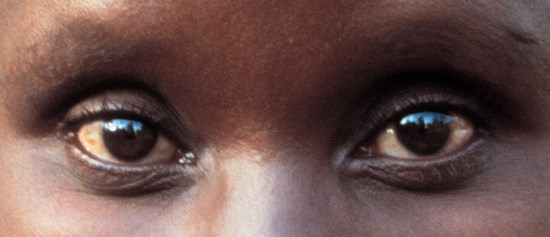
Opposed to the “spectacle of horror”, Gutete Emerita’s framed gaze “disrupts the counting of the individual and the multiple.” (99) Rwanda genocide is turned from a massacre of “nameless beings without an individual history” to a sensible experience that redistributes the visible. As Rancière proposes: “The images of art do not supply weapons for battles. They help sketch new configurations of what can be seen, what can be said and what can be thought and, consequently, a new landscape of the possible. But they do so on condition that their meaning or effect is not anticipated” (103)
Against the terrifying normalization of mass productions, Jaar’s intervention speaks directly to the problem of human disposability in a way that disrupts aesthetic regimes of mediated suffering. Through that disruption, the artist renders visible the fundamental categories of the political that makes necessary the reflection upon the intolerable reality.