Preface
7 pm, March 19, 2019. Nursultan Nazarbayev made an urgent announcement on national channel saying that he resigned after 30 years of presidency.At that moment, phone lines and messengers collapsed from people discussing the long-awaited political change in Kazakhstan, sharing hopes and fears about the future. Within the next few days, the government made statements about the status of the first president as a military leader and “the father of the nation”, about K. Tokayev temporally (later officially) taking the place of the second president, about Nazarbayev’s elder daughter becoming the government spokesperson.That news brought the population back to reality where the replacement of roles didn’t change the structure of power.
Stage Directions
Local activists decided to act upon expected presidential elections and influence what Ranciere called “the distribution of the sensible” .“The distribution of the sensible reveals who can have a share in what is common to the community based on what they do and on the time and space in which this activity is performed.” The time choice for the acts was undoubtedly significant, but so were the spaces for expression or, to be precise, their absence. Although “freedom of speech and art is guaranteed, and censorship is prohibited”under the constitution of the Republic of Kazakhstan, “any form of protest, picket, demonstration or march that expresses social, group or individual opinion must get a permission of government 10 days prior of the act if it wants to be legal.” The regulations might remind those of Greek polis for citizens: “before men began to act, a definite space had to be secured and a structure built where all subsequent actions could take place.” However, the modern Kazakhstani limitations do not secure space, hardly ever permitting sanctioned protests. Arendt stated that “to be deprived of it[space] means to be deprived of reality, which, humanly and politically speaking, is the same as appearance.”With their appearance, the activists took back the power to create own reality because, as Butler formed it, plural actions allow to “rethink the space of appearance”. Let’s look at those actions.
Act I
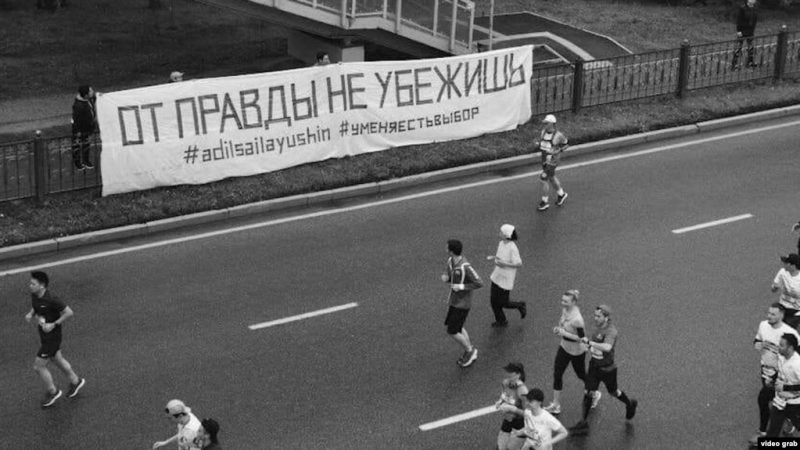
The first activists in the Spring 2019 banner series got a 15 days’ detention for “carrying out a public action without agreement of permission from the local authorities to express their interests”.Asya Tulesova and Beibarys Tolymbekov’s personal and civil interests were fair elections. They named their act ‘peaceful flash mob’ (the term “flash mob” is not mentioned in the legal restriction). They made a sign “You can’t run away from the truth” with the hashtag “#AdilSailayUshin” (Kazakh: #ForFairElections) and put it along the Almaty marathon on April 21, 2019.Other participants, who weren’t sentenced but fined, captured the moment on cameras. Thanks to them, we can see images of people running along and away from the call for truth.
Discussing the effect of the statement I cannot ignore Austin’s performative utterances because it induced the action claimed with the words.Asya and Beibarys were detained but the case and the photos were all over the internet under #AdilSailayUshin. Within a month, more activists spoke up in ‘the banner manner’, which I will discuss later, resulting in a similar police reaction. Collectively those events got into international press and archived in so much digital and printed evidence that they cannot disappear. Indeed, no one could run away from the truth, that Asya and Beibarys stated: fair elections were wanted in Kazakhstan. Therefore, they made their “happy” performative sentence – the action that was done.
Act II
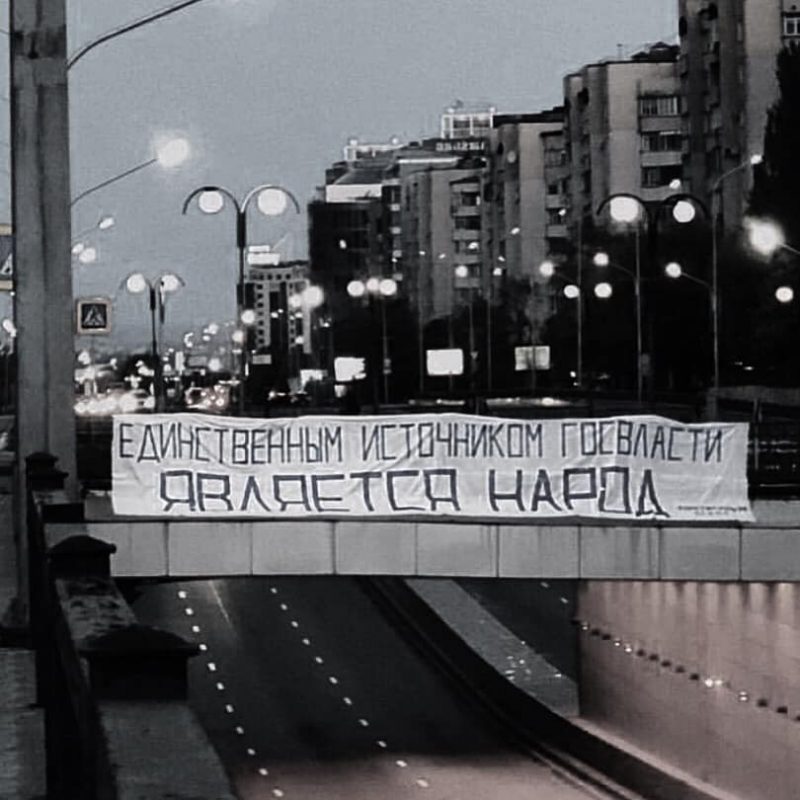
The same cannot be said about the next act/sign I want to mention (there were other detained activists between two events). On April 29, Roman Zakharov hoisted a sign with a direct quote from the Constitution of Kazakhstan: “The people shall be the only source of governmental power.”His performative utterance was “unhappy” as it did not make the action true.Instead, he was jailed for 5 days for “intentionally littering the city’s public places” (this accusation deserves a whole independent essay).Both banners (by Asya&Beybarys and Roman) oppose the function of writing and painting defined by Plato. For him, “writing and painting were equivalent surfaces of mute signs, deprived of the breath that animates and transports living speech. The mute surface of depicted signs stand in opposition to the act of ‘living’ speech, which is guided by the speaker towards its appropriate addressee.”In the reality of art within legal limitations, signs become vocal and stand ‘instead of’ living speech, which is muted. Ranciere claimed that “politics revolve around what is seen what can be said about it, around who has the ability to see and the talent to speak, around the properties of spaces and the possibilities of time.”The Kazakhstani acts reversed politics towards themselves taking on the visual, vocal, temporal and spatial potential of people that realized them.
Act III
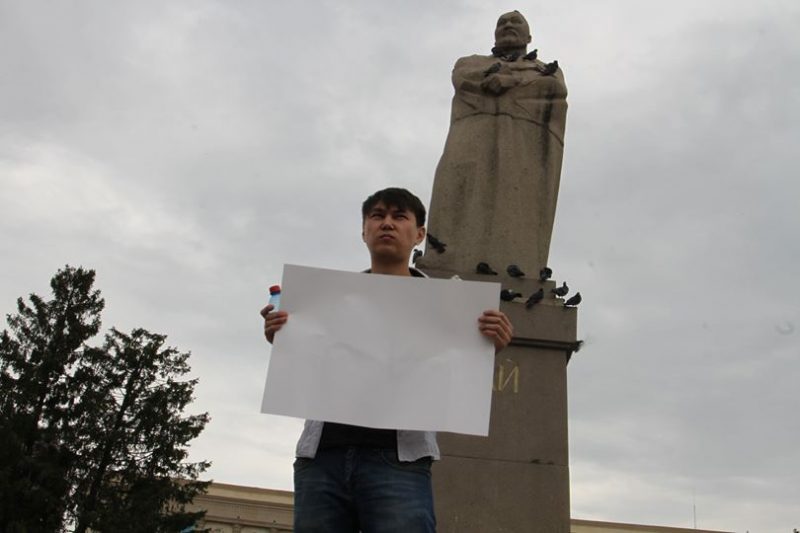
I also cannot ignore the pure aesthetics of Kazakhstani activists. “Aesthetics can be understood in a Kantian sense – re-examined perhaps by Foucault – as the system of a priopri forms determining what presents itself to sense experience. It is a delimitation of spaces and times, of the visible and the invisible.” I’ve already discussed space and time in two acts. For visibility and invisibility, I would like to introduce another activist who wanted “to test the limits of his right to peacefully demonstrate” after the previous events. On May 6, Aslan Sagutdinov “stood in a public square holding a blank sign, predicting he would be detained. He was right.”With his act, he pushed the aesthetics of activism and “forms of visibility” even further.He decided “to depict and portray instead of instruct”, his image was blank but understandable for people.What was wanted the whole time were not statements but a right to make them. The blank sign that has a space for expression. This potentiality of space, which was not sanctioned by law, led to the reaction of the police. So the invisible hopes and fears of all participants became visible with the blankness.
I state the police as the participants of the acts because without their reaction there would be no creation of “the space of appearance”. None of those bodies, individuals, could establish that space alone, it happened “only ‘between’ bodies.” Each act led to the reaction of police, attracted supportive bodies to the courts, created virtual bodies discussing the events online. I discussed those acts together because one body “does not act alone when it acts politically”. As Butler stated: “Indeed, the action emerges from the “between”, a spatial figure for a relation that both binds and differentiates.”
Epilogue
The space of appearance that was created over this summer hasn’t been destroyed as Arendt would predict. She said that “unlike the spaces which are the work of our hands”, those created by action “do not survive the actuality of the movement which brought them into being, but disappear not only with the dispersal of men” “but with the disappearance or arrest of the activities themselves.” Kazakhstani activists prove the irrelevance of that limitation. They not only made statements but also fueled collective actions among citizens who gathered for public talks, became observers at the election, three times got a sanctioned physical space for protests and created civil rights organizations. The elections were still highly violated, and people get detained for non-sanctioned protests these days. A preliminary conclusion might not be ‘happy’ but now the potential space of appearance seems real for people as it has been repetitively activated. So words, signs, and blankness create spaces as long as they are created between bodies. “A space of appearance comes into being wherever men are together in the manner of speech and action.”
Key terms: sanctioned, protest, space of appearance, aesthetics, speech